Thursday, April 27, 2023

This guy is just too tough to kill

 Set in Finland during the waning days of World War II, Sisu pits a grizzled hero (Jorma Tommila) against sadistic German soldiers who will stop at nothing to steal the gold Tommila's character discovers during the movie's gritty opening.
   Battle scarred and fierce, Tommila's Aatami Korpi has no intention of surrendering his riches. As he traverses the forbidding landscape of Lapland with his trusty dog, Korpi stands as an emblem of a familiar movie type: A guy who shouldn't be messed with.

    Sisu is a no-holds-barred foray into brutal invention, the kind that requires ingenuity and a willingness to abandon ordinary logic in favor of reinforcing the idea that Korpi can survive anything -- from hangings to plane crashes to bullets to ... well ... you know the drill.

   Korpi's nickname -- The Immortal -- underscores his ability to transcend ordinary limitation, even while his muck-covered flesh takes beating after beating.

   The Nazi soldiers, who have been ordered to destroy everything in their path, are led by a callous SS officer (Aksel Hennie) who sees the gold as a means to buying his way into a safe heaven, thus avoiding post-war prosecution for war crimes. 

   Korpi hardly speaks; he's too busy fighting for his life, a task that allows director Jalmari Helander to indulge a taste for blood, gore, and shocking violence. 

    Helander marches in the ranks of filmmakers who understand how to up a movie's savage ante, sometimes in ways that are breathtakingly outrageous.

     The word Sisu, we're told, doesn't yield to easy translation but stands for the kind of no-quit courage it takes to survive insurmountable odds. The movie makes that seem like an understatement.

  A hint of moral rectitude arises when Korpi helps to save a group of women the Nazis are holding as sex slaves, but mostly the movie operates at elemental levels.

  Not all viewers will want to subject themselves to Sisu's unrelenting brutality. But those who have a taste of this kind of cinema will find an intense one-hour and 31-minute plunge into a starkly diminished world.

  All that's left is the drive to survive and, of course, sisu. Lots of it.

A zesty comedy with lots of kick


   Two social classes of British Pakistanis find themselves at odds in Polite Society. Based on what I just said, you probably wouldn't guess that Polite Society serves up a mixture of martial arts and Bollywood flash, even making room for a sci-fi twist.
  Writer/director Nida Manzoor's zesty comedy focuses on  ferociously determined Ria (Priya Kansara), a 17-year-old student who wants to derail the engagement of her older sister Lena (Ritu Arya). 
  Truculent and focused, Ria hates the idea of arranged marriage, even though Lena is swept away by her fiancĂ© Salim (Akshay Khanna). Ria suspects that Salim's snobby mother (Nimra Bucha) has ulterior motives. 
   She also believes that Lena should fly solo so that she can continue pursuing a career as an artist, a goal Lena seems to have abandoned.
   For her part, Ria aspires to be a stunt woman, a job that will allow her to attain a bit of niche-oriented celebrity.
  Could Ria be operating under a cloud of delusion? We wonder. After all, Lena may have hit the jackpot. A handsome, charming doctor, Salim seems an ideal match for any young woman.
    Following a sitcom road map, Ria does everything she can to forestall the pending nuptials, including invading a men's locker room with two pals (Seraphina Beh and Ella Bruccoleri). 
    While Salim works out, the trio accesses Salim's laptop, hoping to find sleazy revelations that might bring Lena to her senses.
    The movie can be accused of being a bit derivative and a preposterous third-act plot twist probably goes a little too far over the top. But it's difficult to resist Manzoor's commitment to full-on zaniness, particularly when it's offered at a fast-moving 104 minutes.
    Polite Society may not go heavy on social impact but it offers an opportunity to watch a teenager give oppressive tradition a karate-chopping, high-spirited kick in the pants.


Thursday, April 20, 2023

What to make of ‘Beau is Afraid?’


    Artificial trees rotate, changing colors during the production of a play that's being staged outdoors in what seems like an enchanted forest.
   In a decaying urban neighborhood, the streets teem with miscreants, one of whom makes a habit of running about naked before repeatedly stabbing random passersby.
   A psychiatrist asks his patient whether he has thought about killing his mother.
   An aggressively cheerful suburban couple cares for a man the wife ran over with her car, putting him up in a room belonging to their snarly teenage daughter.
    On first impression, these images defy connection, but they're all part of director Ari Aster's Beau Is Afraid, a three-hour mashup of styles, locations, and concerns held together -- more or less -- by the performance of Joaquin Phoenix.
    The always adventurous Phoenix portrays Beau, a character whose interior life may be the sole source of this darkly funny, highly inventive, and sometimes wearying movie.
   In fairness to Aster's outsized ambitions, it would be wrong  either to advise viewers to see or avoid a movie that, at least for me, sustained involvement and sometimes amusement for nearly two hours and 30 minutes of its running time.
    Fearful and anxious, Beau serves as a springboard from which Aster launches a parade of images, many startling, eerie, and impressive. 
     Aster (Hereditary and Midsommnar) mixes humor with horror as he unleashes a wild psychological storm, much of it revolving around Beau's mother issues.
     We meet Mom in flashbacks and in the film's final segment. Zoe Lister-Jones plays Beau's mom as younger woman, and Armen Nehapetian portrays Beau as a 13-year-old whose sexual development can't escape Mom's supervisory attentions.
     In a bravura performance, Patti LuPone turns up as Beau's adult mom. Throughout the movie, Beau tries to reach Washington state for his mother's funeral, a conceit that takes him from slum, to suburbia, to forest, to a dazzlingly home in Washington. 
     Once unleashed, LuPone, launches into tirades fueled by furious resentment about how much she's sacrificed for Beau, a character who seems to be stuck in a some indeterminate limbo.
     Beau Is Afraid is so packed with characters and set pieces that it's impossible to mention all of them without writing a review that would rival the movie in length. 
    Highlight performances include: 
    Nathan Lane and Amy Ryan as a suburban couple who lost a son during a war in Caracas, Venezuela. No, the imagined seems to have nothing to do with anything.
    Kylie Rogers keeps up with the weirdness as the daughter of this suburban couple, who also house an emotionally damaged veteran (Denis Menochet) in a trailer in their backyard.
    Parker Posey appears in a sex scene that's both thematically significant and starkly funny.
    A beautiful, haunting animation sequence qualifies as a kind of character in itself.
    Hints of other movies waft through the weirdness. Maybe it's me, but I felt traces of 2001: A Space Odyssey and The Wizard of Oz.
    It's impossible to discuss the movie's ending without spoilers. All I'll say is that Aster seems to arrive at three points at which the story might be over. I experienced a letdown each time I realized that wasn't the case. Aster had more to show -- if not to say.
    Does of all this work? It's a fair question but one that admits of no simple answer. Watching Beau Is Afraid, I sometimes wondered whether it might have made a dozen brilliant short films. I  also wondered whether David Lynch could have hit the same kind of notes in a more economical two hours. 
   And, yes,  the overworked and somewhat stale mother/son dynamic wore itself out.
   And yet ... 
   Time may reveal whether Aster's movie should be considered a fragmented work of genius or an incoherent oddity or something else entirely. 
   Whatever it is, Beau Is Afraid deserves not to be dismissed.

A little known composer gets his due


   A flamboyant biopic about Joseph Bologne, Chevalier tells the story of a little known Caribbean-born black man (Kelvin Harrison Jr) who became a virtuoso violinist and composer in 18th Century Paris.
 Eager to declare its boldness, the movie opens with a bristling scene in which Bologne upstages none other than Wolfgang Amadeus Mozart (Joseph Prowen) in a battle of dueling violins.
  This dramatic overture signals the movie's ardent approach. Director Stephen Williams shakes off musty period-piece trappings, serving up swelling arpeggios of emotion, sex, bigotry, and ambition.
   Against all odds, Bologne rises in French society, having been awarded the rank of Chevalier by an admiring Marie Antoinette (Lucy Boynton) in the days just before the outbreak of the Revolution.
  While preparing for an audition to become director of the prestigious Paris Opera, Bologne falls for Marie-Josephine de Montalembert (Samara Weaving), a singer who defies her racist husband (Martin Czokas) by taking the lead in Bologne's opera. 
      She also becomes the lead in Bologne's romantic life.
     After Bologne's mother (Ronke Adekoluejo) is freed from enslavement in Guadeloupe, she turns up in Paris. By this time, Bologna believes that his musical superiority can topple any barrier. He doesn't fully embrace the woman his white plantation owning father bedded. 
     In an earlier flashback, we learned that Bologne's father brought him to Paris as a boy and left him at a school for budding musicians.
     Harrison conveys Bologna's talent, arrogance, and charm in a role that could turn him into a bankable leading man, and the supporting cast -- notably Weaving and Boynton -- fills both costumes with style and assertion.
      The arc of the story is clear. Inevitably, French society will rebuff the Chevalier, reminding him that a title and talent aren’t sufficient to overcome bigotry. 
     Learning that he'll never be accepted as a quintessential Frenchman, a chastened Bologne finally listens to his mother and finds comfort among his fellow Caribbeans. 
    Recognizing ambitions larger than his own, he also joins the revolutionary ranks.
      Chevalier seldom meets a beat it doesn’t underline. You half expect the characters to break into arias of triumph, suffering, and romance as the plot unfolds.  
      But Harrison's performance engages, the social dynamics of the story (though broadly drawn) ring true, and the movie proves entertaining -- even if it doesn't quite attain the level of significance that the subject seems to demand. 

This father doesn't know best


 Ray Romano makes his directorial debut with Somewhere in Queens, the story of a construction worker (Romano) who’s emotionally invested in the basketball life of his teenage son "Sticks" (Jacob Ward). Romano’s Leo pushes his son to pursue a college scholarship. He wants to shield the kid from a life working in the family business, a small company operated by Leo’s dad (Tony Lo Bianco) and his instantly dislikable brother (Sebastian Maniscalco). Leo’s wife (Laurie Metcalf) has recovered from breast cancer but lives in fear of its return. The plot hinges on the arrival of Dani (Sadie Stanley), a girl who captures Sticks
' heart. Unlike Sticks her interest in a relationship doesn't go beyond sex and affection. Romano, who co-wrote the screenplay with Mark Stegemann, can't entirely avoid cliches in his creation of an Italian family environment (Sunday dinners and parties) and I had trouble buying a major plot twist. Moreover, the movie can feel confused about whether to focus on Sticks or Leo. In its more genial moments, Somewhere in Queens proves likable but its pleasures are limited.

Wednesday, April 19, 2023

A father's request torments his daughter


French director Francois Ozon returns to the screen with Everything Went Fine, the story of a woman (Sophie Marceau) whose stroke-disabled father (Andre Dussollier) wants to put an end to his life. Dussollier’s Andre asks Marceau’s Emmanuèle to help arrange an assisted death for him, a position to which he clings even after he begins to show signs of recovery.  Andre's refusal to live a diminished life seems an extension of a selfishness that's revealed in some of the film's flashbacks. Emmanuele faces a major obstacle. Medically assisted death is illegal in France, so Emmanuèle and her sister (GĂ©raldine Pailhas) must get their father to Switzerland, where he can fulfill his desire. Based on a memoire by Emmanuèle Bernheim, the movie deals with the guilt and anger resulting from Andre's request. Andre's chilly wife (Charlotte Rampling) shows little interest in his suffering for reasons which the screenplay eventually reveals. Hanna Schygulla, the great German actress, appears as a Swiss woman who arranges assisted deaths for those who can afford to travel to Switzerland, where people legally can choose to die. Ozon admirably resists the temptation to sentimentalize a story told with an even hand and little judgment of its characters. Without indulging in showy emotional displays, Marceau excels as a woman living with conflicted emotions that allow for no easy resolution.

Art, yes, but what about the hot water?


  Director Kelly Reichardt specializes in slow-moving movies that encourage viewers to linger. Put another way, you don't just watch Reichardt's movies (First Cow, Wendy and Lucy, and Meek's Cutoff), you live in and with them. 
  Employing minimal editing, no manipulative music, or startling plot twists, Reichardt allows viewers to inhabit the worlds she creates.
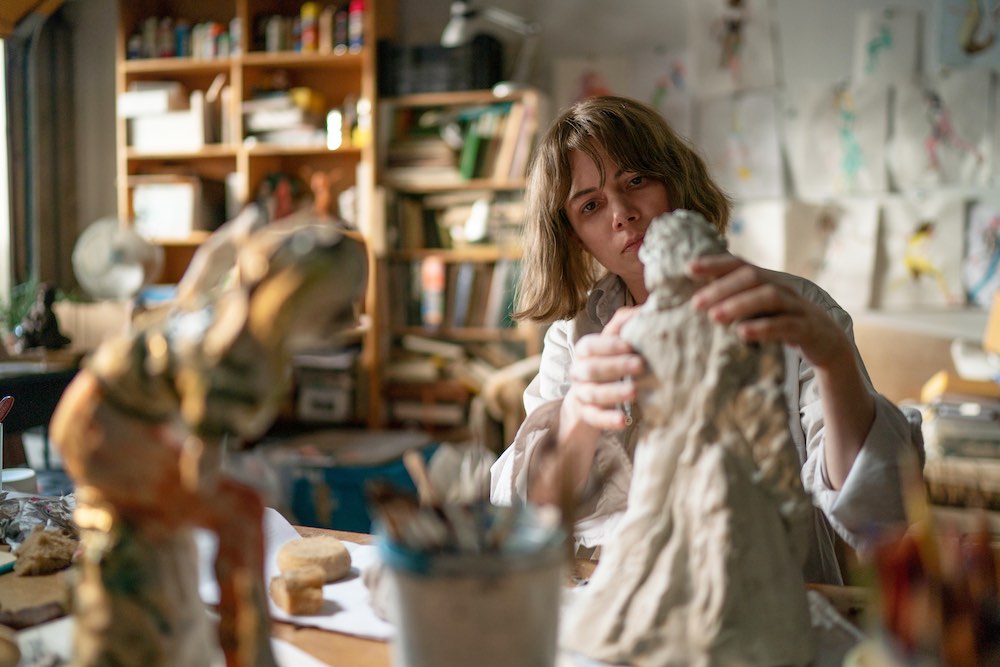
  In Showing up, Reichardt introduces us to a ceramicist (Michelle Williams) who makes miniature female figures, often in contorted poses that invite interpretation. 
  Williams's Lizzy might be the mopiest figure to appear in a movie this year. She’s alternately depressed or annoyed about being part of a dysfunctional artistic family while dealing with the pressures of preparing for a show.
  Separated from Mom, Dad (Judd Hirsch) makes functional pottery. Mom (Maryann Plunkett) runs the art school where Lizzy works, and Lizzy’s mentally ill brother (John Magaro) is tolerated by a family that considers him a genius.
   The family members all live in close proximity to one another.
   Reichardt effectively takes us inside this loose-knit community. But her approach raises an inevitable question: What’s to be gained from being there? 
  Sans emotional peaks, Showing Up can feel as mopey as Lizzy, a non-celebration of art-making in which a commendable lack of manipulation sometimes results in a kind of aesthetic inertia.
    While bringing Lizzy's family dynamics to light, the movie makes room for another artist, a sculptor played by Hong Chau, recently seen in The Menu and The Whale.
     Chau’s Jo also happens to be Lizzy’s landlord. Jo drags her feet about fixing Lizzy's broken hot-water heater, creating a source of constant aggravation for Lizzy. Jo’s also busy getting ready for her own art opening.
      As a retired potter, Hirsch's Bill can't resist ingratiating himself with a gallery owner who attends Lizzy’s opening at the behest of its reigning artist in residence (Heather Lawless).
     Amid the flow of daily life, a metaphor seems to arise. Early on, Lizzy’s cat maims a pigeon that has flown into Lizzy's home. Lizzy removes the bird from the house. It's later recovered by Jo, who assumes responsibility for the bird -- sort of.
    Jo often leaves the recuperating pigeon with Lizzy who carries it around in a cardboard box, another burden. The point? Artists suffer the same small torments as the rest of us while simultaneously trying to persevere in their work. 
    Wounds. Healing. Recovery. These, I suppose, are the metaphoric implications suggested by the bird.
      No one talks much about art or anything else for that matter. A sense of the ordinary pervades almost every scene and Reichardt dwells on Lizzy's statuettes as if they were creations of art historical importance. They were made for the film by ceramicist Cynthia Lahti. 
     We get to know Lizzy at a specific moment in her life, an achievement to be sure. But for me, Showing Up is hampered by an unrelenting insularity that can make its characters seem limited and even uninteresting.
    A narrow-gauge effort can be piercing. Sometimes, though, it's just narrow.
      

Thursday, April 13, 2023

Bob's Cinema Diary April 14: 'Cherry' and 'Mafia Mamma'

Cherry 


A couple  of weeks ago Cherry, a movie about a 25-year-old woman facing a difficult choice, might not have been acutely topical. But recent court decisions have put the future of abortion pills in doubt and given the movie an unexpected jolt. Maybe not directly, but in its well-observed approach to Cherry (Alex Trewhitt), an unsettled Los Angeles woman who learns that she is 10 weeks pregnant. Cherry has 24 hours to decide on whether to use the pill. If not, California law will require that she wait and have a surgical abortion. Of course, Cherry also can opt to have the baby. It's clear from the outset that Cherry, who works in a thrift store and is devoted to roller skating, isn't prepared for parenthood. Trewhitt gives a convincing performance as an addled young woman who can't bring herself to talk about her situation with her mother, sister, or father. She discusses it with her boyfriend, but he immediately balks at the idea of parenthood. With no guidance forthcoming, Cherry must confront her situation alone. Director Sophie Galibert keeps the tone light but not so light that the seriousness of the issue is lost. Yes, choice can be difficult, but Cherry fortunately has a choice to make: The movie makes you wonder what would have happened had that not been the case.

Mafia Mamma

A mafia comedy with a scenic Italian backdrop. What's not to like? Well, an awful lot about director Catherine Hardwicke's misguided Mafia Mamma, a farcical look at a harried American mom who inherits the leadership of a famous mafia family. In an effort to poke fun at mob-movie cliches, Hawdwicke replaces them with comedy cliches, the most notable being a fish-out-of-water scenario with Toni Collette working hard to turn Kristin Balbano into a woman who’s woefully ignorant about mob tactics. She hasn’t even seen The Godfather, an immediate strike against her, not to mention the source of a few  lame jokes. After Kristin arrives in Italy for her grandfather’s funeral, she receives help from Monica Bellucci, the secretary who served the recently deceased Don. Conflict, of course, arises. The Balbanos feud and fight with the Romanos, another mob family. The movie dines on cliches and stereotypes without giving them enough comic punch to knock them onto fresh turf. Recently separated, Kristin is a horny boss who grows into a crime role that the movie ultimately launders. The movie’s major accomplishment: It may make you hungry for gnocchi, a delight that Kristin craves soon after landing in Italy.


Wednesday, April 12, 2023

Dracula's sidekick gets his own movie


   His name is Robert Montague Renfield. You probably know him only by his last name and occupation. He's the bug-eating assistant to the infamous Count Dracula, vampire of all vampires. 
    In a world of spinoff and rehash, we shouldn't be surprised that Renfield has ascended to the role of title character.
    But for me and possibly for others, the main reason to see Renfield has less to do with a hapless assistant, played by Nicholas Hoult, than with the blood-sucking count, rendered in this helping by Nicolas Cage, the master of unhinged theatricality.
    It's, therefore, instantly dispiriting that the movie -- true to tis title -- mostly centers on Renfield, transporting him to present-day New Orleans where he meets a corruption-fighting police officer (Awkwafina) and labors to escape Dracula’s grasp.
    A ridiculously strained development follows. Renfield is drawn into a conflict with a drug-dealing gang called the Lobos, hoodlums led by Bellafrancesca Lobo (Sohreh Aghdashloo) and her gleefully sadistic son Edward (Ben Schwartz). 
     Forget haunted castles and fog-shrouded landscapes. Forget seductive wooing of victims who fall under Dracula’s sway. Writers Ryan Ridley and Robert Kirkman, the latter of Walking Dead fame, and director Chris McKay work to subvert genre cliches but find few adequate replacements.
     If Renfield aims to be a comic/horror mashup it misses badly on the latter and hits only intermittently on the former -- not to mention its  flood of hyper-active gore splashing.
     The premise has promise. Imagine a Renfield who's sick of being Dracula's flunky. To further complicate matters, the miserable creature hasn't entirely squelched his desire to do good. 
      Dracula, on the other hand, seems immune to any sort of identity crisis. He unashamedly embraces his evil nature, appearing first as an undernourished vampire whose head looks like it has been sculpted from rotting cheese. 
     Working with heavy make-up and a set of pointy choppers, Cage fully vents the fabled character, indulging his taste for flamboyance, sarcasm, and grandiosity.
      Still, I wouldn't class this outing as one of Cage's great displays. He does what he can with a classic character, but the screenplay gives him nowhere to go.
     Hoult's performance takes shape as the movie progresses. Renfield has been granted super-human strength by Dracula. Fueling his powers by consuming insects, Renfield’s miserable existence unfolds in the shadow of a narcissistic boss.
     The movie's best gag involves a sweater. After Renfield helps rescue a group of innocents at a bar, Awkwafina's Rebecca encourages him to see himself as a hero. Renfield begins to seek independence, renting an apartment, donning sweaters that would be at home in an Archie comic book, and joining a self-help group that tries to teach him how to shed his co-dependency.
    In all, Renfield has the feel of an explosion that spews its shards into a whirl of gross-outs, jokes, frenzied action, toothless social commentary, and more. 
     Sadly, none of these fragments cohere into the bloody rewarding romp that may have been intended. Oh well, it’s possible to enjoy Renfield in small bites, but Bela Lugosi can rest easy.