Showing posts with label Judd Hirsch. Show all posts

Wednesday, April 1, 2026

An agreeable comic drama


  Movies about psychologically damaged people can easily lead to dramatic overkill. Fantasy Life, which stars Amanda Peet as a 50ish actress whose career has evaporated, takes a different approach. Written and directed by Matthew Shear, who also plays a lead role, the movie takes place against a backdrop of ongoing crises that have become the soundtrack for the characters’ lives.
  Shear plays Sam, a schlub who, after losing his job as a paralegal, consults with his therapist (Judd Hirsch). Hirsch’s Fred prescribes drugs for OCD and also suggests that the unemployed Sam might babysit for his son’s three preteen daughters. 
   Shy and subject to panic attacks, Sam seems entirely unsuited for the job, which — of course — he takes.
  David (Alessandro Nivola), the girls’ father, works as a musician who’ll soon depart on an Australian tour as a fill-in bassist with a popular rock band. 
  The real story begins when Mom (Peet) arrives in Manhattan after having taken a mental health break on Martha’s Vineyard. Mired in depression about her vanishing career, Dianne decides that Sam should accompany her to Martha’s Vineyard for the summer. He’ll look after the kids, and she’ll continue with her inertia.
   Sam agrees. It doesn’t take long to see that he’s attracted to Dianne. Why not? Dianne’s attractive, both she and Sam are emotionally wounded, and Dianne’s marriage has hit a rough patch. It’s also clear that Dianne likes Sam, who makes no demands and praises her skills as an actress.  Less a matter of sexual attraction, the two create a comfort zone that both of them desperately need.
   Shear gently develops a relationship that raises eyebrows with Dianne’s parents (Bob Balaban and Jessica Harper). Hirsch is joined by Andrea Martin, who plays his wife and secretary.
  Aside from Sam, the characters seem affluent enough not to have to worry about money, and Shear’s eye-averting characterization turns him into a kind of walking human apology. 
  The story builds toward a climactic dinner scene. Dianne’s resentments erupt in comic fashion — or at least that seems to be the intent.
  Shear operates on a human scale, but Fantasy Life can seem a bit edgeless, and Sam’s mental issues --he's Jewish but antisemitic phrases pop intrusively into his head -- feel under-explored. Sam's inability to cope is made clear enough without what seems an  extraneous embellishment.
  Mostly, though, Fantasy Life passes easily without being uproariously funny or straining for satire. Call it agreeably light.

Wednesday, April 19, 2023

Art, yes, but what about the hot water?


  Director Kelly Reichardt specializes in slow-moving movies that encourage viewers to linger. Put another way, you don't just watch Reichardt's movies (First Cow, Wendy and Lucy, and Meek's Cutoff), you live in and with them. 
  Employing minimal editing, no manipulative music, or startling plot twists, Reichardt allows viewers to inhabit the worlds she creates.
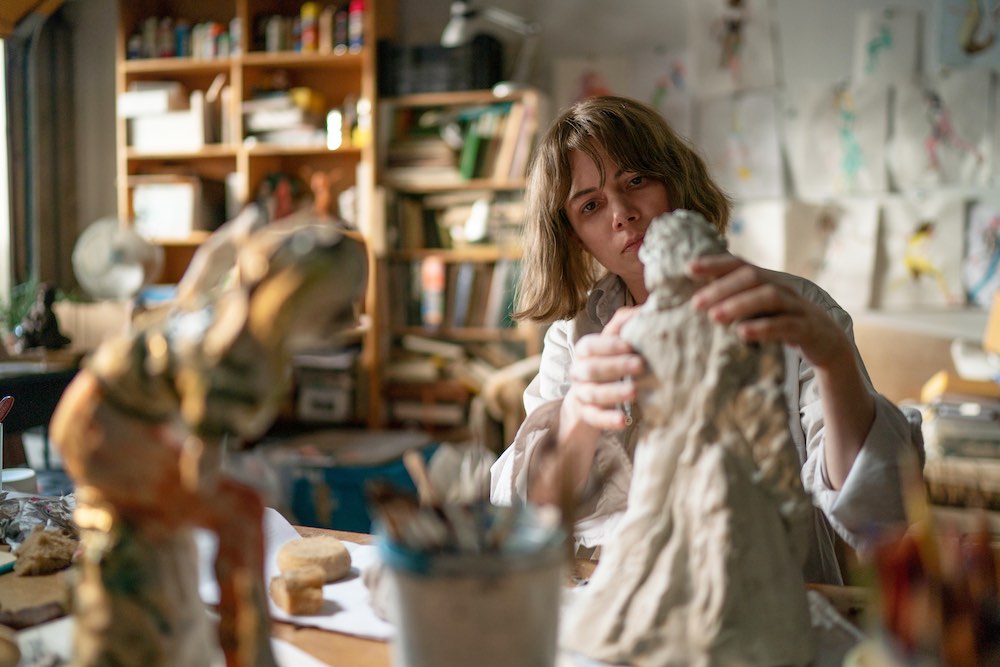
  In Showing up, Reichardt introduces us to a ceramicist (Michelle Williams) who makes miniature female figures, often in contorted poses that invite interpretation. 
  Williams's Lizzy might be the mopiest figure to appear in a movie this year. She’s alternately depressed or annoyed about being part of a dysfunctional artistic family while dealing with the pressures of preparing for a show.
  Separated from Mom, Dad (Judd Hirsch) makes functional pottery. Mom (Maryann Plunkett) runs the art school where Lizzy works, and Lizzy’s mentally ill brother (John Magaro) is tolerated by a family that considers him a genius.
   The family members all live in close proximity to one another.
   Reichardt effectively takes us inside this loose-knit community. But her approach raises an inevitable question: What’s to be gained from being there? 
  Sans emotional peaks, Showing Up can feel as mopey as Lizzy, a non-celebration of art-making in which a commendable lack of manipulation sometimes results in a kind of aesthetic inertia.
    While bringing Lizzy's family dynamics to light, the movie makes room for another artist, a sculptor played by Hong Chau, recently seen in The Menu and The Whale.
     Chau’s Jo also happens to be Lizzy’s landlord. Jo drags her feet about fixing Lizzy's broken hot-water heater, creating a source of constant aggravation for Lizzy. Jo’s also busy getting ready for her own art opening.
      As a retired potter, Hirsch's Bill can't resist ingratiating himself with a gallery owner who attends Lizzy’s opening at the behest of its reigning artist in residence (Heather Lawless).
     Amid the flow of daily life, a metaphor seems to arise. Early on, Lizzy’s cat maims a pigeon that has flown into Lizzy's home. Lizzy removes the bird from the house. It's later recovered by Jo, who assumes responsibility for the bird -- sort of.
    Jo often leaves the recuperating pigeon with Lizzy who carries it around in a cardboard box, another burden. The point? Artists suffer the same small torments as the rest of us while simultaneously trying to persevere in their work. 
    Wounds. Healing. Recovery. These, I suppose, are the metaphoric implications suggested by the bird.
      No one talks much about art or anything else for that matter. A sense of the ordinary pervades almost every scene and Reichardt dwells on Lizzy's statuettes as if they were creations of art historical importance. They were made for the film by ceramicist Cynthia Lahti. 
     We get to know Lizzy at a specific moment in her life, an achievement to be sure. But for me, Showing Up is hampered by an unrelenting insularity that can make its characters seem limited and even uninteresting.
    A narrow-gauge effort can be piercing. Sometimes, though, it's just narrow.
      

Wednesday, November 23, 2022

Stevel Spielberg, movie love and family trouble


    Why hold back? Steven Spielberg is one of the greatest storytellers ever to make movies.
      Few directors pace a movie better. Few are as unerring when it comes to camera placement. And although he knows how to create stirring images, Spielberg also has gotten amazing performances during the course of what has become a long career. 
    Think Robert Shaw in Jaws. Richard Dreyfus in Close Encounters of the Third Kind. Liam Neeson and Ralph Fiennes in Schindler's List. Leonardo DiCaprio in Catch Me If You Can. Daniel Day-Lewis in Lincoln.
    You get the idea. Spielberg not only makes movies but, as a friend once said, he knows how to make movies.
      For the most part, Spielberg also knows what makes a good story.
      But does that mean that a movie based on Spielberg's life makes for a compelling tale? 
      That's the question that I kept asking myself while watching The Fabelmans, a quasi-autobiographical coming-of-age movie about an aspiring filmmaker and his sometimes troubled family.
      The answer to the question isn't a simple “yes” or “no.” 
     At nearly two-and-a-half hours in length, The Fabelmans is a collection of hits and misses that ultimately tells us that its main character has had a life-long love of movies, that making films has helped him digest difficult experiences, and (not to be too schmaltzy) that true artists never allow themselves to be dissuaded.
        Taken from a script Spielberg co-wrote with Tony KushnerThe Fabelmans probably shouldn't be taken as a definitive version of Spielberg's youthful life. It is, after all, a movie.
       The story begins when Sammy Fabelman, the stand-in for Spielberg, is taken by his parents (Paul Dano and Michelle Williams) to his first movie. Once inside the theater, young Sammy (Mateo Zoryon Francis-DeFord) becomes captivated by the train wreck he sees in Cecil B. DeMille's The Greatest Show on Earth.
       Given Spielberg's penchant for on-screen action, it's hardly surprising that his first influence was a devastating train wreck, a sequence Sammy tries to recreate with a toy train he receives as a Hanukah gift. Sammy films the mini-wreck with his dad's camera.
       Sammy's early striving serves to introduce one of the movie's major themes: A frustrated concert pianist and a dreamer, Mom encourages Sammy's pursuit of art. Dad, an engineer by trade, takes a far less poetic approach. He wants his son to learn how to make things people can use. He demeans Sammy’s movie obsession by calling it a hobby.
       Fortunately for the story, the Fabelmans are a peripatetic lot. The film follows the Fabelman family (Mom, Dad, Sammy, and his three sisters) as they move from New Jersey to Phoenix to Northern California during the 1950s and 1960s.
        Surprisingly, at least to me, Sammy (played by Gabriel LaBelle as an older kid) doesn't encounter antisemitism until high school.
       The school’s jocks, notably an Aryan-looking popularity king played by Sam Rechner, bully Sammy.  One of school's few Jews, Sammy is accused of being a Christ-killer and is humiliated with a schoolyard beating.
       Despite such calumnies, Sammy eventually finds a girlfriend (Chloe East), a zealous Christian who, at this point in her life, has conflated her love of Jesus with her emerging sexuality. 
      The various films that Sammy makes, including a western and a war movie, are among the film's most engaging bits. Sammy develops his directorial chops as he learns about action, editing, and acting. He's his own film school.
       Williams' Mitzi anchors the movie's pivotal reveal, which Sammy discovers while reviewing footage he shot during a family camping trip. It's an important insight: Film can record truths that otherwise might remain hidden.
         As a woman whose personality embraces playfulness, determination, resolve, and caring, Williams gives the film's most memorable performance. Dano creates a kindly fatherly figure who mostly suffers in silence. Seth Rogen signs on as Benny, Dad’s best friend, a jokester family members call Uncle Benny, even though he’s not related to them
         In the middle of all this, Spielberg drops an extended cameo from Judd Hirsch, who plays Uncle Boris, a brother of Sammy's grandmother. Her death prompts Boris's unexpected visit. 
         Something of a black sheep. Boris seems to have spent his life around the fringes of show business. He sees the artist in Sammy and encourages him (more like tough-love bullying with a Yiddish accent) not to forsake his filmmaking dreams.
         I didn't need The Fabelmans to tell me that Spielberg loves movies and the treasured big-screen lineage of which he’s such a vital part.
        Moreover, I don't think The Fablemans qualifies as a great coming-of-age movie. It's probably at least 30 minutes too long, it doesn't always display the drive that makes many Spielberg movies irresistible and it can’t help but be a trifle self-serving.  
       But because Spielberg has had such an important career, the movie probably will generate interest among his admirers. I'm glad I saw The Fabelmans, even though I didn't love it in the way I love Spielberg's best work.
       Despite some painful family disclosures, The Fabelmans doesn't feel like a tell-all tale; it’s a story in which a fledgling filmmaker, quickly wins applause. The accolades may be coming from Sammy’s Boy Scout troop, but we know that’s just the beginning of what will be a great career. Sammy will not be dissuaded.
        What did you expect? A movie in which a talented kid is condemned to carry the scars of family life into an emotionally wounded and anonymous adulthood?
        No way. That could be an Arthur Miller play. Spielberg had other plans. 

Monday, December 23, 2019

A frenzied Adam Sandler in 'Uncut Gems'

The crazy world of a New York jewelry salesman -- and gambler.
Desperate and out-of-control, Howie Ratner -- the main character in Uncut Gems -- still manages to retain sparks of hope. He can't allow himself not to believe in the future. A long-shot basketball bet will pay off. The relationship with the woman he keeps in a Manhattan apartment won’t go haywire. At the same time, he’ll be able to maintain his Long Island family life.

Most of all, the raw opal Howie illegally purchased from Ethiopia will be the big one, the score that allows him to eliminate his gambling debts and find something resembling security.

But wait. I misspoke. Howie isn't interested in security. He's interested in wheeling and dealing. He wants to be a rainmaker and he tries to capitalize on anyone who holds promise, say an NBA star -- Kevin Garnett as himself -- who visits Howie’s Manhattan shop. Garnett falls in love with the opal, which Howie plans to sell at auction.

Suddenly, there’s another ball to juggle. How can Howie keep Garnett on the hook and also deliver the diamond to the auction house at a previously agreed upon time?

That's a plateful of story and the movie’s directors — the Safdie brothers (Josh and Benny) — needed the right actor to keep its wheels spinning. Turns out the right actor is Adam Sandler. Equipped with slightly protruding teeth and wearing a leather jacket, Sandler's Howie speeds through life like a man trying to skate across dangerously thin ice. He's loud and abrasive and it's not easy being around him. That's where Sandler's ability to transmit rays of hope proves useful.

We don't want to get too near to Howie, but we also can't look away. Maybe he's even dislikable enough for us to hope that he crashes. Is that the payoff we want from the movie or do we want to see Howie navigate dangerous waters and emerge whole?

The Safdies also introduce us to some of Howie’s unseemly associates, which include some very mean men to whom Howie owes a great deal of money. The movie could have been called Howie’s World.

Filming in free-wheeling style and making maximum use of New York City locations, the Safdies allow Howie's mix of anxiety and ambition to drive the story, offering some unexpected developments along the way. Far from being a bimbo, his mistress (Julia Fox) actually cares about Howie. Who’d have thought?

We also meet Howie's wife (Idina Menzel), a woman who long ago ran out of patience with her husband. Judd Hirsch portrays Howie's dad, offering a glimpse of the what could be read as the origin of Howie’s personality.

All of this takes place under the sharp eye of Darius Khondji's restless camera, which adds to the frenzy. The Sadies virtually dare us to keep pace.

Proceed at your own risk, but if you choose to stay home, you'll miss a movie about the latest in a long line of characters who dare to dream big -- even if they don't always have what it takes to make those dreams come true,.

Friday, June 24, 2016

Another alien attack. Ho Hum.

They're back. Aliens take another shot at Earth in scattershot Independence Day: Resurgence.
Independence Day: Resurgence wasn't made available to critics until its Thursday night opening. That doesn't necessarily mean that the movie was being hidden from critical view or that audiences should presume that Resurgence will be a misguided mess.

You can judge for yourself if you venture into Resurgence. My vote: The massive size of the alien craft in Resurgence -- some 3,000 miles in diameter -- is matched by an equally massive lack of imagination. If director Roland Emmerich was trying to re-capture the entertainment magic he found in the 1996 original, the trick fell flat.

Off-the-rack plotting and cliched dialogue mark what appear to be a scattershot collection of scenes. Watching Resurgence is a bit like watching a boxer throw nothing but jabs -- most of them missing their target. The movie flails.

Here's one indication of the fall-off since '96. Jeff Goldblum, an actor who knows how to create characters of cynical intelligence, seems to be imitating himself as Dr. David Levinson. He's off his game.

It may not be fair to say that Resurgence is imitating the first movie, but it has a derivative feel as earthlings battle giant creatures who arrive on a spacecraft that destroys large parts of the Earth before anyone can figure out what to do about it.

By now, everyone knows that Will Smith -- hero of the first movie -- sat this one out. Maybe he didn't want to participate in space battles that look like Star Wars knockoffs. Maybe he's tired to carrying blockbuster-sized burdens.

A screenplay credited to five writers, including Emmerich, makes room for fresh blood. Liam Hemsworth shows up as a fighter pilot as does Jesse T. Usher, who's portraying the son of the character Smith played in the first movie.

Sela Ward signs on as the new, strictly business president of the US.

Of course, some of the actors from the 1996 edition return: These include Bill Pullman, now a former president who has nightmares about another alien invasion. Brent Spiner reprises his role as Dr. Okun, a guy who has been in a coma since 1996, and who, as a result, hasn't had a haircut in two decades. Judd Hirsch drops by as Goldblum's grumpy but supposedly lovable father.

Most of the jokes implode and the story -- Earth vs. a queen-bee alien -- is just one more exercise in overkill from a movie that looks as if it had been hastily assembled under threat of alien invasion; i.e. plot elements and characters are introduced without finesse. Worse yet, Resurgence builds little tension; it just just hurtles along, leaving nothing in its wake but planetary destruction and something we already have in large enough supply, disappointment.


Thursday, November 15, 2012

Sean Penn as an aging rock star

This Must Be the Place hits some wild notes, but never quite finds its niche.
An erstwhile rock star who goes by the name Cheyenne has taken up residence in Ireland. Darkly painted finger nails, red lipstick and tumbling Alice Cooper locks make it clear that Cheyenne clings to his renegade image, even though he no longer performs. In case he needed to seem even stranger, Cheyenne speaks with the fey lilt of a fatigued ingenue.

In playing Cheyenne, Sean Penn often extends his lower lip so that he can blow wayward strands of hair off his face, as if trying to puff away the image that has settled over him. As can be the case with faded performers, Cheyenne is unsure he ever deserved big-time recognition in the first place.

Cheyenne is the main character in the odd, sometimes arresting and often wayward movie, This Must Be the Place, and it's no surprise that he's played by Penn, a daring actor who isn't afraid to challenge himself. Penn incorporates the residue of Cheyenne's former excesses -- a typical trio of sex, drugs and rock 'n' roll -- into the character's every breadth, and gives This Must Be the Place its odd centerpiece.

Director Paulo Sorrentino, who co-wrote the screenplay with Umberto Contarello, doesn't seem to be worried about landing on stable turf. He puts the story in motion when Cheyenne visits the U.S. for his estranged father's funeral and then decides to make a road trip to search for the low-level Nazi guard who humiliated his father in Auschwitz.

This journey -- perhaps a way of connecting with the father he hasn't seen in 30 years -- brings Cheyenne into contact with a gruff Nazi hunter (Judd Hirsch), who tries to dissuade him from any mission of revenge. The man who haunted his father's memories hardly rates a tremor on the Nazi Richter scale, says Hirsch's character.

Disregarding such advice, the creatively spent Cheyenne takes to the road, encountering a series of people relevant to his search, including the Nazi's granddaughter (Kerry Condon). These characters turn up like clues scattered across isolated corners of the U.S., giving the movie the flavor of a typical American indie -- only charged with a sense of surrealism. Indie icon Harry Dean Stanton turns up at a restaurant where Cheyenne makes a stop, further establishing the movie's offbeat bona fides.

Now and again, Cheyenne calls the wife he has left in Dublin, a down-to-earth woman (Frances McDormand) who works as a firefighter in Dublin, the city where Cheyenne has built the mansion in which he lives a life that seems uneventful to the point of vacancy.

Sorrentino, who demonstrates undeniable visual skill, achieves a sense of weirdness without strain, even making room for a cameo from David Byrne, who plays himself, a still fertile musical talent whose stardom, unlike Cheyenne's, didn't lead to a dead-end.

If This Must Be the Place has a subject, it probably has something to do with the ways in which Cheyenne clings to adolescence, a sad man whose perpetual childhood may spring from futile efforts to win his father's love. Cheyenne has all the money he needs, but his life lacks purpose. Still, he's capable of disarming moments of honesty and insight.

It may not matter precisely what This Must Be The Place has in mind or that Cheyenne's confrontation with an aging Nazi is capped with an image of startling -- if self-conscious -- shame. To be honest, I'm not sure what really matters in a movie that wafts its way through 118, often-bizarre minutes, all the while leaning heavily on Penn's performance.

If you see This Must Be the Place, see it for the strange notes that Sorrentino hits in telling a story that tries to scrape the make-up off Cheyenne and return him to the human race.

Does it?

I'm not sure, but This Must Be the Place stands as one of the year's certifiable cinematic oddities.