Showing posts with label David Koepp. Show all posts

Wednesday, June 10, 2026

Aliens visit Spielberg again


 In a recent interview, Steven Spielberg said that if anyone deserves to have a close encounter with aliens, it’s him. Who, after all, has done more to prompt interest in extraterrestrial visitors with big-screen movies that lend a magical aura to the notion that Earth already has hosted interplanetary guests? For me, Close Encounters of the Third Kind leads Spielberg's alien-picture pack.
    But Spielberg is not a philosopher or, as far as I know, a geek who’s in love with astrophysics; he’s an entertainer and storyteller who operates in the old Hollywood tradition, using his considerable prowess to serve up gripping narratives that have mass appeal. At his best, Spielberg delivers pop-cultural implants that can buoy fatigued spirits.
    This brings us to Disclosure Day, Spielberg’s latest foray into alien visitation, this one brimming with a message that aliens — seen but not freshly imagined — are healers who come to Earth to spread a conciliatory message.    
    The movie tells us that the human capacity for empathy has more to do with evolutionary progress than brute force. We've forgotten how to listen to one another, to feel one another's sorrows. Precisely why alien life forms would want to offer their help to beleaguered earthlings remains unclear.
   There’s little point in arguing against Spielberg’s case, advanced with obviousness in David Koepp's screenplay. But Disclosure Day is more than a lecture; it's a scattered collection of intrigue-laden bits that sing a familiar song: A corporate/military cabal tries to stifle individuals who want to spread the truth about alien visitations. They've been happening since the last century and maybe even before that  -- or so the movie says.
     It’s instructive to note that I’m writing more about Spielberg than about the characters in Disclosure Day. That may be because, aside from Emily Blunt’s portrayal of an aspiring TV journalist who feels stuck in a weather person’s job — the characters tend to be the kind of archetypal figures a schematic story needs.
    The list includes the scowling corporate boss (Colin Firth) of Wardex, the company that insists humanity must be protected from knowledge of alien visitors lest chaos erupt. Math whiz Danny (Josh O’Connor) defects from 
Wardex, having realized that knowledge about aliens belongs to everyone.
    Tag-along characters include Danny's girlfriend Jane (Eve Hewson), a former novitiate who left convent life. Jane thinks Danny must be stopped because the truth might undermine faith in God, thus rendering life meaningless for believers. Jane conveniently presents an opportunity for Spielberg to accomplish a feat that has eluded others; the melding of science and faith.
     Faith puts man in the center of God’s gaze on Earth, but who’s to say that that gaze isn’t wider than the faithful presume? Put another way, maybe God made ET, too.
    The faults in Disclosure Day are not with the film’s making, but with a screenplay that’s bound to ideas expressed with a heavy hand and which tamp down the movie's sense of mystery. 
    Sometimes, the film seems to rehash familiar Spielberg tropes. Blunt’s Margaret and O’Connor’s Daniel are deeply influenced by signature events from their youths, childhood in Margaret’s case. They've been touched (or perhaps selected) by aliens as possible carriers of the messages. Both Danny and Margaret are being driven by forces they don't understand, but which they feel compelled to follow, shades of the character Richard Dreyfuss played in Close Encounters.
     Early in Margaret’s hectic Kansas City life as a weather forecaster, a cardinal flies through the window of the loft she shares with her partner (Wyatt Russell ). Margaret’s capabilities are transformed. She can speak languages she never studied. Equally important, she can enter the minds of strangers, grasping their feelings with uncanny accuracy. 
   A scene in which Margaret applies her new skills when pulled over by a cop brilliantly brings the matter to life. Delivering dialogue at breakneck speed, Blunt makes the whole business credible. Margaret's abilities go public during a TV broadcast in which she begins speaking in strange clicks. Her colleagues think she's lost it. We take it as a sign that she’s channeling an alien language. 
    The movie’s design features a hand-held alien device Wardex has snagged; it allows people to appear in different places at the same time and to penetrate and manipulate others. Never mind how it works; it also can turn on power when generators are shut down, a universal remote of sorts.
    The dangers of unwanted intrusions are obvious, which partly explains why Wardex renegade Hugo (Colman Domingo) has organized a clandestine opposition to the company and why Danny made off with evidence of horrible abuse of aliens and other solid proofs that of earthly alien existence. Humanity has been deceived.
      Hugo and his team even reconstruct Margaret's childhood home so that she can reconnect with a signature event in her childhood, cloaking the whole business with a bit of pop psychology, something about returning home before being able to move forward.
     Spielberg’s magic touch can be felt sporadically, but too much of Disclosure Day functions as a sci-fi procedural that espouses lofty ideas about how humanity might save itself from conflict, one of which simmers in the background as tensions between the US and Russia mount.
     Don't get the wrong impression. Disclosure is far from awful. It's just not up to Spielberg's best. Spielberg’s undeniable skills are well displayed. Blunt’s performance has a distinctive edge. And, if nothing else, skeptics can giggle quietly, if by the end, they haven't been convinced to take the whole business seriously.
      So, yes, greatness eludes Disclosure, and for all its supposed weighty themes, the best thing about it involves a mismatched battle between a red car and a speeding train. We're talking down-to-earth action that makes the pulse pound in ways the movie's headier aspects don't. Spielberg’s skill at concocting this action wowed me more than the movie's benevolent aliens.

Tuesday, July 1, 2025

'Rebirth' follows the Jurassic formula


   Dinosaurs may be extinct, but Jurassic Park movies endure. I haven't seen every one of the six Jurassic movies that preceded this summer's edition, Jurassic World: Rebirth, but I'm familiar enough with the Jurassic formula to know it when I see it in action.
  A few positive impressions before nipping at this summer behemoth:  Director Gareth Edwards and screenwriter David Koepp cleverly construct the movie's abundant set pieces, landing one grisly sight gag I won't describe here.
  Additionally, Edwards keeps the movie's parallel storylines moving. In one, a family is stranded on a dinosaur-inhabited island on the equator. In another, a small  team traverses the same mysterious terrain in hopes of obtaining dinosaur blood samples for a pharmaceutical company.
  The family arrives in the film's jungle by accident. The better-prepared crew hopes to profit from its entry into a "forbidden" zone where they'll encounter all manner of dinosaurs: ocean dwellers, air-borne dinosaurs, and land lovers. Some of the dinosaurs have been the subject of an abandoned genetic mutilation project. CGI brings them all to polished life.
  The film's unfortunate family (Manuel Garcia-Rulfo, Luna Blaise, and Audrina Miranda) is accompanied by the lazy, semi-obnoxious boyfriend (David Iacono) of the family's college-bound daughter. 
  When an attack by an ocean-dwelling dinosaur scuttles their sailboat, the family is rescued by the dinosaur-hunting crew that's en route to the forbidden island, which has been ceded to the dinosaurs. No humans allowed.
   Jurassic Park Rebirth echoes the formula Spielberg began with Raiders of the Lost Arc (1981), adopting a structure that might have been snatched from episodes in a bygone Saturday serial. 
   Perhaps to temper the terror, the movie includes moments of cuteness: A baby dinosaur bonds with Miranda's ll-year-old character. 
   And, yes, a rapturous scene in which a pair of long-necked dinosaurs display affection toward each other seems designed to encourage rapture. To me, the awe felt engineered. Despite the lush jungle surroundings, little about Rebirth feels organic.
    Not surprisingly, the movie's dinosaurs keep busy trying to eat various members of the cast, succeeding in mostly predictable fashion.
     That's part of the trouble: The movie seldom creates the anxiety that surely must have been intended. Even the presence of a fierce T-Rex seems more like fan service than a horrifying lesson in the dangerous consequences of genetic engineering. 
    Ah yes, there he is, baring his sharp teeth and waving his hideously withered arms.
     Three previous Jurassic World movies stormed the box office: Jurassic World, Jurassic World: Fallen Kingdom, and Jurassic World: Dominion. Gone are the stars of those movies (Chris Pratt and Bryce Dallas Howard) but Rebirth struck me as more of a refresh than a rebirth.
     Credit Edwards (Godzilla) and Koepp, who wrote the original Jurassic Park and its follow-up, The Lost World: Jurassic Park, for keeping the movie watchable.
     But if familiarity didn't breed contempt, it didn't notch up the requisite thrills, either. Dread works best, I think, when it doesn't seem so well-managed.


Wednesday, March 12, 2025

'Black Bag': a tense tale about trust


   Director Steven Soderbergh's Black Bag uses the threatened meltdown of a nuclear plant to add an element of global peril to a movie that, despite such ominous stakes, plays an intriguing game of small ball. 
  Collaborating with screenwriter David Koepp, Soderbergh focuses on the increasingly tense relationships between a group of British intelligence agents, one of whom plans to sell the meltdown malware that could trigger mass casualties and which the British have deemed too dangerous to employ.
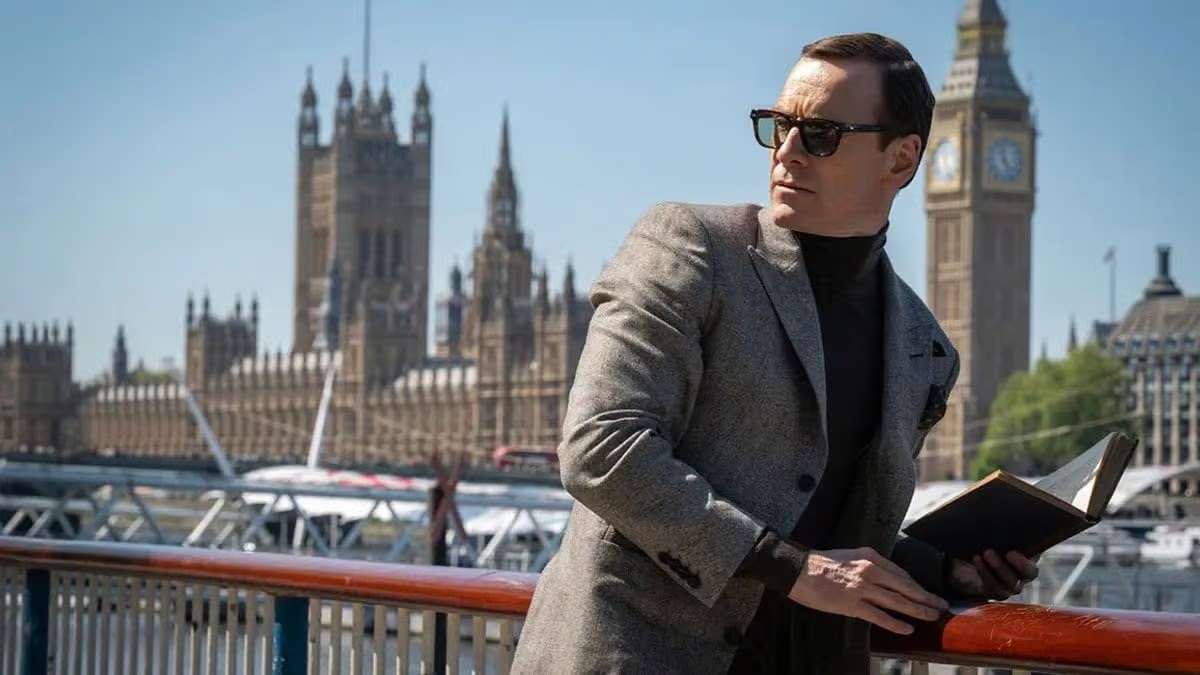
  Playing married spies, Michael Fassbender and Cate Blanchett lead a strong cast that keeps the movie percolating. Everyone's behavior becomes suspect.
   The set-up immediately raises the personal stakes for Fassbender's George. Early on, George learns that his wife's name has appeared on a list of five agents who might be traitors. If she's the culprit, he's going to have to kill her. Will George be more loyal to his wife than to his job? We're not sure. Maybe he's not sure either.
    Blanchett's Katherine seems cagey and intelligent, and it's clear that she and George have carefully worked out the calculus that allows their marriage to continue, even though they sometimes have to reply to each other’s questions by saying "black bag." That means the answer is too secret to divulge.
     Fassbender makes George into a tightly wound professional who keeps us off balance.  To begin his investigation, George stages a dinner party at which the suspected agents (Regé-Jean Page, Tom Burke, and Marisa Abela) and a member of the agency's psych team (Naomie Harris) wind up spilling tea on one another. They reveal enough to bring out festering animosities, but not enough to allow George to identify the culprit. 
    Pierce Brosnan has a nice turn as the head of the agency. He and the rest of the cast embody a drama that bristles with small and large betrayals.
   At times, the movie's many intricate turns get ahead of the audience, but it's not necessary to follow the characters into every cranny Soderbergh explores. A smart screenplay encourages confidence that a satisfying conclusion will be reached. 
    Black Bag includes a skillfully edited polygraph scene that reminds us that truth is difficult to come by in an environment where nearly every one lies. How can they not? It's part of the job.
   

Friday, August 24, 2012

In this movie, speed is the message

Speeding bikes, heavy traffic and a silly plot turn Premium Rush into a fun ride.

Wilee (Joseph Gordon-Levitt) rides a bike with no brakes and no gears to shift. He's a minimalist who works as a bicycle messenger in Manhattan, which means that he's adept at dodging the city's omnipresent taxis, as well as every other form of vehicular transportation. Wilee's also the main character in Premium Rush, a smartly paced and entertaining movie in which speed, danger and stunts are hung on a plot that's built around one of Wilee's assignments. As the movie progresses, director David Koepp works in Chinese gambling dens, an immigration scheme and a very corrupt cop, played with bizarre relish by Michael Shannon. At heart, Premium Rush is a chase movie, but Koepp has fun with graphics, using them to show us how Wilee thinks through the complex maneuvers required to move around jammed city streets. Koepp, who has written action movies such as Mission Impossible, The Lost World: Jurassic Park and Spider-Man and who has directed movies such as Ghost Town, mounts the action with sharpness and clarity. As Wilee furiously pedals to complete his task, Koepp fleshes out the story by moving back and forth in time. Gordon-Levitt infuses Wilee with just enough character (no desk job for this bike jockey) to avoid becoming a cartoon. I've read that the bike riding stunts are real and have not been digitally created, another ploy that helps distinguish Premium Rush from the rest of the breathless genre movies that whiz by during the course of a summer.