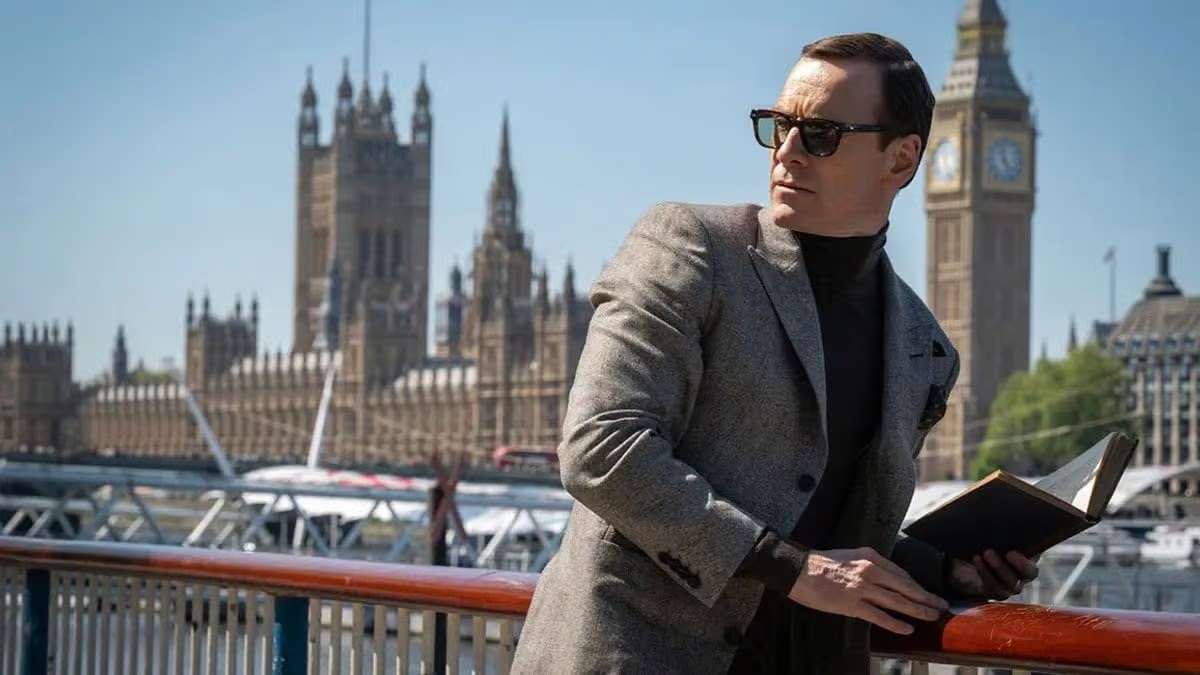
Director Jim Jarmusch's Father Mother Sister Brother offers a trio of short films, each with the texture and open-ended quality of a carefully crafted short story.
Rocky Mountain Movies & Denver Movie Review
FOR MOVIE LOVERS WHO AREN'T EASILY SWEPT AWAY
Thursday, January 15, 2026
A three-part take on family relations
Director Jim Jarmusch's Father Mother Sister Brother offers a trio of short films, each with the texture and open-ended quality of a carefully crafted short story.
Thursday, May 22, 2025
An orphanage hosts a mysterious boy
Wednesday, March 12, 2025
'Black Bag': a tense tale about trust
Director Steven Soderbergh's Black Bag uses the threatened meltdown of a nuclear plant to add an element of global peril to a movie that, despite such ominous stakes, plays an intriguing game of small ball.
Tuesday, October 18, 2022
Cate Blanchett commands the screen in 'Tar'
Tar, an intensely realized drama starring Cate Blanchett as a revered conductor, extends beyond the world of classical music to take a penetrating look at the ultra-successful career of Lydia Tar, a fictional character who represents what we've come to regard as star power.
Thursday, December 16, 2021
A slow and overlong 'Nightmare Alley'
It’s no surprise that director Guillermo del Toro has remade Nightmare Alley, a 1947 noir movie starring Tyrone Power in a role intended to challenge the actor's glamor-boy image.
Thursday, December 9, 2021
Great cast, less-than-great satire
A massively destructive comet — five to 10 kilometers wide — barrels toward Earth. It's scheduled to hit Earth in six months, destroying all of the planet's life. Extinction looms.
Thursday, August 15, 2019
'Bernadette': flat where it should be sharp
Bernadette lives in a large Seattle house that seems to be falling apart around her, although trace elements of a re-design can be seen. A sparsely furnished modern-looking bedroom, for example. Bernadette's husband works for Microsoft and has become a Ted-talking star in the world of high tech. Her whip-smart daughter is bound for Choate, a prep school that very likely will ensure her a place on the success track. Bernadette spends much of her time talking to Manjula, a Seri-like digital assistant in India.
Of course, she’s miserable.
Such is the life of Bernadette (Cate Blanchett), the title character of Where’d You Go Bernadette, director Richard Linklater’s adaptation of a well-received 2012 novel by Maria Semple.
Smart, judgmental and misanthropic, Bernadette can be a pain in the butt, and her contempt for what she calls “life’s banalities” doesn't seem to have led her toward anything resembling a cultural high ground. After years of ignoring her strange behavior, Bernadette's husband (Billy Crudup) has decided his wife needs help.
I can’t say I believed any of this because Linklater's movie can’t find a way successfully to blend satiric observation and character study while also giving his movie a bit emotional heft. As social satire, the movie takes hit-and-miss swipes at middle-class parents, over-achieving kids, annoyingly progressive schools and Seattle's tech-crazed world.
Even Kristen Wiig, as a neighbor and nemesis of Bernadette, isn't able to break through; she's playing a character who's so steeped in her "liberal" values that she's turned her life into a form of parody.
Bernadette's daughter Bee (Emma Nelson) narrates a story that gradually lets us know why Bernadette has lost her grip. She was once a star architect who won a MacArthur Grant for her genius. She designed houses that others envied, but after one of her vaunted projects met a tragic end, she vanished from the Los Angeles scene. She and her husband moved to Seattle, a city she says she hates.
Bee announces that she wants her parents to take her to Antarctica as a reward for something or other. Bernadette reluctantly agrees, even though the trip means she won't be able to avoid the horror of mingling with other passengers on a cruise ship.
Linklater's best movies are conversational gems that catch moods and moments, movies such as Slacker, Dazed and Confused and Before Sunrise. He's also made observant comedies, as those of us who enjoyed Bernie and School of Rock can attest. Boyhood may have been Linklater's best and most deeply felt movie.
Here, Linklater's working in a commercial vein while trying to retain the sharp idiosyncrasies of Semple's novel. The movie's most outrageous moment arrives in the form of a mudslide that disrupts a fund-raising party at the home of Wiig's character. It lands with a thud.
There's one very nice scene in which Bernadette encounters a former colleague (Laurence Fishburne) from Los Angeles. She regales him with a dizzying monologue about what she's been doing for the last 20 years. It's one of the few times Blanchett's amped-up theatricality proves revealing.
By the end, Bernadette starts delivering on-the-nose dialogue, offering its message in a form that comes close to bromide. Someone as creative as Bernadette must create or she'll go nuts. She'll become a menace to others. She's not cut out for ordinary suburban life.
Well, I thought, who really is? And, as I said, I didn't feel as if Linklater made me believe in Bernadette or her vast array of problems.
Thursday, November 2, 2017
Thor returns to the screen with a wink
If you've been worrying about the fate of the beleaguered population of Asgardia, you've even more reason to fret now that the residents of that peaceable realm face a dire threat in Thor: Ragnarok, the latest big-screen entry from (who else?) Marvel Comics.
There's even more about which one can fret in this latest Marvel entry. It's possible, for example, to fear that Hela (sister of Thor and daughter of Odin) might seize control of Asgardia and begin her malicious rule.
Actually, you needn't worry about any of that because there's nothing much at stake in the amiable Thor Ragnarok aside from the future of the Thor franchise -- and that's pretty much assured anyway.
Hela, by the way, is brought to life by Cate Blanchett who has been outfitted with a piece of headwear that sprouts what look like antlers when Hela's fury rushes to the surface.
Blanchett's Hela, by the way, must not be trifled with. We know this because she's also known as "the goddess of death," a description that probably doesn't help her on intergalactic dating sites.
Should you find Hela too serious, perhaps you'll be amused to see Chris Hemsworth (as Thor) try to function without his trademark hammer as his brother Loki (Tom Hiddleston) alternates between the roles of ally and foe in the battle to save Asgardia. The banter between Thor and Loki constitutes one of the movie's high points, and the two actors navigate the screenplay's sillier waters with old-pro ease.
New Zealand director Taika Waititi (What We Do in the Shadows and Hunt for the Wilder People) attempts (often successfully) to leaven the proceedings with humor. Even detractors may be forced to acknowledge that Waititi imbues the proceedings with a level of self-mockery that, at the very least, demonstrates that he's aware that the fate of one more Marvel Comics franchise may not be essential to the continuation of our fragile species.
Waititi's also makes nice use of a supporting cast that includes Tessa Thompson as Valkyrie, a valiant warrior woman who drinks too much, and Mark Ruffalo, who -- in this edition -- turns up as Bruce Banner after having spent several years in captivity as his CGI alter ego, The Hulk.
The triumph of Hulk over his Banner self has something to do with the evil Grandmaster (Jeff Goldblum in a one-armed golden cloak). The Grandmaster presides over the planet Sakaar, where he runs an in-house battle between unwitting invaders and his captive champion, the Hulk.
Many Marvel movies depends heavily on the ability of the director to make us overlook their plots, a task you may wish to regard as dramatic accessorizing. In this regard, you'll meet Korg, a creature who looks as if he were made of rocks. Korg (voice by Waititi) is very strong but speaks softly in a signature scene in which he commiserates with Thor over the loss of his mighty hammer.
At one point, Thor also loses his hair -- or at least his long locks are trimmed, making him look like a very buffed businessman who has spent too much time at the company gym, a comic-book Sampson.
OK, so not all the joke are great. At one point, Valkyrie helps Thor escape through something the film inelegantly calls the Devil's Anus, a passageway linking two of the movie's worlds.
You'll also find spaceships, combat and a constellation of jokes, as well as a story in which Karl Urban portrays Skurge, a character who's recruited (more or less against his will) into Hela's evil orbit.
And, yes, Anthony Hopkins shows up (at least briefly) as Odin, although in this outing, Odin has more to do with establishing the plot than with participating in its development.
Parts of Ragnarok slog more than they soar, but Thor Ragnarok offers a bit of fun, and if we must have more Marvel movies (and we have little choice in the matter), we need more directors like Waititi, good-humored souls who refuses to be over-awed by the prospect of steering a movie into blockbuster terrain.
Better, I suppose, than the previous two Thor movies, Ragnarok nonetheless resembles a mirage; it allures, amuses and appeases before quickly receding into the dim recesses of memory.
At this point, you may be asking a pertinent question. What the hell is Ragnarok? I think it has something to do with a Norse prophecy about impending catastrophe.
The movie itself is no catastrophe thanks in part to Hemsworth who gives one of his more likable performances. Besides, it's difficult to hate any movie that allows Blanchett to chew the movie's abundant and not always impressive scenery -- archly, of course.
Thursday, March 10, 2016
A frustrating 'Knight of Cups'
I know many serious film lovers who are slavishly devoted to the films of director Terrence Malick, so much so that they transfer the brilliance and emotional depth of films such as The Tree of Life to lesser works, notably the recent To the Wonder (2012).
With Knight of Cups, Malik provides another test for devotees because this strange foray into the libidinous world of Hollywood leaves a gaping maw of consternation in its wake.
Malick begins with a quote from The Pilgrim's Progress, a 1678 Christian allegory. Author John Bunyan's work about a journey to the Celestial City isn't the only source Malick quotes: He also cites passages from The Hymn of the Pearl, a Gnostic myth about a boy sent to Egypt to retrieve a pearl from a serpent.
I bring all this up not to demonstrate my knowledge of Christian literature, which is -- at best -- confined to perusals of Wikipedia, but to suggest that Malick's willful obscurity seems a frustratingly protracted exercise in navel gazing as filtered through what feels like a dense spiritual fog.
Equally troublesome is Malick's tendency to pepper his films with the barely audible thoughts of his characters. He blurs their speech and de-emphasizes anything resembling human connection. His characters live in worlds of their own.
This approach has been likened to dreams; but dreams and poetry always have been tricky stuff for movies, and they can do a filmmaker in as quickly as they can save him or her.
In Knight of Cups, Malick mostly abandons linear storytelling as he soaks in the often beautiful imagery of his collaborating cinematographer, three-time Oscar winner Emmanuel Lubezki.
Taking its title from a tarot card, Knight of Cups casts the always adventurous Christian Bale as Rick, a screenwriter who's searching for meaning in his generally hollow life. Foundering in a sybaritic material world, Rick is a forsaken man.
When he's not engaged in sexual relationships, Rick is seen walking, driving his vintage convertible or looking at things. Of course, the gifted Lubezki gives Rick (and us) plenty at which to stare as Malick's camera explores Los Angeles.
Because most of Rick's quest (if that's what it is) involves women, Malick finds an opportunity to bring a diverse core of actresses to the screen.
Nancy (Cate Blanchett) plays Rick's ex-wife, a physician who works in a clinic. Karen (Teresa Palmer) appears as a Las Vegas stripper. Helen (Frieda Pinto) works as a model. Elizabeth (Natalie Portman) gets pregnant by Rick. She's married to someone else.
As if flipping through a deck of Tarot cards, Malick structures his story around chapter headings such as The Moon, The Hermit and more. It takes more effort than it's worth to connect these titles to the hazy unfolding of Malick's Los Angeles-based scenes, some which include Rick's father (Brian Dennehy) and his bother (Wes Bentley).
Father and son are locked in an explosively angry duet.
Antonio Banderas presides over a Hollywood party attended by various Hollywood "insiders," a boisterous Bacchanal.
At first, it seems as if Malick wants to make a movie about another lost soul snared by the siren call of Hollywood hedonism. But he also seems to want to give Rick's searchings spiritual meaning: A lost soul, Rick is separated from God and trying to establish a connection or maybe he's just seeking meaning in a godless world or maybe ...
Well, in the end, who really cares what Rick is seeking?
We've all got troubles of our own, and Malick never convinces us (or at least me) that we should get involved with his.
Thursday, December 24, 2015
Todd Haynes: Loving and hating the '50s
Carol -- the much-praised romance from director Todd Haynes -- carefully recreates the climate of the 1950s in which an affluent WASPy husband seems to care less about his wife's sexual orientation than about maintaining appearances.
Though never overly emphasized, the social issues in Carol allow the movie to bite into the rotten apple of repression that defined a post-war decade dominated by a rigorous commitment to conformity.
But Haynes' adaptation of The Price of Salt, a 1952 Patricia Highsmith novel, hardly qualifies as a fiery expression of outrage against 50s hypocrisy: It's a double-edged romance -- one between two women and the other between Haynes and the style of the '50s.
The most powerful figure in screenwriter Phyllis Nagy's screenplay -- at least at first blush -- is Carol (Cate Blanchett): Carol lives in an upper-middle class life in suburban New Jersey. She once had an affair with her best friend Abby (Sarah Paulson). She's well aware of her sexuality, but is languishing in a marriage that exists only on paper.
Although Carol's husband, Harge (Kyle Chandler) resents the affair, he seems willing to allow the trappings of class to mute his emotions -- at least when he's not too drunk to keep his anger and need in check.
Harge clings to Carol -- if not for love than to have someone take his arm when he attends a country club function.
Carol and Harge also have a daughter named Rindy (Kk Heim), a girl who figures into their struggle: Carol wants out of the marriage. Harge eventually threatens to keep her from her daughter.
But I get ahead of myself. The story's major event occurs early. While shopping in a Manhattan department store, Carol meets Therese (Rooney Mara), a young woman who's working the counter in the toy department. Carol instantly is attracted to this shop girl. It's clear that Mara's Therese feels something, as well.
Elegantly dressed, Blanchett's Carol exudes suburban superiority; for a movie in which desire plays an important role, it's interesting that Blanchett's Carol seems awfully calculating.
She leaves her gloves on Therese's counter, an obvious invitation for further contact. Later, she invites Therese to her home. She opens a door for this younger women (who wants to be a photographer), but doesn't push her through: She beckons Therese to enter.
I wondered whether Carol -- as a character -- would be possible without her fur coat, Olympian cheek bones and surface composure. If Carol lived in the South and things didn't go well for her, you could almost see her evolving into Blanche Dubois.
Rooney's performance is quieter, but she holds her own with a show of determined intensity. At the outset, Therese's life hovers in a kind of limbo: She has a boyfriend (Jake Lacy). He thinks they're on the verge of getting married. He's very wrong.
Things become clear to Lacy's Richard when Therese, who's only discovering her sexuality, agrees to take a cross-country car trip with Carol.
Carol's depressed about her inability to jettison Harge, who has spirited their daughter away. She's eager to feel free. Not surprisingly, it's on this trip that Carol and Therese first have sex -- in a motel in the town of Waterloo, Iowa.
Lots of emotion roils beneath the surface here, but Carol doesn't always take full advantage of its potential. The movie can be slow and intermittent in its ability to intrigue, but it builds as it goes. And Haynes finds a way (better not disclosed here) to give the movie's ending some kick.
Carol and Therese are two characters who don't necessarily live in the '50s; they live in a world that has been production designed, costumed and turned into a diorama: Carol can feel a bit airless.
And that may result from the conflict that animates Haynes' work: He seems to love the style of the '50s while chafing against the decade's constraints. It's weird in a way: The movie's volatile issues are bathed in the comforting nostalgia of its design, enhanced by cinematographer Ed Lachman's warmly conceived imagery.
Don't be surprised if production designer Judy Becker and costumer Sandy Powell carry home Oscar gold for their work on Carol, Haynes' second foray into the '50s after Far From Heaven (2002).
Love aside, Carol and Therese remain two very different women. They're from two different generations and two different social backgrounds. I won't say more, but I will tell you that I thought what happens to these women after Carol concludes might have made for an equally or even more interesting movie.
Thursday, October 29, 2015
'Truth' looks at big-time TV news
Truth, the story of how a team of crack 60 Minutes' reporters got misled while doing a 2004 story about George W. Bush's military record, tries to mount what might be the most high-minded defense of journalistic misjudgment ever.
The real-life story resulted in resignations and firings, including the abdication of Dan Rather from the anchor throne of the CBS Evening News. Rather also had to issue an on-air apology.
In Truth, absorption with the details of researching the story ultimately gives way to a lamentation over a once honorable news business that has been swallowed by self-serving corporate concerns.
Look, I'm as happy as the next former ink stained wretch to cry in my beer over the sorry state of contemporary journalism, but Truth may not have found the right story to make the case.
For those who've forgotten, the CBS story revolved around two central contentions.
One: During the Vietnam War years, influence was used to get the privileged Bush into the Texas Air National Guard, presumably as a way to avoid combat. Two: Bush didn't fulfill a substantial portion of his Guard commitment.
That's a good story to be sure, particularly in a year when Bush was running for his second term, but significant doubt was cast on the authenticity of two documents Mapes and company relied on to prove make their argument.
Truth, which stars Cate Blanchett as Mary Mapes and Robert Redford as Dan Rather, suggests that a few missteps along the way didn't necessarily undermine the story's essential veracity. That may be true, but it's not a position I'd want to argue in the court of journalistic ethics.
Redford, who starred in All the President's Men, a 1976 story about the journalistic triumphs of Watergate, again takes up the cudgels for a probing press. But even in a story of involving mistakes, Rather is made to embody a heightened form of journalistic virtue.
A pair of suspenders can't turn Redford into Rather. Still, he gives a decent enough performance as a guy who's been around the journalistic block.
Rather may be the big name in the story, but Truth focuses most of its attention on Mary Mapes, the gifted producer who led the team of reporters who researched the story before the heavy interviewing artillery -- i.e., Rather -- arrived.
Blanchett's certainly good at showing how the satisfactions of a job well done are undermined once Mapes learns that the story she thought was meticulously researched began to fall apart.
Dennis Quaid, Topher Grace and Elisabeth Moss hold their own as members of the reporting team. Bruce Greenwood, David Lyons and Rachel Blake add flavor as CBS news division execs.
Obviously, the reporting team worked hard on the story, and Rather had ample reason to have confidence in Mapes, who won acclaim and, later, a Peabody, for her work on the infamous Abu Ghraib story. (The movie, in an obvious irony, points out that Mapes won her Peabody after she'd been fired by CBS.)
So what we ultimately get feels a bit addled, a movie that mourns the demise of hard-nosed journalism, but focuses on a case in which the reporters very well may have been suckered.
Vanderbilt concludes with outraged flourishes over they way a major corporation treated reporters with a fighting spirit and a willingness to keep asking tough questions.
Sure CBS was concerned about revenue, its image and possible government retaliation. Maybe the network put its interests above a pursuit of the truth, but that doesn't mean the story that set off this firestorm wasn't flawed.
It's hardly surprising that things ultimately got ugly at CBS. When a network has to fall on its sword, you can bet that blood will be shed, and -- in the case of the Bush story -- some of it belonged to journalists who sincerely thought they had uncovered something big.
Perhaps they did, but the country since has moved on from a story whose greatest impact was felt by those who reported it.
Thursday, March 12, 2015
Familiar tale proves entertaining
Taking a break from Shakespeare, director Kenneth Branagh manages a neat trick: He serves up a visually witty and passably entertaining version of a story so familiar, we hardly can believe anyone wants to tell it again.
Lily James (of Downton Abbey) appears as Cinderella, a preternaturally understanding young woman who does her best to adjust to the substantial misfortunes fate deals her -- the early-picture death of her mother (Hayley Atwell) and the later demise of her doting father (Ben Chaplin).
It seems Dad made only one major mistake in his life: After being widowed, he married the conniving Lady Tremaine (Cate Blanchett) and brought his new wife and two daughters (Sophie McShera and Holliday Grainger) into his stately home.
You don't need to know much more because you already get the drift.
The pleasures of this Disney-produced edition of Cinderella have less to do with discovery than with its visual extravagance, created in part by cinematographer Haris Zambarloukos.
Branagh's use of computer generated imagery serves to suggest a connection with Disney's fanciful animated version, a 1950 release that's regarded as a classic. Technological advances allow Branagh to offer novel views of wonders such as lizards turning into footmen for a pumpkin that has been transformed into a carriage.
Did I mention the movie's lovable mice?
An able supporting cast helps bring Chris Weitz's screenplay to life, as well.
Richard Madden plays the prince in this version, never a great role. The prince's father (Derek Jacoby) presses his son to get married, but pushes for the young man to wed a royal.
We also meet a devious Grand Duke portrayed by Stellan Skarsgard, who's ultimately saddled with the task of bringing additional intrigue to the story.
In this telling, Lady Tremaine -- a.k.a. The Wicked Stepmother -- tries to cook up a conspiracy with the Grand Duke that will prevent Cinderella from fulfilling her romantic destiny.
I suppose we shouldn't be surprised that the gifted Blanchett makes the role her own, avoiding the temptation to create a sneering caricature.
The fairy godmother is played by Helena Bonham Carter, an actress who attempts to wring every bit of amusement out of her role.
This Cinderella isn't delivered with a heavy hand, and the result is an entertainment that boasts a wide range of secondary pleasures.
Examples: Dante Ferretti sets are suitably impressive. Sandy Powell's costumes provide their own amusement, particular those of Drisella and Anastasia, the two impossibly snooty stepsisters. Evil Stepmom boasts a preposterously expressive collection of hats.
Given the scale and color of the production, it's hardly surprising that Cinderella functions like a musical in almost every respect, except for the fact that it has no musical numbers. I can't say I missed them.
The primary audience -- girls and tweens -- probably will enjoy the movie, and the parents who accompany them won't suffer. To ask for anything more from another telling of the Cinderella story might be to demand the impossible.
Thursday, April 24, 2014
Seeking paradise in the Galapagos
Directors Dayna Goldfine and Daniel Geller began their efforts after finding black-and-white footage of Friedrich Ritter and Dore Strauch, the original settlers on the unpopulated island of Floreana in the southern Pacific.
According to the movie's web site, the footage was shot during expeditions by Captain Alan Hancock to the Galapagos Islands, a desolate spot that seems better suited to lizards and giant tortoises than to human beings.
Ritter, a physician who fancied himself a philosopher, was aggrieved when a few other intrepid souls followed him to Floreana, including a purported baroness who seemed to become sexually involved with most of the men on the island.
Life on Floreana wasn't easy, and much of the footage shows Strauch and Ritter working to sustain life by cultivating crops to support their vegetarianism.
Ritter's goal was to forsake the individuality-crushing confines of civilization and community. Naturally, the arrival of other people only fueled Ritter's belief that contact with others meant conflict.
The newbies on Floreana included another German couple and the aforementioned baroness -- one Eloise von Wagner Bosquet -- who brought a couple of lovers with her. The baroness planned to build a hotel on the island.
The story, which includes a possible murder and assorted other mysteries, is carefully assembled with a variety of name actors reading from correspondence by all the participants.
Voices are provided by Cate Blanchett (Strauch), Diane Kruger (as the female member of the second couple) and Connie Nielsen (as the baroness). Thomas Kretschmann reads the words of Ritter.
Interviews with some of the offspring of the handful of people who lived on the Galapagos Islands add a bit of contemporary spin to the proceedings.
The German newspapers wrote about Ritter and Strauch as a new Adam and Eve. It doesn't take much by way of imagination to know that a paradise never found can't be lost.
The Galapagos Affair is an interesting and bizarre story about the way in which noble dreams so often lead to folly.
Thursday, February 6, 2014
'Monuments Men' misses the mark
In his sixth directorial effort, George Clooney has made a middle-of-the-road movie about an intriguing subject, the attempt to rescue priceless art seized by the Nazis during World War II.
The Monuments Men of the title are a group of aging academics and art specialists charged with saving paintings, sculpture and monuments from Hitler's rapacious legions. Upper-echelon Nazis wanted to appropriate most of western art for a gargantuan museum to be named after the Fuhrer. Pieces that didn't make it into Hitler's art mausoleum would find their way into the private collections of Nazi bigwigs.
Clooney also stars in the movie: He plays Frank Stokes, an art historian from Harvard's Fogg Museum: Stokes leads the culture-saving effort after assembling his team in what amounts to a subdued Dirty Dozen style.
Matt Damon plays James Granger, an art expert from the Museum of Metropolitan Art in New York; Bill Murray portrays architect Richard Campbell; John Goodman appears as a sculptor; Jean Dujardin portrays a French art dealer; and Bob Balaban plays Preston Savitz, a character whose professional skills weren't entirely clear to me. British actor Hugh Bonneville takes on the role of a British art expert who's trying to rehabilitate his reputation as a drunk.
Cate Blanchett has a smaller role as Claire, a French woman who works at a Paris museum, and who has been forced to assist the Nazis in their pilfering. It takes a while for Damon's character to convince Claire, who also has ties to the Resistance, to help find hidden art treasures: She's fearful that the U.S. will appropriate masterpieces in much the same way as the Germans have done.
A couple of major tensions break through the movie's somewhat frozen surface. First, there's an on-going argument about whether any piece of art is worth a human life. That raises additional questions about the importance of culture, even during war-time duress.
Early on, Clooney's Stokes asks President Roosevelt -- a leader for whom art was not a top priority -- what the war will have meant if, at the end of it, Michelangelo's David has been reduced to rubble.
The Monuments Men also race to keep important art objects out of the hands of the advancing Russians, who are portrayed as eager to get their hands on landmarks of Western civilization.
As it turns out, much of the stolen art was hidden in German mines, but the movie's discoveries have a plodding feel. The men's various missions proceed without much vigor.
That seems a major miscalculation: The Monuments Men is like a caper movie -- only without the caper.
The screenplay by Clooney and Grant Heslove (based on a book by Robert M. Edsel) makes some attempts at humor, most of it italicized by one of the most disappointing musical scores in recent memory, a shock since it was written by the gifted Alexandre Desplat, whose work I've almost always admired.
The movie attempts to differentiate among the characters in broad ways, but, as depicted here, these are not the most interesting group of people. Moreover, Clooney doesn't find enough ways to demonstrate either the men's passion for art or their expertise.
Ironically, the movie could have benefited from more talk about art. Michelangelo's Madonna of Bruges turns up, as does a famous Ghent altar piece, but for a movie about the enduring importance of art, Monuments Men pays too little attention to it.
Oh well, call it a miss by some very talented people: This little-known and clearly fascinating story deserved more than the shrug The Monuments Men induces.
Thursday, April 7, 2011
'Hanna' unleashes more girl power
The movie’s most important gimmick can be found in its title character. Sixteen-year-old Hanna (Ronan) comes equipped with the kind of identity that earns respect in movies. She’s a carefully trained killer, a deadly helping of girl power served in an action context.
Ronan’s Hanna may have an Alice in Wonderland face, but she’s not likely to show up at any tea parties. She can take on multiple foes, out run even the most determined of pursuers, speak a variety of languages, and hunt game before breakfast. Did I mention that she handles weapons as deftly as other kids text?
Raised in a Finnish forest by a rogue CIA agent (Eric Bana), Hanna has been well schooled in the survival arts. She has been taught to anticipate danger and to defend herself.
In fairness, it must be said that Ronan elevates Hanna above the script’s abundant absurdity, giving her an eerie determination that makes this disorienting and far-fetched thriller more compelling than it deserves to be. When Hanna leaves the isolation of the forest, she’s like an alien trying to understand a new planet.
But Ronan can’t totally make up for the script’s lack of logic, unless you buy the idea that references to fairy tales excuse a multitude of sins, particularly a lack of plausibility.
I’m not over-interpreting: Wright makes explicit references to classic fairy tales, beginning with an illustrated edition of Red Riding Hood that Hanna peruses in an early scene and culminating in a showdown in an abandoned German amusement park where Wright offers one last grandly overstated chance to equate evil with a wolf.
Having passed beyond the age of the brothers Grimm, we must look for our ogres, witches and wicked stepmothers in the one place that reliably supports big-screen villainy: the secret corridors of government. Hanna must square off against a CIA bureaucrat (Cate Blanchett) who combines the bite of the Big Bad Wolf with the cunning of a wicked witch.
If Ronan is able to take Hanna beyond gimmickry, Blanchett – a gifted actress who need not apologize for anything she does – fares less well. Her Marissa, an all-business killer, is a predator, right down to her bleeding gums. She’s arch, vicious and burdened by a wavering Southern accent.
Wright, who directed Ronan in Atonement and who also directed a big-screen version of Pride and Prejudice, this time forsakes literary adaptation for a kinetically charged fantasy in which Hanna spends nearly the entire movie on the run. When Hanna decides she’s ready to leave the forest, she’s captured by Marissa’s troops. After she escapes, she heads for Berlin, where she’s supposed to reunite with Bana’s character.
En route, Hanna faces a variety obstacles. Notable among these supporting menaces: Tom Hollander’s Isaacs, a freakish blond killer whose looks and intonations suggest a level of perversity so ingrained, it has become casual.
At heart, Hanna is little more than a glorified series of chases with one interlude offering a bit of relief. Hanna latches onto a normal family that’s touring Morocco in a battered van. Hanna does her best to make friends with the family’s teen-age daughter (a lively Jessica Barden), but Hanna has not learned much about social interaction.
The movie doesn’t sit still for long, and Hanna soon finds herself back in motion, traversing borders with an ease that defies logic. She also runs a lot, an activity that has prompted comparisons to director Tom Tykwer’s 1998 Run Lola Run. Unlike Tykwer’s streamlined effort, Wright’s Hanna loads up on plot, boosting its adrenalin level with a throbbing Chemical Brothers score that amounts to musical fist pumping.
At the end of a movie, it’s sometimes interesting to imagine what might be next in the life of its main character. For Hanna, that question only can be answered in movie terms. What’s next? The only thing I could think of for this wholly unreal character was a sequel.
Put another way: I don’t think there are any proms or SATs in young Hanna’s future.