Showing posts with label Frank Grillo. Show all posts

Thursday, July 28, 2022

‘Paradise Highway’ wastes two great actors


A movie that features Juliette Binoche and Morgan Freeman in prominent roles is bound to tempt viewers who otherwise might not care about a pulpy story in which a long-distance truck driver (Binoche) tries to rescue a girl (Hala Finley) from a ring of sex-traffickers. Freeman plays a former lawman who steps out of retirement to aid in the search for Binoche's Sally and the girl, who take to the road in Sally’s semi. The cast also includes Frank Grillo as Sally's imprisoned brother. On the eve of his release, he asks Sally to transport some illicit cargo so that he can square himself with a gang that's threatening his life. Shocked and unsettled, Sally learns that the cargo is a girl who’s bound for sex slavery. Reluctantly, Sally opts to save the girl. I'll say no more except to note that I found it painful to watch two terrific actors saddled with lame dialogue. Moreover, Binoche is miscast as a foul-mouthed, tough-minded long haul driver, a role deprives of her of the ambiguous allure that has drawn us closer in so many movies. Too often, Freeman is stuck bantering with his younger partner (Cameron Monaghan) as they try to save the girl. I think you can guess the girl’s fate but neither Binoche nor Freeman can save the movie.

Wednesday, January 12, 2022

It's January. Do we need to wake up yet?

Shattered

The Pink Cloud

     The thing about January, at least in terms of movies, is that there’s not much to say. Many moviegoers are still catching up with last year’s best efforts. Moreover, a kind of tacit acknowledgment among the movie faithful promises that nothing terribly significant will happen before the new year tightens its grip on the collective consciousness.
    I’m excluding deaths, which this January included Peter Bogdanovich and Sidney Poitier. 
     Sad news aside, it’s with low-voltage spirit — or maybe it’s just a mood — that I turned my attention to two movies that have the year 2022 firmly affixed to their release. 
    I begin with Shattered, a movie that falls into the category commonly known as thrillers. Such movies often tell stories in which crime figures prominently.  The nastier the crime, the bigger the supposed thrills.
     Classified as a thriller, Shattered caught my attention because it features an appearance by John Malkovich.  Malkovich can project a judgmental quality embellished by hints of superiority. He knows how to add a sinister garnish to a commonly turned phrase.
    Unfortunately for Shattered, Malkovich portrays a minor character, a motel operator whom the screenplay eventually feeds to its femme fatale, a conniving woman who inflicts pain and death with an angelic, choir-girl smile plastered on her face.
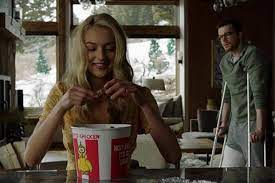
     Shot from certain angles, this woman (Lilly Krug) looks beautifully innocent. We’re meant to understand that a lonely, newly divorced tech whiz (Cameron Monaghan) could easily be infatuated by her.
     Having sold his company for a mega-fortune, our tech whiz has moved into an isolated house in Montana that reeks of modernism. 
      Shattered involves a home invasion with a twist. The homeowner -- Chris by name -- invites the perpetrator into his house after she offers to nurse him back to health. While walking to his car with his new love interest, Chris was attacked by a pipe-wielding thug. The result: a badly broken leg.
    The screenplay touches the expected bases. We’re briefly introduced to Chris's former wife (Sasha Luss) and his young daughter (Ridely Asher Bateman), a sure sign that they will re-emerge at some later point.
       Krug's Sky has no interest in the tech whiz aside from the fact that he’s rich. Predictably heartless, she's unfazed by the sadistic impulse required to drill into the cast that encases Chris's mangled leg. She wants to steal Chris's identity and take his fortune. She's cruel but shallow.
       Just in case we didn't know that Sky is up to no good, she also murders her lesbian lover and roommate (Ash Santos), having moved in with Santos's character because her digs offered a view of the tech whiz’s home. Sky used a telescope to case the joint.
      Eventually, Sky's partner in crime (Frank Grillo) shows up, perhaps for no other reason than to break the sadistic monotony of Sky’s cruel rampage. 
      A familiar, played-out story leaves us to wonder how much we're supposed to care about an MIT grad who seems to have over-achieved himself into what looks like early and pointless retirement.
       Formula hardly matters in movies anymore but character still does, and Shattered’s crew falls low on the interest scale.
       Nothing about The Pink Cloud -- an allegorical offering from Brazil -- qualifies the movie as a thriller. Though shot before COVID, the movie acquires topical resonance in these days of quarantine and isolation, which -- as I'll explain later -- becomes a double-edged sword.
       The Pink Cloud poses an interesting question: What would happen if you found yourself quarantined with a stranger with whom you’d just had a sexual encounter? What if a diverting afternoon's   pleasure suddenly turned into a kind of sentence?
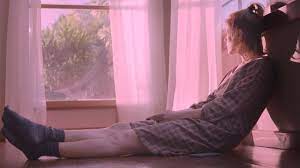
        So goes the fate of Giovana (Renata de Lelis) and Yago (Eduardo Madonna), the unfortunate duo that learns they are stuck in Giovana's apartment after a lethal pink cloud descends on their  town. 
   Once exposed to the mysterious cloud, death occurs within 10 seconds.
    The situation might have been bearable for both Giovana and Yago had it not gone for years. But the damn cloud won't go away.
     As time passes, the movie’s reluctant couple deals with the birth of a son, the result of their first encounter. They eventually tire of each other and seek ways to escape their isolation. He tries virtual relationships and she immerses in a virtual reality mask that enables her to simulate the experience of lying on a sandy beach. 
       Pink Cloud explores relationships in pressure cookers while glancing at parental responsibilities in a severely limited world. 
     Interesting stuff, but the movie solves some of its problems a bit too easily. Food and other purchases are delivered through a tube that attaches to one of the apartment's windows. It’s not clear how the movie's implied economy works. 
    And, of course,  neither we nor the characters know where the cloud came from. Perhaps, it originated in Metaphor Land, inviting comparison to any situation in which the atmosphere suddenly turns toxic.
    Director Iuli Gerbase's employs a couple of Zoom calls and FaceTime exchanges to open things up, but the movie centers around the way Giovana and Yago differ. Simply put, she yearns for the outside world; he comes to terms with confinement and may even like it.
    The two actors are good, but haven't we had a taste of isolation and sensory deprivation during the past couple of Covid years? The idea of experiencing more of it in a movie may not be the most appealing of prospects. 
    It may be odd to say but Gerbase seems to have made the movie too effective for its own good. I appreciated the effort but wanted out.

    So that’s early January. 
     I want to say something about Poitier. Poitier became a star when I was a kid. I saw The Defiant Ones (1958) at the Embassy Theater in North Bergen, New Jersey. I remember thinking that Tony Curtis, with a southern accent by way of New York, was no match for Poitier. 
     With its italicized symbolism — white and black convicts chained to each other and on the run — survives more as a social artifact than a telling statement about race in America.  
     Times have changed but current views about race haven't impinged on Poitier’s movie-star status. 
    If I had to pick a favorite Poitier movie it would be Raisin in the Sun, a 1961 big-screen adaptation of Loraine Hansberry’s play. As Walter Lee Younger, Poitier gave one of his angriest, most vulnerable performances. He made us feel Walter Lee’s delusions, as well as the intensity of his desire to break the bonds of a suffocating job as a white man’s chauffeur.
     Like most memorable actors, Poitier infused his work with flavors (anger, conviction, and stature among them) that suggest far more than what was often written on the pages of the screenplays he brought to life.  
       He was one of the greats. 
     

Thursday, September 2, 2021

A "Gateway' to nowhere


Despite a strong cast led by Shea Whigham, The Gateway never fuses into the gritty urban drama it seems to want to be. (The story is set in St. Louis but the movie actually was shot in Norfolk, Va.) Whigham's Parker —  another character with a single name -- works in a field that seems at odds with his behavior. Parker’s job as a social worker might well expose him to drug-world violence. But the movie amps things up by turning Parker into a pistol-packing former boxer. Parker wants to keep kids out of the foster-care system that nearly swallowed him as a child. Parker becomes increasingly involved in the lives of a woman (Olivia Munn) and her daughter (Taegen Burns) after a hot-tempered husband and father (Zach Avery) is released from prison. Avery's Mike quickly falls in with his old criminal clique led by the merciless Duke (Frank Grillo). When he gets crosswise with a drug cartel, Dahlia and Ashley are put at risk. Bruce Dern crops up as the jazz-trumpeter dad from whom Parker is estranged. Director Michele Civetta seems to be trying to say something about the complex corruptions that plague St. Louis and about one flawed man who tries to do some good. Noble aims remain unfulfilled because of lame dialogue and a plot that doesn’t fully engage the ambiguities and conflicts in Parker’s character. In sum, The Gateway's gritty stroll down mean streets leads to a dead end.


Thursday, January 21, 2021

Bob's Cinema Diary: 1/22/21 -- 'Derek DelGaudio's In & Of Itself' and 'No Man's Land'

Derek DelGaudio's In & Of Itself


It would be unfair to call Derek DelGaudio a magician, although he does specialize in card tricks and illusions. It  would be equally unfair to call DelGaudio a storyteller, although that's part of his repertoire, as well. In the absence of a better description, it's probably best to label DelGaudio a performance artist.  Taken from several versions of DelGaudio's off-Broadway show from a couple of years back, In & Of Itself captivates with a heady mix of the abstract and the concrete. DelGaudio was filmed by director Frank Oz working in a small theater in which the audience frequently is asked to participate. DelGaudio appears before a wooden wall into which several box-like squares have been cut and which become part of the stories that DelGaudio tells. At its heart, In & Out (available on Hulu) is an exploration of identity: DelGaudio's, the members of his audience, and those who will see the film version. The movie begins with DelGaudio telling a story he claims to have heard in a bar in Spain. He sketches a tale about a man who played increasingly dangerous games of Russian roulette and acquired the name "Roulettista." Later, he talks about learning that his mother is gay. Whatever direction he charts, DelGuadio manages to create an edge that suggests that both he and the audience might be at risk. Of what? I'm not sure, but DelGaudio's deadpan delivery helps keep us off guard and allows Oz to sustain a consistent level of tension. Home movies and animation are employed to varying effect but keep In & Of Itself from feeling stagebound as DelGaudio builds toward the film's emotional (really) finale. 

No Man's Land
 

The Texas/Mexico border is dotted with areas that are south of official border crossings and north of the actual border. No Man's Land begins on a ranch located in this ambiguous territory. As evident as a cowboy hat at a stock show, the movie's purpose quickly emerges: to challenge a young Texan's idea about the immigrants who cross his family's property en route to the US. What could have been a topical gut-punch of a movie becomes an unconvincing journey about one man's redemption as he meets Mexicans who are willing to help him. The key incident in director Conor Allyn's contemporary western involves the shooting of a Mexican boy who's trying to cross the border with his father (Jorge A. Jimenez). Jake Allyn, the director's brother, plays Jackson, the son of a rancher (Frank Grillo) who's used to chasing Mexicans off the land where he lives with his wife (Andie MacDowell) and another son (Alex MacNicoll). After shooting the boy in a chaotic encounter, a guilt-ridden Jackson flees to Mexico on his trustee horse Sundance. Jimenez's character pursues him. So does a Texas Ranger (George Lopez in a deadpan but compassionate performance). Most of the movie deals with Jackson's encounters with Mexicans who feed him, shelter him and teach him that they're people, too. The movie invites us to consider questions about forgiveness and accountability (fair enough) but a persistent haze of idealization undermines credibility and creates a feeling that most of what we're seeing has been pre-programmed to deliver a message.

Thursday, April 18, 2013

'Disconnect' tries to plug into real emotions

Parts more powerful than the whole in this admirably ambitious look at loneliness, isolation and the pain of daily living.

E-mail, chat rooms, cell phones, laptops, instant messaging, tablets and photos that go viral all become part of the high-tech plot machinery in Disconnect, a drama that attempts (and almost succeeds) to use technology as a gateway to examining the loneliness and isolation that often colors contemporary experience.

Director Henry Alex Rubin, who previously directed the documentary Murderball, takes a somber approach to material that's topical, disturbing and not without examples of cruelty.

A large and well-employed cast helps to overcome an increasingly melodramatic and inelegantly contrived screenplay as Rubin -- working from a script by Andrew Stern -- moves through a variety of story lines, each of which proves more interesting than the ways in which the director ties them together in the end.

Rubin's cast of characters includes a married couple (Alex Skarsgard and Paula Patton) that recently lost a son. They become victims of identity theft. We also meet two teen-age boys (Colin Ford and Aviad Bernstein) who adopt the on-line identity of a teen-age girl in order to embarrass a classmate (Jonah Bobo) whom they regard as geeky and vulnerable.

Bobo's Ben struggles with a range of typical problems faced by kids who are considered "uncool" by their classmates. His parents (Jason Bateman and Hope Davis) don't seem to realize the depth of their son's torment. Nor does Ben's sister (Haley Ramm), a teen who disdains her brother because her friends regard him as a social misfit.

Meanwhile, the ex-cop father of one of the bullying boys (Frank Grillo) is hired to investigate the identity theft experienced by Skarskard and Patton.

If all that weren't enough (and it might well have been) Rubin adds the story of an ambitious TV reporter (Andrea Riseborough) who discovers an on-line site that traffics in teen-age sexual exploitation. Riseborough's Nina tries to persuade one of the teen workers (Max Theiriot) to be interviewed for an expose that's bound to boost her career.

That's enough plot for several movies, but Rubin staves off confusion, as he develops the movie, giving each story a palpable sense of sadness.

Viewers inevitably will compare Disconnect to a movie such as Crash, which also tried to examine lots of interconnected lives. The comparison may be unavoidable, but that shouldn't negate Rubin's accomplishment.

Disconnect is the kind of emotionally charged project that requires actors to dig deep, and Rubin's cast doesn't let him (or us) down. Unfortunately, though, the material ultimately lets the actors down, and we're left with a movie in which some terrific and highly credible scenes don't jell in totally convincing ways.

Thursday, January 26, 2012

Liam Neeson vs. wilderness and wolves

The Grey takes us deep into the Alaskan wild for a mixture of action and horror.

In the new movie The Grey, Liam Neeson dances with wolves that, for the most part, get the best of a band of grizzled oil rig workers who are stranded in the Alaskan wilderness after a harrowing plane crash.

I don’t know if Neeson is having trouble finding quality scripts or whether he enjoys making these kinds of movies, but he certainly gives action directors their money's worth by bringing instant gravitas to a genre that’s not always taken seriously.

In this case, Neeson – who also starred in Taken and Unknown -- has signed on for a movie that sets action and horror against an inhospitable and frozen landscape.

Once the surviving workers get their bearings, it becomes clear that they’ve quickly made the transition from gritty hard guys to potential wolf food. And it doesn’t take long for director Joe Carnahan, who directed Neeson in the A-Team, to show us the wolves, large, ferocious howlers that are naturally cunning and lacking in mercy, sort of like film critics.

Neeson’s John Ottway, an emotionally wounded man who’s charged with shooting wolves that threaten the oil workers, begins the movie at a forbidding-looking Alaskan drilling site. He's in such a distraught state that he even contemplates suicide.

Ottway obviously has known some other kind of life. He seems to have gone to Alaska in the same way that an earlier generation of movie characters joined the French Foreign Legion. I guess we’re meant to think that the plane crash forces Ottway into a last-ditch attempt at engagement.

The crew that tries to escape the crash scene with Ottway is appropriately motley. The men are differentiated from one another in mostly expected ways. Frank Grillo, for example, portrays an ex-con whose belligerence becomes his defining trait. He’s quick to challenge Ottway’s leadership, even though it’s clear that Ottway has plenty of wilderness savvy.

Obviously, many in this small band will die, and, as is often the case with such movies, you can amuse yourself by speculating about the order in which the unlucky will be picked apart by wolves. You also can brace for the film’s more “philosophical” moments, which play like so much dorm-discussion baloney.

Much is made of a poem (“Once More Into the Fray”) that Ottway says his father wrote. It’s the kind of poetry that could be appreciated only by someone who’s never read a good poem; sort of Jack London meets a Boy Scout handbook.

But if the movie has a message, you’ll find it in the poem: Grit your teeth and do battle with hostile nature.

Carnahan uses gauzy but obvious flashbacks to fill in a blank that doesn’t need filling; they explain why Ottway tends to be so damn morose.

Hey, I’m as frightened by an assortment (or so I've read) of real wolves, puppets and animatronics as the next guy. Some of the scenes in The Grey are rich with apprehension, and a few of the movie's twists even go against the grain of formula

Still, it would have taken a better-written movie to get me to leap whole-heartedly into this glum and frozen fray.