Showing posts with label Jacob Elordi. Show all posts

Wednesday, February 11, 2026

A misguided 'Wuthering Heights'


    In the 1847 novel Wuthering Heights, Emily Brontë painted a Gothic picture drenched with complex characters, class conflict, calculated cruelty, obsessive love, and haunting landscapes.
   Now, we have director Emerald Fennell’s version, which uses the novel as a springboard for a story that includes domination and submission and masturbation as a famed literary duo — Heathcliff (Jacob Elordi) and Cathy (Margot Robbie) — again play out their disastrous connection.
   More sensual than sensible, this Wuthering Heights includes a moment in which Heathcliff licks the wallpaper in Cathy's bedroom. How could he resist? The wallpaper had been designed to mirror Cathy's lustrous skin, including even her veins.
  Apart from the novel, my favorite Wuthering Heights adaptation remains director William Wyler’s 1939 version starring Laurence Olivier and Merle Oberon. Devotees of the novel complained that Wyler had softened Bronte's story of insanely possessive love. It was a fair criticism. The novel never was an exaltation of romantic love, as has sometimes been proclaimed.
   In the 2026 version, Fennell performs open-heart surgery on the story in an attempt to reveal the gooey ooze of its innards and palpitating passions. 
   I admired the audaciousness of Fennell’s previous work (Promising Young Woman and Saltburn) but found her Wuthering Heights to be a sometimes silly attempt at giving a 19th-century novel some contemporary spin. 
   Moreover, the movie’s preoccupation with production design and costume prove distracting. The costumes, particularly Cathy's ridiculously ornate dresses and jewelry are presented as emblems of ostentation, snarky, overstated jokes. The same goes for the preposterous decor of the upscale manse where Linton (Shazad Latif), a landed aristocrat, cloisters Cathy. 
   When Linton becomes Cathy's husband, the marriage provides the main reason for Heathcliff -- Cathy's poor unrefined soul mate -- to vanish from the West Yorkshire moors for five years. He returns as a wealthy man who purchases Wuthering Heights, the place where he and Cathy grew up,  a downscale slide from Linton's carefully manicured Thrushcross Grange estate.
   I’m not going to rehash the story here, but Fennell, who also wrote the screenplay, presents it in outline form, establishing a bond between Robbie’s Cathy and Elordi’s Heathcliff early on and carrying it through to what’s presented as a tragic conclusion for two people who are treated as symbols of an enduring link that can't be broken.
  Many characters from the book have been excised. Among those that remain: Hong Chau plays Nelly Dean, Cathy’s devoted and perhaps cunning companion; i.e., a servant. Martin Clunes portrays Cathy’s father, a debauched, alcoholic gambler, a gaseous human belch of a man.
  Then there’s Isabella (Alison Oliver), Linton’s bird-brained ward, who — in this version — consents to being abused and demeaned by Heathcliff as part of his vengeful manipulations. Who knew? Isabella’s into degradation. Heathcliff's marriage to her is an undisguised act of revenge.
   The movie begins when Cathy and Heathcliff (Charlotte Mellington and Owen Cooper) are children who witness a public hanging, an event that establishes Cathy as a grinning, untamed child who seems to enjoy the brutal moment.
    Soon after the hanging, Cathy's father rescues Heathcliff from the streets and decides to raise him. Cooper, who delivered an amazing performance in the series Adolescence, suggests depths that the screenplay never plumbs when the adult Heathcliff arrives. I half-wished the movie had remained in Cathy and Heathcliff's childhoods.
   As for the main actors, Robbie turns Cathy into a woman of bratty insistence. I wasn’t sure what Elordi was doing as Heathcliff. At times, he seemed to be posing for a Hunks of the Moors calendar.  His Yorkshire accent proves variable. 
   In the novel, Heathcliff is described as dark of complexion, and some have argued that Heathcliff should have been played by an actor of color. Heathcliff's skin tones aren't all that define him, though. Rejection and mistreatment have bent him toward obsession and longing. 
   Fennell has taken a classic story and tried to burnish it with a variety of outre flourishes that play like italicized statements. The riches of Thrushcross Range contrast obviously with Wuthering Heights, the decaying house in which Cathy and Heathcliff were raised, and which here looks as if it might double as a set for a Texas Chainsaw Massacre remake.
   So, no, this is not your grandmother's Wuthering Heights. Heathcliff and Cathy eventually consummate their relationship to the accompaniment of much heaving breath. Cathy and Heathcliff are often caught standing in downpours; they're awash in nature or maybe they don't have enough sense to get out of the rain. 
    But such melodramatic touches, Anthony Willis' brooding aggressive score and the use of tunes by Charli xcx suggest that Brontë’s work needed boosting, perhaps due to 19th century period constraints. If so, it's a misguided choice: Bronte's resonant themes should have been enough to provide some insight into our wealth-gap dominated moment.
   Fennell has put the movie's official title in quotations, a signal that her interpretation will be, to put it mildly, "liberal."  Purists may see this 2026 version more as vandalization than interpretation, but it's probably too much to say that Fennell has made a Wuthering Heights in name only. Still, it’s close enough to let the idea roll around in your mind before moving on.


Wednesday, October 22, 2025

A ‘Frankenstein’ infused with passion

 
   Throughout the first half of Guillermo del Toro's long-awaited Frankenstein, I kept waiting for an aria to pierce Alexandre Desplat's heavy orchestral score. For the record, a variety of operas based on the Frankenstein story have been written. Add a few arias, and del Toro's movie happily could have joined their ranks.
   But, no, del Toro presents his operatic melodrama without anyone breaking into song.
  Instead, Frankenstein serves as the director’s adaptation of and meditation on the classic Mary Shelley story, which first appeared in 1818, spurring more than 200 years of sustained interest. That’s a hell of a run.
   A del Toro dream project, Frankenstein swells with passion. I guess that's notable -- a director displaying palpable enthusiasm for the dark corners of the stories that inspire him. There's no question that del Toro -- The Devil's Backbone (2001), Pan's Labyrinth (2006), The Shape of Water (2017) along with movies such as Blade II (2002), Hellboy (2004), and Crimson Peak (2015) -- has built a visionary body of work that's often rooted in mythic aspiration.
    In Frankenstein, del Toro puts his considerable visual skills to work, but adds another dimension: He splits the story in two, telling it from the perspectives of both Victor Frankenstein (Oscar Isaac) and his monstrous creation (Jacob Elordi).
   To quote the current lingo, the poor creature has “his own truth,” and insists on sharing it.
    Of the two stories in del Toro’s 149-minute opus, the monster -- listed in the credits as The Creature -- gets the best of things, emerging as a near holy innocent in a corrupt human world. Stitched together from the carcasses of dead soldiers, The Creature learns to speak as he wrestles with questions of identity and loneliness. 
   If the movie has any heart, it belongs to the monster. NBA tall and rendered in cool tones reminiscent of a cadaver before rot sets in, Elordi becomes the movie’s sorrowful centerpiece, a wounded outlier whose torment never can be eased. The poor creature can’t even die.
      Abuse, of course, breeds fury. The Creature's super-strength comes off as the justifiable rage of a character whose very existence represents an act of exploitation. Frankenstein keeps The Creature chained in the nether regions of his laboratory, denying him even rudimentary freedoms.
    Del Toro guides us toward the story's all-too-obvious irony: The monster may be more human than the mercilessly driven Frankenstein, played by Isaac with a verve that borders on hysteria.
   Not surprisingly, del Toro loads the movie with statements (sets, costumes and make-up) that burst with Gothic mood and intent, beginning his story with a bracing chill. A Danish sea captain (Lars Mikkelson) tries to free his ship, which has become stuck in Arctic ice. Enter the badly wounded Frankenstein, whose presence and condition will be explained later. 
       Once tucked away on the ship and after a tussle with the now tattered monster, Frankenstein tells his story, narrating the tale until The Creature catches up with his creator and delivers his side of the story.
      Backstory accumulates, fragments of narrative stitched together in quilt-like fashion. We learn of young Victor’s abuse at the hands of his father (Charles Dance), a gifted surgeon and brutal taskmaster who schools his son in anatomy. He disciplines young Frankenstein with a stick across the face lest he damage the hands the boy will need for his own surgical career. 
       Later, Frankenstein will meet Harlander (Christoph Waltz), the patron who wants to fund research into reanimating the dead.
      We also meet Victor’s younger brother William (Felix Kammerer) and his fiancee Elizabeth (Mia Goth),  who happens to be Harlander's niece. Recognized as a rare beauty, Elizabeth has a scientific mind and a keen interest in insects. Frankenstein’s pheromones kick in, but Elizabeth remains loyal to her betrothed.
      Elizabeth quickly develops a sympathetic interest in Frankenstein’s creation, raising another question:  Are humans more than an accumulation of body parts?  She surveys Frankenstein's body and asks which part contains the soul.
     As for body parts, they abound.
     When Frankenstein moves into the tower that serves as his laboratory, del Toro embraces the opportunity to show the products of war carnage that Victor accumulates for his experiment, a task made easier by Waltz's Harlander, an arms dealer already familiar with ravaged battlefields. 
      A psychological motif makes its presence felt as two father/son relationships are juxtaposed: Victor’s relationship with his tyrannical father and The Creature's relationship with Victor, who summons the monster with an assist from an elaborate lightning rod constructed in the tower he has turned into his laboratory.
      The film’s emotional heart beats loudest during touching scenes in which the creature, fleeing after Frankenstein tries to destroy him, is sheltered by a blind old man (David Bradley) who expands The Creature's vocabulary and teaches him the meaning of the word “friend.” 
      No matter how wobbly the build-up, Del Toro sticks the ending.  Isaac’s performance calms down, and the movie sounds a melancholy yet slightly hopeful note. 
      I wish I could say that Frankenstein was gripping throughout its entire 149-minute length. Moreover, del Toro's impassioned approach arrives with a downside; it sometimes feels overblown, an exercise in overstatement that gushes rather than unfolds.
       Honesty compels me to confess that Mel Brooks’ Young Frankenstein (1974) has made it difficult for me to watch any Frankenstein movie without playing an alternate comedy version in my mind, a problem I presume most viewers won’t have. 
       My idiosyncrasies aside,  del Toro's boldly conceived version of Shelley's first novel finds some of the tragic grandeur in an oft-told tale. Imposing as Frankenstein can be, I couldn't help wondering, though, whether all the effort couldn’t be reduced to something narrower and much less lofty: two guys struggling with unresolvable daddy issues.

Wednesday, April 23, 2025

A wan drama fails to spark


    Set in post-Korean War America, On Swift Horses wrings much of the life out of a story about two characters trying to find their places during a sexually repressive American moment.
    The movie begins with Lee (Will Poulter) visiting his girlfriend (Daisy Edgar-Jones) in Kansas while on leave from the Korean War. Lee hopes to return from the war before settling down with Edgar-Jones's Muriel, who agrees to marry him.
     Chances for a successful marriage seem doomed from the start, partly because Muriel ignites more sparks with Lee's brother Julius (Jacob Elordi), who also served in Korea but isn't returning to the Army.
    Director Daniel Minahan creates expectations for a tale about a love triangle but soon shifts gears, alternately following Julius and Muriel as a way of exploring gay issues against a 1950s backdrop.
    When the story moves to San Diego, Lee -- now home from battle -- tries to realize his middle-class dreams and Muriel begins suffocating under the strictures of a life she doesn't want.
    Sexual identity forms the basis of the connection between Julius and Muriel. Julius knows he's gay; he senses Muriel is attracted to women, even though she has yet to act on her desires. For a time, Muriel tries to maintain her image as a typical married woman but soon begins an affair with Sandra (Sasha Calle), a woman who lives nearby. 
    Sometimes playing hooky from her job as a waitress, Muriel also spends time at the track, socking away her winnings, presumably for the marital split she (and we) know will culminate when she begins dipping her toes into the gay world, circa 1950.
      For his part, Julius heads to Las Vegas instead of joining Lee and Muriel in San Diego as he initially had promised. Skilled at poker, he lands a job identifying cheats at a gambling joint. He also begins a romance with a co-worker (Diego Calva), a young Mexican man with more ambition than Lee and a willingness to cut corners. Danger lurks.
     Elordi doesn't seem to have shed the Elvis vibe he brought to Sofia Coppola's Priscilla (2023); his performance -- or so it struck me -- sometimes plays as if it were culled from poses of the 1950s. Edgar-Jones convinces as Muriel wobbles her way into a new life.
    Credit Poulter, whose character is stuck in a factory worker's life, for bringing depth to a role that plays second fiddle to the two main characters.
   Burdened by a structure that shifts between Muriel and Julius, a slow-moving story benefits from the supporting work of Calva and Calle. Either of their characters might have given the movie a more compelling center.
    Adapted from a novel by Shannon Pufahi, On Slow Horses struck me as a wan version of a Todd Haynes  journey into '50s sexuality (see Carol). Minahan pushes a big pile of dramatic chips onto the table but can't cash enough of them in. For a movie fueled by repression, social pressure, and awakening desire, it's a bit of a slog.
     

Thursday, December 5, 2024

Lies, deceits and a final reckoning


   With the movie Oh, Canada, director Paul Schrader adapts Foregone, a novel by Russell Banks, who also wrote Affliction, which Schrader turned into another of his movies in 1997. Schrader's latest movies (First Reformed, The Card Counter, and Master Gardener)  have had a strange stillness, as if the director has moved beyond storytelling into a near meditative state. 
  Full of fraught memories and soul-wrenching torments, this meditative state isn't marked by calm or clarity. It's full of reckonings.
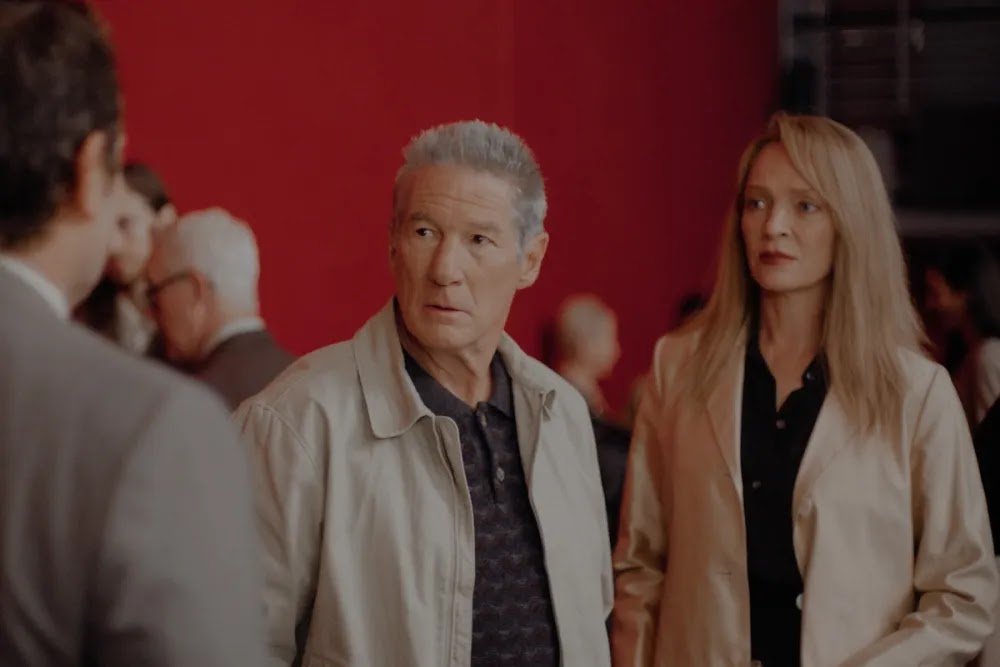
   Richard Gere, who starred in Schrader's American Gigolo (1980), reunites with the director to play Leo Fife, an American-born documentary filmmaker who fled to Canada during the Vietnam War. 
  Riddled with cancer, the aging Fife has agreed to allow two of his former students (Michael Imperiole and Victoria Hill) to make a documentary about his life and work. Fife insists that the interview -- really an extended deathbed confession -- be conducted in the presence of his wife Emma (Uma Thurman).
   Gere has been made to look gaunt and wasted. Cancer devours Leo's body, but lies and deceits eat away at his soul. He hopes to set the record straight. But Schrader has too much integrity to turn the story into a tale of last-minute redemption.
  Schrader fragments the story so that we see Gere playing Fife at various stages of his life. For the most part, though, a younger Fife is played by Jacob Elordi. Gere and Elordi create an account of Fife's life that may be distorted by memory but nonetheless makes a mockery of the director's reputation as a filmmaker of courage and conviction.
   An early episode illustrates the point. Fife, then married to his pregnant wife (Kristine Froseth), agrees to run the family business of his wealthy father-in-law, abandoning dreams of teaching and writing. He soon employs his modus operandi concerning women, he flees.
   Because Fife makes films, it's tempting to look for spiritual kinship between Fife and Schrader, but such speculations can be dicey. Leo Fife built a reputation by being a good filmmaker, but he has no laurels on which to rest. The scaffolding that upholds his vaunted stature has been subject to rot. Exposing it doesn't make it a less bitter pill to swallow.

Tuesday, November 21, 2023

One very weird summer vacation


   Emerald Fennell's Saltburn skewers those who aspire to the heights of wealth and privilege, with the writer/director indulging her taste for evisceration, exaggeration, and obvious provocation.
    Fennell focuses on Oliver Quick, an Oxford student played by Barry Keoghan. The bookish Quick, whose name sounds as if it were lifted from a Dickens' novel, attracts the attention of one of Oxfords  cool guys (Jacob Elordi). 
     Increasingly comfortable with his newfound acceptance, Oliver tells Elordi's Felix that he won't be going home for the summer, despite the recent death of his alcoholic father. He says he can't bear to be around his mentally deranged mother; he wants to keep his high-achieving life on track.
  Perhaps out of pity or maybe because he's kind, Felix invites Oliver to visit Saltburn, the massive estate where his family lives in aristocratic splendor and where Felix, despite his obvious entitlement,  seems closest to normal.
  Turns out the rest of Felix's family consists of bizarrely drawn characters, all vividly sketched in caricature fashion. Mom (Rosamund Pike) speaks through clenched teeth, launching acidic barbs in all directions; Dad (Richard E. Grant) seems monumentally out of touch; sister Venetia (Alison Oliver) reeks of trouble. Her mother describes her as "sexually incontinent."
  Two additional characters took up residence at Saltburn before Oliver's arrival. These hangers-on include another Oxford student (Archie Madekwe), a young man who's somehow related to the family and a family friend (Carey Mulligan) who insists on spewing repeated tales of the catastrophes that have befallen her. 
  The butler (Paul Rhys) seems to regard himself as superior to one and all. Perhaps he's the referee in a game in which the participants have lost sight of all boundary lines.
   OK, sounds like we're on the road to a broadly conceived comedy of manners but Fennell, who directed Promising Young Woman, has other things in mind. Her movie becomes increasingly bizarre -- perhaps even perverse. That shift gathers force when Oliver, whose creepy leanings already have been established, climbs into the bathtub where Felix recently had been bathing and, by the way, masturbating. Oliver starts to drink the bathwater as it swirls down the drain.
    Clearly, Oliver is not what he seems. You certainly wouldn't want to ask him how he spent his summer vacation.
    The detail about the bathtub might be a spoiler; I include it to ward off the squeamish and to demonstrate that Fennell specializes in sights intended to make us wince, perhaps the equivalent of the queasy responses elicited by graphically repellent gore in horror films.
    I'd be lying if I didn't say that some of this is entertaining and funny -- in a twisted sort of way. 
    Like Promising Woman, Saltburn wraps up with far-fetched twists that continue Fennell's outrageous march through developments that are meant, I think, to encourage us to look back and search for clues that might have tipped us off to where the movie was headed.
     On one level, Saltburn -- by including images that invite averted eyes  -- can be viewed as a movie that dresses for dinner and then throws up on itself. On another, it's a daring comic display of the base motivations that underly class privilege.
    Whatever view you take -- and I'd opt for the latter -- Fennell takes us on a ride that bounces over some wicked bumps. Obviously I can't know her intent, but by the look of things, I'd guess, as was the case in Promising Woman,  that she prefers comedy that leaves bite marks.