Showing posts with label Carey Mulligan. Show all posts

Wednesday, April 2, 2025

A private concert on a lonely island


   Expanded from a short film, The Ballad of Wallis Island features its co-writer, Tim Key, as Charles, a two-time lottery winner who has settled on a Welsh island after touring the world. A widower, Charles has become a loner.
   Eccentric and nostalgic, Charles invites two members of a once popular band called McGwyer-Mortimer to give a concert on his island retreat. He offers to pay them well.
   Charles's plan seems ill-fated from the start. He fails to inform either McGwyer (Tom Basden) or Mortimer (Carey Mulligan) that they've both been invited. Former lovers, they haven't performed together for almost a decade.
   Initially, the movie focuses on Basden's Herb McGwyer, a musician who's annoyed to learn he won't be performing at a normal venue. He’s put off by the prospect of playing on a rocky beach for a minimal audience, but he needs the money to finance a long-stalled solo album. 
   As it turns out, Charles will be an audience of one in this slight but sufficiently diverting movie.
   Even though Mulligan's Mortimer shows up with her new husband (Akemnji Ndifornyen), we're primed for the romantic reunion McGwyer seems to want. The screenplay conveniently pushes  Ndifornyen's Michael out of the way. A birdwatcher, he's off to look for puffins.
   Slight and hampered by Mulligan's early departure from the movie, Wallis Island leans heavily on Key's performance while attempting to deal with the pain and loss McGwyer must learn to accept. 
    Director James Griffiths uses songs from Basden to add a folksy quality, and Basden and Mulligan recall the chemistry their characters once shared with a nice number called Lover Please Stay.
   If after seeing the movie, you're tempted to hurry to an atlas to locate Wallis Island, I'll save you the trouble. It doesn't exist. The Ballad of Wallis Island was filmed on the coast of Wales and at a Welsh nature preserve on Ramsey Island. A Google search discovered a real Wallis Island in the Polynesian Pacific.
     Ah, the magic of movies.


Tuesday, November 21, 2023

One very weird summer vacation


   Emerald Fennell's Saltburn skewers those who aspire to the heights of wealth and privilege, with the writer/director indulging her taste for evisceration, exaggeration, and obvious provocation.
    Fennell focuses on Oliver Quick, an Oxford student played by Barry Keoghan. The bookish Quick, whose name sounds as if it were lifted from a Dickens' novel, attracts the attention of one of Oxfords  cool guys (Jacob Elordi). 
     Increasingly comfortable with his newfound acceptance, Oliver tells Elordi's Felix that he won't be going home for the summer, despite the recent death of his alcoholic father. He says he can't bear to be around his mentally deranged mother; he wants to keep his high-achieving life on track.
  Perhaps out of pity or maybe because he's kind, Felix invites Oliver to visit Saltburn, the massive estate where his family lives in aristocratic splendor and where Felix, despite his obvious entitlement,  seems closest to normal.
  Turns out the rest of Felix's family consists of bizarrely drawn characters, all vividly sketched in caricature fashion. Mom (Rosamund Pike) speaks through clenched teeth, launching acidic barbs in all directions; Dad (Richard E. Grant) seems monumentally out of touch; sister Venetia (Alison Oliver) reeks of trouble. Her mother describes her as "sexually incontinent."
  Two additional characters took up residence at Saltburn before Oliver's arrival. These hangers-on include another Oxford student (Archie Madekwe), a young man who's somehow related to the family and a family friend (Carey Mulligan) who insists on spewing repeated tales of the catastrophes that have befallen her. 
  The butler (Paul Rhys) seems to regard himself as superior to one and all. Perhaps he's the referee in a game in which the participants have lost sight of all boundary lines.
   OK, sounds like we're on the road to a broadly conceived comedy of manners but Fennell, who directed Promising Young Woman, has other things in mind. Her movie becomes increasingly bizarre -- perhaps even perverse. That shift gathers force when Oliver, whose creepy leanings already have been established, climbs into the bathtub where Felix recently had been bathing and, by the way, masturbating. Oliver starts to drink the bathwater as it swirls down the drain.
    Clearly, Oliver is not what he seems. You certainly wouldn't want to ask him how he spent his summer vacation.
    The detail about the bathtub might be a spoiler; I include it to ward off the squeamish and to demonstrate that Fennell specializes in sights intended to make us wince, perhaps the equivalent of the queasy responses elicited by graphically repellent gore in horror films.
    I'd be lying if I didn't say that some of this is entertaining and funny -- in a twisted sort of way. 
    Like Promising Woman, Saltburn wraps up with far-fetched twists that continue Fennell's outrageous march through developments that are meant, I think, to encourage us to look back and search for clues that might have tipped us off to where the movie was headed.
     On one level, Saltburn -- by including images that invite averted eyes  -- can be viewed as a movie that dresses for dinner and then throws up on itself. On another, it's a daring comic display of the base motivations that underly class privilege.
    Whatever view you take -- and I'd opt for the latter -- Fennell takes us on a ride that bounces over some wicked bumps. Obviously I can't know her intent, but by the look of things, I'd guess, as was the case in Promising Woman,  that she prefers comedy that leaves bite marks.

Monday, November 20, 2023

Leonard Bernstein's dizzying whirl of a life

   Bradley Cooper’s Maestro is many things -- sometimes all at once.
  Cooper directs and stars in a kaleidoscopic look at Leonard Bernstein, perhaps the most famous American classical music personality of our time.
 Bernstein, of course, didn’t confine himself to the classical canon. He composed for Broadway, notably creating West Side Story’s brilliant score. He also became a literate spokesman for the classics, explaining them to children at his famous Young People’s Concerts, which were televised in the 1950s and early '60s.
 Cooper has produced an avid work that, until its morose final act, moves at headlong speeds. Most of the first part of the film is presented in black and white, shifting to color for its second half and concluding with a lingering death scene that’s nothing short of operatic -- at least in its agonizing length.
   Right off, Cooper establishes Bernstein’s attraction to men. A  bisexual, he married Chilean actress, Felicia Montealegre, played by Carey Mulligan in one of the year’s best performances. Mulligan's Felica bristles with fast-talking charm, sophistication, and intelligence; she's almost the living embodiment of a character Katharine Hepburn might have played at her wittiest best.
   As much as anything, the movie is about the marriage between two people who loved each other, although one of them (Bernstein) seldom was wholly there for the other. 
  But don’t pity Felicia. She knew who Bernstein was when she married him, and Cooper and Mulligan make it clear that the two care about each other. Lenny, as he was known to friends, and Felicia were soulmates; she did what many women did for men and some still do; she subordinated her rising stage career to the demands of husband and family. 
    Mulligan’s performance is a marvel, but what about Cooper, who initially drew criticism for donning a prosthetic nose that some thought would over-emphasize Bernstein’s Jewishness? Forget the nose, it’s a non-issue. Cooper’s performance captures the nasality of Bernstein’s speaking voice; he's true to Bernstein's vigorous conducting style which hovered somewhere between possession and aerobics.
   But the performance takes some getting used to. In the film's early going, I found Cooper’s dead-on portrayal distractingly unrelaxed. Bernstein can seem so precisely drawn that it’s like looking at a portrait in which the edges have been too sharply defined. 
   But that’s the point, I suppose. Bernstein was on the move, sampling life and deep-diving into music, which was the core of his life, maybe even his entire life
   When he conducts Mahler’s 2nd Symphony at Ely Cathedral in England, Bernstein's famed physicality attains full force. It wouldn't feel entirely out of place if Cooper were to conclude the scene with an apotheosis, something as grandly magnificent as  Bernstein’s direct ascent into heaven. 
    Just kidding, but it's difficult to overstate how transported Bernstein seems to be by the music's power.
    What the film lacks (and it’s an important deficiency) is an assessment of why Bernstein was such a significant figure musically, and you won’t learn much about Bernstein’s interpretation of classical pieces. If you're interested, you can find plenty of that on YouTube.
     I haven’t made up my mind about all of Cooper’s directing choices. The opening sequences include shifts from one location to another that  storm onto the screen with the verve of someone bursting into a room, and the ways the characters snap off their dialogue, sometimes felt overdone. I wondered whether Cooper wasn't guilty of too much self-conscious wielding of the cinematic baton. 
     But then again, that’s part of Cooper’s interpretation of the screenplay, which he wrote with Josh Singer, and Maestro boasts too many commanding scenes to ignore: Bernstein lying to his daughter (Maya Hawke) about his sexuality or an argument between Bernstein and Felicia that takes place in the Bernstein’s Central Park West apartment while a snoopy float from the Macy’s Thanksgiving Day Parade floats by. True to his free-wheeling spirit, Bernstein at one point fantasizes that he's one of the dancing sailors in On the Town, another Broadway production for which he wrote the music.
     Maestro goes down more easily if you accept the fact that it’s not a conventional biopic. It's an immersion in Bernstein’s emotionally charged life, his roving eye for bed partners, his bouts of depression, and his ferocity about music. 
    Cooper doesn’t dwell on the social constraints that kept Bernstein closeted — at least to the public; he leaves it to us to remember that attitudes toward gay people were quite different in 1943, the year Bernstein made his debut as a conductor with the New York Philharmonic, a last-minute substitution for an ailing Bruno Walter. 
      At one point, Bernstein’s sister (crisply portrayed by Sarah Silverman) tells Felicia, who's a bit down, that she shouldn't be surprised. Surely, she understood what it’s like to be caught in Bernstein’s orbit. 
    That’s what Cooper does. He catches us in Bernstein’s dizzying orbit. He suggests that Bernstein’s career sprang from a life lived at spin-cycle speeds that left both joy and pain in its wake -- for others and for Bernstein himself.
    

Thursday, November 17, 2022

Two reporters dig for an important story


 She Said, the story of how two The New York Times reporters exposed the abusive conduct of Harvey Weinstein, effectively dramatizes 
the ins and outs of reporting a big story in which sources are reluctant to talk and the target of the investigation wields significant power. 
    As the co-founder and the public face of Miramax, Weinstein was a major player in the world of movies, a producer of influence that he evidently used to help those whom he favored and thwart those he didn't.
    For some women, the side of the equation on which they landed depended on how they responded to Weinstein's sexual advances, some made in startlingly crude and even criminal fashion.
    Megan Twohey (Carey Mulligan) and Jodi Kantor (Zoe Kazan) revealed that Weinstein, now serving a 23-year prison sentence for rape and sexual assault, had been settling sexual abuse cases with women for years, silencing them with restrictive non-disclosure agreements.
       Mulligan's Twohey seems the more aggressive of the two, more seasoned in pitfalls of pre-#MeToo harassment. Early on, we learn that Twohey wrote stories about women who had things to say about Donald Trump’s behavior. She was dejected when the stories appeared to change nothing.
       Kazan's Kantor gives the movie a steady beat. Despite discouragement, Kantor persists and she shows that reporters can respect the sensibilities of those with whom they deal. Better yet, her concern never seems like an ingratiating journalistic ploy.
      Brief references are made to the home life of each of the women. Husbands aren't upset that their wives are working feverishly, as often happens in such movies. Both women deal with the demands of motherhood. But the movie’s focus remains on the work required to nail the story.
      Of the supporting performances, the always interesting Patricia Clarkson proves an unsurprising standout as a Times editor. Samantha Morton makes a strong impression as Zelda Perkins, a woman who once served as a personal assistant to Weinstein. Ashley Judd plays herself, a prominent show business figure who ultimately went public about Weinstein.  Jennifer Ehle has a nice turn as Laura Madden, a woman who was battling breast cancer when she told her Weinstein story.
     Andre Braugher is convincing as Times editor Dean Baquet, particularly in a couple of scenes depicting terse conversations with Weinstein who tried to derail the story.
     Dramatizing the grunt work of journalism isn't easy. At times, it almost looks as if Schrader has made a movie about cell phone calls -- calls that awaken the women from sound sleeps, calls while walking in parks, calls while walking with husbands, calls that disrupt meetings, and on and on.
      I'm not sure how the problem could have been resolved; besides, the story and its detail have more to do with the movie's success than cinematic flair. 
     We only see Weinstein (an actor) from the back in one scene near the end of the movie but we're made to understand the power that he used to impose himself on women, many of them young and naive.  Schrader includes a real phone call between Weinstein and Ambra Gutierrez, an Italian model, but she wisely creates no scenes in which we see Weinstein committing his crimes.
     That doesn't mean that Weinstein's presence isn't felt throughout. With help from enablers, he abused his position and got away with it -- until some of the women he harmed and two determined reporters helped bring his misdeeds to light.

Sunday, March 7, 2021

Winners of the 2021 Critics Choice awards


    Nomadland hit high notes as it took home four awards at Sunday's Critics Choice Awards. The Critics Choice Awards sometimes serve as a bellwether for the Oscars, but this is a strange year. Who knows? Maybe Oscar will chart its own course.
    Still, I suspect  that Nomadland now stands as the front-runner when it comes to best picture. 
    This year's race for best actress should be interesting. Andra Day, also a Critics Choice nominee, won the Golden Globe for her performance in The United States vs. Billie Holiday, but Carey Mulligan took home the Critics Choice award for Promising Young Woman
    On Oscar night, I wouldn't bet against Nomadland's Frances McDormand, another Critics Choice nominee for best actress. Nor would I rule out Viola Davis, also a Critics Choice nominee, for her performance in Ma Rainey's Black Bottom. 
   Oh well, lots of Oscar talk awaits.
   Meanwhile, here’s the list of this year’s Critics Choice winners. Full disclosure: I'm a voting member of the Critics Choice Association.


Best Picture
Nomadland  


Best Director

Chloe Zhao, Nomadland


BEST ACTOR 

Chadwick Boseman -- Ma Rainey’s Black Bottom 


BEST ACTRESS 

Carey Mulligan – Promising Young Woman 


BEST SUPPORTING ACTOR 

Daniel Kaluuya – Judas and the Black Messiah


BEST SUPPORTING ACTRESS 

Maria Bakalova – Borat Subsequent Moviefilm  


BEST YOUNG ACTOR/ACTRESS 

Alan Kim – Minari 


BEST ACTING ENSEMBLE 

The Trial of the Chicago 7  


BEST ORIGINAL SCREENPLAY 

Emerald Fennell – Promising Young Woman 


BEST ADAPTED SCREENPLAY 

Chloé Zhao – Nomadland 


BEST CINEMATOGRAPHY 

Joshua James Richards –  Nomadland


BEST PRODUCTION DESIGN 

Donald Graham Burt, Jan Pascale – Mank  


BEST EDITING – TIE  

Alan Baumgarten – The Trial of the Chicago 7  

Mikkel E. G. Nielsen – Sound of Metal 


BEST COSTUME DESIGN 

Ann Roth – Ma Rainey’s Black Bottom  


BEST HAIR AND MAKEUP 

Ma Rainey’s Black Bottom 


BEST VISUAL EFFECTS 

Tenet 


BEST COMEDY 

Palm Springs 


BEST FOREIGN LANGUAGE FILM 

Minari 


BEST SONG  

Speak Now – One Night in Miami  


BEST SCORE 

Trent Reznor, Atticus Ross, and Jon Batiste – Soul 


Thursday, January 14, 2021

A muted drama about excavating the past


   In The Dig, a British widow with an interest in archaeology wants to conduct an excavation on her land. To make her dream a reality, she hires an excavator known for his meticulous work.
   Director Simon Stone adapts a novel by John Preston to tell the story of the 1939 excavation of Sutton Hoo, the site of medieval burial mounds where an Anglo-Saxon ship was found. 
    The distant past becomes shockingly present when the ship is unearthed, a piece of history to be exhumed and then memorialized.
    The subject of excavation could have given the filmmakers an opportunity to connect us with the majestic erosions of time and forgotten people — if only for a moment or two.
    Instead, director Stone and screenwriter Moira Buffini serve up a  period piece that neither is tense nor sorrowful enough to transcend the status of a dry — or at least “dryish” — footnote, a strange outcome considering how often the story is drenched in Suffolk downpours.
    Carey Mulligan plays Edith Pretty, the pallid careworn woman who owns the property on which the dig will take place. 
     Ralph Fiennes portrays Basil Brown, the man who conducts the dig at Edith's request. Edith also has a young son (Archie Barnes) who's interested in the dig and begins to bond with Brown.
     Stone seldom brings the material to a dramatic boil. There's not much tension, for example, in wondering whether Edith will give her find to a local Suffolk museum or to the more prestigious British Museum.
    The major issue involves attempts by the British museum -- under an esteemed archaeologist played by Ken Stott -- to take control of the project. Without formal credentials, Brown might be pushed aside.
    A digressive subplot finds Lily James's Peggy working at the site with her husband Stuart (Ben Chaplin). James and Chapin portray a couple on shaky ground.  Edith's cousin Rory (Johnny Flynn) arrives to help Brown and to become a potential love interest for the sexually deprived Peggy. Her husband regards marriage as a bit of a formality to cover his real sexual interests.
   Mulligan gives a reserved performance compared to her work in A Promising Young Woman. Fiennes creates a man of the lower-classes who has developed and honed a specialty. Some of the people who've worked with Brown think he's "difficult," but for the most part he seems agreeable.
    Stone adds a sorrowful twist involving Edith's lingering illness --  that and her fear about the looming war. 
   Although this period piece may not be lacquered, it lacks the kind of animating energy that would have made it more interesting and too many of its various plot threads feel undernourished. As it stands, the dig might be more interesting than most of the characters. 
    Perhaps that why when I think of the movie in retrospect, I almost hear the sound of trowels digging quietly and determinedly in the Suffolk soil.

Tuesday, December 22, 2020

A revenge movie with topical thrust


    A 35-year-old woman gets drunk at a club and goes home with a stranger. What, we ask? Another movie about a confused single woman who stumbles toward late-picture self-realization? Or worse, a looming romcom?
    Wrong.
     In the hands of first-time director Emerald Fennell and star Carey Mulligan, Promising Young Woman becomes something more. 
     Turns out that Mulligan's Cassie (short for Cassandra) is an avenger. Born into a world of tolerated sexual abuse, Cassie feigns drunken submission before humiliating the horny but unsuspecting guys she picks up.
      Cassie, who dropped out of medical school, works as a barista in a coffee shop owned by the savvy Gail (Lavern Cox), a character who helps fulfill the movie's wisecrack quota.
    I won't tell you what pushed Cassie into an under-achieving life devoted to avenging herself on men but the explanation allows Fennell to assay some of the ways in which women who've been abused can be treated.
     Ruthless as she can be with men, Cassie hasn't totally give up on the opposite sex. Ryan (Bo Burnham) shows up at the coffee shop: A pediatric surgeon, Ryan attended med school with Cassie. He knows that she's whip-smart and begins his pursuit. Cassie doesn't make it easy for him, but he persists and ultimately, her cast-iron will begins to bend.
     A supporting cast that includes Alison Brie and Connie Britton, also boasts a fine small performance by Alfred Molina as a regretful, self-hating lawyer.
     Mulligan ably fills the movie's center, even if you can see some of the twists coming and an exaggerated conflation of events strains credibility at the very end.
      Maybe it doesn't matter. Fennell, the actress who plays Camilla Parker Bowles on The Crown and who served as a show runner on the Killing Eve series, knows that when you put so much in motion, there must be an out-sized payoff. She tries hard to deliver, but this could be a case in which the finale would be better appreciated in a theater where a vocally responsive audience might add some extra charge. 
      Still,  Fennell creates a pointed bit of entertainment that may not be perfect but leaves you eager to see more.

Thursday, November 5, 2015

When British women fought for the vote

A slice of history that shouldn't be forgotten.
Currently, two women (one in each major party) are trying to become president of the United States.

Britain already has had a woman prime minister, and many other countries -- Germany, of course -- have elevated women to their top power positions.

This is not to say that every vestige of gender inequality has been wrung from a still-patriarchal world, but to point out that it wasn't so long ago that the political arena belonged exclusively to men.

Suffragette, a straightforward period piece about the struggle by British women to gain the vote, returns us to a time when women were denied one of the most basic of democratic rights.

Suffragette focuses on one woman's political awakening. She's 24-year-old Maud Watts, played with nuanced intensity by Carey Mulligan.

As the movie develops, Maude must risk everything -- her husband (Ben Whishaw) and her young son (Adam Michael Dodd) -- to push for a cause she deems essential if women are to have a voice in how British society evolves.

Whishaw's character loves his wife, but acquiesces in the way that women are abused at the laundry where Maud works, also his place of employment.

Watts' involvement in an increasingly militant movement begins when she joins a co-worker (Anne-Marie Duff) at a meeting. Pharmacist Edith Ellyn (Helena Bonham Carter) serves as the main organizer, a woman who's eventually driven to extremes to accomplish her goal.

Before Suffragette concludes, some of its women will have resorted to violence: Not surprisingly members of the movement engage in a familiar-sounding debate about how far they are justified in going to advance their cause.

Director Sarah Gavron, working from a screenplay by Abi Morgan, does her best work in scenes that show how the movie's women are subjugated. They are sexually harassed and demeaned in the workplace. And they find little support from male co-workers.

The film takes place in 1912, some 16 years before British women were granted full voting rights.

When we meet the movie's women, the battle for the vote had been going on for some time, led by figures such as Emmeline Pankhurst, portrayed in a cameo by Meryl Streep.

Streep's brief appearance comes off as an attempt at prestige grabbling. It's a way of nodding at history rather than exploring it.

It falls to a character named Steed (Brendan Gleeson) to represent the male opposition. A Scotland Yard detective, Steed tries to convince women they'd be better off if they simply went home and tended to their domestic lives. He also arrests them, and clearly stands as a staunch defender of the current order.

Suffragette attempts to turn itself into a clarion call for activism in a battle that remains unfinished, but the movie's real value has to do with the urgency of many of its performances and with the way in which it reminds us that some of the things we take for granted only resulted from hard-fought and costly battles.

Thursday, May 7, 2015

Another run at Thomas Hardy

Carey Mulligan holds the center of Far From the Madding Crowd.

Filmmakers haven't always had the best of luck with British novelist Thomas Hardy, so it's hardly surprising that director Thomas Vinterberg's big-screen adaptation of Hardy's Far From the Madding Crowd is a curiously mixed affair.

In its early going, Winterberg's movie plays like a CliffsNotes-inspired cascade of hurried plot developments.

A sampler:
-- We meet Bathsheba Everdene (Carey Mulligan), a young woman who fancies herself as radically independent. In short order, Bathsheba inherits a farm and an estate-like home in the fictitious rural area of Wessex that Hardy tended to favor.

-- An aspiring farmer (Matthias Schoenaerts) meets Bathsheba, and, within what seems like seconds, proposes to her. Schoenaerts, who hails from Belgium, makes the interchange believable, a sincere expression from a socially awkward man.

Of course, Bathsheba turns him down.

-- Thanks to a poorly trained sheep dog, Schoenaerts' Gabriel Oak loses his flock in a harrowing sequence in which his sheep are driven by the dog over a cliff. The loss causes Gabriel's farm to fail. Bereft of land, he sets out to find a new life.

-- After helping extinguish a fire on an estate he happens to be passing, Gabriel learns that he has stumbled upon Bathsheba's newly inherited property.

She hires him to work as the place's shepherd in residence. Metaphorically, he's always trying to put out the fires in her life.

You get the idea: Vinterberg, who began his career making Dogma films (The Celebration), and who, in 2012, scored with the disturbing The Hunt, advances the plot while offering what amount to quickly drawn character sketches.

The approach might have worked had Vinterberg's otherwise naturalistic images not been interrupted by the arrival of plot twists that seem hopelessly melodramatic. Hardy intended those same twists as evidence of the ways in which chance -- indifferent to human aspiration -- could alter and even ruin lives. Here, they're awkward stand-outs.

The rest of the story concerns a series of developments in which Bathsheba debates the merits of three suitors: Gabriel, whose love and loyalty never wavers; the tediously tormented William Boldwood (Michael Sheen), owner of the farm adjoining Bathsheba's estate; and the dashing Sgt. Francis Troy (Tom Sturridge), a military man and obvious cad.

In one of the novel's most discussed scenes, Troy cuts through Bathsheba's resistance with a deft display of swordsmanship that arouses her desire. The movie follows suit, and Bathsheba -- heretofore governed by common sense -- falls prey to passion.

Marriage always seemed superfluous to Bathsheba, who needed no man to support her. Troy upsets the apple cart by turning her on.

Bathsheba marries Troy only to discover that she's not his one true love. Troy believes that the real love of his life (Juno Temple) humiliated him by leaving him waiting at the altar. He was wrong. In dithering haste, his fiancee showed up at the wrong church.

Mulligan ably conveys Bathsheba's intelligence, determination and wit, and there's nothing particularly wrong the rest of the performances, either.

But David Nicholls' screenplay either dawdles or moves to quickly, and although the movie flirts with being exceptional, it never quite fuses Hardy's themes into a heartbreakingly felt drama.

In a 1967 version, director John Schlesinger took two hours and 48 minutes to tell Hardy's story; perhaps it's a sign of progress that Vinterberg's version comes in just under two hours.

Thursday, December 19, 2013

For a folksinger, life is no picnic

Inside Llewyn Davis -- the latest from the Coen brothers -- is plenty bitter, deliciously so.
An unlikable main character. A dated '60s folk-music scene. Rooms full of cigarette smoke. Fringe life in New York City during a miserably cold winter.

Those are just some of the ingredients that help make Joel and Ethan Coen's Inside Llewyn Daviss the cinematic equivalent of stepping into a puddle of slush. Now, if you know and appreciate the strange, funny and chilled sensibilities found in most Coen brothers' movies, you'll understand that I mean that as a compliment.

Inside Llewyn Davis defies the odds and turns out to be a tribute to the Coens' ability to tease out the humor in almost any situation, including one in which their main character suffers a series of misfortunes.

I particularly loved the fact that the folkies we meet during the course of Inside Llewyn Davis are not burdened by anything as cliched as concern for their fellow inhabitants of the planet. They're a sometimes unpleasant group of struggling careerists, most of them waiting -- albeit unknowingly -- to be eclipsed by an emerging Bob Dylan, the artist who ultimately would leave them all behind.

Put another way: If you're looking for kumbaya fellowship, you'll want to stay outside Llewyn Davis -- far outside.

The Coens focus their acerbic attentions on Llewyn Davis (Oscar Isaac), a former seaman who's trying to establish himself as a viable solo act in the New York folk music scene. Llewyn's attempting to go it alone after his partner committed suicide. It's not like Llewyn has been toppled from a lofty perch, though: He and his partner weren't that big a deal anyway.

As played by Isaac, Llewyn is talented enough to be encouraged about his prospects. He has reason to see himself as an unrecognized artist. It's not until late in the movie that he meets a Chicago folk impresario (F. Murray Abraham) who tells him that he's got something -- but not enough to be a headliner.

And that's the rub: Llewyn's story is a grimly funny take on a proverbial frustration: "close, but no cigar."

So what does the title mean? What's inside Llewyn Davis? The way I read the movie and Isaac's masterfully dour performance, it's this: Llewyn thinks he's an artist. He thinks that he should be paid for his art. He refuses to perform like a trained seal, clapping his hands in hopes that someone throws him a fish. He's got standards -- even if no one else happens to give a damn about them.

As the story unfolds, Davis wanders around Manhattan looking for a place to crash. He imposes on Jean (Carey Mulligan), a former lover and singer who's now living with Jim (Justin Timberlake). Jean and Jim sing together, but their music isn't as soulful as Llewyn's.

To make matters worse, Jean has become pregnant and doesn't know if the baby is Llewyn's or Jim's. She's furious, a woman of blistering scorn.

In Llewyn Davis, the Coens have made a movie without much forward progress. Nothing momentous happens. While staying at Jean's apartment, Llewyn meets a strangely sincere soldier who also sings (Stark Sands) at the fabled Gaslight Cafe on weekends: He later tries to impose himself on a wannabe cowboy with a rumbling bass voice (Adam Driver).

Llewyn meets Driver's Al Cody at a recording session for a song he totally disdains: Written by Jim, it's called Please Mr. Kennedy, a ridiculous pop anthem that takes Kennedy to task for his interest in a reinvigorated space program.

When it comes to skewering a certain kind of upper Westside couple, the Coens show no mercy. Ethan Phillips plays a professor who's always happy to welcome Llewyn into his home. His wife (Robin Bartlett) likes to sing with Llewyn and who has the aura of a worn but comfortable piece of furniture.

For this duo of West Siders, Llewyn's the weird, artsy guy who might be asked to entertain other dinner guests, and you get the feeling that Llewyn disrepsects the couple's tolerance, generosity and boundless capacity to endure his impositions.

To make matters worse, Llewyn loses the couple's cat, a pet whose name clues us into the nature of the Coens's enterprise. (See movie. Discover name.)

The movie supposedly was inspired by the story of real-life folk singer Dave Van Ronk, but its origins don't really matter. You'll get the drift as the Coens unfurl their deadpan take on the early '60s.

Nowhere is this more evident than when Llewyn joins a jazz musician (John Goodman) and a stoic driver (Garrett Hedlund) on a car trip from New York to Chicago. Goodman sits in the back seat, alternately sleeping and tearing Llewyn apart for being something he deems as risible as a folksinger. It's a small bit of genius characterization from one of the Coens's regular performers. Goodman is funny, dissolute and sometimes dead-on.

The Coens open the movie with a scene that repeats at the end and which becomes even more mordant the second time around. What else should we expect? Inside Llewyn Davis is a bitter pill, but like many other bitter pills that the Coens have served us, it's well worth swallowing.


Thursday, May 9, 2013

A 'Gatsby' full of razzle dazzle

Baz Luhrmann goes way over the top to tell a classic American story.


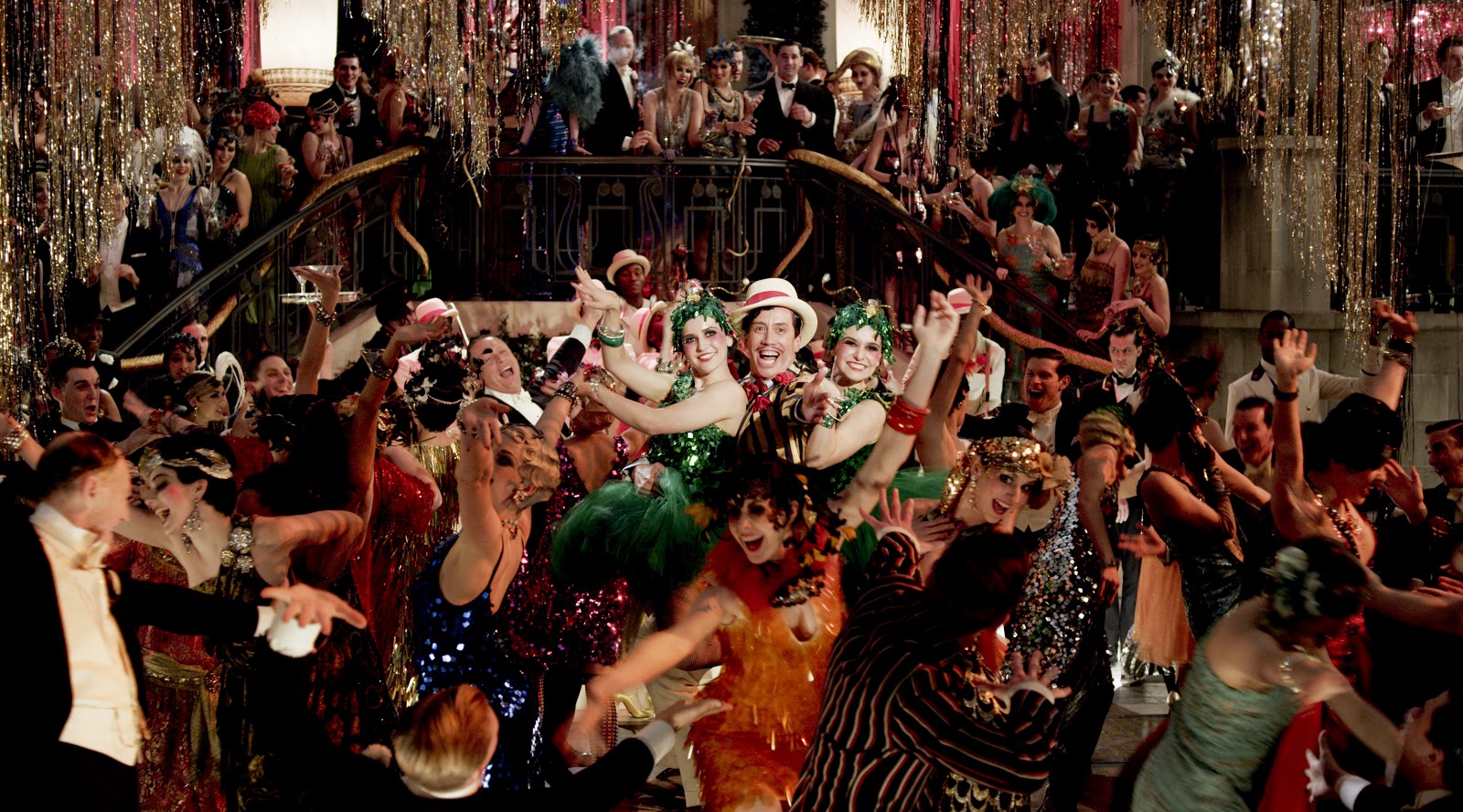
Director Baz Luhrmann has accomplished something close to extraordinary in his vivid, dizzying and ultimately misguided version of The Great Gatsby. He has taken F. Scott Fitzgerald's iconic 1925 novel -- a classic of American literature -- and turned into as glossy and colorful an extravaganza as might have been seen in the days when big-screen spectacles were drenched in three-strip Technicolor.

Put another way: Luhrmann's Gatsby has the glamour-laden production values of a musical -- only one in which somebody forgot to write the songs.

Luhrmann, who already has proven himself a maestro of overstatement in works such as Moulin Rouge! and Romeo & Juliet, has added 3-D to this version of Gatsby, presumably to give the movie a sense of immersive depth. The 3-D images might be the only depth you'll find in this showy, anachronistic and occasionally cartoonish version of the Gatsby story.

In Luhrmann's hands The Great Gatsby has become a frenzied display of technique, much of it devoted to creating the bacchanalian delirium that turned Gatsby's fabled parties into a magnet for New York's high-living crowd. Are we talking Gatsby or outtakes from the Playboy Mansion? You be the judge.

Fitzgerald, of course, told the story through a narrator named Nick Carraway, a Midwesterner who travels to New York and rents a small cottage next to Gatsby's ostentatious Long Island mansion. Nick meets Gatsby because of Gatsby's long-standing and unquenchable love for a woman named Daisy, who happens to be Nick's cousin. Nick is supposed to serve as a go-between for Gatsby and Daisy.

When we meet Daisy, she's already married to Tom Buchanan, Yale graduate and certifiable lout who indulges his libido with Myrtle (Isla Fisher), a low-class mistress from Queens.

Luhrmann uses some of Nick's narration (i.e., Fitzgerald's prose), even allowing pieces of it to wander across the screen in the form of typescript that floats above the fray.

But fidelity to text is hardly the point here: Luhrmann hasn't recreated America of the 1920s. He has invented a dreamscape all his own; the movie -- which mixes rap and Gershwin on its sound track -- isn't so much an evocation of the past, but a visit to an alternate universe stocked with jiggling flappers, feverish jazz musicians and a Jewish gangster played by an Indian actor (Amitabh Bachchan) who seems to have wandered into the story from some multi-cultural universe of the 21st century.

Luhrmann's Gatsby is a bold, vividly realized and distressingly literal retelling of a story that has been put on film before, but never with so much loudly trumpeted artifice and self-conscious daring; the soundtrack arrives complete with musical contributions from Jay Z and Beyonce.

Of course, Luhrmann has made alterations to the story (Nick tells the tale from some sort of rehab facility where he's struggling with alcoholism and regret), but changes to Fitzgerald's story are the least of the problems. Most of those center around the fact that Luhrmann has taken the events of the novel -- always secondary to Fitzgerald's prose -- and added so much technologically created upholstery that everything collapses into it.

Only those who do not own television sets can have escaped prior knowledge that Leonard DiCaprio portrays Jay Gatsby, the hopeful and deluded man who spends a lifetime trying to recreate his past so that he can become a suitable suitor for Daisy, a member of the upper classes to which the low-born Jay longingly aspires.

Looking as if he's posing for a fashion ad in the Sunday New York Times magazine, DiCaprio projects the calm of a man who's willing to create a storm to attract the beautiful Daisy who lives across the bay from him. And, yes, Gatsby spends an inordinate amount of time staring across the dark waters of Long Island Sound at the luminous green light that glows on dock of the Buchanans' East Egg home. The symbolism is inescapable: The light represents everything that remains visible but out of reach for Gatsby.

Gatsby is one of those amorphous figures who tries to create a new version of himself, but only can achieve it by associating with and profiting from the corruption and crime that leads to quick wealth. He has obscene amounts of money, but his affluence never can equal the more seasoned wealth that people such as the Buchanans have come by as a birth right.

Daisy is played by Carey Mulligan, who seems entirely too grounded for the part of a dreamy fantasy girl. A scowling Joel Edgerton portrays her husband Tom, polo player and former Ivy League jock, a man with a smash-mouth personality. In Luhrmann's hands, these pivotal characters seldom seem like plausible people; they move through the movie carrying the weight of the literary archetypes that they seem to represent.

As for Nick, the narrator ... well ... let's just say that Tobey Maguire rises to the challenge of making him as uninteresting as most narrators are, the man who floats outside the story, fascinated by it but unattached to its core.

Of all the characters, only Daisy's friend Jordan Baker -- played by Elizabeth Debicki -- seems to fit into a recognizable universe.

By now, I'm sure you've caught my drift; Luhrmann's movie is more about production design than about the distorting powers of the American dream. Its rewards have more to do with vintage cars, sprinting camera movements and glitzy overstatement than with the tragic undertow of Fitzgerald's story.

A confession of sorts: I watched The Great Gatsby with a sense of sustained amazement at Luhrmann's capacity for emotional amplification, but presenting an entire movie in an over-the-top style doesn't leave much by way of wriggle room.

I suppose sales of Fitzgerald's much-purchased novel will enjoy an inevitable boomlet because of Luhrmann's movie, but I'd be willing to bet that this Gatsby has more influence on American fashion than on the country's intellectual, emotional or cultural life.

In that sense, Luhrmann may have found the key to bringing Fitzgerald's film-resistant novel to the screen. Luhrmann may not get at much that feels real or substantial, but his Gatsby sure as hell is dressed for success.

Tuesday, October 4, 2011

'Drive' is stylish, but where's it headed?

A compelling Ryan Gosling needed a better movie.
Ryan Gosling is an actor who's capable of projecting an unsettling sense of stillness. Gosling's thin half-smile can be difficult to read, a mixture of beneficence and menace that easily could spring in either direction. Like many great movie actors, he excels at holding things back, which gives him a quality of wary intelligence, as if he senses things that might be beyond ordinary reach.

Watching Drive -- a thriller from director Nicolas Winding Refn -- I kept waiting for a movie to materialize around Gosling, who easily holds the screen as a Hollywood stunt driver who also drives getaway cars. As a getaway driver, he gives his clients five minutes of total commitment, and then ... well ... all bets are off.

As Refn's camera wanders across Los Angeles' seamy side, the screen fills with deftly executed visual gestures, but Refn's movie ultimately lacks the brash invigoration of breakthrough style or the heft of real substance.

As it turns out, Drive may be most notable for giving Albert Brooks, a very funny actor, an opportunity to play an evil character. Brooks brings a relaxed sense of amorality to a low-life criminal who offers to back Gosling's character's career as a racecar driver.

Gosling's character -- he's never named -- seems a pure movie creation, an increasingly ferocious avenger who becomes a protector for a vulnerable woman (Carey Mulligan) and her young son.

If you think of Drive as a darkly hued noir meditation, you may find some artsy kick in it. I wouldn't say Refn totally has stumbled, but he hasn't gotten Drive into a consistently credible gear, either.

As has been pointed out by other reviewers, the movie's opening sequences qualifies as its best, largely because Refn understands that skillful driving involves knowing when to slow down, as well as when to speed up. Despite such interesting touches and some shockingly explosive violence, Drive proves a letdown. Maybe it's too damn minimal for its own good.

Thursday, September 23, 2010

'Wall Street' sequel closes mixed

Michael Douglas and Shia LeBeouf tackle Wall Street.

America's favorite champion of greed is back. Freshly released from prison, Gordon Gekko is ready to use his status as a celebrity criminal to lecture the nation on how Wall Street ravaged the economy, pushing unsuspecting investors over a financial cliff. Wall Street: Money Never Sleeps -- director Oliver Stone's follow-up to his 1987 hit -- plays variations on the kind of revenge themes that gave the first installment much of its punch and offers more than a few discourses on how we found ourselves on the brink of financial ruin.

Money Never Sleeps can be likened to a much-heralded initial public offering. The movie begins with high expectations and momentum, but ultimately suffers from a greed of its own: the desire to jam a ton of information and opinion into a story that sometimes loses itself in a tangle of financial maneuvers. And beyond all expectation and perhaps sense, Stone includes an epilogue that tries for (gasp!) a bit of happily-ever-after bliss.

Don't think I'm completely sour on Stone's effort. To begin with, Money Never Sleeps represents one of the few instances when a sequel makes sense. The audacious Gekko is past due for release from prison, and there hardly could be a better time for Stone to aim his cannons of rancor at Wall Street. In all, the idea of a Wall Street sequel seemed like a hanging curve ball, a fat pitch Stone could knock out of the park. I'd say, he's doubled off the left field wall.

The set-up is simple enough. Gekko, ably reprised by Douglas who won an Oscar for his work the first time around, is released from jail after having spent eight years on ice for insider trading. Not one to waste an experience, Gekko writes a best-selling book that goofs on the signature line from the last movie: It's called Is Greed Good? Gekko's ideally positioned to reveal the ways in which Wall Street sold out the country for fun and profit. Gekko, after all, invented the game. The book lands Gekko on the lecture circuit.

But Gekko isn't entirely happy being a prophet at the gates of the crumbling wall of capitalism. He seems to understand that he's hurt others, notably his family. Saddened by the death of a son (from a drug overdose), a remorseful Gekko would like to reconcile with his daughter (Carey Mulligan). Disgusted with her father, Mulligan's Winnie runs a left-leaning Web site. She's also engaged to a "hungry" young investment banker (the always avid Shia LeBeouf.) She hasn't spoken to her father in years.

LeBeouf's Jake Moore - really the movie's main character - embarks on his own vengeful ploy when he realizes that his Wall Street mentor (Frank Langella) has been victimized by the corrupt manipulations of another tycoon, the silky smooth Bretton James (Josh Brolin). Jake meets Gekko at a speaking engagement, and asks for advice. Gekko agrees to play the role of revenge consultant on condition that Jake brokers a meeting between father and daughter. For her part, Winnie has no idea that Jake has been in touch with her father.

That's enough about plot to give you an idea about where the story is headed - or maybe not. The script by Alan Loeb and Stephen Schiff expands its portfolio to include a green energy company that badly needs an infusion of capital, Swiss banks that still know how to hide money, an aging power broker (Eli Wallach) who may be cagier than we think. All this and bailouts, too.

But you know what? The real fun of Stone's movie - and it does have some kick -- involves precisely the things the director may be attempting to condemn. Brolin, in another fine performance, plays a character who's interesting only because he's rich and powerful and has a well-upholstered lifestyle.

And the movie is at its engaging best when the rich are seen flaunting their wealth, power and cunning. A charity ball at the Metropolitan Museum of Art drips with alluring opulence. The infighting at a Federal Reserve meeting creates the illusion that we're experiencing an inside look at how the power structure works.

Moreover, Jake's energy has an infectious quality. He may be young, but he's living high on the hog in a fancy Manhattan apartment. LeBeouf conveys the giddy sense of confidence that can come from being certain about one's ability to make big money, something I've observed in others but never experienced personally.

But there's a liability in focusing on Jake's adrenalin-fueled ambition. The movie invests too much of its dramatic capital in LeBeouf's character, a young man who's not the equal of the character Charlie Sheen played in the original. And the relationship between LeBeouf and Mulligan falls short of terrific. It's as much plot contrivance as love affair.

The movie also indulges in a myth, a bit of nostalgia for capitalism past. Time was - or so we're led to believe - when Wall Street was different. Langella's Louis Sabel comes on like a cut-rate version of an Arthur Miller character, a Wall Street trader who longs for the days when companies had substance. Remember when we used to make things? Remember when we didn't accumulate mountains of debt just to stay afloat?

Not content to take shots at Wall Street excess, Stone also drags in murky real-estate practices. Susan Sarandon plays Jake's mother, a Realtor who has to borrow money from her hotshot son in order to hold onto properties that have become increasingly difficult to unload. Chewing on a New York accent thick enough to choke a house cat, Sarandon is fun to watch.

I've previously admired Mulligan's work. Here, though, her most impressive feat involves the way that Winnie cries. On a couple of occasions, a lone tear trickles down Winnie's rounded cheek. Very touching.

I decided to let those solitary tears stand for my feelings at the end of a movie. Money Never Sleeps mostly held my interest, but it lacks the emotional and intellectual that the subject demands. In a key line that I reveal here only because it found its way into the trailer, Gekko instructs Jake about the harsh way of things: "It's not about the money. It's about the game," says Gekko.

In the context of the character, the line makes sense, but try telling that to the people who suffered most from the Wall Street collapse, those with vanquished IRAs, devastated pension funds or lack of gainful employment. For all its pontificating, Wall Street: Money Never Sleeps works better as glossy escapism than as a biting social critique.

'Never Let Me Go': sensitive -- but remote

Mulligan, Knightely and Garfield in a rare happy moment.

Kazuo Ishiguro’s 2005 novel, Never Let Me Go, seemed an unlikely candidate for big-screen adaptation. That hasn’t stopped director Mark Romaneck, working from a screenplay by novelist Alex Garland, from attempting to bring Ishiguro’s carefully calibrated novel to the screen.

If ever a movie wanted to be taken seriously, it’s Never Let Me Go. Tastefully made, quietly presented and bathed in arty attitudes, Never Let Me Go look as if has been tailored for art-house consumption.

That's not necessarily a bad ambition, but too much of the time, the movie proceeds as if in a trance, unfolding in languid fashion while suggesting deeper meanings that, upon reflection, may not seem quite so deep.

The movie’s problem may be simple: Ishiguro told the story as a first person account from a 31-year-old woman named Kathy, played here by Carey Mulligan. Kathy recounted her days in school with strange precision and with ominous hints about what might be in store for her and her classmates.

Despite the intermittent use of an off-screen narration delivered by Mulligan, the story deadens when viewed from the outside, the only perspective an audience has. That’s why some of its most heartbreaking moments don’t drip with emotion.

I’m not sure that Never Let Me Go can be written about without spoilers. All I’ll say is that the three main characters are not facing a happy future. They’re also involved in a mild love triangle. Both Kathy and Ruth (Keira Knightley) are taken with Tommy (Andrew Garfield). Followed through stages of their lives, these three act like normal kids, then inquisitive teenagers and finally young adults. No matter how ordinary they seem, a sense of quiet strangeness surrounds them.

No faulting the performances, but Never Let Me Go winds up feeling as remote as it is finely honed. The more we learn, the more we wonder why none of the characters bothers to rail against his or her lot in life, something I didn’t feel while reading the novel. Maybe that’s the point Romaneck (One Hour Photo) is trying to make: He’s telling us about the way powerlessness is bred into people. And I suppose it’s true that most of us accept things the way they are. Our minds can be as gray as the sweaters worn by the students at Hailsham, the school where much of the story -- perhaps its best parts -- is set.

If you see Never Let Me go, you’ll realize that the movie has a sci-fi connection: Romaneck (like Ishiguro) probably wanted to play down the sci-fi aspects of his story and raise a philosophical question that can’t be stated here without spoiling more of the movie.

All I can say is that at the point at which my heart should have been breaking, I felt as I’d fallen into a kind of trance. The movie ultimately seems purposed to serve as an arty encouragement, a call to embrace life to the fullest because death looms for one and all.

It’s a lesson this artful, sensitive but emotionally reticent movie would have done well to heed.