Showing posts with label Molly Parker. Show all posts

Thursday, January 27, 2022

When the ride comes to an end


      There are big deaths (you know the one I'm talking about) and smaller losses, those that challenge the way we view ourselves  — debilitating illness, retirement or some other life-altering change of circumstances.
     In Jockey, Clifton Collins Jr. plays a jockey facing such a moment. Along with aging, a variety of injuries have taken their toll on his body and on his psyche. He no longer rides without fear. And if he can’t ride, what’s left?
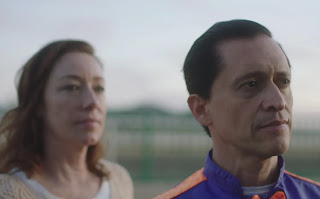
     Collins's Jackson mostly plies his trade for Ruth (Molly Parker), a trainer with whom he's developed a kind of  partnership. The know how to read each other.
Collins conveys the mix of will and doubt that besets Jackson as he tries to push beyond his limits. He fights to lose weight, checks his hand for trembles, and forces himself to continue his training.
    Bentley cast real jockeys in some of the movie's roles, a decision that enhances the movie's sense of authenticity, a feeling for the routine of track life, alternating moments of drudgery and beauty.
    When the jockeys share stories, we realize that they've all suffered injuries but none of them wants to abandon the rush that accompanies the opening the starting gate.
    To round out the story, Bentley -- who co-wrote the screenplay with Greg Kwedar -- introduces an aspiring young rider (Moises Arias) who turns up claiming that he's Jackson's son from a long-forgotten dalliance. 
    The character also serves a thematic function, offering Jackson an opportunity to pass the torch to another generation while also sounding a cautionary note. Arias' Gabriel might be looking at Jackson as more than a possible father; he could represent the young man's future.
    Jockey may put Collins into the forefront after a career of character acting but even if it doesn't, it provides him with a well-deserved showcase.
    Credit Bentley for avoiding a big-race finale. Instead, he opts for a poignant look at what it means for a man to accept his fate and let go of the thing he prizes most.


Tuesday, January 5, 2021

Powerful acting in an uneven movie


    Hungarian director Kornel Mundruczo's White God stands as one of the most riveting movies of 2014, a political allegory that made you gasp and left you wondering how its many scenes with dogs had been filmed
    A drama of shocking immediacy, Mundruczo's Pieces of a Woman marks the director's English-language debut and provides an opportunity for Vanessa Kirby to give one of the year's most emotionally naked performances.
     Familiar for having played Princess Margaret in The Crown, Kirby portrays Martha, a young woman who loses her baby during a home birth. The 23-minute scene in which Martha goes into labor was recorded by cinematographer Benjamin Loeb in a single agonizing shot. 
     Kirby's character, the baby's father (Shia LaBeouf), and a midwife (Molly Parker) are all caught up in a fraught, anxious moment. Taking place before the opening credits, the scene sets a high bar of intensity that the movie will have trouble topping. 
     Before the birth sequence, Mundruczo sketches the relationship between Martha and LaBeouf's Sean. He works in construction; she works in an office. He's a brusk jokey guy who knows that Martha's mother (Ellen Burstyn) thinks her daughter can do better.
    Clearly psyched about becoming a father, Sean's bustling energies and his sympathetic behavior during the protracted labor sequence keep us from dismissing him as entirely "boorish," a term he later uses sardonically in describing himself to Martha's mother.
     Martha, however, turns out to be the movie's driving force. Sean spins like a helpless wheel around Martha's increasingly distant behavior. At one point, he forces himself on her sexually, another scene that has generated much discussion.
    On one level, Pieces of a Woman deals with relationships, family, and grief. On another level, it's about acting, the way actors navigate heavy emotional waters, leaving themselves exposed as they deep dive into what feels like unprotected waters.
     But that doesn't mean that Pieces of a Woman succeeds as a drama. An uncompleted bridge becomes one of Mundruczo's several visual symbols, along with apple seeds. Whatever Mundruczo intended to convey with these visual metaphors feel labored. The movie's at its best when it's being literal and physical rather than symbolic.
    Another current animates the story. Burstyn's character wants her daughter to press charges against the midwife. Martha resists, opening the door for Burstyn to deliver a short monologue about having been a Holocaust baby. She follows by making an offer to Sean, which I didn't buy -- not on either side of the transaction.
         Anyone who ever has experienced or knows someone who has experienced the death of an infant during childbirth probably should think twice before seeing a movie that may strike them as too realistic, too evocative of a terribly painful experience.
    Those who approach the movie on a more neutral footing will find  a performance in which Kirby establishes herself as a master of mood and self-containment. It's as if she's in one movie and everyone else in another, which makes sense because Martha travels through the story in a state of extreme alienation. She's separated from everyone by an experience that can't be rationalized or even explained.
    Pieces of a Woman stands as a collection of scenes -- some quite powerful -- that demand a lot from its cast without ever totally cohering for us.


Thursday, August 20, 2020

Two teen movies: Coming of age again

A sometimes powerful 'Words on Bathroom Walls'
     If you’ve ever participated in or listened to conversations about movies, you’ve probably never heard anyone say, “Gee, I wish there more coming-of-age movies about teenagers.”
    Such movies haven't exactly been in short supply.
    Words on Bathroom Walls fits the standard profile but with a major exception. It’s about a teenager who suffers from schizophrenia. That means that Adam (Charlie Plummer), the movie’s main character, hallucinates, erupts in violent outbursts, and lives in a world in which he’s constantly accompanied by three imaginary companions.
     Director Thor Freudenthal (Diary of a Wimpy Kid) does a good job depicting the fragmented world in which Adam spends his time. He shows us what's going on in Adam's mind, trying to make it as real for us as it is for him.
     Adam's trio of hallucinatory companions includes sweet young Rebecca (Anna Sophia Robb). A bro-type (Devon Bostick) represents Adam's party side. Adam's bat-wielding buddy (Lobo Sebastian) plays the role of enforcer.
      Freudenthal doesn't flinch from the issues that torment a young person whose dreams may be thwarted by mental illness. Adam aspires to be a chef.
    Tossed from a high school after a violent incident, Adam finds himself in a last-chance situation at a Catholic school where he meets a priest (Andy Garcia) who's religious but tolerant of Adam's lack of belief.
     Adam’s mom (Molly Parker) is hopeful but she's dealing with other major stresses. Adam deeply distrusts his divorced mom’s live-in lover (Walton Goggins ).
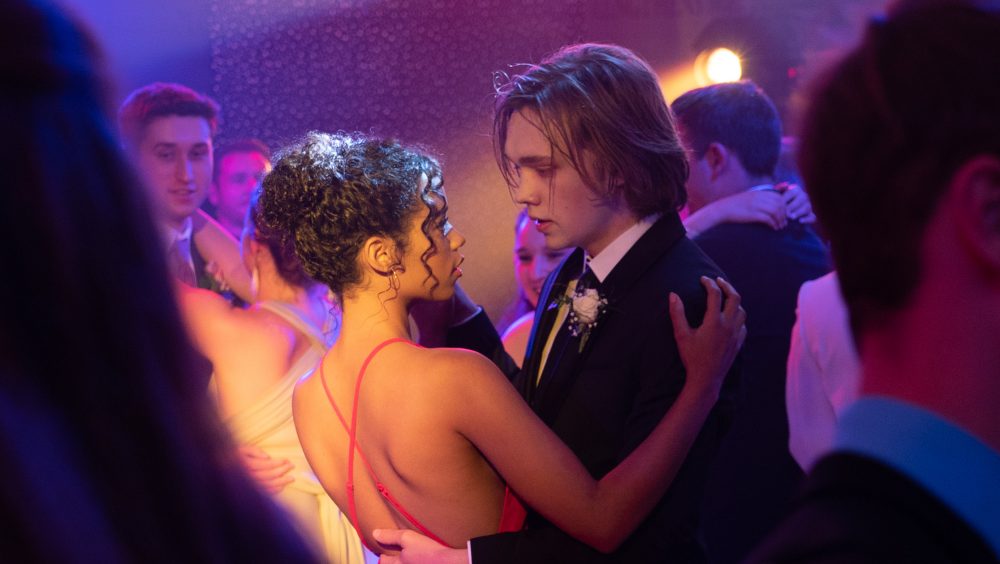
     The movie concentrates on the burgeoning relationship between Adam and a whip-smart student (Taylor Russell) who supplements her income by writing school essays for other students.
     Adam keeps his troubles secret as he vacillates between taking his meds (which have a debilitating side effect) and proceeding without chemical intervention.
     Plummer handles all of this without depriving the audience of the sympathy and engagement it needs to stick with Adam.
    The finale involving a prom and a graduation ceremony strains credibility and the screenplay, adapted by  Nick Neveda from a YA novel by Julia Walton,  isn’t difficult to outguess.
    At its best, though, Words on Bathroom Walls contains moments that are sensitively realized and deserves credit for refusing to suggest that every problem disappears at high school graduation.

Chemical Hearts, a tame teen offering
    
Chemical Hearts, another teen movie, will be available for streaming on Amazon.
     Directed by Richard TanneChemical Hearts focuses on Henry (Austin Abrams), a teenager who edits his high school newspaper and who fancies himself a writer.  A young woman (Lili Reinhart)  reluctantly functions as an assistant editor on the paper. 
    Entirely normal and decent, Henry struggles to break the walls of silence and reserve that surround Reinhart's Grace,  a teen who mangled her knee in an auto accident in which her football star boyfriend was killed.
    Guilt-ridden and wary, Grace gradually allows Henry to become part of her life.
    The title connotes the movie’s principal notion. Romantic love is a chemical reaction, Henry's older sister tells him. At its height, it feels great but when it's taken away from us, we're miserable.
    Tanne creates a high-school environment that allows for a bit of diversity and also includes some of the touchstones of teen life: a Halloween party, for example.
    The movie deserves credit for taking the hurts of adolescence super-seriously but,  at the same time, can seem too eager to turn adolescent angst into something more profound than it really is.
     Whatever the case, Chemical Hearts never breaks the medium-grade ranks of its well-populated genre.