Showing posts with label Charlie Plummer. Show all posts

Wednesday, September 10, 2025

Walking in the shadow of death


  Francis Lawrence, who directed four films in the Hunger Games series, plunges into Stephen King territory with The Long Walk, an adaptation of the first novel King wrote.  Notably, the book appeared after Carrie (1974), King's first published work.
  Set in a dystopian world that resembles the present, the story focuses on 50 young men chosen by lot to participate in a lethal competition. They must walk at a brisk pace of three miles-per-hour. Those who quit or collapse will be executed on the spot. Only one will survive to reap the amazing rewards that have been promised to the winner.
 With help from a youthful cast led by Cooper Hoffman and David Jonsson, Lawrence and writer J.T. Mollner adopt a minimalist approach that concentrates on the walk through depleted rural American landscapes that suggest a forlorn, declining America. 
    The walkers develop relationship but they're shadowed by doom. They know they woh't all make it to the end. Their banter sometimes reminded me of the way soldiers relate to one another in war movies. 
  The characters work their way through moments of  bonhomie, competitiveness, cruelty, and budding friendship. Many of them help and encourage one another, but they know that, in the end, their efforts will be futile. Some are bitter and cruel, notably Charlie Plummer's Barkovitch.
   Of course, the young men are being exploited. The officer supervising the walk (Mark Hamill's the Major) claims that these brave young men will inspire a sluggish population to overcome its laziness. Neither we nor they believe that the walkers want anything more than to be granted the prize, fulfillment of anything they wish for -- money, women, safety.
    Although he includes flashbacks involving Hoffman's character's mother (Judy Greer), Lawrence wisely sticks to the road, where we see those who violate the contest's rules shot by soldiers who accompany them in armored vehicles. 
   After hundreds of miles, some begin to stagger.
   Personal secrets are revealed as the characters get to know one another, but Long Walk works better the less you try to understand the logic of the world that created this exercise in competitive torture. 
    Those expecting a "big" King adaptation may be taken aback by the movie's lack of paranormal garnish. This is King in a minor key.
   Still, The Long Walk makes for an intense,  economical one-hour and 48-minute journey into a world where walkers seek to preserve their humanity in a country that seems intent on depriving them of it.



Thursday, February 3, 2022

A silly mission to a falling moon


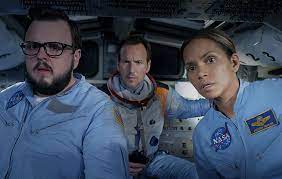
    It's not easy to know where to begin writing about a movie such as Moonfall.  Director Roland Emmerich's latest helping of sci-fi offers a ragged patchwork of elements, none  particularly interesting. 
   To put it bluntly, Moonfall - which stars Halle Berry and Patrick Wilson -- qualifies as a poorly written, badly constructed attempt by Emmerich once again to put the Earth and all its inhabitants in grave danger.
   In the age of CGI and convincing portrayals of space travel, one of the worst things you can say about a sci-fi movie is that it's too silly to be taken seriously. In Moonfall, Emmerich breaks new ground in absurdity.
   The story hinges on a mammoth conceit: One day, the moon  mysteriously alters its orbit, triggering a series of earthquakes and tidal waves. Wholesale devastation begins as the moon enters a collision course with Earth.
   There's little more you need to know, except that Berry and Wilson play former astronauts who wind up trying to save the world. They're helped by a brainy oddball (John Bradley) who predicted the impending catastrophe but was considered too much of a crackpot to be taken seriously.
  A couple of subplots are tossed into the mix, slowing the roll of the Earth-saving mission while introducing half-hearted themes about the nobility of sacrifice.  Carolina Bartczak, Michael Pena, and Charlie Plummer appear in supporting roles in these earthbound segments.   
   Once a hero, Wilson's Brian Harper is a ruin of a man. Harper was blamed for the death of a fellow astronaut during a space mission. No one believed his explanation, which was tied to the movie's conspiratorial revelations.
  Berry's Jo Fowler was also a part of that ill-fated mission, seen in a prologue set a decade before the main plot kicks in. 
   Once disaster strikes, the secondary characters flee the West Coast for Colorado. I guess the mountains are supposed to save them from destruction.
   Wilson should be excused if he sometimes looks confused. Who wouldn't be with a story such as this? Berry does her best to bring conviction to every line she utters. I guess someone had to act as if any of this matters.
   Why is the moon suddenly circling closer to Earth? 
    Turns out the moon is a hollow mega-structure that may have been created by aliens. Fowler, Harper, and Bradley's KC Houseman  eventually find themselves steering their spaceship through a hole leading to the moon's innards.
    Amidst an exposition-heavy ending, the screenplay spits out themes involving artificial intelligence. 
    Did I mention that a lethal dark force zips through the movie in what resembles a cloud composed of lead filings. Its purpose: the destruction of biological life.
   If you're a Berry fan, you may be disappointed that her character seems to fade from view as the movie reaches its conclusion, a loony attempt at something you might think of as techno-mysticism set deep inside the moon's gyroscopic interior.
    Emmerich's movies (Independence Day, Godzilla, and White House Down) rely heavily on mass destruction. No surprise, then, that Moonfall offers more of the same.
   Moonfall can feel like a dated helping of sci-fi, a cinematic visitor from a time when such movies didn't worry about making sense. In some hands, that might have been entertaining, but Emmerich's Moonfall proves more folly than fun.
   It's not only the moon that's hollow; it's the whole damn movie.


Thursday, August 20, 2020

Two teen movies: Coming of age again

A sometimes powerful 'Words on Bathroom Walls'
     If you’ve ever participated in or listened to conversations about movies, you’ve probably never heard anyone say, “Gee, I wish there more coming-of-age movies about teenagers.”
    Such movies haven't exactly been in short supply.
    Words on Bathroom Walls fits the standard profile but with a major exception. It’s about a teenager who suffers from schizophrenia. That means that Adam (Charlie Plummer), the movie’s main character, hallucinates, erupts in violent outbursts, and lives in a world in which he’s constantly accompanied by three imaginary companions.
     Director Thor Freudenthal (Diary of a Wimpy Kid) does a good job depicting the fragmented world in which Adam spends his time. He shows us what's going on in Adam's mind, trying to make it as real for us as it is for him.
     Adam's trio of hallucinatory companions includes sweet young Rebecca (Anna Sophia Robb). A bro-type (Devon Bostick) represents Adam's party side. Adam's bat-wielding buddy (Lobo Sebastian) plays the role of enforcer.
      Freudenthal doesn't flinch from the issues that torment a young person whose dreams may be thwarted by mental illness. Adam aspires to be a chef.
    Tossed from a high school after a violent incident, Adam finds himself in a last-chance situation at a Catholic school where he meets a priest (Andy Garcia) who's religious but tolerant of Adam's lack of belief.
     Adam’s mom (Molly Parker) is hopeful but she's dealing with other major stresses. Adam deeply distrusts his divorced mom’s live-in lover (Walton Goggins ).
     The movie concentrates on the burgeoning relationship between Adam and a whip-smart student (Taylor Russell) who supplements her income by writing school essays for other students.
     Adam keeps his troubles secret as he vacillates between taking his meds (which have a debilitating side effect) and proceeding without chemical intervention.
     Plummer handles all of this without depriving the audience of the sympathy and engagement it needs to stick with Adam.
    The finale involving a prom and a graduation ceremony strains credibility and the screenplay, adapted by  Nick Neveda from a YA novel by Julia Walton,  isn’t difficult to outguess.
    At its best, though, Words on Bathroom Walls contains moments that are sensitively realized and deserves credit for refusing to suggest that every problem disappears at high school graduation.

Chemical Hearts, a tame teen offering
    
Chemical Hearts, another teen movie, will be available for streaming on Amazon.
     Directed by Richard TanneChemical Hearts focuses on Henry (Austin Abrams), a teenager who edits his high school newspaper and who fancies himself a writer.  A young woman (Lili Reinhart)  reluctantly functions as an assistant editor on the paper. 
    Entirely normal and decent, Henry struggles to break the walls of silence and reserve that surround Reinhart's Grace,  a teen who mangled her knee in an auto accident in which her football star boyfriend was killed.
    Guilt-ridden and wary, Grace gradually allows Henry to become part of her life.
    The title connotes the movie’s principal notion. Romantic love is a chemical reaction, Henry's older sister tells him. At its height, it feels great but when it's taken away from us, we're miserable.
    Tanne creates a high-school environment that allows for a bit of diversity and also includes some of the touchstones of teen life: a Halloween party, for example.
    The movie deserves credit for taking the hurts of adolescence super-seriously but,  at the same time, can seem too eager to turn adolescent angst into something more profound than it really is.
     Whatever the case, Chemical Hearts never breaks the medium-grade ranks of its well-populated genre.

Thursday, December 21, 2017

The super-rich also can be cheap

In All the Money in the World, director Ridley Scott tells a 1973 story in which the grandson of J. Paul Getty was kidnapped -- and grandpa refused to pay the ransom.

All the Money in the World stands as a triumph of sorts. With his film already shot, director Ridley Scott decided to replace Kevin Spacey in a principal role. Scott's 11th-hour decision qualifies as an act of cinematic bravado designed, I suppose, to stave off any focus on Spacey, the recent subject of much-publicized sexual abuse allegations.

So the first question: Do the seams show? The answer: Not really.

Although it's difficult not to be aware that Christopher Plummer was a last-minute addition to the production, Scott's skill and Plummer's canny performance as J. Paul Getty help create a spry thriller with plenty of pulse.

In 1973, J. Paul Getty III (Charlie Plummer, no relation to Christopher) was snatched off the streets of Rome, where he was wandering aimlessly, a long-haired hippie without much personal direction. Paul's billionaire grandfather, the world's wealthiest man at the time, refused to pay the $17-million ransom the kidnappers demanded.

It falls to Paul's mother, Gail Harris (Michelle Williams), to try to free the boy, no easy task. Divorced from her wayward husband, J. Paul Getty II (Andrew Buchan), Harris has no money of her own and doesn't really want the help of an ex-CIA operative (Mark Wahlberg) dispatched by the elder Getty to help with any negotiations to free his grandson.

We get the sense that Getty wants Wahlberg's character to clean up a mess; perhaps Getty see the kidnapping as a nuisance that interferes with his obsessive fondling of ticker tape from the markets; Getty enjoys watching his already staggering wealth increase.

Plummer, who played Scrooge in this year's The Man Who Invented Christmas, expands on his performance as a classic miser; Plummer creates a man of great wealth whose sole devotion is to things. Unlike people, things remain unchanged by any winds of betrayal. Getty collects art on a major scale but otherwise establishes himself as a world-class cheapskate. He believes that anyone can become rich, but only a select few can "be" rich.

Plummer doesn't look particularly convincing as a younger version of Getty in a few awkwardly inserted flashbacks, but those are among the few distractions in Plummer's rendition of one of history's major skinflints, a self-absorbed tycoon. In this telling, Getty values his name more than anyone who inherited it from him. He keeps a payphone in his London estate for anyone wishing to make a call. If necessary, the butler will supply change.

Young Getty's kidnapping gives Scott a premise that plays to his strengths, propelling the movie forward and creating tension.

The kidnappers eventually "sell" Getty No. III to Calabrian mobsters who hope to succeed where the first crew faltered. More ruthless than their predecessors, these second-wave kidnappers eventually cut off one of the boy's ears and send it to an Italian newspaper, affording Scott an opportunity to create a wincingly painful scene.

One of the kidnappers -- Romain Duris' Cinquanta -- develops a relationship with young Getty. Cinquanta eventually tries to help the young man who had been summoned back to Rome by his mother after spending time with his father, who -- at the time -- was immersed in drug-fueled Moroccan escapades.

Williams leads Scott's strong cast as a self-assured woman. Her Gail Harris refuses to be intimidated by Getty. A single attribute gives her leverage: She doesn't want any Getty money. Harris' crisp manner suggests that she's not the warmest person: She may not have money, but you'd never know it from her behavior.

Fine performances and the sense that the story lifts the veil on a lifestyle few of us ever will encounter help Scott sell All the Money right up until the end.

During the film's closing scenes, Scott suggests that Getty dies just as his grandson's story reaches its conclusion. Getty actually died several years later, but Scott shows Getty as a man staggering through his cavernous mansion with only his cherished possessions, a dying titan capable of seeing the beauty in a painting of the baby Jesus but unable to find any in his own children or grandchildren.

The moment feels contrived, an all-too-pat restatement of what's already been said. All the Money may not reach as powerful a crescendo as Scott probably wished, but that doesn't mean his thriller isn't involving. In a crowded holiday field, All the Money holds its own.