Showing posts with label Sacha Baron Cohen. Show all posts

Wednesday, October 21, 2020

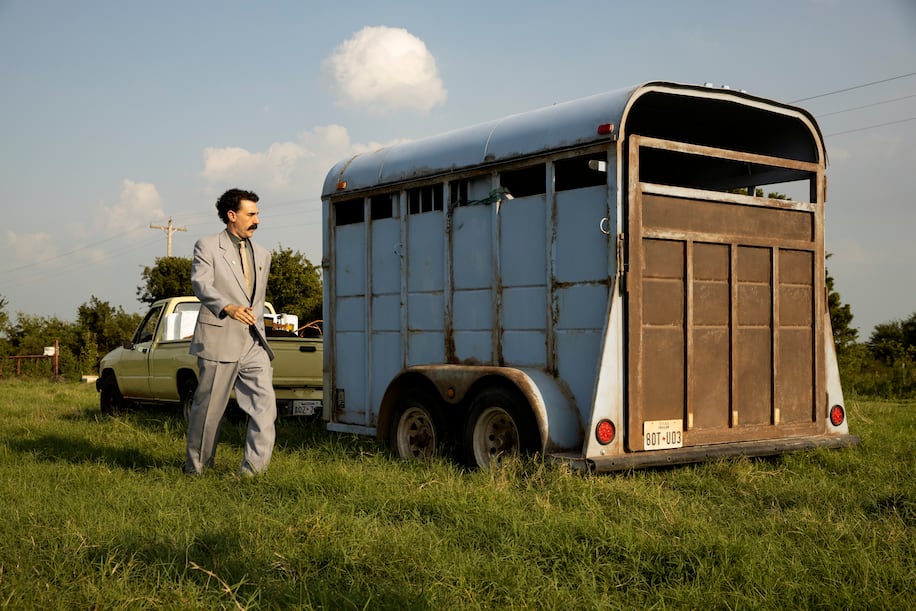
Borat is back and as "bad" as ever


   Of course, it’s too much, too gross, too over-the-top, too indulgent in whatever excesses might cross your mind.
    The latest Borat movie — prosaically entitled Borat Subsequent Moviefilm — brings Sacha Baron Cohen to the pop-cultural forefront at a time when many are nervous about the upcoming election, trying not to be overly confident that four years of Trump will have been sufficient to cure the country of its roguish impulses.
     It is in this climate that Borat, the preposterous journalist from Kazakhstan, returns after his initial introduction to the big screen in 2006. 
    The plot is as unashamedly ridiculous as you might expect. Rescued from disgrace by his government, Borat is sent to America with a mission. He must deliver a token of appreciation to vice president Pence, a gift in the form of Jimmy the Monkey. 
     No one will be surprised to discover that this idiotic endeavor doesn't  proceed smoothly. Borat’s daughter Tutar (Maria Bakolva ) stows away in the crate containing Jimmy and the unfortunate creature is consumed — either in an act of self-cannibalism or by a famished Tutar before the beast even can be unpacked.
    Ever ingenious, Borat decides that Tutar herself would make a fitting substitute for Jimmy. He’ll give her to Pence as a token of his government’s wish to be acknowledged by "McDonald" Trump, who thus far has not sufficiently recognized the glories of Kazakhstan, not the real nation, but a fictional one in which backwardness has become official policy.
     Available on Amazon Prime, screening links for Borat arrived with a request that critics do not disclose anything that might ruin the movie's eruptive spray of jokes.
    I’ll abide by the semi-injunction and proceed with the most general statement I can make: When I laughed at various bits in Borat, many involving Ali G-style encounters with real people, I laughed hard. But I also found some of Borat's interactions with the unsuspecting went too far or were too pitiless. 
    Moreover, some of the gags made me wonder whether some of the people brought into Borat’s sphere were in on the joke. 
    And in a moment when reality and fiction too often have become indistinguishable, I found myself fretting about the additional blurring of lines that already are far too wavy.
   OK, a few hints about what you’ll encounter in a second helping that can't help but feel less brazenly original than the first.
  En route to their encounter with Pence — long before a fly landed on the veep's streamlined head — Borat and Tutar meet with a pastor for a joke made at the expense of a strand of  opposition to abortion. The joke is so simple and absurdly conceived that it becomes hilarious in its unabashed silliness.
    As he travels around the US, Baron Cohen tends to focus on Trump enthusiasts, at one point encountering a couple of America-first believers who subscribe to various conspiracy theories, for example. 
    Baron Cohen’s intrusion into a southern debutante ball leads to a joke of such exaggerated grossness that it may make both fans and detractors cringe.  
    And of course, there’s Borat’s state-sanctioned misogyny and undisguised anti-Semitism — which leads to a bit with a clueless bakery clerk — that defies belief. 
    Baron Cohen is Jewish, so it’s safe to assume that he’s interested in exposing anti-Semitism at its most idiotic. It's also clear that Baron Cohen subscribes to a principle I once heard articulated by political commentator Michael Kinsley in an entirely different context. If you don’t go too far,  you may not go far enough.
     Put another way — and borrowing from another side of the political coin — extremism in the defense of comedy is no vice, particularly at a time when a parade of bizarre realities has crippled the ability of satire and parody to strike major blows.
     Baron Cohen doesn’t satirize. Rather, he meets the dragons of ignorance head-on, as if to say, "I’ll fight the fires of stupidity with more stupidity, so much so that you can’t help but see what ignorance looks like when it’s stripped to its naked core."
    Maybe I’m over-thinking the whole thing. All I know is that I said at the outset: Borat made me laugh very hard, made me think that Baron Cohen sometimes veered out of bounds, and made me wonder which, if any, of his real-life subjects were playing along with him.
   Of course, Borat sometimes offends, but Baron Cohen’s bet is that there’s nothing that he can do that’s more offensive than some of the realities he's exposing as Borat once again springs to life from the glorious nation of Kazakhstan.

Wednesday, September 30, 2020

When absurdity becomes very serious


     The 1969 Trial of the Chicago 7 was an early piece of real-life political theater, a warped legal proceeding staged against a backdrop of roiling protest against the Vietnam War. 
      In The Trial of the Chicago 7, writer/director Aaron Sorkin mixes the account of an absurd courtroom drama with a slightly dimmed appreciation of the American spirit as embodied in the "radical" defendants and their rebellious lawyer.
     In addition to the seven white defendants, Bobby Seale, a member of the Black Panthers, was attached to the proceedings as a kind of sidecar on the countercultural rollercoaster. 
      And rollercoaster it was: Sorkin zips his way through scene-after-scene as he dramatizes portions of a trial that lasted five months. Flashbacks enable him to abandon the confines of the courtroom. The organizers seek permits for the demonstrations. The police fire tear gas. A female FBI agent tries to cozy up to Jerry Rubin.
     The period was chaotic and so, at times, is the movie, a series of sketches that bump up against one another, sometimes without great finesse. And for all its tumult, the movie offers little by way of game-changing overviews either of the period or of trial.
     Limitations aside, the greatest allure of Sorkin's entertaining effort involves the work of a strong cast, an ensemble of gifted actors who walk us down the movie's countercultural memory lane.
     Standouts include Sacha Baron Cohen as Abbie Hoffman and Eddie Redmayne as Tom Hayden, a founder of Students for a Democratic Society. Hoffman and Hayden shared common goals but disagreed on how to attain their goals.
     Hoffman, who was very funny, relished theatrics; Hayden approached protest with high-stakes seriousness. Their disagreements and ultimate rapprochement underlies Sorkin's recreation of the trial. 
      The defendants weren't the only stars of the proceedings. A fine Mark Rylance portrays William Kunstler, the radical  attorney who defended the seven. 
     Yahya Abdul-Mateen II makes a formidable Seal, the Black Panther who, along with the others, was charged with conspiracy to cross state lines to incite a riot. But unlike his co-defendants, Seal wasn't involved in planning the event and had been in Chicago for only two days during the 1o68 convention.
    The so-called riot that's at the heart of the case took place in Chicago's Grant Park during the Democratic convention at which Hubert Humphrey was nominated to run against Richard Nixon. 
      In an introduction to the movie, Sorkin uses real footage in which the esteemed Walter Cronkite sets the stage: "The Democratic convention is about to begin in a police state. There just doesn't seem to be any other way to say it." 
     The defendants ran a gamut of personalities, but the size of the cast forces Sorkin into sketching rather than painting detailed portraits. David Dellinger (John Carroll Lynch) serves as a conventional guy with deep political convictions and Jeremy Strong portrays Jerry Rubin, who plays a kind of goofy second fiddle to Hoffman.
     And, yes, Cohen gets pretty close to capturing Hoffman's Massachusetts accent and comedic instincts.
    Hoffman and Rubin were Yippies; i.e., members of the Youth International Party, a group that flew a sex, drugs and rock 'n' roll banner over its protests.
    Every trial needs a judge and this one had a particularly incapable one. Frank Langella's Julius Hoffman makes ridiculous decisions without ever really sensing the absurdity that threatens to overwhelm him.
    Perhaps Hoffman's greatest faux pas occurred when he had the disruptive Seal, who eventually asked to defend himself, bound and gagged in the courtroom. The judge made Seal an advertisement for the oppressive nature of the trial. Charges against Seal were dropped before the trial finished.
     Joseph Gordon Levitt plays the prosecutor, a decent enough fellow who, nonetheless, approaches his job seriously. John Mitchell (John Doman) -- Nixon's Attorney General -- personally assigned Gordon-Levitt's character to the trial for reasons that had more to do with what he thought the seven represented than with anything they did.
    Michael Keaton does effective cameo duty as Ramsey Clark, the attorney general under Lyndon Johnson, who became a witness for the defense in the trial.
    It may be difficult for those who weren't alive during the '60s to grasp just how incendiary the times were. The trial may have had a disembodied theatrical quality, but Americans and Vietnamese people were dying in a senseless war that awoke a generation of protest.
     When the chips are down, Sorkin turns earnest and I wondered how another director might have lit  the match that needed to be thrown onto this political gas can of a movie. 
     Still, the performances and byplay (a Sorkin specialty) give the movie plenty of burn. 

Thursday, May 26, 2016

A dense, unsatisfying 'Alice'

Another wild, crazy and scattered trip to an alternate reality.

Alice Through the Looking Glass arrives in theaters as an effects-laden, visually dense extravaganza that feels more like a wild-and-crazy theme park ride than a trip to Wonderland.

Director James Bobin (Muppets Most Wanted) takes over from Tim Burton, who made his version of Alice in Wonderland six years ago. Simply put: Burton's movie -- though no masterpiece -- was better.

Familiar characters emerge from Bobin's galaxy of imaginative sets, bizarre costumes and dizzying action. But this time, the appearance of old favorites generates little by way of fond recall.

When we first meet her, Alice (Mia Wasikowska) is a skilled sea captain who loses her father's ship to a greedy fleet owner. An unhappy Alice then walks through the famous Looking Glass.

Once she enters this alternate reality, Alice learns that she must travel through time in order to help save The Mad Hatter (Johnny Depp). The Hatter, poor fellow, has fallen into a near-terminal funk as the result of having lost his family.

Alice also meets Time (Sacha Baron Cohen), a character who controls something called a Chronosphere, a spinning globe into which Alice climbs so that she's able to go back in time, perhaps to repair past wrongs. Mostly, it's an excuse for a screenful of summer-time action.

The movie holds two queens in its hand -- the White Queen (a pasty-looking Anne Hathaway) and the Red Queen (an arch Helena Bonham Carter). Enmity between the queens traces back to their childhoods, in case you've been longing to know why they never seem to be able to get along.

If someone told you that Bonham Carter, under the customary ton of makeup, was really a very large toy, you might believe it. More than others who suffer the same fate, Bonham Carter has an air of China-doll unreality about her.

As for Depp, his silly ramblings as the Hatter made me again wish that he'd once and for all leave childhood films behind.

I could say more, but all I'll tell you is that the amusements are skimpy, the sights overwhelming and the whole business seems to have lost the heady, mind-warping spin of Lewis G. Carroll.

In short: Big production, small yield. In 3D, of course.

Monday, December 24, 2012

A dark, melodramatic 'Les Miz'

You may find imperfections, but the big-screen version of Les Miserables ultimately proves stirring.
The voices sometimes seem to be straining. An abundance of extreme close-ups tends to give the movie a feeling of cramped intimacy. Although filmed mostly on sets, the movie steeps itself in gritty 19th century realism. It's a musical with dirt under its fingernails.

I'm talking about Les Miserables, the big-screen adaptation of the much-revered musical that made its debut in Paris in 1980 and seems to have been in production somewhere ever since.

Melodramatic, operatic and seen through cinematographer Danny Cohen's dark lens, Les Miserables bypasses its imperfections, ultimately getting where it needs to go. It's less a story well-told than a production massively mounted, but that may be precisely what the material needs.

Based on an 1862 Victor Hugo novel, Les Miserables thunders its way through nearly three hours of suffering, death and melodrama, frequently miring its cast in mud, muck and -- as the title promises -- the kind of bone-deep misery that might have roused envy even in Dickens, himself no slouch when it came to injustice and suffering.

As directed by Tom Hooper (The King's Speech), Les Miserables is top heavy with marquee names, including Anne Hathaway, who tackles the role of the tormented Fantine in a performance in which emotion seems to spill from her every pore.

I'm not going to provide background for every character in Les Miz, but Fantine, you may recall, is a single mother, a status that caused her to be scorned and persecuted for profligacy in France of the 1800s. And, yes, it might be advisable to bone up on Hugo's story before you go because plot points breeze by as if propelled by wind machines.

The story centers on poor Jean Val Jean (Hugh Jackman), the ex-convict who violates his parole and spends a lifetime fleeing Javert (Russell Crowe), a lawman who applies justice like a lash. Amanda Seyfried turns up as Fantine's daughter, Cosette, a woman who eventually is sheltered by Jean Val Jean.

All of this takes place against a post-revolutionary historical backdrop in which the monarchy has been restored in France, and the people are suffering under the weight of too much regal indifference.

The movie's third act deals with the revolt of 1832, introducing us to Marius (Eddie Redmayne), a revolutionary who's smitten by Cosette. Be assured barricades will be stormed. The spirit of the people will be aroused. You will be stirred.

To heighten the feeling of emotional urgency, Hooper had his actors sing their numbers as the cameras rolled rather than relying on lip-synching. The technique is employed to mixed result.

Jackman, who has a history in musical theater, carries it off convincingly, as does Hathaway. Crowe, who has a background singing with rock bands, is only moderately successful. Trussed up in the costume of a 19th century lawman, Crowe moves around as if encased in plaster. Javert's a rigid guy, but Crowe never seems entirely comfortable playing him.

Hooper doesn't quite suffocate the production, but I wish he had let it breathe some, and I got tired of watching close-ups of the singers. Hooper must have wanted his camera to bring us close to the performances, but the face of a singer -- particularly when grappling with heavy emotion -- isn't always a thing of beauty.

The major numbers in Les Miserables -- At the End of the Day, I Dreamed a Dream and One Day More -- are effectively performed, and there's even a bit of comic relief. Sacha Baron Cohen makes an appropriately despicable and conniving Thénardier, an inn-keeper who for a time takes charge of Cosette. Baron Cohen receives an able assist from Helena Bonham Carter -- now a specialist in playing grotesque-looking women -- as Madame Thénardier. Samantha Barks makes a bit of splash as their daughter, Éponine.

I'm not a particular fan of musicals, and Les Miz involves wall-to-wall singing with almost no spoken dialogue. I can't exactly say that Les Miserables left me humming any of its tunes. But whatever problems the big-screen version has, I mostly enjoyed it and even felt a slight tingling of the spine during its finale. Put another way, Les Miserables has genuine theatrical power.


Tuesday, May 15, 2012

Strange bedfellows: tyranny and humor

Sacha Baron Cohen's The Dictator isn't as transgressive as his best comedy, but it's not laugh free, either.


Sacha Baron Cohen has a genius for turning inappropriate remarks and vulgar behavior into transgressive social critiques. Daring as he is dirty, Cohen first came to the attention of American audiences with Da Ali G Show, which aired on HBO. Cohen pushed Ali G -- an outlandish British hip hop journalist -- into the real world, where he conducted interviews that often left his prey foaming with outrage or shaking their heads in disbelief. Ali G was, if you can stand the contradiction, brilliantly ignorant.

Baron Cohen transferred these skills to the big screen with 2006 with Borat (inspired), a comedy that he followed with 2009’s less successful Bruno. Now comes The Dictator, a film that begins with a dedication to the late Korean dictator Kim Jong-il, a brazen bit of humor that sets the tone for a comedy that includes most of the Baron Cohen trademarks: blatantly stated bigotry, exceptional vulgarity and broadly aimed satire.

In The Dictator, the combination produces enough laughs to keep Baron Cohen fans happy, although the movie seldom seems as daring or dangerous as Baron Cohen’s bizarre mockumentaries, which brought him into contact with non-actors who weren’t in on the joke.

This time out, Baron Cohen plays Admiral General Aladeen, the cruel dictator of the fictional Middle Eastern country of Wadiya. Early on, Aladeen travels to New York City to address the United Nations. There, another Wadiyan leader (Ben Kingsley) leads an assassination attempt involving one of Aladeen’s many hapless doubles.

Not that plot matters. The point is to put this arrogant, self-absorbed tyrant into the middle of Manhattan, where -- shorn of his beard -- he can be the proverbial fish out of dictatorial waters.

Left to his own devices, Aladeen lands a job at the Free Earth Collective, an organic Brooklyn food store run by a feminist activist (Anna Farris). He also reunites with a Wadiyan nuclear scientist (Jason Mantzoukas) who escaped one of Aladeen's many execution orders, handed out by the capricious dictator as casually as others distribute business cards.

Among his many New York-based educational experiences, Aladeen learns to masturbate, an activity that gives director Larry Charles, who directed the two previous Baron Cohen movies, an opportunity to go gross -- not his first nor his last in a picture that probably contains a few too many such moments.

Oddly, the movie’s most trenchant bit of comedy comes in a speech Aladeen delivers at the end. Its target: Not the dictatorial abuses of the Sadaam Husseins and Muammar Gaddafis of the world, but conditions closer to home.

Did I think The Dictator was a great movie? No. Did I laugh enough to recommend it to Baron Cohen fans, as well as to those who arrive at the theater adequately forewarned? Yes.

A final thought: At February’s Oscar ceremonies, Baron Cohen walked the red carpet dressed as Aladeen, complete with fake beard. He proceeded to spill the ashy contents of an urn he was carrying on E! red carpet host Bryan Seacrest’s tuxedo. The ashes, said Aladeen, belonged to the late Kim Jong-il.

It was a great “oops” moment that fit Baron Cohen’s humor perfectly, soiling the usual red carpet orgy of praise and fatuous banter, and setting a standard of impropriety that The Dictator can’t quite match.

Tuesday, November 22, 2011

'Hugo," a dreamy triumph for Scorsese

Director Martin Scorsese makes a kids' film (sort of) -- and in 3D no less.

If you don't believe life is strange, consider this: Martin Scorsese, master of Mean Streets, Goodfellas and Raging Bull, has made a kids' movie - and not just any kids' movie, but a beautiful helping of 3-D that might make Steven Spielberg jealous.


Sure that seems out of character for Scorsese, but as you dig deeper into Hugo, Scorsese's elegant adaptation of The Invention of Hugo Cabret - a 2007 children's book by Brian Selznik - it becomes increasingly apparent why Scorsese chose to become involved.


In addition to being a first-rate director, Scorsese is also one of the most knowledgeable film lovers in the world, and Hugo brings him back to the time when movies had naïve innocence, and no one was quite sure whether moving images were more than a passing fad.


We're talking about the time, say, of the Lumiere brothers, a wonderful moment when audiences could be startled and thrilled by the simple sight of a train arriving at a station.

Don't be put off. Hugo is not an arcane helping of cinema history designed to impress buffs. It's a film in which a jaw-dropping mastery of craft is matched by a celebratory spirit about what movies can do.


The story revolves around Hugo (Asa Butterfield), an orphaned boy who lives in the walls of a train station in Paris where he has taken it upon himself to wind the station's clocks. Hugo also has a talent for fixing things, and he sustains himself by stealing bits of food and outwitting the station's police inspector (Sacha Baron Cohen).


Hugo has one remaining link to the father (Jude Law) he lost in a fire at the museum where Dad worked: an automaton, a wind-up creation with a passive face, clockwork innards and a skeletal frame.


Hugo hopes to activate the automaton, an aspiration that brings him into contact with a variety of characters: Georges (Ben Kingsley), the sour-faced owner of the station's toy booth; Georges' wife Jeanne (Helen McCrory); and their adopted daughter Isabelle (Chloe Grace Moretz).


The performances range from good to excellent, but the real star of Scorsese's movie may be the movie itself.


I don't think I've seen a film that has made much better use of 3-D than Hugo. Every shot seems to have been composed to maximize the capabilities of 3-D cameras. Scorsese and cinematographer Robert Richardson move those cameras through the station's labyrinth of cogs, gears and wheels, through its bustling waiting room and through the streets of Paris in the 1930s.


The station itself is a triumph of production design, an urban hub that flirts with nostalgia without entirely succumbing to it.


All of this (and more) make Hugo a bona fide technical triumph. And that may be part of the point Scorsese and screenwriter John Logan are making. They're not interested in gadgetry for its own sake; they're interested in the equipment that helps make dreams real.


That brings us back to where I started: The love of cinema.


It turns out that Kingsley's Georges is none other than Georges Milies, a famous early filmmaker whose 1902 film, A Trip to the Moon, featured an iconic shot of a rocket landing directly in the eye of the Man in the Moon. By the time, Hugo begins, Milies has grown old, and his work mostly has been forgotten. Thanks to a late-picture development, a film historian (Michael Stuhlbarg) helps reconnect Milies with a part of himself he thought he'd lost.


It's possible that Hugo, which makes skillful use of film footage from Milies, Harold Lloyd and others, will prove more of a delight to adults than to children. But I'd take kids to see it because they'll be watching a story that has been beautifully assembled, because the kids at its center are smart, brave and sincere, because Hugo might teach them something about a cultural inheritance they didn't know they had, and because the movie doesn't debase itself by pandering to what it thinks kids might want to see.


Those familiar with Scorsese's passions will understand and appreciate the fact that Hugo also becomes a bit of a commercial for film preservation, one of Scorsese's prime concerns. He does this not by shortchanging the story of a lonely boy who's captivated by movies, but by enhancing it.


To his credit, Scorsese makes it clear that restoring old films is about more than finding bits and pieces of bygone footage in unlikely places; it's about the restoration of lost dreams.