Showing posts with label Ti West. Show all posts

Thursday, July 4, 2024

A porn star's bumpy road to fame


   At one point in the movie MaXXXine, a porn star (Mia Goth) seeking crossover fame as a horror movie queen,  tries to evade a slimy private investigator (Kevin Bacon). To avoid her pursuer, Goth's Maxine seeks refuge inside the famous Psycho house on the Universal Studios lot.
   Mark the Psycho house as one of many movie references in the third installment of director Ti West's horror trilogy, which began in 2022 with X and Pearl
   West primes us to see Norman Bates, or a facsimile, pose a frightening new danger, but he purposefully undermines the suspense he creates. Once inside, all we see is the wooden scaffolding that keeps the house from collapsing. 
     We're behind the facade, a strategy West repeatedly employs as he plays with horror and movie tropes from the 1980s. The result ranges from smartly mounted jests to self-conscious displays of pop-cultural savvy.
    MaXXXine feels like an ambitious movie that can't quite shed enough of its genre skin to emerge as something startlingly fresh, even as West works to expose the seaminess behind Hollywood’s bright lights.
     The movie's casting probably broadens its reach. Employing a southern accent that makes his words sound as if they've been dipped in grease, Bacon scores as PI John Labat. 
     The rest of the cast includes Giancarlo Esposito, as  Teddy Night, Maxine's unscrupulous agent. Two homicide detectives (Bobby Cannavale and Michelle Monaghan) figure in the plot. Elizabeth Debicki portrays the ambitious director of the crossover horror movie Maxine hopes will make her a star. Of course, it's a sequel. 
     Then there's Goth, who has staked out impressive territory in three of these movies, most notably in Pearl, the best of the trilogy. 
    Goth plays the only character who survived the first movie, which saw a group of young filmmakers trying to break into the biz by making a porno. Post X, Maxine  traveled to Hollywood where she made a mark in the adult-film world.
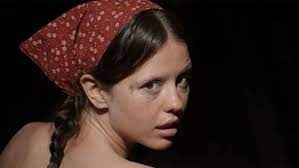
     Goth's performance embodies one of West's central observations; those who don't wish to become monsters shouldn't aspire to stardom. The movie never forgets that Maxine's past is bathed in the first movie’s bloodshed. Her freckled face looks innocent, until it curdles into an expression of monstrous ambition.
        Although it’s difficult to take seriously amid all of West’s showmanship, a story emerges. During the 1980s, a real-life serial killer called The Night Stalker terrified Los Angeles. News footage tells us about this horrific chapter of LA history, which West uses as a springboard to put Maxine in danger.  More can't be said without spoilers.
     West's movies have become known for adding layers of meaning that elevate them from the usual Hollywood gore ghetto -- while also not abandoning major plasma flows.
    The gore in MaXXXine slashes and smashes its way onto the screen like exclamation points.
     The movie's conclusion struck me as more risible than chilling; it's followed by a needless epilogue that restates the movie's ideas.
      It's also arguable that the parade of movie allusions gets out of hand.  West even finds a way to put a bandage on the nose of Bacon's PI. We're clued to remember Jack Nicholson's Jake Gittes, the detective who discovered Los Angeles's dark side in Chinatown.
     Chinatown (1974), of course, was not an '80s movie, but West uses the reference to draw thematic connections to his LA foray -- the story that festers beneath the surface, the lowdown.
      Garish, glitzy, and gruesome, MaXXXine can’t outdo its predecessors. Still, if you’re a fan of the first two movies, West gives you no particular reason to avoid the trilogy’s semi-successful finale.
       Oh, I almost forgot an important question: Is  MaXXXine scary and creepy enough to haunt you once you leave the theater? I don't think so.

Thursday, September 15, 2022

A prequel serves up horror of its own


    Maybe you haven't spent the last several months yearning for a prequel to the movie X, released earlier this year. Perhaps you didn't even see X, a well-regarded helping of horror about the dangers of trying to make a porn film on an isolated farm.
    Director Ti West's reasonably smart film referenced horror history while serving up its own brand of chills.
   Pearl takes us back to 1918 to tell us how the desiccated hag of the first movie spent her youth. Using the same settings found in X, West enhances the color of his images. He adopts an approach reminiscent of the way Todd Haynes paid homage to director Douglas Sirk in Far From HeavenPearl comes on like melodramatic comfort food from a bygone cinematic era.
    Too much genuflecting at the altar of film history? 
    Maybe, but West links his work to the past and, in this case, to his previous movie.
   References to other movies aside, Pearl functions well as a stand-alone effort, although it won't be everyone's idea of a scary good time. Slowly paced and evocative, Pearl uses its nostalgic allure to draw us into the increasingly weird world of its title character.
    West turns Pearl into a showcase for Mia Goth, who played dual roles in the first movie and was unrecognizable as the killer crone of X.  Here, Goth meets the moment with unsettling flashes of mania and longing.
  Goth's Pearl lives an emotionally and sexually undernourished life on a farm with her sternly religious mother (Tandi Wright) and paralyzed father (Mathew Sunderland).
   Dressed in overalls, Pearl looks as if she might have tumbled out of Norman Rockwell painting. We know better, particularly when Pearl spears a goose with a pitchfork and feeds it an alligator or when she has enthusiastic masturbatory sex with a scarecrow.
   Pearl joins a long line of insanely frustrated women. She dreams of being a star and finds encouragement from the projectionist (David Corenswet) at the town theater. He urges her to dream -- but shows her a "special" film he acquired in France, a helping of porn that underscores the theme of dreams that are smashed or even perverted.
   Pearl's chance at escape arrives when a friend (Emma Jenkins-Purro) tells her that a traveling dance troupe plans to hold auditions at the town's church. 
  Against a backdrop of illuminated crosses, Pearl gives a knock-out performance but an eerily stoic panel of judges rejects her. They want a blonde.
   What's a frustrated young woman supposed to with her husband off fighting World War? And what about those movie-inspired fantasies in which Pearl sees black-and-white images of chorus girls kicking their way to the glamorous life she believes she deserves?
  The answer is obvious but still alarming. Pearl's smile --a grin that stretches her face to the breaking point -- no longer will mask the evil that festers within.
  West offers gore and murder but served sparingly when compared to the butchery that sometimes dominates contemporary horror.
   And despite his love for movie references, West’s approach remains idiosyncratic and he’s not afraid to take chances -- big ones. At one point, Pearl delivers a lengthy monologue, part confessional and part threat. It could have derailed the movie but Goth makes it work.
   Clearly, Pearl is too twisted and weird for all viewers. But it's more accomplished than X and it allows Goth to smear the screen with blood, unleashed rage, and a killer smile -- or maybe I should say, a killer’s smile.


Thursday, March 17, 2022

Two very different horror films: 'X' and 'Master'

    Contemporary horror has gotten meaty enough that I'm sure it has inspired doctoral theses wherever film studies are taught. Thanks in large part to Jordan Peele (Get Out and Us), racial prejudice has joined the world of horror movies. You can include the recent Candy Man in that category, as well.
  Then there's the world of horror served straight no chaser, movies that are more aligned with the history of horror than with any topical issue. These movies require that we know that filmmakers are keenly aware of horror conventions and precedents. Such films may be violent and even vile, but we're expected to be in on the joke. 
 
X
    Let's start with a movie that's both a riff on previous efforts and an attempt to deliver an alarmingly  sleazy helping of horror. 
  X walks in the bloody footsteps of Texas Chainsaw Massacre and a variety of other movies that aficionados will easily identify. 
   Director Ti West (The House of the Devil, The Innkeepers) also takes a bow toward Boogie Nights as he tells the story of a group of young folks who gather at an isolated farmhouse to make a porn film. The year: 1979.
    The cast includes the porn movie's female leads (Brittany Snow and Mia Goth) and a young woman (Jenna Ortega) whose original job involves the production's sound. Ortega's Lorraine eventually decides that if she's going to work on a porn film, she might as well be in one. Porn seems less a matter of talent than of a simple decision. Yes or no? The women decide.
   The men are represented by Martin Henderson as a low-rent impresario with few illusions about what he's doing. He's joined by Owen Campbell as RJ, an aspiring filmmaker who deludes himself into thinking he's making an independent film. Kid Cudi plays the well-hung Jackson, the male star of the porn film which is given silly a throwback title, The Farmer's Daughter.
    Trouble, of course, lurks. The crew has rented a facility from a farmer and his wife, characters we instantly recognize as lethally dangerous. Both are old to the point of desiccation with leathery skin that looks as if it might have been preserved in formaldehyde. 
     I won't get into spoilers but you should know that West doesn't skimp on gore or nudity. He tries to serve two masters: an audience that's hip to horror ploys but also wants to be creeped out and shocked.
     He does a bit of both in a movie that adds thematic weight to its blood-clogged pores, much of it centering on Pearl, the farmer's wife. Pearl laments the loss of her beauty and sexuality and, therefore despises, a youthful crew that has turned sex into something that requires only consent.
     The old woman wants nothing more than to be desired, the one thing age has denied her. West occasionally photographs her with backlighting that seems to liberate her from time and hints at how she might once have looked.
     (I haven’t named the actress that plays Pearl but suggest you look it up after you’ve seen the movie.)
     Occasionally, we see a preacher railing about sin and hellfire on a black-and-white TV in the farmer's house, a detail that yields an unexpected payoff before the movie ends.
     West does a reasonably good job of mixing skin and gore, although the movie's willingness to kneel at the altar of contemporary horror keeps it a bit hemmed in: We know we're watching a movie -- albeit one that inhales deeply and breathes sleaze.
       Whether you want to breathe along with it remains an open question. Know this, though, X may not transcend its horror  niche but it embraces it with unwavering commitment.
     
Master
    In Master, director Mariama Diallo takes a different tack. Diallo has made a horror film in which the characters are haunted by institutional racism at fictional Ancaster College.
      The prestigious school has a tarnished history.  In its early years, a woman was hanged for witchcraft. Since then the students have perpetuated a legend: Every year, the witch's ghost selects a freshman whose soul she will steal on the anniversary of her death.
      Enter Jasmine (Zoe Renee), a high school valedictorian who we instantly know will be the witch's next target. Along with her roommate Amelia (Talia Ryder), Jasmine is assigned to Room 302, which has a history of turning at least one of its occupants into a victim. 
       It's less a room assignment than a sentence.
       At Ancaster, Jasmine faces both supernatural and social threats. The student body isn't welcoming. 
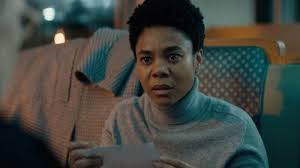
       A fine performance from Regina Hall as a housemaster and tenured academic helps raise questions about the price a black student pays to prove worthy in an institution steeped in white bona fides.
       Amber Gray plays Liv Beckman, a Black professor who pushes wokeness on her students. Jasmine's paper on  The Scarlet Letter earns an F from BeckmanPoor Jasmine. She failed to connect Hawthorne's story to critical race theory.  
      The film also makes room for a mystery about a woman who insistently phones Hall's character and, of course, there's the ghost.
       Master might be a case in which the horror could have been dropped to good effect. Racism in academia remains a valid and important subject and it might have benefited from a bit more subtlety.
        Eerie manipulations and obviousness aside, Master still manages to hit some powerful notes about the endemic persistence of racism in the so-called "best of circles."