Thursday, December 12, 2024

A powerful story eloquently told


  With Nickel Boys, director RaMell Ross, who has worked mostly in documentaries, brings a daring version of a Colson Whitehead novel to the screen. Multi-layered and willing to speak in its own visual  language, the movie insinuates itself in memory in evocative and mournful ways.
  Beginning with an opening that qualifies as an idyl about Florida in the 1960s and carrying the story into the 21st century, Ross introduces Elwood, a teenager who’s on track to escape the limits of life in Tallahassee as the power of Jim Crowe begins to wane. Elwood's on the verge of attending college, when a cruel detour lands him in a juvenile reformatory. 
    Ross risks an unconventional telling of his tale. In its early stages, Ross's camera shows us only what Elwood sees. Elwood's vision offers a slightly blurry take on the world we're entering. Snippets of news might be gleaned from TVs in a store window Elwood passes. Two young Black men step aside to allow whites to pass on a sidewalk. Elwood's grandmother expresses tender love for him.
    Initially, Ross's subjective approach may disorient viewers, but he proceeds leisurely, allowing us to experience the story with an immediacy that throws us off guard and keeps us from getting too far ahead of the characters.
     Elwood’s teacher (Jimmie Fails) has worked hard to get his charge into Melvin Griggs College. En route to the school and a fulfilling life, Elwood hitches a ride with a man driving a stolen Impala. Presumed guilty of something (probably doesn't matter what), Elwood is sent to a reform school known as Nickel Academy.
   Naive and trusting, Elwood believes he’s going to finish his education. It takes time for him to realize that he’s in a penal institution where young Black men are exploited and segregated from the white population of the "school." The young men work for free, and corrupt school officials profiteer, selling food that's meant to feed the Black "students."
     Some of the boys "disappear.” We don't need a guide to tell us what that means.
    Whitehead modeled his story on the Arthur G. Dozier School for Boys, a real-life Florida institution where 100 Black students died and were buried in unmarked graves. The school operated from 1900 to 2011.
    Ross could have taken the easy way out, presenting  his story in linear fashion, but he charts his own path. For what might be a quarter of the movie, we see events only through Elwood’s eyes, which means we don’t know what he looks like until the viewpoint shifts to that of Turner, another Nickel youngster who’s more savvy about the system. 
  Ethan Herisse (as Elwood) and Brandon Wilson (as Turner) give performances that reflect each young man’s personality and history; Elwood maintains a belief in the possibility of being treated fairly; Turner grounds his cynicism in the reality of cruel experience. 
   If the long arc of the universe bends toward justice, Elwood wants a more immediate result. He continues to believe that his capabilities will be recognized. I'd call that a deep expression of faith.
   Perhaps to add context, Ross includes real images, some bordering on the surreal. He also distorts the flow time; sometimes, we meet a grown Elwood -- or so we think. An adult living in Harlem where he runs a successful moving business, Elwood can't escape the torments he experienced at Nickel. He needs to testify about them to help bring Nickels down.
   Emotionally, the film opens slowly. It features a deeply affecting turn by Aunjanue Ellis-Taylor as the grandmother who, despite limited resources, never gives up on Elwood. Ellis-Taylor provides a lesson about how much can be accomplished with limited screen time.
    Ross's experimental approach takes some adjustment.  The shifting points of view deprive us of context, forcing us to look beyond what's being shown. Sometimes, we have to pull back to remind ourselves whose eyes we're looking through. 
    But Nickel Boys creates the kind of disquiet that's spawned by memories that cannot be appeased.
     No, make that should not be appeased.  One of the year’s most haunting movies, Nickel Boys resonates with the eloquence of poetry, speaking powerfully as it pulls us into lives robbed of promise.


'Conclave' and 'Wicked' top list of Critics Choice nominees

    The Critics Choice Association has announced its nominees for its 30th annual Critics Choice Awards. Conclave and Wicked lead the way with 11 nominations each. Dune: Part Two and Emilia Pérez followed with 10 nominations each. Notably, Emilia Pérez received nominations in both the Best Picture and Best Foreign Language Film categories. 
 Winners will be announced in a live broadcast on E! on January 12, 2025. 
 Disclosure: I'm a member of the Critics Choice Association and voted in the nominee process. 
  As always, I encourage you to make your own lists, argue about everyone else's choices, and enjoy catching up with all the films you may have missed.


Best Picture
A Complete Unknown
Anora
The Brutalist
Conclave
Dune: Part Two
Emilia Perez
Nickel Boys
Sing Sing
The Substance
Wicked

Best Actor
Adrien Brody, The Brutalist
Timothee Chalamet, A Complete Unknown
Daniel Craig, Queer
Colman Domingo, Sing Sing
Ralph Fiennes, Conclave
Hugh Grant, Heretic

Best Actress
Cynthia Erivo, Wicked
Karla Sofia Gascon, Emilia Perez
Marianne Jean-Baptiste, Hard Truths
Angelina Jolie, Maria
Mikey Madison, Anora
Demi Moore, The Substance

Best Supporting Actor
Yura Borisov, Anora
Kieran Culkin, A Real Pain
Clarence Maclin, Sing Sing
Edward Norton, A Complete Unknown
Guy Pearce, The Brutalist
Denzel Washington, Gladiator II

Best Supporting Actress
Danielle Deadwyler, The Piano Lesson
Aunjanue Ellis-Taylor, Nickel Boys
Ariana Grande, Wicked
Margaret Qualley, The Substance
Isabella Rossellini, Conclave
Zoe Saldana, Emilia Perez

Best Young Actor/Actress
Alyla Browne, Furiosa: A Mad Max Saga
Elliott Heffernan, Blitz
Maisy Stella, My Old Ass
Izaac Wing, Didi
Alisha Weir, Abigail
Zoe Ziegler, Janet Planet

Best Acting Ensemble
Anora
Conclave
Emilia Perez
Saturday Night
Sing Sing
Wicked

Best Director
Jacques Audiard, Emilia Perez
Sean Baker, Anora
Edward Berger, Conclave
Brady Corbet, The Brutalist
Jon M. Chu, Wicked
RaMell Ross, Nickel Boys
Denis Villeneuve, Dune: Part Two

Best Original Screenplay
Sean Baker, Anora
Moritz Binder, Tim Fehlbaum, Alex David, September 5
Brady Corbet, Mona Fastvoid, The Brutalist
Jesse Eisenberg, A Real Pain
Coralie Fargeat, The Substance
Justin Kuritzkes, Challengers

Best Adapted Screenplay
Jacques Audiard, Emilia Perez
Winnie Holzman, Dana Fox, Wicked
Greg Kwedar, Clint Bentley, Sing Sing
RaMell Ross & Joslyn Barnes, Nickel Boys
Peter Straughan, Conclave
Denis Villeneuve, Jon Spaihts, Dune: Part Two

Best Cinematography
Jarin Blaschke, Nosferatu
Alice Brooks, Wicked
Lol Crawley, The Brutalist
Stephanie Fontaine, Conclave
Greig Fraser, Dune: Part Two
Jomo Fray, Nickel Boys

Best Production Design
The Brutalist
Wicked
Conclave
Nosferatu
Gladiator II
Dune: Part II

Best Editing
Anora
Challengers
Conclave
The Brutalist
 Dune: Part II
September 5 

Best Costume Design
Conclave
Nosferatu
Maria
Wicked
Dune: Part Two
Gladiator II

Best Hair and Makeup
Beetlejuice Beetlejuice
Dune: Part II
The Substance
Wicked
Nosferatu
A Different Man

Best Visual Effects
Gladiator II
Wicked
Dune: Part Two
Better Man
The Substance
Kingdom of the Planet of the Apes

Best Animated Feature
Flow
Inside Out 2
Memoir of a Snail
Wallace & Gromit: Vengeance Most Fowl
The Wild Robot

Best Comedy
A Real Paiin
Deadpool & Wolverine
Hit Man
My Old Ass
Saturday Night
Thelma

Best Foreign-Language Film
All We Imagine As Light
Emilia Perez
Flow
I'm Still Here
Kneecap
The Seed of the Sacred Fig

Best Song
Beautiful That Way, The Last Showgirl, Miley Cyrus
Compress/Repress, Challengers, Trent Reznor, Atticus Ross
El Mal, Emilia Pérez, Zoe Saldana, Karla Sofia Gascon, Camille
Harper and Will  Go West, Will & Harper, Kristen Wiig
Kiss the Sky, The Wild Robot, Maren Morris
Mi Camino, Emilia Pérez, Selena Gomez

Best Score
Volker Bertelmann, Conclave
Daniel Blumberg, The Brutalist
Kris Bowers, The Wild Robot
Clement Ducol & Camille, Emilia Pérez
Trent Reznor & Atticus Ross, Challengers
Hans Zimmer, Dune: Part Two

Wednesday, December 11, 2024

A loopy, discombobulated 'Kraven'


   I'd never heard of Sergei Kravinoff until I looked at the credits for Kraven the Hunter, the latest Sony Marvel movie to reach the screen.
  Still confused, I sought more information. Better known as Kraven the Hunter, Kravinoff, I read, is an arch-enemy of Spider-Man. That didn't help, either. Spider-Man didn't appear in the credits or, as I later found out, in the movie.
  Seeing this standalone helping of lethal action resulted in only mild clarification. Marked by R-rated violence, director J.C. Chandors's scattered origin story plays like a darkly-hued Russian thriller that occasionally stops to remember its comic-book origins.
    The story kicks off in earnest when Sergei (Aaron Taylor-Johnson) flees his corrupt father (Russell Crowe) and sensitive brother (Fred Hechinger). He’s off to the woods, where he builds a yurt-like home and communes with wildlife
   Sergei, who'll become Kraven, holds a grudge against Crowe's Nikolai Kravinoff, a big-time drug dealer who drove Sergei's mom to suicide. Dad divides the world's inhabitants into two categories: Weak and strong. Mom was weak. 
  Two villains appear. Alessandro Nivola plays Rhino, a psycho nut job whose skin can turn into rhino hide when he needs protection. The transformation is painful, requiring the insertion of a tube into a portal that links to Rhino's gut, pumping him full of whatever turns sadists into rhinos.
   Christopher Abbott plays Foreigner, a villain who can vanish in one place and reappear in another, although it's unclear how he manages this trick.
  Perhaps to keep Kraven from drowning in testosterone, the screenplay introduces Calypso (Ariana DeBose), a lawyer who allies herself with Kraven; she helps him locate the miscreants he pursues. He has a list.
   Kraven has an advantage over his foes. He possesses the keenly developed senses of a hunter who forms bonds with animals. You may not get him, but four-legged creatures view him as a friend.
   Employing a Russian accent, Crowe delivers his sparse lines with fortune cookie terseness. "Man who kill legend becomes legend,'' he tells his then teenage sons during a hunting trip to Ghana in the movie's early going.
   At one point, Demitri, Kraven's sensitive brother, opens a piano bar and lounge. Listening to his son sing, Dad delivers the movie's most unabashedly irrelevant line. He announces that he trusts no man who doesn't like Tony Bennett. 
   Enough. Chandor (Margin Call, All is Lost) tries to corral a heap of disparate characters and ingredients: a Russian drug lord who groves on Tony Bennett, a potion that brings Sergei back from the dead, action scenes in which Kraven climbs walls and scampers on all fours, and a thundering herds of CGI yaks among them.
  Oh well, as Crowe's character might describe the resulting discombobulation, "No sense in screenplay makes nonsense on screen."

Two centuries before 'The Hobbit'


Director Kenji Kamiyama (Blade Runner: Black Lotus, Ghost in the Shell: Stand Alone Complex) brings well-honed anime chops to Lord of the Rings: The War of the Rohirrim, a story set two centuries before the Lord of the Rings saga most viewers know. Mostly for Lord of the Rings fans, War of Rohirrim pits the kingdom of Rohan and their leader Helm Hammerhand (voice by Brian Cox) against Wulf (Luke Pasqualino), the revenge-hungry son of Freca (Shaun Dooley), a warrior killed by Helm early in the proceedings. Helm's daughter Hera (Gaia Wise)  becomes the central figure in a long-running revenge saga dotted with a few references to what will follow. Kamiyama keeps a dense story moving, tying it together with a narration provided by Miranda Otto, who played Eowyn in director Peter Jackson's films. It's difficult to imagine a crop of Rings newbies flocking to Rohirrim, although the movie qualifies as a stand-alone production. Strong visual work proves admirable, and, although it fails to generate big-time excitement, the movie serves as a suitable fix for those who can't get enough Lord of the Rings related entertainment. Put a different way: It's not great, but better than I expected.


Thursday, December 5, 2024

An FBI hunt for white supremacists


  The Silent Brotherhood, a foray into the ranks of right-wing extremism, was written by reporters Kevin Flynn and Gary Gerhardt. I remember the book’s 1990 publication because its authors were then co-workers of mine at The Rocky Mountain News, a now defunct Denver daily.
   Gerhardt passed away in 2015, and Flynn went to become a Denver City Council member after the News’s demise. 
  I don't know when I first heard that The Silent Brotherhood would be adapted for the screen and that it would star Jude Law, but the movie based on Flynn and Gerhardt's book -- now called The Order -- finally is reaching the nation’s theaters.
    The Order tells a story triggered by the murder of outspoken Denver talk show host Alan Berg (Marc Maron in a brief performance). I didn’t know Berg well, but I’d met him and had been on his show a couple of times, talking movies, I guess.
   Berg was gunned down in front of his Denver condo in 1984, a crime that, in The Order, becomes the catalyst for a penetrating look at the criminal activities of violent neo-Nazis operating in the Pacific Northwest during the 1980s, often supporting themselves by robbing banks.
  Australian director Justin Kurzel takes a no-frills approach to a true crime story with frightening political implications, providing insight into people attracted to the furthest corners of the American far right. 
  Law plays Terry Husk, an FBI agent who’s drawn into the investigation when he’s assigned to an office in a remote corner of Washington state. He’s had big cases in New York and elsewhere, but seems to be on the downside of his career.
  Law creates a character who's worn, dogged, and sad. But he perseveres.
  Tye Sheridan plays Jamie Bowden, a local cop who knows some of the gang members from when they were kids. Bowden serves as a guide for Husk; in return, he's schooled by Husk in the ways of cops who know the ropes.
   Jurnee Smollett joins the cast as another FBI agent who contributes to the investigation, a fraught task for a Black woman working to bring white supremacists to justice.
  Set during the 1980s, The Order finds its principal outlaw in neo-Nazi Bob Matthews, played with charisma by Nicholas Hoult, soon to be seen in Nosferatu. 
   Matthews, who founded a group called The Order, relies on his likability and persuasiveness to attract others to his foul cause. He creates a sense of belonging among his followers, a brotherhood of the disaffected united by bonds of hatred for the federal government and anyone who isn't white.
   Bombings, an armored truck heist, and other violent incidents light the movie’s action spark; they're part of The Order's disruptive tactics, some motivated by their obsession with The Turner Diaries, a 1978 novel and white supremacist influencer.
   Not every supremacist believes in Matthews's approach. At one point, Richard Butler (Victor Slezak), the head of the Aryan Nations, tries to control Bowden, who he views as a dangerous rogue. Butler comes off as a neo-Nazi institutionalist who’s willing to bide his time.
  The Order has been classified as a crime thriller. Heaven knows, we've seen plenty of them. But in a divided, fearful country, The Order acquires renewed  urgency. It has been 40 years since Matthews died in a fiery confrontation with the FBI. I wish his story felt more like a footnote than a precursor. 

Lies, deceits and a final reckoning


   With the movie Oh, Canada, director Paul Schrader adapts Foregone, a novel by Russell Banks, who also wrote Affliction, which Schrader turned into another of his movies in 1997. Schrader's latest movies (First Reformed, The Card Counter, and Master Gardener)  have had a strange stillness, as if the director has moved beyond storytelling into a near meditative state. 
  Full of fraught memories and soul-wrenching torments, this meditative state isn't marked by calm or clarity. It's full of reckonings.
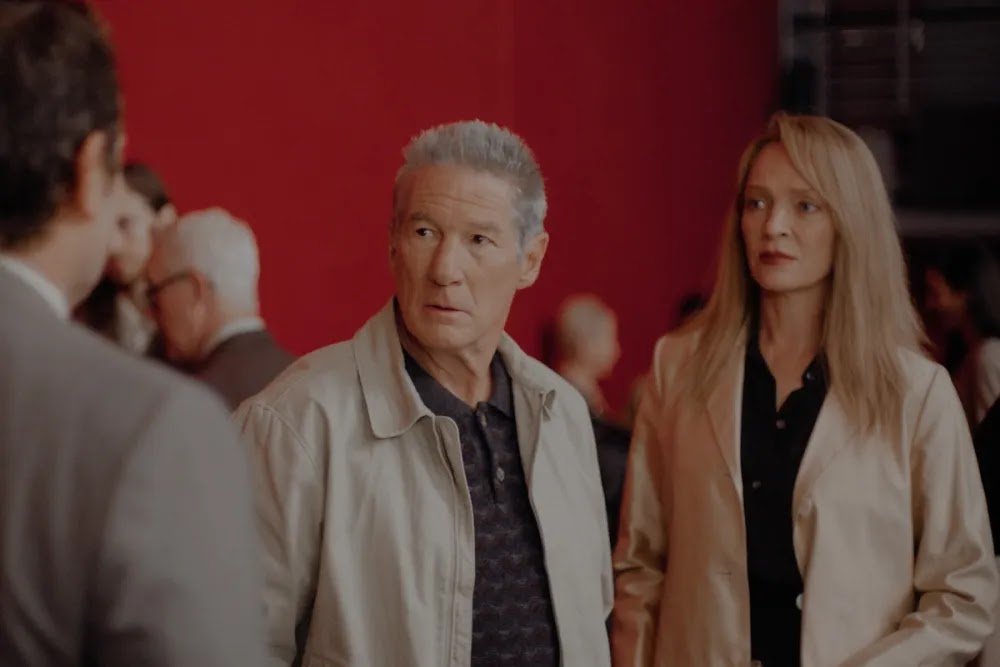
   Richard Gere, who starred in Schrader's American Gigolo (1980), reunites with the director to play Leo Fife, an American-born documentary filmmaker who fled to Canada during the Vietnam War. 
  Riddled with cancer, the aging Fife has agreed to allow two of his former students (Michael Imperiole and Victoria Hill) to make a documentary about his life and work. Fife insists that the interview -- really an extended deathbed confession -- be conducted in the presence of his wife Emma (Uma Thurman).
   Gere has been made to look gaunt and wasted. Cancer devours Leo's body, but lies and deceits eat away at his soul. He hopes to set the record straight. But Schrader has too much integrity to turn the story into a tale of last-minute redemption.
  Schrader fragments the story so that we see Gere playing Fife at various stages of his life. For the most part, though, a younger Fife is played by Jacob Elordi. Gere and Elordi create an account of Fife's life that may be distorted by memory but nonetheless makes a mockery of the director's reputation as a filmmaker of courage and conviction.
   An early episode illustrates the point. Fife, then married to his pregnant wife (Kristine Froseth), agrees to run the family business of his wealthy father-in-law, abandoning dreams of teaching and writing. He soon employs his modus operandi concerning women, he flees.
   Because Fife makes films, it's tempting to look for spiritual kinship between Fife and Schrader, but such speculations can be dicey. Leo Fife built a reputation by being a good filmmaker, but he has no laurels on which to rest. The scaffolding that upholds his vaunted stature has been subject to rot. Exposing it doesn't make it a less bitter pill to swallow.

Wednesday, December 4, 2024

Motherhood is no picnic in ‘Nightbitch’


  Judging by its title, you’d half expect Nightbitch to revolve around a woman gangster who terrorizes her male counterparts with cunning and fury. 
  Director Marielle Heller takes a different tack, directing Amy Adams in what seems intended as an archly comic  look at a woman who realizes that four years of unrelieved motherhood is pinching the life out of her.  
   Her career as an artist? Lost? Sleep? Gone. Sanity? Almost drained. Help from her husband? There's not much of that either. 
  Scoot McNairy plays the clueless husband who travels a lot for business. He's not an ogre, just an average guy who has no idea about the amount of work it takes to be a mom. Additionally, he deludes himself about how much he shares the load.
   As part of her numbing routine, Adam's character also meets with other suburban moms (Zoe Chao, Archana Rajan, and Mary Holland). They gather for story hours for toddlers at the local library. Adams’s character initially disdains what she views as their mindless child-centered lives, but she eventually learns that her compatriots share similar frustrations.
   Is there a way out of this trap? Known only as "Mother,'' Adams' character asks the local librarian (Jessica Harper) to recommend books about magical transformations. Mother's request is prompted by her belief that she's transforming into a dog, a four-legged creature that runs free at night in the company of other dogs.
    And, yes, the movie takes this metaphor literally. Mother's physical transformation begins roughly midway through. Mother notices whiskers and fur growing on her body. Her full dip into doghood requires an effects boost.
    As Mother discovers her inner animal, she also remembers her relationship with her mother, a preview of coming attractions when viewed in retrospect. 
    Based on a novel by Rachel Yoder, Nightbitch isn't subtle -- no need for that when dealing with simmering rage, but the set-up is amusing, and Adams, who put on weight and shed make-up for the role, givers her performance some bite.
    Too bad the movie concludes with a copout that comes close to undermining the story that precedes it. Before her movie's done, Heller files away the movie's sharpest edges, sending us out of the theater disappointed rather than stimulated by the story's satirical sting.

Monday, December 2, 2024

A boxer's search for redemption


At times while watching director Jack Huston's Day of the Fight, I felt as though I were watching an advanced acting class. You can almost feel actors digging to wring every bit of flavor out of every scene. Shot in black-and-white, Day of the Fight tells the story of a one-time middleweight champion trying to pull his life together after being released from prison. Michael C. Pitt plays Michael Flannigan, a boxer we follow on the day of his comeback fight at Madison Square Garden. Mike spends the day trying to mend fences with some of the major people in his life, notably his former wife (Nicolette Robinsonand teenage daughter. He also meets with his trainer Ron Perlman, an uncle (Steve Buscemi) who has been a major influence in his life, and a friend (John Magaro) from the old neighborhood who has become a priest.  Mike also visits the father (Joe Pesci) who tormented him as a kid but now is a demented old man staring out the window of the nursing home where he lives. Flannigan also makes a major bet on himself to win his bout. Huston's gritty New York story aims at the heart, but its beat is slowed by the extra weight of genre familiarity.


A daring 'Queer' doesn't quite payoff


   Much has been made about Daniel Craig's appearance in Queer, an adaptation of a 1985 novella by William S. Burroughs, the Beat writer best known for Naked Lunch. A movie titled Queer marks an obvious departure for Craig, the actor who starred in five James Bond movies.
    Queer takes Craig as far away from Bond as possible, giving him the role of a gay, heroin-addicted writer living in Mexico City during the 1950s, a decade that, at least in cliche, was rooted in conformity, repression, and exaltation of the mainstream.
   A literary exile of sorts, Craig's William Lee spends more time drinking than writing in the seedy digs he rents. Dissolute and needy, Lee never leaves his small apartment without a pistol strapped to his side. Meant for protection, the gun also becomes emblematic of an hombre image, a man willing to go the violent distance if necessary. He offers a reasonable approximation of what might be called the William Burroughs look.
    Although he has little trouble finding sex, Lee stumbles when it comes to deeper relationships. He sees an opportunity for more than a fling when he meets Eugene (Drew Starkey), a handsome young photographer who we know will frustrate Lee's desires. Eugene quickly makes it clear that he has little interest in emotionally connected relationships. 
   Persistent to the point of obsession, Lee clings to Eugene, who seems untethered from nearly everything.
    Eventually, Lee persuades Eugene to accompany him on an Ecuadorian adventure. Lee plans to take a drug he's heard can make people telepathic. He hopes a psychedelic will enable him to bond with Eugene, assuming Eugene will reciprocate. Seen from the outside, the idea that they might become soul mates becomes the delusional denouement of an exotic travelogue.
   Working from a screenplay by Justin Kuritzkes, director Luca Guadagnino uses the last third of his movie to conjure images of psychedelic tripping; he adds a touch of surrealism to the proceedings, a disorienting arrival considering the carefully studied grit of its Mexico City scenes. (Much of Queer was shot in studios.)
    Guadagnino has built a reputation for “art” movies with gay content, Call Me by Your Name being a prime example. The sex scenes in Queer are more graphic than anything Guadagnino included in Call Me by Your Name.
     A small supporting cast relieves the movie's thematic claustrophobia. Lesley Manville appears as an eccentric botanist who has been studying South American psychedelics, notably a drug called Yage. A resident of the jungle wilds, she's gone a bit bonkers. 
      In what might be his most interesting work to date, Jason Schwartzman plays Joe Guidry, a gay friend of Lee's who lives in Mexico City and who seems to enjoy rambling on about his many trysts. Joe's comfortable with himself in ways Lee can't be.
     Unfolding during a sometimes fatiguing two hours and 15 minutes, Queer slogs its way through three chapters and an epilogue, providing Craig with a platform from which to take a deep dive into alienation, self-abasement, and existential loneliness.
     But Queer has a dated quality. Burroughs wrote Queer in the late 1940s, when everything about it -- including its title -- might have seemed startling; for some. the novel became an immersive wallow in the defiance associated with living on the cheap, prowling dirty streets and sleeping on dirty sheets.
   To the extent that Queer can be seen as a thinly disguised memoir, it might generate interest among Burroughs enthusiasts or those who want to remind themselves that Craig, who has appeared in some 40 movies, successfully has escaped the Bond prison.
     Queer gives Craig plenty with which to work, but the movie -- part endurance test and part curiosity -- never coheres into the bold, challenging work that must have been intended. 
     I'd call it a missed opportunity, but I'm not sure for what.