Showing posts with label Boyd Holbrook. Show all posts

Wednesday, December 18, 2024

Rolling into Bob Dylan's early days


 Timothee Chalamet does his own singing in A Complete Unknown, director James Mangold's lively look at the years Bob Dylan transformed from a folk music prophet into an electrified and electrifying musician who defied classification.
  Although his voice isn't quite as gritty as Dylan's, Chalamet comes close enough to keep the movie credible, and Mangold, who told Johnny Cash's story in Walk the Line (2005), adds enough rising-star power to make for a captivating entertainment.
  Chalamet and Mangold meet Dylan on his terms or their idea of Dylan's terms. A Complete Unknown isn't an interpretation of Dylan's work or life. It's a cultural chronology that begins in 1961 when Dylan -- formerly Bobby Zimmerman -- arrives in New York City. He was 19.
   Dylan has a mission: He wants to visit folk legend Woody Guthrie (Scoot McNairy) who by then was hospitalized in New Jersey with Huntington's disease. He also catches the eye (and ear) of Pete Seeger, played by Edward Norton in a smartly shaded performance. 
    Seeger recognizes Dylan as more than a wannabe trying to worm his way into an already established milieu. That may have been partly true, but Dylan had the chops and imagination to pay his own way.
    Tagged as an original, Dylan also came to the attention of Joan Baez (Monica Barbaro), an established folks star. Their musical and personal relationship seemed to mean more to her than to him.
     The movie also depicts Dylan's relationship with Sylvia Russo (Elle Fanning), an artist based on Suze Rotolo, a former Dylan girlfriend who passed way in 2011, long after the movie concludes at the fabled Newport Folk Festival in 1965.
    Dylan's shift from folk to rock causes a stir at Newport. Seeger struggles to persuade Dylan to use his star status to keep folk music in the forefront. Johnny Cash (Boyd Holbrook) upholds the opposite view, urging Dylan to follow his gut.
   Norbert Leo Butz plays Alan Lomax, the staunchest of Dylan's opponents, a folk purist who tries to keep Dylan's band off the Newport stage.
   The movie includes 40 songs, many of them Dylan favorites that are fun to revisit, even if they're not sung by Dylan. Whatever you think of Chalamet's singing, it never sounds like he's serving up cheap covers of classic Dylan tunes.
   I suppose it's arguable that Chalamet is impersonating Dylan, but that insults his effort. It's quite a feat, playing an enigmatic genius, imp, poet, and artist.
  The screenplay for A Complete Unknown was written by Mangold and Jay Cocks based on the book Dylan Goes Electric! by Elijah Wald; Dylan fans may know where fact leaves off and fiction begins. In interviews, Wald has called the movie "poetically accurate."
   As it happens, I witnessed Dylan's moment of transition. As a young reporter, I covered a concert Dylan gave at a Syracuse, NY arena then known as the Onondaga War Memorial. During the first half of the concert, Dylan appeared alone on stage and sang the songs that had breathed new life into folk music.
    In the concert's second half, Dylan was joined on stage by the Paul Butterfield Blues Band. Half the crowd cheered; the other half screamed its disapproval, "Bring back the real Bob Dylan," I remember hearing someone yell.
   Dylan pressed on, like, say, a rolling stone.
   I don't know if Bob Dylan, who's now 83, ever has been knowable. Mangold suggests he was ambitious, difficult, and creative, cruel at times, and caring, at other times. If Dylan's career is about anything, it's about resisting definition. 
   Maybe that's why Mangold can't and probably didn't want to offer a definitive portrait. Instead, he highlights touchstones in a career that produced the only songwriter ever to win a Nobel Prize for literature. 
  Mangold, Chalamet, and the rest of the cast bring what could have been a dusty time capsule of a movie to life. That was more than enough for me.


Wednesday, June 19, 2024

'Bikeriders' revs a 1960s engine


  In 1953, Marlon Brando climbed onto a motorcycle and created Johnny Strabler, a character that became an iconic figure who still adorns posters in his leather jacket and tilted cap. The Wild One may not be a great movie, but it stands as a reference point for movies that try to capture the spirit of rebellious youths who impolitely ram their heads against the walls of social convention.
   Bikeriders -- from writer/director Jeff Nichols (Loving, Mud) -- opts for immersion in the midwestern motorcycle culture of the 1960s, basing its screenplay on The Bikeriders, a 1968 book by Danny Lyon. Lyon photographed and documented the lives of members of the Chicago Outlaw Motorcycle Club.  Nichols, who also wrote the screenplay, builds from interviews Lyons (played in the movie by Mike Faist) conducted from 1963 to 1967.
    A prime interview subject, biker girlfriend Kathy (Jodie Comer) becomes the viewer's guide through biker culture. Kathy knows the gang well because she married Benny (Austin Butler), the coolest gang member, a guy who'd rather be beaten silly than remove his Vandals jacket. 
      An actor's feast; Bikeriders boasts riveting, immersive performances from Butler, Comer, and Thomas Hardy, who plays Johnny, the founder of the Vandals -- as they're called in the movie. 
    Hardy can be one of the screen's most imposing actors. Intimidating as a violent leader inspired by The Wild One, Johnny expresses himself through action. When he squares off against an opponent, Johnny asks whether they'd rather fight with fists or knives. They'd be well advised to back down.
      Taking their cue from Lyons' photographs, Nichols and cinematographer Adam Stone create a movie with plenty of dirt under its fingernails. Much of Nichols's episodic story unfolds in the shot-and-beer joint the Vandals adopt as their clubhouse. Riding their bikes in formation, they're a fearsome lot.
      As impossible to ignore as a piece of loud clothing, Comer’s clipped Chicago accent defines a character who's smitten by Benny, whose don't give-a-damn-cool and movie-star looks prove irresistible to her. 
      If it hadn’t been for sexual attraction, Kathy might never have encountered the Vandals; she could have been snapping gum with other girls at some local diner and talking about boys. Instead, she entered a world ruled by the bikers' idea of muscle and manhood.
      When I saw that the cast included Michael Shannon, I wondered how he'd fit into the gang. Not only does Shannon make an impression as Zipco, he also defines one of the group's sensibilities. Zipco hates pinkos, the word he uses to express contempt for loafer-wearing college types
       Other bikers include Brucie (Damon Harriman), Cal (Boyd Holbrook), and Funny Sonny (Norman Reedus), a laidback West Coast arrival who joins the gang. These characters give Nichols an opportunity to explore group pressures. What happens when someone outgrows the gang and wants to leave, for example?
     The story narrows to a tug-of-war between Kathy and Johnny. Tired of trying to keep the Vandals going, Johnny wants Benny to take over the gang. Kathy wants him to settle down. She's had enough of the biker life.
     At the same time, the Vandals are morphing into drug-dealing rogues. Initially rejected by the Vandals, a Milwaukee rider (Toby Wallace) tries to redefine the gang, pushing it toward criminality. 
     For his part, Johnny has trouble relating to a new generation of young men who don't care about the unwritten codes by which the Vandals live -- not that the Vandals were angels before the influx of nihilistic newbies.
      Earlier, I described Bikeriders as a feast for actors. The cast swallows it whole. Even Butler's portrayal of a character that seems drawn from an amalgam of characters from other movies has the right kind of presence. He's more magnetic here than he was as Elvis.
      The trailer for Bikeriders bills the movie's characters as freedom-seeking rebels, but Nichols doesn't seem to be after a big statement; he accepts these characters as they are. But what should we make of them?
     That's where the rubber meets the road for me.  Are these riders relics from a moment that has passed its expiration date or do they have something more relevant and deeper to tell us? And who are these guys and what in their experiences made the biker life so appealing?
     Bikeriders documents the 1960s outlaw/motorcycle scene. The movie crackles with dramatic moments but doesn't have much of a dramatic arc. Rough naturalism and vivid performances give the film its charge, but sans a layer of countercultural romanticism (see Easy Rider) or a more compelling story, we're left to wonder whether there's anything left for the movie to latch onto.

Thursday, July 28, 2022

A trip to Texas that’s not afraid of detours

      
      Send a self-centered New Yorker to Texas and he's bound to arrive with baggage, say a suitcase full of inflated superiority.
     That's Ben Manalowitz, a New Yorker writer who thinks that every story must point to themes large enough to justify his decision to write about it.
     Ben's always looking for definitive statements, an ambition that blinds him to the people who are right in front of him.
     Fortunately, BJ Novak, who wrote and directed Vengeance, the story of Ben's Texas trip, doesn't share the same limitation. Novak has made an entertaining culture-clash comedy full of characters who are more than they seem. 
     Ben (Novak) also writes for a podcast produced by an editor (Issa Rae) who encourages him to dig deeply into a Texas story he discovers when he's drawn into a mystery involving Abby, a woman that he casually hooked up with in Manhattan.
     As it happens, soon after Abby returned to her small Texas backwater home, she turned up dead.
     Abby's family believes that Ben and Abby were more than a one-night fling. That's why her brother Ty (Boyd Holbrook) insists that Ben attend Abby's funeral, where he’s even asked to speak. 
      Ty believes that his sister was murdered. No way she died of an opiate overdose, says Ty, who doesn't accept the coroner's report. Tye wants Ben to help him find the murderer and avenge Abby's death.
    Isn’t that what any significant other would do? And why doesn't Ben just take up residence with Abby's hospitable family while the vengeance plot brews?
     As the movie progresses, Ben's inquiries lead him to Quentin Sellers (a terrific Ashton Kutcher). A music producer who worked with the dead girl, Sellers quickly upends Ben's expectations by delivering a surprisingly astute monologue. 
       Novak creates a main character who isn't instantly likable. Ben thinks he knows more than he does. He can't see beyond the story he thinks he’s telling. Maybe it's just a story he's telling himself
       Vengeance may strike you as talk heavy. It is, but some of the conversations are pointed and the so-called rube characters prove more perceptive than Ben initially suspects. 
       Without straining for effect, Novak toys with red-state cliches -- not only for blue-state Ben's edification but for ours. Don't panic, though; he's not singing Kumbaya, either.
        I won't reveal the movie's ending but honesty forces me to tell you that I'm still trying to come to grips with it. 
        But, hey, I also need to say that Vengeance wisely sidesteps being the kind of movie its suggestive title implies. 
       One last thing: Don’t be surprised if the movie leaves you hungry for a Whataburger.
       

Thursday, February 17, 2022

Bob's Cinema Diary: 2/18/22: 'The Cursed' and 'A Banquet'

 From Get Out to Midsommar, we've seen a variety of attempts to elevate the horror film, adding levels of meaning and creepiness to what otherwise might have been routine genre exercises. Two new films -- The Cursed and A Banquet -- try to follow suit, but neither achieves the level of seriousness that must have been intended -- and, to put in inelegantly, neither likely will scare the crap out of you either.

The Cursed

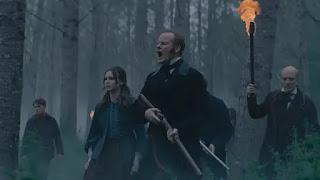
Slow-moving and mired in period trappings, The Cursed tries to marry a werewolf movie to a cautionary tale about the horrific consequences that accrue to greedy landowners who preside over a fog-shrouded rural French village during the 1800s. Landowner Seamus Laurent (Alistair Petrie) rallies a group of fellow owners to expel gypsies from their property. The gypsies, we learn, have a legal claim to some of the land but the avaricious landowners refuse to acknowledge its legitimacy. A brutal mercenary raid on the gypsy encampment unleashes a dark force embodied in a werewolf that begins terrorizing the area, leaving a string of bodies in its ravenous wake. Director Sean Ellis's lugubrious effort -- heavy on fog and candlelight -- is what you might expect if Masterpiece Theater opted for horror. Ellis serves up meticulous details and serious performances, notably from Petrie as the landlord and Boyd Holbrook as a pathologist who investigates the disappearance of the landlord's son and other horrific assaults. Though set in France, the production seems more English as the story unfolds in a 35-year flashback from a gruesome World War I sequence that opens the movie. The werewolf -- eventually seen -- appears more reptilian than furry and Ellis moves toward a fiery conclusion. The Cursed could have been improved by a quickened pace and a little more discretion in showing the werewolves. Beyond that, the story seems trapped by a Gothic seriousness that it must carry like a weight. The Cursed stands as a kind of mood piece interrupted by splashes of violence and spilled guts.

A Banquet

Unlike The Cursed, A Banquet sidesteps the traditions of classical horror. No werewolves or vampires stalk director Ruth Paxton's story about a teenager (Jessica Alexander) who stops eating but mysteriously loses no weight.  Wandering away from a party, Alexander's Betsey witnesses a blood-red moon and, as a result, has a transformative experience.  Suddenly, she's distant, prone to violent outbursts, and repulsed by food. Betsey's  recently widowed mother (Sienna Guillory) and her younger sister (Ruby Stokes) begin to suffer the consequences of Betsey's transformation. Lindsay Duncan plays the girls' grandmother, a practical woman who believes Betsey is putting on some kind of adolescent show. For her part, Betsey insists that something dark approaches. Mother/daughter tensions, stark interiors, feelings of isolation, and oodles of suggestion sustain interest but the movie ultimately proves more evasive than enlightening and its ending ... well ... the movie eventually ends. Many topics remain developed, including disordered eating. In short: Lots of talent on display here but staying connected to an often vague story can be a challenge.


Wednesday, August 11, 2021

He's on the run but doesn't know why


 Italian director Ferdinando Cito Filomarino directs John David Washington in a thriller that has its moments but ultimately fails to find a galvanizing gear. Washington plays the title character, a young man who's vacationing in Greece with his girlfriend April (Alicia Vikander). The couple leaves Athens because their hotel happens to be situated on the spot where an upcoming political protest has been scheduled. When two people seem as happy as Beckett and April, it hardly comes as a surprise when tragedy strikes. On a country road at night, Beckett falls asleep at the wheel. His car topples down a hill and crashes into a house. April doesn't survive the accident. Not only must Beckett deal with grief and guilt, but he also  finds himself running from a policeman (Panos Koronis) and the cop's female associate (Lena Kitsopoulou). Beckett, who speaks no Greek, has no idea why he's being pursued. The details are mostly irrelevant, but Beckett unwittingly finds himself in the middle of a plot against a leftist candidate that also involves a kidnapping. Beckett tries to outrun his pursuers as he makes his way to Athens and the American embassy. Along the way, Beckett meets two activists (Vicky Krieps and Maria Votti) who give him a ride. Boyd Holbrook, part of a cast of undercooked supporting characters, shows up as an American embassy official whose offers of help may conceal other motives. Beckett's final flight pushes him into violent action. This last-act eruption may have been intended to reflect the frustration Beckett has been building for the entire movie, but it can seem more like a last-minute attempt to up the action ante.  Beckett gets what it can from its Greek settings, but can't distinguish itself as either a straight-ahead thriller or a political drama.