Showing posts with label Owen Wilson. Show all posts

Thursday, July 27, 2023

A mansion haunted by a lack of fun


I didn’t expect much from Haunted Mansion, Disney’s second big-screen version of a movie inspired by one of its popular theme park attractions. That's precisely what the movie delivers: not much. Gone is Eddie Murphy of the crummy 2003 installment, replaced by a team led by LaKeith Stanfield and supplemented by Rosario Dawson, Tiffany Haddish, Owen Wilson, Danny DeVito, and in a smaller role, Jamie Lee Curtis. An effects-laden amusement that seldom engages, Haunted Mansion  casts Stanfield as a disaffected astrophysicist and ghost skeptic who’s grieving the loss of his wife. Dawson plays a mother who, along with her nine-year-old son (Chase W. Dillon), moves into a dilapidated New Orleans mansion that might as well sport a neon sign, something on the order of “this way to the ghosts.”  Mother and son miss the boy’s late father. Haunted Mansion feels more like a dated amusement park fun house than a contemporary chiller — but without much of the “fun.’’ Had Disney allowed Haddish — who plays a medium — to cut loose, the movie might have saved itself, although it also might have sacrificed its PG-13 rating. Buried by CGI and make-up, Jared Leto plays the Hatbox Ghost, the badass ghost who wants to trap the rest of the cast in the mansion. Hotbox must be vanquished to lift a long-standing curse -- or some such. Attempts to deal with issues involving grief prove shallow; director  Justin Simien’s movie falls short as either comedy or frightfest. The cast deserved better — and so did we.

Thursday, April 6, 2023

Bob's Cinema Diary: April 7, 2023: 'Paint' and 'One True Loves'

 
Paint

   Carl Nargle is a star at a small Vermont PBS station. His Afro-style doo, trademark pipe, and hushed delivery have turned his show, Paint, into a narcotic for those who want to be reassured that the world is OK. If you think this sounds a bit like PBS's Bob Ross, you'd be right -- sort of
  But Paint, the movie in which Owen Wilson plays a small-town celebrity who's losing his mojo, is less a fictionalized portrait of Ross than an ineffectual comedy about a deluded man who's losing his meager helping of fame. 
  The station where Carl works hires another painter (Ciara Renee) to bring new life to its lineup. Renee's Ambrosia proves popular with younger viewers; her painting is riskier than Carl's, although she doesn't seem to be particularly gifted, either.
   In sone ways Paint is a comedy of incompetence, bolstered by a  station manager (Steven Root) who appears not to know what he's doing. 
   In addition, Carl has relationship problems. A womanizer who works out of the back of his van, Carl can't be relied on for fidelity. 
   Michaela Watkins plays an assistant manager who once was Carl's great love. Lucy Freyer portrays a young station hand who falls for Carl but eventually realizes that his soft-spoken voice -- applied like a delicate brush stroke -- masks his narcissism and laziness. Carl repeatedly paints one scene, a Vermont mountain.
   Wilson inhabits the character with apparent ease, but the satire isn't sharp enough and writer/director Brit McAdams doesn't comment on the way that Nargle might be contributing to a warped understanding of artistic endeavor. 
    In all, the movie has much the same effect as one of Nargle's shows. It calms without ever finding anything much to say.

One True Loves

One True Loves adapts a novel by Taylor Jenkins Reid for the screen. Director Andy Fickman centers the story on Emma (Phillipa Soo), a h
appily married travel writer. Emma hopscotches the world with her husband (Luke Bracey). The screenplay’s major twist occurs when Bracey's Jesse, a photographer by trade, accepts an assignment at a remote location. He doesn't return and is assumed to have died in a helicopter crash. Emma grieves but eventually moves on with her life. She becomes engaged to steady Sam (Simu Liu), a music teacher who has zero wanderlust. By this time, Emma has taken over her parents' bookstore and has discovered the joys of sedentary living in small-town Massachusetts. But a major snag arises. Jesse somehow survived the crash, spent the last four years on a desert island, and now has returned. What's Emma to do? Marry Sam? Resume her relationship with Jesse? The screenplay eventually eases the way for Emma's decision, but en route, it includes sappy scenes, a few lame attempts at drama, and at least one scene in which Sam inappropriately shares his problems with his students. It's meant to be funny, but like many of the movie's other attempts at humor, it misses. OK, many movies rely on some level of contrivance, but in this case, contrivance crushes credibility.

Thursday, February 10, 2022

JLo as a superstar who finds love


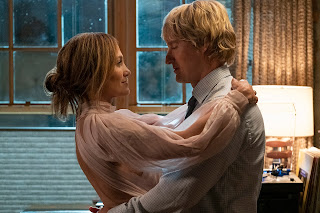
   At one point in Jennifer Lopez’s rom-com, Marry Me, Lopez’s character — a singing sensation named Kat Valdez — tells her audience that love is nothing more than a fairy tale. 
   Poor Kat. She’s flustered because Bastian (Columbian singer Maluma) her equally famous fiancee has been unfaithful to her, news Kat learns moments before the two are scheduled to be married in a grand ceremony during a concert at Madison Square Garden.
  So, yes, weep for Kat. What she thought would be the best of her several previous marriages has gone up in flames.
  There isn't much irony in saying that Marry Me — the title is taken from a hit song that Bastian and Kat have recorded together — qualifies as its own lavish fairy tale complete with musical numbers, product placements (Coach and Guess, among them), and an unashamed commitment to formula.
   Shaken emotionally, Kat decides — during the concert — to marry a stranger, a divorced Brooklyn-based math teacher (Owen Wilson) who’s attending the concert with his teenage daughter (Chloe Coleman) and his school’s gay guidance counselor (Sarah Silverman), the woman who procured the tickets and provides what there is of the movie's comic relief.
    Wilson’s baffled Charlie heads to the stage and the two marry. It’s not supposed to last. It's Kat's impulsive attempt to demonstrate how hollow marriage really is, not to mention a slam at the self-impressed Bastian.
   So that’s the formula: Two unlikely characters are united in a sham marriage. They gradually get to know each other and, here's a shock, they fall in love. 
  A last-minute change of heart by Charlie serves as the third-act obstacle that must be overcome before the couple is reunited —at a math competition in the midwest no less.
   Wilson does his best to create a human-scaled character but the movie makes no bones about being a star vehicle for Lopez — bold, glossy, and operating in a sphere beyond ridiculous, a place where a major star visits a junior high school classroom and charms the students in Charlie’s math club.
   See, Kat really is a down-to-earth human being
   If audiences weren’t willing to accept ridiculous fantasy, a whole lot of movies never would have been made.
    That means there’s an audience for Marry Me and, say this, Lopez doesn’t shortchange the audience when it comes to musical numbers. One involves female dancers dressed (sort of) as nuns and  male dancers with turned-around collars.
     Such moments may be overproduced but Lopez knows how to sell a song even as she splashes her way through what may turn out to be the silliest, most shallow rom-com of the year. 
    

Thursday, June 17, 2021

This football story fails to score


12 Mighty Orphans exemplifies what happens when a sports movie goes stale.  It’s almost as if someone found the movie in a vault and couldn’t quite shake the mold off it. Dreary by Depression-era trappings pervade this story of an underdog high-school Texas football team. The story focuses on a Fort Worth orphanage where many kids were abandoned by economically ravaged parents who no longer could care for them. Based on a true story, the movie shows how an innovative football coach, Luke Wilson's Rusty Russell brought a ragtag team to a high school championship game. The film tries to draw additional poignancy from the fact that Russell himself was an orphan. Every movie set in an orphanage needs an ogre. In this case, Wayne Knight fills the role as a tyrant who's embezzling funds and administering severe beatings to the young men of the Masonic Home for Orphans. The film also needs a kindly doctor, preferably one with a drinking habit: Enter Martin Sheen as Doc Hall. There's also the angry kid (Jake Austin Walker) who must learn to channel his fury onto the football field. Director Ty Roberts includes scenes in which Russell has PTSD-driven flashbacks to his combat days in World War I. The movie also bogs down in dealing with issues involving the orphanage's eligibility to compete at the highest high school level. Treat Williams shows up as a newspaper publisher who becomes a fan of the Mighty Mites. Blink and you'll miss a cameo by Robert Duvall. For all its trying, 12 Mighty Orphans feels as dusty and diminished as the Texas landscape. I'm no judge of Texas accents, so I'll assume the cast hit the right notes, but in the case of 12 Mighty Orphans, hitting the right notes results in a movie that's neither a devastating look at Depression-era suffering nor a rousing football yarn. The movie's not just old-fashioned; it’s just plain old.


Friday, November 24, 2017

'Wonder' has lots of YA appeal

Because of scheduling conflicts, I was unable to attend an advance screening of Wonder, the big-screen adaptation of R.J. Palacio's 2012 YA novel. Directed by Stephen Chbosky and starring Julia Roberts, Wonder tells the story of 10-year-old Auggie (Jacob Tremblay), a boy born with facial deformities. Roberts portrays Auggie's mom, a caring mother who decides that it's time for Auggie to leave the protected safety of home schooling and attend school with other kids. Owen Wilson appears as Auggie's dad, a father who thinks it's a mistake to expose Auggie to the bullying and ridicule that surely will taunt him, even in an upscale New York City private school. The Pullman family, of which Auggie is a member, lives comfortably in a Brooklyn brownstone. No arguments about money in this household. Wonder touches many bases. Auggie's older sister Via (Izabela Vidovic) tends to be neglected by her parents, who are consumed with Auggie's welfare. Via has her own problems: Her best friend (Danielle Rose Russell) stops speaking to her at the beginning of a new school year. Julian (Bryce Gheisar) becomes Auggie's chief tormenter; Jack (Noah Jupe), a scholarship student who's not sure he fits in either) befriends Auggie. Mandy Patinkin portrays the school's understanding principal; Daveed Diggs appears as one of Auggie's teachers, and Nadji Jeter plays Via's boyfriend. The performances are all up-to-snuff in a movie that explores real issues in an idealized environment. Chbosky (The Perks of Being a Wallflower) engineers the story to jerk some tears and provide hope. Wonder qualifies as worthy YA fiction. I saw it at a showing that was full of kids, who seemed involved in the movie's every turn, but as an OA (old adult), the movie struck me as a bit of an after-school special -- albeit one emboldened by marquee names and an estimable message; i.e., that we never can be entirely sure we understand why people behave as they do.

Thursday, February 11, 2016

Another visit from Derek Zoolander

Ben Stiller revives a character that should have been left alone.

The original Zoolander (2001) became a cult favorite in the days when you still could find a Blockbuster store at which you could rent a weekend's full of dumb comedies. Here we are, 15 years later, and you'll have to go to a multiplex -- at least for a while -- to catch the even dumber sequel, Zoolander 2.

But there's dumb funny, and just plain dumb, and after you chuckle at renewing your acquaintance with the movie's collection of "ridiculously good-looking" dopes, there's not much left to tickle the funny bone in this amped-up rehash.

I suppose ardent fans of the first movie will turn out, but despite the return of Ben Stiller (as Derek Zoolander), Owen Wilson (as Hansel), Will Ferrell (as Mugatu) and the addition of Penelope Cruz (as an Interpol agent, fashion police division), this one proves overproduced and undernourished.

The movie opens with the collapse of the Derek Zoolander Center for Kids Who Can't Read Good and Who Want to Learn to Do Other Stuff Good, Too. The building, a holdover from the first movie, falls into the East River.

A series of newscasters -- Katie Couric among them -- tell us that Derek's wife (Christine Taylor) died in the collapse. An incompetent father, Derek soon loses his son to social services and retreats to a cabin in the frozen wilds of extreme northern New Jersey.

He's so dispirited, he can't even do his patented Blue Steel look anymore.

We also learn that Hansel, Derek's modeling rival, has retreated from the limelight; he's ashamed to show his face, which was scarred when the Zoolander Center crumbled. Hansel now lives in the Malibu desert among of tribe of misfit nomads that includes Kiefer Sutherland and others who try to buoy Hansel's by catering to his taste for orgies.

Derek and Hansel soon are summoned to Rome for a big modeling job that could resurrect their faded careers. Zoolander goes so that he can prove he's capable of raising his 11-year-old son, played by Cyrus Arnold.

A series of cameos from the likes of Kristin Wiig, Sting and Benedict Cumberbatch doesn't do much to add merriment.

Justin Theroux, who appeared in the first movie, also turns up, as does Billy Zane, but the movie almost seems as if it's satirizing itself rather than poking fun at the world of high fashion.

The first movie had some difficulty expanding what began as a sketch into a full movie, and this one struggles even more with a Rome-based story involving the murder of pop stars and a plan to eliminate such fashion icons such as Vogue's Anna Wintour, Tommy Hilfiger , Vera Wang, Valentino, Marc Jacobs and others. Perhaps because they're good natured, these gods of fashion appear in the movie; they may live to regret it.

And, no, Donald Trump who did cameo duty in the first movie, skipped this one.

The fun wears out quicker than a fashion trend, leaving us wondering why anyone thought it would be a good idea to revive characters who should have been allowed to remain favorites of their zealous fans while leaving the rest of the world alone.

Tuesday, August 25, 2015

Senseless, relentless and cruel

Owen Wilson and Lake Bell play a mom and dad fleeing Asian rebels who are portrayed as savages.
No Escape, a rank helping of violence, makes the fate of one American family the focal point of attention in an unnamed Asian country that's consumed by rebellious street violence. Owen Wilson and Lake Bell, actors who usually work in comedies, are miscast as a Mom and Dad who wind up on the run with their two daughters (Sterling Jerins and Claire Geare). Pierce Brosnan turns up as a disheveled bum who's more than he seems. Brosnan's character sounds the movie's excuse for a theme (western money interests have screwed the Third World) and performs a couple of last-minute rescues. Guess it helps to have played Bond. Absent any significant thematic thrust, the movie comes off as another example of fear-mongering in which decent Americans are threatened by hostile, uncivilized thugs. Director John Erick Dowdle, who wrote the screenplay with his brother Drew, serves up lots of punishing violence and one vertiginous sequence in which Wilson's character tosses his daughters over a chasm between two tall buildings in order to save them. Dowdle works the movie's family over, but No Escape increasingly feels like an exercise in purposeless cruelty. Early in the movie, Owen's Jack Dwyer, who has come to the country as a mid-level businessman, leaves his wife and kids at the hotel where they're being housed. He wanders the city's market in search of a newspaper. Judging by how little Jack seems to know about the country he's in, you may wonder whether he's ever bothered to read one.

Thursday, January 8, 2015

Inherent confusion in 'Inherent Vice'

Paul Thomas Anderson tackles a Thomas Pynchon novel and ... well ... er ... that is ...
Director Paul Thomas Anderson has gone where no director has gone before; i.e., he has attempted to bring a novel by the reclusive Thomas Pynchon to the screen.

Those familiar with Pynchon's work immediately will understand why this is such an audacious endeavor on Anderson's part. Pynchon's novels aren't plot-driven, and frequently veer off into clouds of digression as he watches the social order break into bizarre fragments.

If a Pynchon novel doesn't always make sense in conventional terms, well, look around you. What really does?

When I was in college during the '60s, we were all devouring Pynchon's V., a debut novel that revolved around a character named Benny Profane.

Pynchon provided a counterweight to the formalized rigor of academic reading. We were smitten. We congratulated ourselves for getting "it," whatever "it" was.

In Inherent Vice, Anderson dips into Pynchon's 2009 neo-noir fantasy, an LA-based story that introduces us to a character named Doc Sportello (Joaquin Phoenix). Doc's 1970s life unfolds in a pot-induced haze that keeps him wandering through post-Manson, hippie detritus in a fictional town called Gordita Beach.

If the private eye was staple of 1940s Hollywood, he's reduced to blood-shot eye by Anderson, less a savvy guy with his own moral code than a bemused idler.

The movie opens when Sportello is visited by a former girlfriend, the elusive Shasta Fay Hepworth (Katherine Waterston). It seems Shasta Fay has become the lover of real-estate magnate Michael Z. Wolfmann (Eric Roberts).

Wolfmann has disappeared and Shasta Fay wants Sportello's help to locate him, presumably to save him from those who would put him in a sanitarium -- or something like that.

At this point, I'm going to let the ship that's carrying the Anderson/Pynchon plot sink. No more attempts to recount what can't be recounted. The plot is a blur of dodges, gestures and noir mimicry. Trying to follow it is a bit like getting lost in a new town without benefit of a map or GPS. You either panic and scream or you decide to enjoy the strange sights.

For me, these sights are embodied in the form of characters who enter the movie like figures from a pop-up book.

A sampling:

-- Sauncho Smilax (Benicio Del Toro). He's Sportello's lawyer, a guy who seems like a refugee from a Hunter Thompson story.

-- Lt. Detective Christian F. "Bigfoot" Bjornsen (Josh Brolin), an LA cop who specializes in civil rights violations.
-- Dr. Rudy Blatnoyd (Martin Short), a dentist who wears purple suits and heads a mysterious ring called Golden Fang.

-- Coy Harlingen (Owen Wilson), a saxophone player who's presumed to have died, but whose wife (Jena Malone) thinks he's still alive.

You can tell by the character names that Pynchon's universe is one of broad comedy carved with a satirist's knife.

I'm putting off my assessment for a bit because (as a matter of public service) I want to share with you the way that I watched the movie.

I tended to drift in and out of the various episodes. While each was unfolding, it held my attention, but as Anderson shifted from one bit to the next, I had difficulty remembering exactly where I'd been.

I enjoyed the music -- both Jonny Greenwood's score and the tunes selected by Anderson to accompany various segments. I chuckled. My mind wandered. I chuckled some more. My mind wandered some more.

When Reese Witherspoon showed up as Deputy DA Penny Kimball, I was amused to see her. She's one of Sportello's sexual companions and informed sources.

I felt a sense of alienated indifference as the characters exchanged information that seemed important to them, but left me shrugging.

The movie's narration -- delivered by Joanna Newsom as a character named Sortilege -- sometimes approaches Pynchon's eloquence, but doesn't necessarily clarify much of anything.

Two performances are of special note. Phoenix, who appeared in Anderson's The Master, brings stoned integrity and his own level of confusion to the role of Sportello.

He's best in scenes in which he squares off with Brolin's Bigfoot, a character who becomes a bold parody of a quintessentially starched Los Angeles detective. Bigfoot has a crew-cut and a fondness for phallus-shaped popsicles. Unashamedly brutal and a man of porcine appetites (he's always eating), Bigfoot stands as a kind of one-man satire of law enforcement at its worst.

Now, what to make of all this?

You can probably tell from the tone of this review that I'm not ready to rip into Anderson's movie. I hope you also can tell that it's an experience to which not everyone will take. The old adage -- it helps if you're stoned -- may be applicable here, an observation I offer not as an encouragement for pot smoking, but as a guidepost to the experience that awaits you.

I enjoyed some of the movie's asides, watching Bigfoot in a non-speaking role in Adam 12, for example. On top of everything else, the guy wants to be on TV. Martin Short made me smile, as did Sportello's visit to a massage parlor in the middle of nowhere.

I'm sure I'm leaving something out. The neo-Nazis who guard Wolfmann perhaps? I'm not sure it matters.

Was a time when I might have gotten more pleasure from this meander through a lost moment in the counterculture moors. I suppose in the end, Anderson didn't totally convince me that Pynchon's work should be brought to the screen, even with the help of the gifted cinematographer Robert Elswit who coats each scene with downside lacquer.

If you're an Anderson fan (and I mostly am), you probably owe it to yourself to give this one a try. If you're a Pynchon fan, you're already used to plots that leave you scratching your head.

Everyone else? I'd say that the movie unfolds as a series of digressions from ... well ... let's talk.

Did I feel hostility toward Inherent Vice? Not really.

Did I like it? Sometimes.

Was I bored by it? Occasionally.

Would I watch it again? Not immediately. Probably someday. Who knows?

Thursday, August 21, 2014

More men who've yet to grow up

If Matthew Weiner, creator of the landmark TV series Mad Men, accomplishes nothing else in his life, he will have earned a place in showbusiness history. Unfortunately, Weiner's first foray into big-screen entertainment isn't nearly as daring as his TV work. The major revelation offered by Are You Here are end-of-picture scenes in which Zach Galifianakis appears beardless. Other than that, you'll find only traces of Weiner's brilliance in a story about Ben and Steve, two friends (Galifianakis and Owen Wilson) who are going through separate crises. Things come to a head when Ben's father dies, and leaves him a ton of money, much to the dismay of Ben's more responsible sister, played by Amy Poehler). As it turns out, recently departed dad was living with a younger woman (Laura Ramsey), who attracts Steve's eye and who's stuck in full earth mother mode throughout proceedings. Questions arise: Will bipolar Ben finally start taking his meds? Will Steve, who works at an Annapolis TV station as a weatherman, ever set aside his glib, irresponsible ways? Neither Ben nor Steve is exceptionally interesting, which means the only reliable pleasure in Are You Here stems from some of Weiner's clever dialogue. It seems clear that Weiner wanted to do something that would be both funny and meaningful. I hope, in his next effort, he's more successful. This bromance takes few unexpected turns.

Thursday, June 6, 2013

Vince Vaughn, Owen Wilson go Google

Google may be a high-tech mecca, but The Internship downloads few laughs.
Just what we needed, another fish-out-of-water comedy, this one starring motor mouth Vince Vaughn and reliable goofball Owen Wilson. Make that two fish out of water.

The new comedy, The Internship, focuses on a couple of displaced salesmen who attempt a leap into the digital age.

Absent any other opportunities, this duo of former watch salesmen applies for an internship at Google's California headquarters, the high-tech playground where some of the movie was filmed.

The comedy mostly centers on the way two relics of the old economy try to blend with bright, young hotshots. These youthful techies also face an uncertain economic future, but they're totally prepared for the information-oriented economy that's beginning to attain near-imperial stature.

Overly long and not especially funny, The Internship -- which was directed by Shawn Levy (Date Night) -- misses a chance to bring a sharp satirical edge to material that seems ripe for it. Vaughn plays Billy, a character so mired in the '80s, he uses Flashdance as a source of inspiration. It's not a great joke to begin with, but then the movie acts as if it actually believes that Flashdance really did have something useful to say.

Working from a script by Vaughn and Jared Stern, Levy keeps the humor on obvious levels, but it's not easy to believe that two guys in their 40s could be this deficient in "technical" knowledge, particularly Vaughn's character, who's made to seem dumber than he needs to be.

An example: Instead of talking about going on-line, Billy talks about going "on the line." If that's your idea of wit, have it, but that (and much else about The Internship) struck me as strained and slightly pathetic.

Levy seems to be trying to freshen an old formula by setting his comedy in the middle of a high-tech mecca where the two older guys become part of a team that's competing with other teams for permanent jobs at Google, which the movie seems to regard as the equivalent of ascension into heaven.

The competition makes it possible to add characters who presumably are meant to woo a younger demographic. Dylan O'Brien plays the bright but jaded young teammate; Tobit Raphael portrays a home-schooled Asian mama's boy, and Tiya Sircar appears as the girl in the group who pretends to be more street smart than she really is. Josh Brener plays the team leader, the Google employee who's supposed to whip his charges into fighting shape.

In addition to designing apps and learning how to work Google's help line, the teams even square off in a Quiddich match.
I doubt that we needed more evidence that Google is a nesting place for the kind of young people who are fluent in Harry Potter-speak. At times, the movie makes Google look like summer camp for nerds with Type-A personalities.

Aasif Mandvi provides additional support as the stern Google manager who oversees the competition, and Max Minghella plays an overly competitive and eminently dislikable rival of our sometimes feckless heroes.

Being a red-blooded adult, Wilson's character falls for an older Googler played by Rose Byrne about whom, in this instance, there's little worth saying.

Cameo appearances from Will Ferrell and John Goodman are funnier than some of the more extended roles, although Goodman's playing a variation on the kind of supposedly savvy hustler he's played many times before.

You won't be surprised to know that Vaughn and Wilson, reprising their previous teaming in Wedding Crashers (2005), wind up helping their younger charges, cementing an otherwise uneasy relationship. A night of club-hopping in San Francisco helps build a bridge between generations.

Vaughn does his talk-fast, say-little shtick, as someone in the movie points out; Wilson relies on his oddball sincerity, and the whole thing passes without downloading enough laughs to make it a summer stand-out.

Put another way: Google top funny comedies, and The Internship isn't likely to show up -- unless of course Google -- which, among other things, comes off looking like a beehive of busy creativity -- compiles the list.


Thursday, October 13, 2011

A 'Big Year,' yes, but an awfully small movie

Owen Wilson, Jack Black and Steve Martin find a formula for blandness.
On the elevator leading to the parking lot after a preview screening of The Big Year, a woman asked me what I thought of the movie.

"Well, it certainly felt like a year to me," I said perhaps a bit too glibly.

My fellow passenger said she thought the birds were beautiful.

The birds? Yes, the birds.

Based on a book by journalist Mark Obmascik, The Big Year is about birders, enthusiasts who engage in a pastime that the uninitiated among us call bird watching. But some birders are more passionate than others, and the most passionate among them participate in a contest known as The Big Year. The winner: the person who sees the most species over the course of the year. The prize: The title, world's best birder.

Now, let me make something clear. I like stories about obsessive personalities. If birds are your obsession, I'm willing to listen for hours. But "The Big Year," a movie about passion and obsession, doesn't feel especially passionate or obsessive. It's a straight-ahead, mid-range production that neither annoyed nor thrilled me.

Director David Frankel (The Devil Wears Prada) builds his movie around three characters:

-- Kenny Bostick, played by Owen Wilson. Kenny is the most competitive and compulsive of the birders in The Big Year contest. He's so committed to piling up numbers that he badly neglects the wife (Rosamund Pike). She's remodeling their house and having difficulty becoming pregnant, a task made more daunting by her husband's prolonged absences.

-- Brad Harris, portrayed by Jack Black. Harris is employed but has the kind of slacker look you'd expect from a Jack Black character. Brad's at odds with his father (Brian Dennehy) over a life that's consumed by birds. His mother (Dianne Wiest) supports the preoccupation that has taken on greater importance for Brad than his occupation. She even makes his travel arrangements.

-- Stu Preissler, played by Steve Martin. Stu is a successful New York executive who goes into semi-retirement to compete in The Big Year. His wife (JoBeth Williams) has an independent life of her own, and is totally supportive of her husband's efforts.

That's the rundown. The movie spends most of its time making points: The Big Year competitors are secretive; participation involves extensive travel, including to Attu, Alaska, a hardship post that's also a birders' paradise, Of course, no one can participate in something this consuming without difficulty.

Each of the three main characters has a basic problem: Harris needs money to compete; Bostick must decide whether he's willing to sacrifice his marriage to be the world's best birder; and Preissler must determine whether he's going to give up the corporate world for good and settle into the beautiful retirement home he and his wife have built in Vail.

None of these "conflicts" leads to anything especially heavy; the movie feels light and its attempts at humor are mostly mild.

So what's missing?

As it turns out, the author of the book, Mark Obmascik, was in the audience at the preview screening I attended. In remarks before the film, Obmascik said that after a life of writing about cops, felons and politicians, it was a pleasure for him to write about people he actually liked.

And these characters are mostly likable, but on screen, they're also bland. Preissler and Harris team up in an attempt to defeat the arrogant Bostick, but this is a movie of dull edges, underdeveloped subplots and undernourished secondary characters. The main performances? They're OK, nothing more.

Despite its stabs at conflict and laughs, The Big Year qualifies as the cinematic equivalent of easy listening. It's pleasant, which - I admit -- may be damning with faint praise. And, yes, the birds are beautiful.

Friday, June 24, 2011

Speedy 'Cars 2' misses the magaic

Pixar moves into the fast lane for a sequel that doesn't flame out, but is burdened by too much plot.
Pixar and Disney have revved up their engines for Cars 2, an action-oriented sequel to the more subdued 2006 original, which took place in the sleepy desert town of Radiator Springs.

This time, the Pixar team -- led by director John Lasseter -- delivers a globe-hopping series of races and action sequences that leap from the U.S. to Japan and, then, to Italy, France and the United Kingdom. Building his picture around motion and commotion, Lasseter serves up a creative hunk of animation, but it doesn't come close to Pixar's best work, say all the Toy Story movies, two of which Lasseter directed.

I admit it: I still have trouble adjusting to the notion of an all-car universe in which the cars talk and give each other high fives by bumping front tires. The only thing my car has ever said to me is, "More gas, please!" OK, maybe one time it said, "You think replacing the water pump was expensive, wait until you have to redo my clutch."

Watching Cars 2 requires picking through the clutter created by an overly complicated plot that's built around espionage, racing, alternative fuels and the importance of remaining loyal to friends. It's an eight-cylinder effort where six might have done nicely.

The movie finds Lightning McQueen (Owen Wilson) returning to racing to face off against Italian rival Francesco Bernoulli (John Turturro). An international Grand Prix has been set up by Sir Miles Axelrod (Eddie Izzard), a car that claims to have invented a replacement fuel for gasoline.

Always eager to race, McQueen risks embarrassing himself by agreeing to allow the buck-toothed Mater (a tow truck voiced by Larry the Cable Guy) to tag along. Unfortunately, Mater does more than tag along. He begins to dominate the picture. In tow truck or human form, a little Larry the Cable Guy goes a long way.

In case racing fails to provide sufficient kick, the movie adds two British spy cars: Finn McMissile (Michael Caine) and Holley Shiftwell (Emily Mortimer). They're trying to discover who's behind a scheme involving an army of cars that have been tagged as lemons.

Mater probably is over-exposed because the character has been given responsibility for creating the movie's emotional tug. Early on, Mater and McQueen have a falling out. It takes the rest of the movie for them to reconcile.

Now, I'm not saying that Cars 2 is a dud. The overall arc of the movie isn't especially satisfying, but the detailing can be great, and Lasseter's backgrounds are nothing short of stunning, beginning with the splashy Tokyo sequences. He (and co-director Brad Lewis) do a terrific job creating the sights of Paris and London.

In general, the movie lets you visit a vividly realized fantasy version of Europe, and you don't have to worry about where the dollar stands against the Euro. Too bad this Pixar move into the fast lane also features an unfortunate amount of heavy artillery. Who needs automatic weapons in an animated movie aimed at little kids?

Well, not just little kids. True to Pixar form, Lassiter makes a valiant (if not entirely successful) attempt keep both adults and children happy. Cars 2 is a buoyant helping of middle-grade entertainment that's destined to do good business.

How do I know? The kid sitting next to me at a preview screening thought the movie was "cool." His assessment may not capture everything there is to say about the movie's quality, but it probably tells you something about its commercial prospects.

Thursday, June 2, 2011

A fantasy about life in Paris in the 1920s

These days, Woody Allen seems to miss as often as he hits, but on occasion, he still connects. That’s the case with Midnight in Paris, Allen’s 41st film, a slender but entertaining amusement starring Owen Wilson as a Hollywood writer whose most ardent wish is granted: He gets to meet the inspiring artistic heroes who populated Paris during the 1920s.

Wilson’s Gil travels to Paris with his fiancée (Rachel McAdams) and her parents (Kurt Fuller and Mimi Kennedy). Eager to establish his own Parisian agenda, Gil wanders into the city one evening. Around midnight, he joins a group of revelers who ride by in a vintage yellow car.

Voila! Suddenly Gil finds himself in the company of such sanctified luminaries as F. Scott Fitzgerald, Zelda Fitzgerald, Ernest Hemingway, Pablo Picasso, Gertrude Stein and Cole Porter.

Gil’s time-travel life – romantic and fulfilling -- contrasts with his depleted life in the present. He’s engaged to a beautiful but superficial woman (McAdams’ Inez). He's also at odds with Inez's all-business father, and he's sick of his life as a “Hollywood hack.” Commercially successful but dissatisfied, Gil wants to write a novel.

Allen treats Paris with as much reverence as he has treated Manhattan, reveling in the city’s trademark sights. Like Gil, he seems to understand that to visit Paris is to experience both present and past, to view today's sights while absorbing the vibe left by the great minds that have inhabited this most infatuating of cities.

Allen’s treatment of Paris borders on the nostalgic, but he also questions Gil’s (and perhaps our) fantasies about the 1920s. Does anyone’s moment look as good as a brilliant moment in the past? And would that past – if we could live in it – really meet our expectations?

Like Sean Penn in Sweet and Lowdown, Wilson delivers Allen’s lines without being trapped in an Allen imitation. Wilson doesn’t really fit into the Allen mold, which may explain why he holds his own. Wilson’s mixture of naivete, inadvertent humor and gee-whiz romanticism serves the character he’s playing.

Midnight in Paris features a large cast. Standouts include Kathy Bates as Gertrude Stein; Corey Stoll as Hemingway; and Adrien Brody as Salvador Dali. Marion Cotillard is stuck playing Picasso’s winsome muse, an irresistible woman who contrasts with Gil's shrill and insensitive fiancée and her all-business family.

Midnight in Paris survives on charm and clever moments, not the least of which involves Gil’s suggestion that the great Luis Bunuel (Adrien De Van) make a movie about upper-crust guests who are unable to leave a dinner party, a premise that – of course – describes Bunuel’s 1962 Exterminating Angel, a biting satire.

Allen isn’t a satirist. In Midnight in Paris, he’s a whimsical pessimist who ultimately instructs us in the art of acceptance: We must settle for what’s available in our own time. Allen also can’t end the movie without offering Gil a ray of hope in the presence of a potential new woman in his life, making for an ending that’s easier than we might expect from a movie built on admiration for artists who made a habit of not pulling their punches.