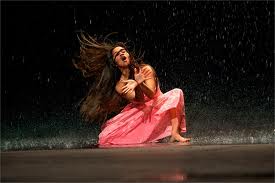
Director Win Wenders' Oscar-nominated documentary captures the ferocity in a choreographer's work.
To the uninitiated (that would be me),
Pina Bausch, the German choreographer who died in 2009, seems like a true original. Her dancers varied in body types and ages, and she concentrated as much on the movements of hands as she did on footwork. Movements in many of her pieces can have the look of body-contorting spasms that occur with machine-like repetition. Pina evidently eschewed the grace and beauty of traditional dance, preferring to find vigor in a dramatic farrago of play, wit, conflict and menace.
Director Wim Wenders' Pina, a documentary tribute to the choreographer and those who dance in her company, Tanztheater Wuppertal Pina Bausch, highlights the work of individual dancers, as well as of Pina’s entire company.
Selecting samples from four pieces by Pina, Wenders presents the dances without explanation, although he does include snippets of interviews with dancers, presented in voiceovers that accompany silent close-ups of each speaker.
Wenders reportedly had been planning to make a film with Pina, who died before that project could be started. Wenders shot the subsequent film in 3-D, and Pina has been widely hailed (along with Martin Scorsese’s Hugo) as an example of 3-D used to artistic advantage rather than to generate cheap thrills or to boost ticket prices.
Many critics have argued that 3-D allowed Wenders to capture a feeling for the space through which the dancers moved. I’m in a distinct minority here, but I didn't think Wenders consistently used 3-D to great advantage. And little in Pina substitutes (what could?) for the shock of immediacy that goes with live performance.
Oddly, Wenders greatest technical contribution, or so it seems to me, involves the sense of intimacy fostered by sound. We hear dancers breathing. We hear the movement of feet on a stage. Because some of Pina’s work included moments without music, these sounds add to the sense of rawness that characterizes much of Pina’s work.
Some of the dancing (Mueller’s Cafe, for example) is done on stage; some of it takes place in industrial settings; some of it transpires on what appears to be the median strip of a busy roadway. These locations add to the novelty of Pina’s challenging works, and keep the film from feeling as if the dancers have been hermetically sealed inside an art bubble.
But even the stagey numbers are not without interest. In an early piece (Rite of Spring), the dancers move atop dirt that has been spread across the stage floor; in another (Vollmond), they splash through a great puddle of water on a stage or scamper over a huge faux rock.
None of the dances are seen in their entirety, but Pina enables us to come away with a strong sense of Pina’s work, as well as an appreciation for the fierce striving of an artist who tried to capture something vivid and transformational.
Pina evidently was the kind of director who gave instructions that left plenty of room for interpretation. At one point, for example, she advised a dancer to consider becoming a little crazier.
Far from being flip, Pina's exhortation serves as a significant statement from an artist who knew that it's sometimes necessary to push past the edge of madness before one can feel free enough to speak.