Showing posts with label Talia Ryder. Show all posts

Thursday, September 21, 2023

Little guys want to get rich, too


      Some subjects don’t lend themselves to movies. The GameStop stock craze might be one of them. 
      Dumb Money — a movie about the short squeeze that hit GameStop stock in 2021— doesn't always clarify its complexities. The result: A lot of conversations about financial matters that aren’t likely to find a place in anyone's encyclopedia of great movie dialogue.
     Paul Dano plays Keith Gill, an obscure financial analyst who turned buying GameStop stock into a cause. With help from his YouTube channel, Gill created a legion of acolytes who followed his lead.
      The movie's supporting characters divide into small investors and big-time market movers. 
       The small fry struggle to outwit the big money and are represented by America Ferrara, as a single mom and hard-working nurse; Myha’la Harold and Talia Ryder, as college students who took a gamble; and Anthony Ramos, as a worker at a GameStop store.
      Director Craig Gillespie (I, Tonya and Cruella) sketches in several big-ticket investors: Vincent D’Onofrio plays hedge fund manager Steve Cohen; Nick Offerman appears as hedge fund manager Ken Griffin; and Seth Rogen portrays Gabe Plotkin, the financier who ran an investment company called Melvin Capital. 
     Sebastian Stan signs on as Vlad Tenev, a co-founder of  Robinhood, the trading app that became an important part of the saga.
     Gill comes closest to giving a scattered movie its center. We meet his wife (Shailene Woodley), his parents (Kate Burton and Clancy Brown) and his brother (Pete Davidson). Davidson provides comic flavor, adding a dose of cynicism and snark to the proceedings.
      Gillespie bolsters the movie’s authenticity with news clips, and uses graphics to show the net worth of each of the main characters perhaps to highlight major disparities between the rich and the wannabes.
        Dumb Money remains watchable, perhaps because it sweeps past us without worrying too much about dotting every "i'' and crossing every "t.'' You may want to do some googling about short squeezes or you simply can get the story's gist:  Based on their assessment that online purchases during a pandemic would push GameStop to the edge of bankruptcy, the Big Boys started short selling the stock. 
    The little guys kept buying, driving the stock price upward. Until trouble struck, the dumb money — Wall Street’s derogatory name for individual investors — seemed to be winning.
       Basing his movie on The Antisocial Network, a book by Ben Mezrich,  Gillespie gives the characters more quirks than depth.
         Gill calls himself Roaring Kitty and wraps a bandana around his forehead before positioning himself at his computer. He's also a compulsive runner.
       Cohen, who now owns the New York Mets, tosses food at the pet pig who shares his house, and Plotkin nervously juggles two homes while watching his investment company slide down the drain.
      But here’s the thing: These aren’t the most intriguing characters ever to reach the screen. The rich guys are pompous, callous and often avaricious. The little guys hope to better their lives. Everyone wants to emerge a winner.
        Sans an overriding  point of view, Dumb Money plays like a footnote to a larger story that's left untold. The movie asks us to root for the average folks without wondering why a nurse must struggle to pay her mortgage or why two college students at the University of Texas spend all their time thinking about money.
      Credit Dumb Money with generating a few laughs but the movie  doesn't leave us with much reason to invest additional thought in a story that rehashes yesterday's news.

Thursday, March 17, 2022

Two very different horror films: 'X' and 'Master'

    Contemporary horror has gotten meaty enough that I'm sure it has inspired doctoral theses wherever film studies are taught. Thanks in large part to Jordan Peele (Get Out and Us), racial prejudice has joined the world of horror movies. You can include the recent Candy Man in that category, as well.
  Then there's the world of horror served straight no chaser, movies that are more aligned with the history of horror than with any topical issue. These movies require that we know that filmmakers are keenly aware of horror conventions and precedents. Such films may be violent and even vile, but we're expected to be in on the joke. 
 
X
    Let's start with a movie that's both a riff on previous efforts and an attempt to deliver an alarmingly  sleazy helping of horror. 
  X walks in the bloody footsteps of Texas Chainsaw Massacre and a variety of other movies that aficionados will easily identify. 
   Director Ti West (The House of the Devil, The Innkeepers) also takes a bow toward Boogie Nights as he tells the story of a group of young folks who gather at an isolated farmhouse to make a porn film. The year: 1979.
    The cast includes the porn movie's female leads (Brittany Snow and Mia Goth) and a young woman (Jenna Ortega) whose original job involves the production's sound. Ortega's Lorraine eventually decides that if she's going to work on a porn film, she might as well be in one. Porn seems less a matter of talent than of a simple decision. Yes or no? The women decide.
   The men are represented by Martin Henderson as a low-rent impresario with few illusions about what he's doing. He's joined by Owen Campbell as RJ, an aspiring filmmaker who deludes himself into thinking he's making an independent film. Kid Cudi plays the well-hung Jackson, the male star of the porn film which is given silly a throwback title, The Farmer's Daughter.
    Trouble, of course, lurks. The crew has rented a facility from a farmer and his wife, characters we instantly recognize as lethally dangerous. Both are old to the point of desiccation with leathery skin that looks as if it might have been preserved in formaldehyde. 
     I won't get into spoilers but you should know that West doesn't skimp on gore or nudity. He tries to serve two masters: an audience that's hip to horror ploys but also wants to be creeped out and shocked.
     He does a bit of both in a movie that adds thematic weight to its blood-clogged pores, much of it centering on Pearl, the farmer's wife. Pearl laments the loss of her beauty and sexuality and, therefore despises, a youthful crew that has turned sex into something that requires only consent.
     The old woman wants nothing more than to be desired, the one thing age has denied her. West occasionally photographs her with backlighting that seems to liberate her from time and hints at how she might once have looked.
     (I haven’t named the actress that plays Pearl but suggest you look it up after you’ve seen the movie.)
     Occasionally, we see a preacher railing about sin and hellfire on a black-and-white TV in the farmer's house, a detail that yields an unexpected payoff before the movie ends.
     West does a reasonably good job of mixing skin and gore, although the movie's willingness to kneel at the altar of contemporary horror keeps it a bit hemmed in: We know we're watching a movie -- albeit one that inhales deeply and breathes sleaze.
       Whether you want to breathe along with it remains an open question. Know this, though, X may not transcend its horror  niche but it embraces it with unwavering commitment.
     
Master
    In Master, director Mariama Diallo takes a different tack. Diallo has made a horror film in which the characters are haunted by institutional racism at fictional Ancaster College.
      The prestigious school has a tarnished history.  In its early years, a woman was hanged for witchcraft. Since then the students have perpetuated a legend: Every year, the witch's ghost selects a freshman whose soul she will steal on the anniversary of her death.
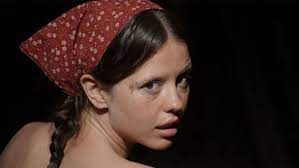
      Enter Jasmine (Zoe Renee), a high school valedictorian who we instantly know will be the witch's next target. Along with her roommate Amelia (Talia Ryder), Jasmine is assigned to Room 302, which has a history of turning at least one of its occupants into a victim. 
       It's less a room assignment than a sentence.
       At Ancaster, Jasmine faces both supernatural and social threats. The student body isn't welcoming. 
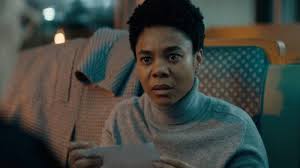
       A fine performance from Regina Hall as a housemaster and tenured academic helps raise questions about the price a black student pays to prove worthy in an institution steeped in white bona fides.
       Amber Gray plays Liv Beckman, a Black professor who pushes wokeness on her students. Jasmine's paper on  The Scarlet Letter earns an F from Beckman. Poor Jasmine. She failed to connect Hawthorne's story to critical race theory.  
      The film also makes room for a mystery about a woman who insistently phones Hall's character and, of course, there's the ghost.
       Master might be a case in which the horror could have been dropped to good effect. Racism in academia remains a valid and important subject and it might have benefited from a bit more subtlety.
        Eerie manipulations and obviousness aside, Master still manages to hit some powerful notes about the endemic persistence of racism in the so-called "best of circles."


Thursday, April 2, 2020

A teen's fight for an abortion

Never Rarely Sometimes Always brims with present-tense urgency.
Sometimes a movie succeeds because it doesn’t do the expected things. One such is Never Rarely Sometimes Always, a spare, no-nonsense look at a pregnant teenager who wants an abortion.

Director Eliza Hittman (Beach Rats) pushes us into the lives of her characters, only hinting at their backstories. As a result, Never Rarely has the kind of ragged, present-tense urgency we associate with the best of independent cinema.

The situation is tense. Seventeen-year-old Autumn (Sidney Flanigan) lives in a small Pennsylvania town where she attends school and works check-out at a local market. Too young to obtain an abortion without parental consent in her home state of Pennsylvania, Autumn takes matters into her own hands.

Thanks to a cousin (Talia Ryder) who pilfers some money, Autumn travels by bus to New York City, where she'll be able to pursue her goal without parental approval. Ryder's Skylar accompanies Autumn on her journey.

On the bus ride to New York, the young women meet a guy (Theodore Pellerin) who's interested in hooking up with them. Pellerin's Jasper has his eye on Skylar, the younger of the two girls.

When Autumn arrives in New York, she’s told that she’s 18 months pregnant, not the 10 months that the Pennsylvania clinic Autumn first visited claimed. Why might the first clinic have lied? The longer Autumn waits, the more difficult obtaining an abortion may become. Maybe that's what the religious-leaning Pennsylvania clinic wanted.

The social workers that Autumn meets as she tries to arrange for her abortion are understanding and helpful, but because Autumn is in her 18th month, she must wait an extra day to obtain the procedure. Without money, the girls are forced to play a waiting game, improvising in a city that doesn’t lend itself to killing time without funds.

This portion of the movie suffers from hang-out syndrome. The young women are killing time and, in a way, the movie must do the same.

The wrinkle that pushes Never Rarely beyond another foray into lower-class misery centers on Autumn's attitude. She never questions her decision. She knows that she’s not ready for motherhood and she wants to make sure that whatever chances she has in life aren’t compromised.

As played by Flanigan, Autumn can be distant, off-putting and difficult to read. She’s not asking for sympathy from anyone, including the audience.

And that's the point: The film makes no discernible pro-choice argument, but you can't help thinking that it's telling us that Autumn deserves to make an autonomous choice. Why not? She's already on her own. Her family (briefly seen early on) is incapable of giving her support. She must confront a series of red tape hurdles. The boys we see in Autumn's hometown are crass and cruel.

The title, by the way, derives from multiple-choice questions that a New York City in-take worker asks Autumn about her personal life. As the scene unfolds, we begin to learn more about Autumn. No details. Just simple one-word answers that open a door to Autumn's teenage life.

Autumn answers the questions. Our imaginations do the rest. We get the picture.