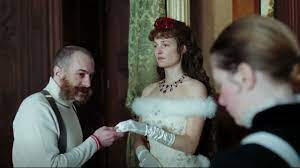
She sensitive about gaining weight, especially at age 40. She spends inordinate amounts of time having servants comb and braid her hair. She's a loving mother and a somewhat indifferent wife. She's widely known as a major figure in 19th Century Europe.
She's Elisabeth of Austria or, more precisely, a fictionalized version of an empress who once created international buzz.
Vicky Krieps plays Elisabeth in Corsage, a movie in which director Marie Kreutzer defies period-piece conventions. Kreutzer purposefully loads her movie with anachronisms, suggesting that any contemporary relevancies in Elisabeth’s story should not be ignored.
To cite two examples: At different points, you'll hear renditions of Help Me Make It Through the Night and As Tears Go By, not exactly 19th-century tunes.
Not everything about Kreutzer's approach works, but at her best, Kreutzer disarms, turning Elisabeth (known as Sisi in her day) into a woman defined by a role that she's increasingly reluctant to play.
As for the title, Corsage refers to the corsets that Elisabeth wears, instructing her handmaids to pull them so tight, they seem like instruments of torture. Metaphoric leaps encouraged.
Elisabeth cared about her waistline. She obsessed about it. For much of the movie, she seems so averse to eating that her behavior probably qualifies as an eating disorder.
The men in Elisabeth's life don't do much for her. Florian Teichtmeister plays Emperor Franz Joseph; he doesn't care if his wife's amorous attentions wander so long as she fulfills her public duties as a regal representative of the empire.
Elisabeth has freer relations with Louis Le Prince (Finnegan Oldfield), a visitor who introduces her to his invention, an early motion picture camera. She's attracted to a man who tends to horses (Colin Morgan) at one of her estates. But these relations don’t do anything to topple the rigid structure under which Elisabeth lives.
Although interestingly appointed and visually deft, Corsage belongs to Krieps, who creates a complex woman: petulant, rebellious, narcissistic, and keenly aware that she's losing the beauty for which she was widely admired.
Elisabeth also possesses a rueful understanding that nothing she says or thinks will impact her husband's decisions. She's meant to be the living equivalent of an official portrait.
Pay attention to the movie's third act, which sets up a tricky finale. Those familiar with Elisabeth's story will know that Kreutzer has taken many liberties, particularly with the movie's conclusion.
Krieps performance intrigues, as does this adventurous take on how to present an historical figure. Kreutzer and Krieps opt for humor, purposeful distortion of time and place, and, ultimately I think, respect for both the contradictions and resolve that marked Elisabeth's personality.


