Showing posts with label Vicky Krieps. Show all posts

Thursday, June 6, 2024

Viggo Mortensen directs a Western


Viggo Mortensen directs and co-stars with Vicky Krieps in The Dead Don't Hurt, a Western that looks as if it's trying to follow in the footsteps of genre-busting exercises such as Marlon Brando's One-Eyed Jacks. Defined more by silence than dialogue, the acting in The Dead Don't Hurt, a bit like the movie itself, can border on self-consciousness. Approached with a hyper-awareness of period detail, the movie works its way through two hours and nine minutes, employing a structure that involves abruptly inserted flashbacks. The basic story: A Danish immigrant, played by Mortensen, and a French Canadian woman of independent spirit, portrayed by Krieps, meet in San Francisco and migrate to a frontier outpost in Nevada where Mortensen's Olsen owns a dilapidated cabin. Krieps's Vivienne tidies up, adding warmth to the bleak surroundings, but Vivienne resists domestication -- not that Olsen tries to force it on her. Immigrant soulmates, Olsen and Vivienne try to define new lives in the West. When Olsen joins the Union Army to fight against slavery, Vivienne -- now alone -- has a predictably violent encounter with Weston (Solly McLoud), the town's bully and part owner of the bar where Vivienne has landed a job.  To further complicate matters, Weston's dad (Garret Dillahunt) is in the midst of a shady deal with the town's mayor (Danny Huston). Mortensen strains to defeat Western romanticism as The Dead Don't Hurt builds to the inevitable confrontation between Olsen and Weston. Mortensen only partially succeeds at subverting the genre's macho cliches by tossing a strong woman into a male-dominated pressure cooker. Delivering some of her lines in French, Krieps gives the movie's best performance, but The Dead Don't Hurt seems to be aiming for more than it delivers. 

Wednesday, January 4, 2023

A royal woman’s constricted life


   She sensitive about gaining weight, especially at age 40. She spends inordinate amounts of time having servants comb and braid her hair.  She's a loving mother and a somewhat indifferent wife. She's widely known as a major figure in 19th Century Europe. 
  She's Elisabeth of Austria or, more precisely, a fictionalized version of an empress who once created international buzz.
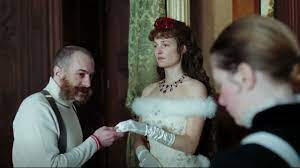
    Vicky Krieps plays Elisabeth in Corsage, a movie in which director Marie Kreutzer defies period-piece conventions. Kreutzer  purposefully loads her movie with anachronisms, suggesting that any contemporary relevancies in Elisabeth’s story should not be ignored.
  To cite two examples: At different points, you'll hear renditions of Help Me Make It Through the Night and As Tears Go By, not exactly 19th-century tunes.
    Not everything about Kreutzer's approach works, but at her best, Kreutzer disarms, turning Elisabeth (known as Sisi in her day) into a woman defined by a role that she's increasingly reluctant to play.
   As for the title, Corsage refers to the corsets that Elisabeth wears, instructing her handmaids to pull them so tight, they seem like instruments of torture. Metaphoric leaps encouraged.
   Elisabeth cared about her waistline.  She obsessed about it. For much of the movie, she seems so averse to eating that her behavior probably qualifies as an eating disorder.
   The men in Elisabeth's life don't do much for her. Florian Teichtmeister plays Emperor Franz Joseph;  he doesn't care if his wife's amorous attentions wander so long as she fulfills her public duties as a regal representative of the empire.  
   Elisabeth has freer relations with Louis Le Prince (Finnegan Oldfield), a visitor who introduces her to his invention, an early motion picture camera. She's attracted to a man who tends to horses (Colin Morgan) at one of her estates. But these relations don’t do anything to topple the rigid structure under which Elisabeth lives.
  Although interestingly appointed and visually deft, Corsage belongs to Krieps, who creates a complex woman: petulant, rebellious, narcissistic, and keenly aware that she's losing the beauty for which she was widely admired. 
   Elisabeth also possesses a rueful understanding that nothing she says or thinks will impact her husband's decisions. She's meant to be the living equivalent of an official portrait. 
   Pay attention to the movie's third act, which sets up a tricky finale. Those familiar with Elisabeth's story will know that Kreutzer has taken many liberties, particularly with the movie's conclusion.
    Krieps performance intrigues, as does this adventurous take on how to present an historical figure. Kreutzer and Krieps opt for humor, purposeful distortion of time and place,  and, ultimately I think, respect for both the contradictions and resolve that marked  Elisabeth's personality.

Thursday, October 14, 2021

Looking for light in Ingmar Bergman's shadow


      In Bergman Island, director Mia Hansen-Love travels to the Swedish island of Faro, the place where fabled director Ingmar Bergman lived and shot many of his films. Faro might be the last place filmmakers would want to work on scripts but Tony (Tim Roth) and Chris (Vicky Krieps) are both trying to finish screenplays.
     Bergman casts a big shadow which can't be avoided on Faro, where guides conduct Bergman safaris. On top of that, Tony and Chris are being hosted in the house where Bergman filmed Scenes from a Marriage. That film, a guide wryly tells them, was responsible for millions of divorces.
    Tony seems able to work and Chris stumbles, trying to write with a fountain pen that keeps running out of ink.
    In a way, Bergman Island serves as a portrait of a relationship, a creative one that has hit some shoals. Tony and Chris don't even agree on Bergman's work. He hates The Seventh Seal, for example.
    Hansen-Love also includes a film-within-the-film as Chris describes the movie she's working on to Tony. In that film, Amy (Mia Wasikowska) and Joseph (Anders Danielsen Lie) try to rekindle or shed what’s left of their former love. She seems more interested in a reunion than he. The movie further complicates matters because both characters have arrived on Faro for a wedding.
   The story shortchanges Roth, focusing mainly on Chris and her screenplay. In a way, Chris’s creative life dominates.
    I've read that Hansen-Love based the film on her 15-year relationship with director Olivier Assayas. It’s impossible to know what sort of relationship to reality Hansen-Love intended but, in part, the movie explores the tensions between an apparently successful male filmmaker and a female counterpart who seems to be trying to establish her profile.
    The movie? Ambiguities and lack of sharp resolution work against satisfaction and neither character seems capable of making anything at Bergman's level -- not that it matters.
    These characters aren't Bergman -- and that's probably the point. 
    They may be on the director's island, but this casually expressed movie left me wondering whether they weren’t marooned elsewhere.

Wednesday, August 11, 2021

He's on the run but doesn't know why


 Italian director Ferdinando Cito Filomarino directs John David Washington in a thriller that has its moments but ultimately fails to find a galvanizing gear. Washington plays the title character, a young man who's vacationing in Greece with his girlfriend April (Alicia Vikander). The couple leaves Athens because their hotel happens to be situated on the spot where an upcoming political protest has been scheduled. When two people seem as happy as Beckett and April, it hardly comes as a surprise when tragedy strikes. On a country road at night, Beckett falls asleep at the wheel. His car topples down a hill and crashes into a house. April doesn't survive the accident. Not only must Beckett deal with grief and guilt, but he also  finds himself running from a policeman (Panos Koronis) and the cop's female associate (Lena Kitsopoulou). Beckett, who speaks no Greek, has no idea why he's being pursued. The details are mostly irrelevant, but Beckett unwittingly finds himself in the middle of a plot against a leftist candidate that also involves a kidnapping. Beckett tries to outrun his pursuers as he makes his way to Athens and the American embassy. Along the way, Beckett meets two activists (Vicky Krieps and Maria Votti) who give him a ride. Boyd Holbrook, part of a cast of undercooked supporting characters, shows up as an American embassy official whose offers of help may conceal other motives. Beckett's final flight pushes him into violent action. This last-act eruption may have been intended to reflect the frustration Beckett has been building for the entire movie, but it can seem more like a last-minute attempt to up the action ante.  Beckett gets what it can from its Greek settings, but can't distinguish itself as either a straight-ahead thriller or a political drama. 

Thursday, July 22, 2021

‘Old’ clould have used some new tricks


      Imagine if you aged 50 years in a single day.
      Or -- on second thought -- don't bother because if you buy into M. Night Shyamalan's Old, you'll be taking a trip that's often more ludicrous than scary, mind-expanding or (heaven forbid) insightful.
     The movie begins when a family arrives at a tropical paradise, an upscale resort with a genial manager and all the amenities anyone could want. 
    Mom (Vicky Krieps) found the place online. Her husband (Gael Garcia Bernal) seems wary, but the two children -- a six-year-old son and an 11-year-old daughter -- are primed for fun in the sun. 
    Well, sort of. We quickly learn that Mom and Dad are keeping a secret about Mom’s health from the kids.
    On the morning after their arrival, the hotel's manager (Gustaf Hammarsten) suggests the family visit a beautiful beach, a secluded spot he recommends only to special guests.
    The vacationers are driven to the beach along with another couple and their daughter. Before long, a couple of additional beachgoers arrive, rounding out a cast that includes Rufus Sewell, Ken Leung, Nikki Amuka-Bird, and Aaron Pierre.
    Once at the beach, the characters begin a mysterious aging process that baffles and unnerves them. Don’t blame lack of sunblock.
     Those who try to escape immediately black out only to reawaken on the beach, trapped again in a rapid-aging nightmare by a steep cliff wall that makes the beach mostly inaccessible.
    Shyamalan employs make-up and adds new cast members to create the aging process, which includes episodes in which Sewell's character,  a surgeon, steadily loses his grip.  A girl becomes pregnant after starting the movie as a pre-schooler. The bones of a vain woman (Abbey Lee) calcify, turning her body into a mangled heap. 
     More cliched than perceptive, the movie has little to say aging, a topic that might given the movie real weight.
    None of the performances are notable, and I stopped trying to keep track of the cast other than to note that Alex Wolff has a somewhat extended turn as the boy of the early scenes at age 15. 
    Enough. Shyamalan has a hit-and-miss track record that includes movies such as Glass, Signs, The Village, Lady in the Water, and of course, The Sixth Sense. 
   Less mystique-oriented than some of Shyamalan's work, Old makes a lame attempt at social relevance, basing its screenplay on  Sandcastle, a graphic novel written by Pierre-Oscar-Levy and Frederick Peters.
     Not to disappoint his fans, Shyamalan gives Old one of his signature twists, a  big late-picture reveal that's easy enough to predict and which falls flat.  
     The finale strives for moral complexity but proves as unconvincing as the rest of a movie that already has drowned  in shallow thematic waters.    
       

Thursday, January 11, 2018

He wants to control ... well ... everything

Daniel Day-Lewis and Vicky Krieps play a challenging duet in director Paul Thomas Anderson's Phantom Thread, a movie about a tyrannical fashion designer.

In what he says is his last screen performance, Daniel Day-Lewis reunites with director Paul Thomas Anderson (Let There Be Blood) to play a fastidious clothing designer who plies his trade in London of the 1950s. Day-Lewis’ Reynolds Woodcock (I leave it to you to deconstruct the surname) dresses women in ways that tend to stamp them with an identity: his. He designs, measures and sews until every woman who wears one of his gowns becomes a perfect representation of one of his sought-after visions.

It’s impossible (and perhaps inadvisable) to watch Day-Lewis in Phantom Thread without considering Woodcock as the embodiment of a certain kind of meticulous artist. His creations can have flourish and sweep, but they are also marked by an attention to detail that goes beyond obsessive to touch the border of tyrannical.

For Woodcock, the dress eclipses the importance of the woman who wears it. He considers himself a visionary, but he works in the world of fashion where whim and shifting tastes can undo a reputation.

A bachelor when we meet him, Woodcock allows his sister (Lesley Manville) to keep his business on track. She’s a guardian and facilitator, the woman who takes care of all the details that Woodcock prefers to ignore. She knows that Woodcock requires space to create. A finely tuned instrument, he can be thrown off by the sound of toast that’s too noisily buttered or a vegetable that's not cooked to his exacting specifications.

Looking gaunt and composed with gray hair swept back to emphasize a steep brow, Day-Lewis takes the full measure of this unusual man, an artist for whom the external world poses constant threats to his powers of concentration.

In Phantom Thread, Anderson creates an intricately designed illusion: A small movie, Phantom Thread suggests big themes, even as it offers helpings of mischievous humor.

Initially, Anderson devotes the movie to establishing Woodcock’s world, a domain over which he exerts absolute control — until the arrival of Alma (Vicky Krieps), a waitress in a country restaurant where Woodcock happens to dine. Woodcock invites Alma to become one of his models.

Alma replaces Johanna (Camilla Rutherford), a model who became a little too demanding for Woodcock’s taste.
When Woodcock brings Alma to his home, he tells her that her imperfections — she cites her small breasts — are not problems, at all. She's the landscape on which the great Woodcock will create his next masterpiece.

Not surprisingly, Alma soon begins to test Woodcock’s patience. She may not be quite as manageable as Woodcock initially hoped. Krieps gives Alma an assertive edge, and it becomes clear that this relationship will take over the movie: Woodcock and Alma are locked in a kind of dance in which he tries to exert his control and she resists.

By this time, Alma is living in Woodcock’s home, working full-time as his model and muse. But she refuses to disappear when he’d prefer not to see her.

Now, as is the case with most movies, it falls to Anderson to make something out of all that he has set in motion — with restraint, wit, and the precision of an elegant camera. Even in a character study, the characters eventually must do something. Anderson must take the finely spun cloth of the movie and weave it into something whole and finished.

How you respond to Phantom Thread may depend on what you make of the twist that Anderson brings to the movie.
I’m prepared to listen to those who disagree, but, for me, as Phantom Thread began adding a twist to the atmosphere Anderson creates, the movie's spell was broken for me. Little more can be said without introducing spoilers, so I’ll simply say that Anderson eventually defines what either can be viewed as a perfect match or a relationship of intricately blended perversities.

The performances are all first rate. By now, we all have come to appreciate Day-Lewis’ ability to inhabit characters in ways that are thorough and commanding without being showy. Watch Day-Lewis create Woodcock's smile, easy yet tentative, almost as if the designer's face is engaged in a game only he understands. Like everyone else who values his work, I hope that Day-Lewis reconsiders his proposed retirement.

Krieps gives the movie’s most surprising -- and in a way -- most dominant performance. Alma's disregard for the high pretenses of art border on a form of bullying. She brings an insistent presence to Woodcock's carefully managed home.

Phantom Thread stands as an absorbing work that proves mildly unfulfilling, a beautifully designed garment that ultimately hangs in a rather small closet. Put another way, what builds novel-like expectations at the outset winds up feeling like a short story by the end.

But that doesn't mean I wouldn't encourage you to see it -- for Day-Lewis, for Krieps and Manville, and for Anderson's insistence on making movies suited only to his own singular taste.