Rosalind Eleazar, an actress familiar to Slow Horses fans, provides the best reason to see Misty Green, Chris Rock’s fourth film as a director.
Rocky Mountain Movies & Denver Movie Review
FOR MOVIE LOVERS WHO AREN'T EASILY SWEPT AWAY
Wednesday, October 14, 2026
On a downslide in Hollywood
Rosalind Eleazar, an actress familiar to Slow Horses fans, provides the best reason to see Misty Green, Chris Rock’s fourth film as a director.
Thursday, May 1, 2025
A disappointing second helping
Wednesday, January 18, 2023
'Alice, Darling' shows the impact of abuse
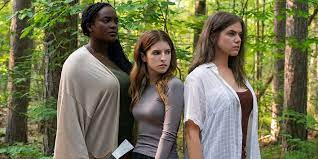
Alice, Darling -- a psychological study bolstered by thriller elements -- relies on the observation that not all abuse is physical. The story centers on Alice (Anna Kendrick), a successful young woman who lives with her boyfriend, an artist played by Charlie Carrick. The two appear to be happy, but Carrick's Simon continually gnaws at Alice’s confidence. The plot, such as it is, begins to unfold when Alice agrees to spend a weekend with two girlfriends (Kaniehtiio Horn and Wunmi Mosaku). The occasion: Horn's Tess has arranged a women-only celebration of her birthday at an isolated cabin. Alice tells Simon she's taking a business trip because she knows he’d object to her spending time with women who will encourage her independence. Kendrick captures Alice's ably fears, which limit her willingness to make her own decisions. Her friends try to loosen her up, but she's still under Simon's control. Director Mary Nighy creates a mood of uneasiness as Horn and Mosaku push Alice toward assertion. They know their friend is being tyrannized. The story's final eruption verges on overstatement — and at times, the movie seems to be straining, particularly with a story about a missing local girl that lingers in the background. Working from a screenplay by Alanna Francis, Alice, Darling works best as a well-observed study of the effects of abuse, and Kendrick’s complex performance as a vacillating, conflicted woman gives Alice, Darling some painfully real bite.
Thursday, April 22, 2021
Survival choices on a voyage to Mars
Thursday, September 13, 2018
A homebody's best friend disappears
In A Simple Favor, Anna Kendrick plays a woman who's determined to be an ideal mother. Kendrick’s Stephanie Smothers is a widow who immerses herself in her son's pre-school activities and in a cooking vlog that she begins with a trademark greeting that defines her vision of an audience. "Hi, Moms,' she chirps.
Stephanie is the kind of mother who brings out the resentments of parents who aren’t quite so gung-ho about pre-school. She drives less conscientious crazy.
Stephanie gives Kendrick an opportunity to go for laughs while keeping us guessing about whether there might be something less controlled under Stephanie's ultra-organized surface.
At first, I thought Kendrick might be overdoing Stephanie's diffidence, offering a near parodic version of a kid-and-kitchen obsessed suburban mom, but her performance grew on me.
Kendrick finds an able comic accomplice in Blake Lively, who plays Emily a woman whose confidence contrasts mightily with Stephanie's timidity. Director Paul Feig (Bridesmaids) makes it clear from the outset that Emily qualifies as a career-obsessed woman who brings a take-no-prisoners attitude to everything she does. When it comes to being a mom, Emily is ... well ... indifferent to the point of neglect.
The movie opens with Stephanie telling her video blog followers that best-friend Emily has disappeared. Emily left her young son with Stephanie, who picked the kid up from pre-school along with her own son. Emily's husband is tending to his sick mother in London.
Once Emily goes missing, A Simple Favor turns into a jaunty, comic mystery built around events that unfold after Emily vanishes.
Enter Sean (Henry Golding), Emily's husband, a novelist who hasn't published anything for a decade but who lives with Emily in a sleekly modern home that evidently is supported by Emily's work as a high-power PR woman for a fashion firm and by ample amounts of debt. Fresh from Crazy Rich Asians, Golding once again is called upon to be handsome, emotionally vulnerable, charming and, in this case, perhaps a bit devious.
I wish the movie had made more time for Rupert Friend, who plays Dennis Nylon (great name), the taste-arbiter who runs the fashion firm at which Emily ruthlessly plies her PR trade.
In this case, though, it's the women -- Kendrick and Lively -- who give the movie its spark as Stephanie turns into an amateur sleuth. She searches for Emily, gradually learning that her friend might not be all that she seemed. Then again, Stephanie isn't all that she seems, either.
As a mystery, A Simple Favor doesn't always work. Feig offers a big reveal too early and an over-stuffed wrap-up threatens to tie the movie in knots.
But Feig keeps A Simple Favor marching to a snappy cadence. He also includes enough satirical garnish to heighten interest without cutting deep enough to draw blood. That's not a criticism. Feig points the movie in the right direction. Simple Favor never extinguishes its sparkle. It's a good-natured helping of venom.
Tuesday, September 13, 2016
Dysfunctional family, dysfunctional movie
Thursday, January 22, 2015
Jennifer Aniston's bitter piece of 'Cake'
Toward the end of last year, Jennifer Aniston's name began to surface as a possible Oscar nominee for her performance in Cake, the story of an embittered woman whose life is mired in grief and rage. Aniston didn't get the nomination, but the actress best known for rom-coms and her long-running stint in TV's Friends, shows the kind of range Academy voters often appreciate.
In Cake, Aniston plays a woman with a scarred face, an aversion to make-up and a pill-popping addiction to pain killers. Aniston's Claire clearly has suffered both emotional and physical wounds.
Director Daniel Barnz, working from a script by Patrick Tobin, takes his time letting us know precisely what happened to put Claire into such a miserable state.
And miserable it is.
Claire has been so impossible to live with that she's driven off her caring husband(Chris Messina). Only her housekeeper (Adriana Barraza) seems willing to tolerate Claire's abusive ways -- and, at one point, even Barraza's Silvana is pushed to the brink.
Claire is so difficult that she's kicked out of a therapy group, which she disdains anyway. After leaving the group, she's haunted by visions of Nina (Anna Kendrick), a former group member who committed suicide.
Presented in straightforward fashion, these hallucinatory encounters give Kendrick something to do, but don't add much to the proceedings.
Those who remember The Good Girl (2002) already know that Aniston can play against type. In Cake, she pours on cynicism and bile, but the movie loses credibility when Claire establishes a relationship -- albeit a halting one -- with Nina's widowed husband (Sam Worthington), a man who has been left with a child.
If you've seen a few indie movies, you won't have much trouble guessing what has driven Claire to near distraction.
I've not been a fan of Aniston's endless string of rom-coms, but acting in romantic comedies is still acting, and Aniston deserves praise for taking a chance on a small, indie movie in which she's required to keep the audience at a distance.
Let's hope Cake helps push Aniston out of the rom-com ghetto. But taken strictly on its own somewhat attenuated terms, Cake needed to be better, as well as bitter.
Wednesday, December 24, 2014
A musical trip 'Into the Woods'
It has taken 27 years for Stephen Sondheim's 1987 musical -- Into the Woods -- to reach the screen. I wish I could say it was totally worth the wait.
But under the direction of Rob Marshall (Chicago and Nine), this megaton Disney production arrives as a mixed blessing with highlights built around Meryl Streep's performance as The Witch, Anna Kendrick's turn as Cinderella, Emily Blunt's portrayal of a baker's wife and a couple of signature musical numbers.
A mash-up of a story incorporates fragments of various, iconic fairy tales: Little Red Riding Hood, Rapunzel, Cinderella and Jack and the Beanstalk.
Shards from these stories are united by the tale of a baker and his wife. The couple tries to gather ingredients needed to break a spell (cast by the witch, of course) that has left them childless.
Credit Marshall with getting the musical off to a rousing start. The opening introduces the major characters in lively, amusing fashion before all head for the woods on a variety of personal quests that sometimes turn sluggish.
For the most part, the movie is well cast. Under a ton of make-up, Streep brings life to every scene in which she appears. James Corden and Blunt are fine as the baker and his wife, and Kendrick makes for a somewhat different Cinderella, a young woman who isn't entirely star struck by the handsome prince (Chris Pine).
Pine, by the way, brings self-absorbed superficiality to the role of the prince, complementing the movie's desire to upend as many fairy-tale stereotypes as possible.
A high point arrives when Red Riding Hood meets the wolf (Johnny Depp made up like a predatory Zoot-suiter). The wolf leers after Red Riding, displaying a lecherous streak. Depp licks his chops, and then vanishes from the screen with a demonstrative howl.
Carefully designed by Dennis Gassner, Into the Woods has a lavish quality that Marshall supplements with special effects when necessary.
The singing -- a key in a musical without big dance numbers -- seems mostly up to snuff, although I have no standard of comparison, never having seen Into the Woods on stage.
The movie's screenplay -- by James Lapine -- reportedly includes a bit of compression and the filing down of a few rough edges, but I leave all that for Sondheim enthusiasts to sort out.
Into the Woods increasingly darkens as it goes against the grain of the original fairy tales. A faux happily ever-after ending is followed by a lengthy final act which goes to great pains to subvert expectations and which, alas, tested my patience.
I found myself longing for this one to conclude before it had worked its way through all of its 124-minute length, but -- in fairness - I'd have to say that Into the Woods seemed acceptable, if not a candidate for movie musical greatness.
What's missing? Goosebumps and a sustained sense that we're watching something that gets beyond its ever-present cleverness.
Thursday, September 27, 2012
A giddy, girly a cappella movie
Thursday, September 20, 2012
A gut-wrenching LAPD drama
In End of Watch, director Robert Ayer pours on lots of gritty, convincing resolve as he takes us inside the world of two Los Angeles police officers. This mostly episodic look at patrolling partners (Jake Gyllenhaal and Michael Pena) covers a variety of tensely portrayed situations and makes it clear that these young cops are as hooked on the excitement of the streets as the gang bangers they frequently confront.
With his head shaved and eyes glaring, Gyllenhaal plays Brian Taylor, a former Marine who provides the movie with an opening narration that establishes these cops as guys who brook no nonsense when they put on their uniforms. Meet them in a bar, you'll like them. Meet them in an alley, and you may be sorry.
Pena, a terrific actor who finally gets a major chunk of screen time, plays Mike Savala, a Mexican-American cop whose wife (Natalie Martinez) is pregnant. Pena creates a tough, likable working-class hero.
When Taylor and Savala aren't battling crime or helping people in trouble, they're bantering in their black-and-white. They're comfortable trading ethnic jibes, cops who are more loyal to each other than to any outside group.
At one point, Taylor tells Savala that he finally has met a woman with whom he can talk, something he's been craving. Enter Anna Kendrick as Janet, the woman who steals Taylor's heart.
Ayer doesn't spare us graphic violence, and some scenes in End of Watch are super-tense. When the cops enter houses with their guns drawn, they have no idea what they might be facing. At such times, End of Watch works on the gut.
Perhaps for leavening, Ayer introduces us to a bit of off-duty life when Taylor joins Savala at a quinceanera, and there are obligatory scenes at the station house where the men receive their daily assignments. Taylor and Savala also get crosswise with an older cop (David Harbour).
At some point, Ayer needs to introduce a story line. Dropped into all the action is a tale in which Taylor and Savala stumble into the world of Mexican drug cartels and become targets for a hit.
Some of the action is seen from the viewpoint of a mini-documentary that Taylor is filming. There's also footage supposedly taken by gang members. By now the use of feigned amateur video has become as stale as the average car chase. Ayer just as effectively could have employed an edgy, hand-held style without putting video cameras into the hands of his characters.
The looming presence of the drug cartels leads to a bullet-riddled finale marked by a level of violence that goes way over the top. I don't know if it's realistic, but it feels too much like an attempt to further juice the already juiced proceedings, making us wonder whether Ayer, who wrote the script for Training Day, isn't more interested in visceral excitement than authenticity.
Still, End of Watch holds you in its grip. It does a good job convincing us that the cops who work in gang-dominated neighborhoods aren't all that different from soldiers in a war zone. Had the movie gone a step further and done more to remind us that the same goes for most of the residents of those same neighborhoods, End of Watch would have been even better.