Showing posts with label Awkwafina. Show all posts

Wednesday, December 15, 2021

Swan Song sings an edgeless tune


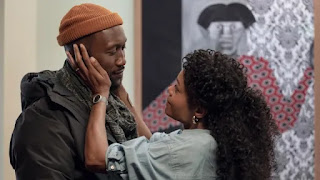
    In Swan Song, Mahershala Ali plays a dying man who has been  given the opportunity to be replaced by a clone. If Ali's Cameron opts for cloning, his wife (Naomi Harris) and young son (Dax Rey) won't know that he passed away. For them, life will continue seamlessly. 
  To pull off the switch, Cameron, an artist by trade, must conceal his medical condition from his wife. The cloning will be performed under the direction of Dr. Scott (Glenn Close) who conducts her business in a stylishly modern house in the middle of nowhere. 
   While under Dr. Scott's supervision, Cameron meets Kate (Awkwafina), another patient who has agreed to be cloned.
   Cameron is partly motivated by his wife's history. She only recently recovered from a period of crippling grief after the death of her twin brother. 
    Nothing, of course, is as simple as it initially sounds: Cameron finds it difficult to cede his life to a clone, a creation he meets as the movie progresses. 
    This raises another ethical issue: If Cameron decides to return to his life and tell his family that he's dying, the clone (named Jack until the day completely inhabits Cameron's life) will be "terminated." 
   Unfortunately, director Benjamin Cleary's debut feature can't get much beyond its central question, which (in a richer movie) might have been sufficient.
    Flashbacks are used to develop the relationship between Cameron and Harris's Poppy, giving Ali and Harris the opportunity to play a love duet — with some difficulties, of course.
     Even if you buy the idea that clones could become undetectable substitutes for humans, the movie can feel anemic. Cleary creates a version of the future that’s sanitized, sleek, and decidedly upscale. A hollow, edgeless feeling opens the door to for a flood of end-of-picture tear-jerking.
   Despite its fine performances, Swan Song can feel like the clone of what might have been a better, more genuinely affecting movie.


Wednesday, September 1, 2021

Strong kickoff for another Marvel character


    Marvel's Shang-Chi and the Legend of the Ten Rings leaps into Asian-American mythos in much in the way that Black Panther brought Afrocentric freshness to the indestructible Marvel universe.
    I don’t know if Shang-Chi and the Legend of the Ten Rings will have the same impact as Black Panther — either commercially or culturally. But this latest Marvel movie has enough positive elements (action, humor and a story with deep family roots) to constitute an entertaining addition to Marvel’s apparently endless stream of movies.
     Shang-Chi gets off to a lively start. Sean (Simu Liu) -- later to become Shang-Chi -- works as a valet in San Francisco along with pal Katy (Awkwafina). It doesn't take long for the two to take a dizzying ride in a borrowed car.
     Sean and Katy also encounter a group of thugs on a bus, a sequence in which clever martial-arts maneuvers are augmented by the excitement of watching a large vehicle careen through the streets of San Francisco.
    Sean, we learn, has a secret. He was raised in China by a father (Tony Leung) who schooled him in martial arts. Leung's Wenwu was no pipe-and-slippers dad. Centuries ago, he acquired the fabled 10 rings which gave him superhero powers and eternal life. He expected his son to take his place as head of a powerful secret force of warriors.
    Shang-Chi had other ideas. He fled China when he was 14. 
    Upon his return to Macau 10 years later, Shang reunites with his younger sister Xialing (Meng'er Zhang). She's still upset that Shang left her with a father who didn't treat his daughter the way he treated his son.
   The plot eventually takes Shang and Katy to the mythic land of Ta-Lo where they meet Shang's aunt Ying Nan (Michelle Yeoh), a wise woman who makes positive use of her martial arts-skills.
    Like most Marvel movies, Shang-Chi gobbles up comic-book mythology as if were popcorn. Wuwen, who gave up his powers when he married Shang's mother (Fala Chen), believes that he can reunite with his late wife if he penetrates a seal that separates an evil soul-sucking dragon from humanity. 
    The meeting of Wuwen and Chen's Jiang Li produces some of the movie's more intriguing and well-choreographed action. Li's the only person who's able to subdue Wuwen's fighting spirit. 
     It makes more sense to see all this in a theater than to write about it in a review. Besides, the mythic elements of the story are supported by recognizable emotions: a husband's inability to accept his wife's death, a son's struggle to accept his true identity, and a sister who can't totally abandon her sibling resentments.
    The Ta-Lo sequences include an element of cuteness in the form of a furry faceless, winged creature that struck me as more Disney than Marvel, a little too precious perhaps. 
    But Shang-Chi never skimps on action. A fight that takes place on scaffolding attached to a high rise offers vertiginous fun.
    I've read that Liu wanted to model his fighting style on Jackie Chan. The fight sequences contain elements of Chan-like humor but, in my view, don’t rise to the level of Chan’s best work, which admittedly makes for a high bar.
   Director Destin Daniel Cretton and his team were smart to give Shang-Chi a sidekick and the movie suffers a bit when Awkwafina is off-screen. Liu masters the physical aspects of the role but sometimes  comes up short on personality. Oh well, that's probably a marginal criticism considering that Shang-Chi is an emerging character.
   The supporting cast -- particularly Yeoh, Leung, and Zhang -- offer more than window dressing. They really supports the movie, as does Benedict Wong, whose role is smaller but still strong. Ben Kingsley adds humor as Trevor Slattery, a fading TV actor whose presence is played for laughs. 
   The movie's ending -- involving dragons (good and evil), a father/son battle, and lots of fiery combat -- can't entirely avoid the bloat that seems obligatory in these efforts.
    Overall, though, Shang-Chi succeeds in introducing a new Marvel character to the screen and proves an invigorating addition to the Marvel universe. 
    Equally important in a world in which sequels seem mandatory, the movie leaves you wanting to see more of Shang-Chi and Katy, a comic-book duo with promising  potential.

Wednesday, March 3, 2021

A beautifully realized animated story


    Disney's Raya and the Last Dragon stands as a beautifully rendered piece of animated storytelling. The movie leans heavily on action before delivering a message about overcoming risks involved in trusting people who might otherwise be considered foes. 
    The story centers on Raya (Kelly Marie Tran), a young woman who lives in a world that has been divided into five distinct territories. Raya's father dreams of uniting the planet's various factions into a harmoniously idyllic country named Kumandra.
    The movie's mythology involves dragons, an evil force called Druun, and thwarted attempts to secure global peace that often lead to battles. 
    Eventually, Raya establishes a connection with the last dragon, a winsome creature named Sisu (Awkwafina). When necessary, Sisu assumes human form, turning herself into a feisty older woman.
    A melding of south-east Asian cultures, Last Dragon has a generic quality when it comes to ethnicity, but directors Don Hall and Carlos Lopez Estrada wisely employ a large ensemble of Asian actors to give voice to the characters.
    Screenwriters Adele Lim and Qui Nguyen seldom allow the movie’s  better angels to overwhelm the action, creating an on-going rivalry between Raya and Namaari (Gemma Chan), a young warrior woman and Raya's long-time enemy.
    Both women are trying to retrieve pieces of a gem that 6has the power to ward off the Druun, an inky floating cloud that turns living creatures into stone. 
    Dragons once kept people safe from the Druun, but the dragons -- save the one of the title -- have been turned to stone. Clearly, the Druun must be contained and, by the end, the movie makes it clear that cooperation can be more powerful tool than combat when it comes to keeping people safe. 
    All of this is leavened with typical humor and colorful characters who join Raya on her quest to recover pieces of the shattered gem: 
    Izaac Wang gives voice to a young chef who joins Raya's quest, along with an ogre-sized character named Tong (Benedict Wong), and a battling baby.
    There's also Tuk Tuk a large snail-like creature that can roll into a ball. Tuk Tuk serves as the vehicle that transports Raya through her many adventures.
   Although the story may be a bit complex for younger audiences, the plot proves easy enough to follow. The dialogue has more to do with 2021 than any mythical past, but Raya emerges as a visually imaginative and involving  piece of animated entertainment. 

Thursday, July 25, 2019

When a lie soothes the way

In The Farewell, a granddaughter confronts her grandmother's fatal illness.
The story of American immigrants can be twofold as pathways of opportunity bump against profound feelings of disconnection -- from old ways and especially from family members who stayed behind.

The Farewell, a movie from director Lulu Wang recognizes the split and finds it most vividly represented in the presence of Billi (Awkwafina), a dejected young woman who returns to China to visit her grandmother (Zhao Shuzen), a woman who has been diagnosed with stage-four lung cancer.

The movie revolves around a secret. Shuzen's Nai Nai hasn't been told that she's dying. Her family decides to allow her to live out her days without knowing that she's been given a death sentence. The need to protect Nai Nai from medical truth pushes the other characters into uncomfortable territory.

Billi, in particular, wonders whether the lie doesn't mask an element of cruelty. Isn't Nai Nai entitled to know her fate?

Oops. I'm making The Farewell sound like a sad family drama that puts its characters through a series of emotionally wringing scenes.

This is not the case. Wang, who based her movie on her own experience, walks the fine line between comedy and drama, mostly navigating her way past any jagged cliffs that could have upset the movie's balance.

The movie opens in New York. Billi's parents (Tzi Ma and Diana Lin) don't want their daughter to make the trip to China, a visit that's being organized around the impending wedding of a cousin (Han Chen) to a Japanese woman (Aoi Mizuhara) who seems totally lost amid her future Chinese relatives.

Billi's mother thinks her daughter is too much of a cynic -- not to mention a downer -- to travel to China for a mission that requires a high-degree of happy pretense. Everyone's attending a wedding, but everyone also knows the real reason for the visit: to say goodbye to grandma. After her parents depart for China, the strong-willed Billi follows.

Other members of the clan include Nai Nai's son (Yongbo Jiang) who works in Japan and who explains to Billi that the lie isn't selfish: It's told so that Nai Nai's relatives can carry the burden of grief and suffering for her, he says. Suddenly, the family's behavior makes sense.

For her part, Nai Nai is a good-spirited woman who practices Tai Chi and who freely dispenses advice to those who may or may not want it. She's concerned about Billi's marital status (single) and so genially intrusive that we're never put off by her.

Credit Zhao with a galvanizing performance that works well with Awkwafina's low-key brooding, a stunning contrast with her live-wire work in the more glamorous and overtly commercial Crazy Rich Asians.

Set mostly in the Chinese city of Changchun, Wang can't resist the opportunity for a bit of social commentary, offered without underscoring when she focuses her camera on the vast, faceless apartment dwellings that have replaced the city's cozier neighborhoods.

Nai Nai herself lives in a new building; the neighborhood of Billi's memory has vanished. Billi was taken to America at the age of six and in a touching scene, she talks about the help she needed to adjust, which her mother couldn't provide. Still, the relationship between Billi and her parents remains a trifle under-explored.

Much of the family interaction takes place around meals, which allows Wang to bring out the personalities of the family: She treats various customs (posing for wedding pictures, for example) with comic affection.

The Farewell focuses on a family fractured by emigration but still inescapably a family -- with all the tensions, love, accusations and regrets that go with it.

Tuesday, August 14, 2018

Obligation vs. love in 'Crazy Rich Asians'

Kevin Kwan's bestselling novel arrives on screen boasting a staggering level of glamor.
At one point in Crazy Rich Asians, the unashamedly lavish adaptation of author Kevin Kwan's bestselling novel, an affluent resident of Singapore encourages his son to eat his dinner by telling him that children are starving in America.

With a single joke -- casually delivered by Ken Jeong -- the movie signals a global reversal of fortune. Forget American prosperity. Asia is not only on the rise, it already has risen. Take that white people.

That's the closest we get to satire in Crazy Rich Asians, a movie so preposterously glamorous, it manages to go beyond fantasy into a material nirvana in which consumption is abundant, conspicuous and treated as an irrevocable birthright of the movie's rich second-generation Asians.

Rather than lampooning the capitalist devotions of the impossibly wealthy residents of Singapore -- a city that couldn't be any more invitingly displayed than it is by director Jon Chu -- Crazy Rich Asian turns into the year's most beautifully appointed rom-com: Crazy Rich Asians tells the story of an American economic professor (Constance Wu) who falls in love with the favored son (Henry Golding) of a wealthy Singapore-based family before she knows that Golding's Nick Young is rich enough to buy half of New York.

The story embarks on its journey when Nick invites Wu's Rachel Chu to travel with him from New York to Singapore for his best friend's wedding. She doesn't know that Nick not only has model-quality looks but belongs to one of Singapore's wealthiest families. He's not just another guy; he's a walking conglomerate.

Of course, Nick's best friend Colin Khoo (Chris Pang) also is fashion-plate handsome, evidently a requirement for the movie's casting director who has populated Crazy Rich Asians with some of the best-looking people in the world.

After arriving in Singapore, Crazy Rich Asians gets down to business: A down-to-earth young woman finds herself at sea amid Singapore's snobby, closed-minded rich. Her main adversary: Nick's mother, played with steely determination by Michelle Yeoh.

Yeoh's Eleanor Young disdains the American notion of personal fulfillment, preferring to hoist a banner of family sacrifice. She believes only fierce loyalty can elevate a family into the modern equivalent of royalty. She favors alliances, not love. In Eleanor's view, Rachel just doesn't bring enough to the table to deserve a marriage to Nick.

All that sounds serious, but the movie's issues emerge amid an ornate comic brocade that features a scene-stealing performance by rapper Awkwafina, who plays a young woman who attended college with Rachel and now lives in Singapore. Her family is well off but has yet to reach the imperial level of the Youngs. She's the sassy best friend who loves penetrating Singapore's wealthy circles but who also understands the absurdity that defines snobbery. Her character has bubble-bursting appeal.

The characters are a well-represented bunch of skin-deep socialites -- some of whom seem more interested in spending wealth than in protecting it. Nico Santos portrays a gay man with a keenly developed fashion sense. Jimmy O. Yang plays one of Nick's hard-partying pals, a guy rich enough to throw Nick's bachelor party by renting a container ship and turning it into a nightclub.

One of Nick's cousins -- Gemma Chan's Astrid -- has become successful in her own right; Astrid registers as an ambitious woman whose marriage has hit a rough patch. She and Yeoh give the movie a welcome bit of dramatic weight.

Wu makes a fine female lead and Golding, who never has acted before, looks the part. Expecting to find hard-core realism in a movie such as Crazy Rich Asians qualifies as a lost cause. Still, the movie already has been hailed as something of a landmark, the first Hollywood film with an all-Asian cast since 1993's Joy Luck Club brought author Amy Tan's novel to the screen. It's too early to say what impact the movie will have on future Hollywood production. Keep your eye on box office receipts for a clue.

At times, Crazy Rich Asians is so unashamedly shallow that you almost marvel at its chutzpah (not a Chinese word). Nowhere is this more evident than in a wedding scene in which the bride walks down a water-flooded aisle to reach the waiting bridegroom. I laughed; some of the audience at a preview screening sighed. Take your pick.

The screenplay -- credited to Peter Chiarelli and Adele Lim -- includes the requisite number of bitchy lines delivered by the women who envy Rachel's success at snagging the story's prize male. Chu hasn't neglected the reliable tropes of the rom-com formula; he embraces them and uses them to give the movie a comfortable familiarity.

Crazy Rich Asians may not be a great movie (or even a particularly good one) but watching it feels like taking that luxury vacation that the starving people of America couldn't possibly afford. Think of it as a trip to a cinematic spa in the company of some of the world's best dressed and most attractive people.