Showing posts with label Ken Loach. Show all posts

Sunday, March 29, 2020

Life is no picnic for this gig worker

Director Ken Loach delivers a timely movie about a family under great economic duress.

It’s sad, disturbing and more than a little depressing.

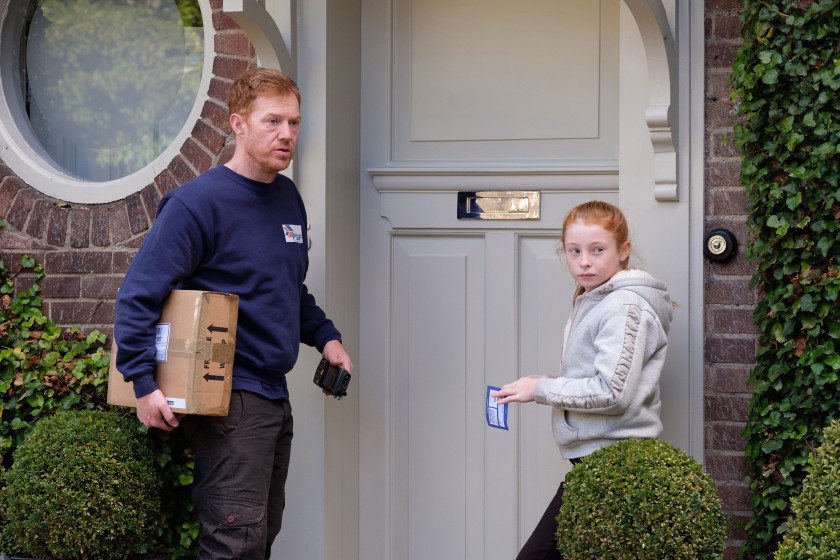
So why am I suggesting that this is the perfect time to watch director Ken Loach’s Sorry We Missed You, an unflinching look at the troubles that befall those who work in the gig economy? With much of the country sheltering in place, there couldn’t be a better time to examine the plight of those who make deliveries to our now-isolated homes.

I’m not suggesting that the story of Ricky Turner (Kris Hitchen) is representative of everyone who works for a service that delivers all manner of packages. But credit Loach with taking a potent look at the difficulties of families that live hand-to-mouth without ever getting ahead, a circumstance not confined to the gig world.

Typical of Loach, Sorry We Missed You — the title derives from notes left for those who aren’t home — the movie consists of an accumulation of incidents, in this case, a mounting series of economic and domestic problems faced by a beleaguered family.

Hoping to become a master of his fate, Ricky buys a van and signs up at a delivery company managed by a tyrant (Ross Brewster), a taskmaster who cares only about keeping up the delivery rate at his depot.

The “opportunity” is a bit of a sham. The company doesn’t have "employees;" it has “franchisees.” Delivery people work under the guise of being independent mini-entrepreneurs who control their own destiny. In reality, they’re exploited and abused by a rigged system that exhausts them without bringing the promised rewards.

Working from a screenplay by Paul Laverty, Loach carefully explores the various ways in which Ricky’s family is victimized by economic circumstances.

Mom (newcomer Debbie Honeywood) works for an outfit that offers in-home care; she tends to people who can’t fend for themselves. Some are appreciative; some are abusive, but she treats all of them with empathy and near-saintly amounts of patience.

To make Honeywood’s Abby’s situation even worse, she must take busses to the various folks she visits during her long workdays. She had a car, but it was sold to provide the down payment for Ricky’s van.

The family’s teenage son (Rhys Stone) skips school, fancies himself a graffiti artist and fights with his father. Younger sister Liza Jane (Katie Proctor) can’t hide the shaken feelings that follow increasingly volatile family arguments. Work demands keep both parents away from home. Parenting often reduces to quickly delivered instructions in phone calls.

None of this would matter if we didn’t feel for these people. Ricky and Abby are decent folks who want nothing more than to earn a living, buy a house and live without constant worry about how they'll make ends meet. They're willing to work hard for these modest goals. They want no handouts, just a fair shake.

So, yes, this is the time to think about those who must struggle to survive and the toll that such battles take on families, even when there is no coronavirus.

Now 83, Loach always has been a champion of the working class. His extensive filmography includes movies such as Riff-Raff (1991), Ladybird, Ladybird (1994), My Name is Joe (1998) and I, Daniel Blake (2016). We’re lucky that Loach has been able to keep his career going for more than four decades, focusing on people who don't often find their way to the screen.

Sorry We Missed You won’t elevate your spirits. It hasn’t been made so that you could feel better about the world. But it will broaden your understanding of what it means to barely survive, a condition far more Americans soon may be facing.

Thursday, June 8, 2017

A decent man faces a crushing system

I, Daniel Blake , director Ken Loach's latest issue-oriented movie, deftly makes its point..

Among filmmakers, British director Ken Loach remains unique in his steadfast commitment to socially relevant film-making. For half a century, Loach, who's now 80, has directed films about the kinds of marginalized people who seldom find their way to the screen.

In I, Daniel Blake, Loach continues to focus on the tribulations of people struggling with forces beyond their control -- in this case, issues involving failing health and diminished opportunities to earn a living.

Daniel Blake, the movie's main character, works as a carpenter until a heart attack keeps him from seeking employment. Much of the movie involves Daniel's efforts to obtain support from the state.

Loach chronicles Daniel's frustrating dealings with social services personnel and with the Internet, a common enough bit of technology about which he knows little. Misguided social workers keep telling him to go on-line to fill out forms.

At one point, a clueless government employee orders Daniel to produce a resume, a meaningless task for someone who knows how to demonstrate his skills only by doing what he's done for all of his adult life; i.e., building things.

Loach makes Daniel (Dave Johns) a sympathetic figure, a decent man who's sensitive to the plight of others. Daniel befriends a young woman (Hayley Squires) he meets at a welfare office. Daniel uses his meager resources to help buy food for her kids. He also repairs her rundown apartment. He's helping, but he's also affirming something that he badly needs: to feel useful.

Guided by his commitment to realism, Loach resists adding the kind of uplift that might be found in a less sobering film, which is not to say that Loach wallows in thick neorealist mud. Daniel can feel desperate, but the film does not.

Besides being a clear-eyed statement about the failures of institutions designed to help people such as Daniel, we also find Loach's love of ordinary people and his abiding empathy for their daily struggles. That shouldn't be an extraordinary accomplishment, but sadly not many filmmakers are as skilled as Loach in putting such struggles at the center of their movies.

Thursday, May 2, 2013

Ken Loach walks on the lighter side

Even when he's not at his best, director Ken Loach remains a treasure.

Loach's new movie -- The Angels' Share -- proves lighter and more amusing than much of Loach's work, but to say that a Loach movie is funny doesn't automatically mean that it's void of realism.

Loach, the 76-year-old director of movies such as The Wind Shakes the Barley and Riff Raff, possesses a great feel for life among the lower classes, and Angels' Share is no exception to the Loach rule: Make movies about real people experiencing real problems.

This time, Loach heads for Scotland for a story that mixes hard-scrabble authenticity with comedy and even a bit of caper-movie high jinks. Although the blend isn't seamless, Angels' Share hits enough of the right notes to serve as a much-needed antidote to the tyrannies of the summer mainstream which already have begun to sweep over us.

This time, Loach focuses on a hot-tempered Scot (Paul Brannigan) who can't seem to stay out of trouble. Charged with administering a severe beating to a sympathetic stranger, Brannigan's Robbie gets a break from a judge. Believing that Robbie has promise, the judge assigns community service rather than a prison term.

The judge may be prescient: Robbie finally has a reason to get right with the law and with himself. Robbie's pregnant girlfriend (Siobhan Reilly) insists that she'll dump him the moment he strays. She wants Robbie to be a father to their child, not an example of everything the kid should try to avoid.

Robbie insists that he'll try, and when he holds his infant son for the the first time, you believe him.

Loach begins to add comic elements when he introduces the group with whom Robbie performs his community service. This small collection of misfits falls under the tutelage of a compassionate but serious supervisor (John Henshaw). When Hensaw's Harry -- a man with a connoisseur's fondness for good whisky -- takes his charges on a field trip to a distillery, Robbie begins to discover that he has a nose for whisky. He's a natural-born connoisseur of taste and aroma, not a bad skill to possess in country that produces some of the world's premier spirits.

Robbie's newfound interest gives him a chance to develop a skill that promises a way out of a vicious circle that pits him against a foe who's determined to draw Robbie into a battle, mostly because of some long-simmering family feud.

I loved the fact that Loach included lots of information about malt whisky, even taking us on a guided tour of a distillery. Watching Loach turn his movie into Malt Whisky for Dummies may be a showstopper for some. For me, it was an intriguing introduction to the skill, obsessiveness and knowledge required to produce a fine whisky. I don't drink the stuff, but I'm always fascinated by displays of expertise.

Now, some of the comedy might be a little too broad, and, of course, the thick Scottish accents would defy comprehension if The Angels' Share didn't come equipped with subtitles.

Brannigan makes an entirely credible Robbie, a young man at war with his own violent propensities. In one of the movie's most affecting scenes, Robbie meets with the family of the man he has beaten. Robbie's coke-crazed outburst has left him speechless and shamed.

Robbie's cronies add comic color, but as much as I admire Loach, I'd have to say that the movie's caper antics don't exactly mesh with Loach's more serious intentions or with the movie's comic byplay.

Still, I'd recommend The Angels' Share. Named for the bit of whisky that inevitably evaporates during production. The Angels' Share may not go down as smoothly as you'd like, but it's no rot gut, either.