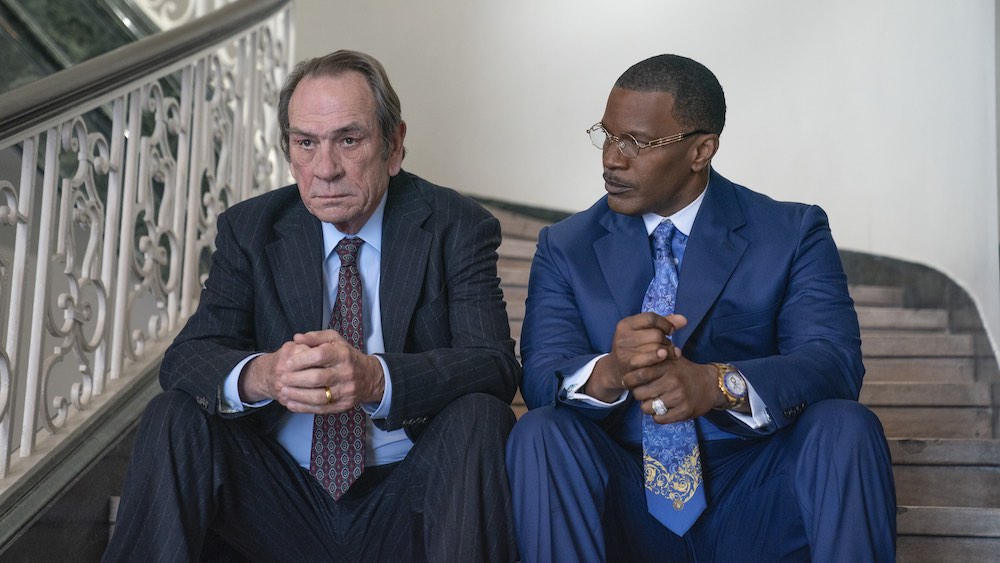
It may sound improbable, but The Burial might be the most entertaining movie ever made about a contract dispute. Ridiculous? Well, add this to the equation: One of the main characters in the movie owns funeral homes in Mississippi, not exactly an occupation that prompts anticipatory smiles.
But is The Burial entertaining?
Yes. I say this because although The Burial tells a David vs. Goliath story that revolves around a serious issue, the movie has the soul of a feel-good comedy.
Moreover, Betts -- with a massive assist from Jamie Foxx -- has us rooting for a lawyer who’s already super-rich when we meet him. Foxx gives a power house performance as Willie E. Gary, a flamboyant attorney with a habit of winning. A whirling dervish of bravura energy, Gary can talk like a country preacher.
He may be religious, but Gary has taken no vows of poverty. Aspirational to the max, he lives in a Florid mansion with his wife (Amanda Warren). He wears expensive suits, drives expensive cars, and owns a private plane he’s named "Wings of Justice." A diamond-studded watch adorns his wrist.
Gary, a real-life character who has been the subject of a 60 Minutes profile, isn't a revolutionary or an innovator; he’s someone who’s defiant enough to beat the opposition at its own game.
Why not? The son of a sharecropper and one of 11 children, Gary put himself through Shaw University and North Carolina Central University School of Law. Forget Harvard Law, Gary specializes in taking other attorneys to school.
Oh yeah, the real-life law suit that inspired the movie...
In 1995, funeral home owner Jerry O'Keefe (Tommy Lee Jones) sued the Loewen Group, an empire-building Canadian company that was devouring smaller American funeral homes.
Faced with financial difficulties, O'Keefe, accompanied by his attorney Mike Allred (Alan Ruck), travels to Vancouver to meet with Loewen chief Raymond Loewen (Bill Camp) on his yacht.
A deal was made — or so it seemed. O'Keefe would sell several of his funeral homes to Loewen but would keep the profitable burial insurance part of his business. They shook hands. O'Keefe signed the agreement; Loewen didn't. O'Keefe's suit followed.
Betts could have suffocated the movie in a tangle of legal issues. Instead, she takes an approach more suitable to broad-based entertainment.
Working from a screenplay she wrote with Doug Wright, author of a New Yorker piece about Gary, Betts builds the movie around her biggest asset, the comic flare and unabashed conviction Foxx brings to the role.
To sharpen the courtroom conflict, the easily underestimated Gary battles a Harvard Law School graduate (Journee Smollett) brought in to head the Loewen team. Known for her aggressive approach, Smollett's Mame Downs has earned a bitingly descriptive nickname, The Python.
Infighting among Gary team members, notably between Gary and Ruck's Mike Allred, lights additional sparks. O'Keefe's long-time attorney, Allred regards himself as an expert in contract law. He doesn't easily adjust to working with Gary. Allred hasn't entirely conquered years of Mississippi prejudice.
Mamoudou Athie plays Hal Dockins, a young black friend of O'Keefe and recent law school graduate. Hal introduces O'Keefe to Gary and remains involved in the case, a calm counterpoint to Gary's brashness.
Hal also makes a discovery that sharpens the case's racial dynamics, which had been in play from the outset. Part of the reason Hal wanted Gary to lead the team involved the make up of Hinds County, Miss., where the trial would be held. Hinds County is more than 70 percent black.
Jones wisely takes a quietly determined approach. Undemonstrative but forthright, the 75-year-old O'Keefe has a single goal. He wants to protect his fortune for his 13 children and 40 grandchildren.
Betts keeps the movie from turning into a love fest between Gary and O'Keefe. O'Keefe is Gary's first white client but the two have enough country in them to understand and care about each other.
A scene in which Gary, O'Keefe and Loewen meet to discuss a possible settlement is a small classic of gamesmanship -- except O'Keefe doesn't seem to be playing a game, which gives him an edge. He wants what he wants: to drag Loewen down for all the trouble he believes the company has caused him.
The courtroom scenes are crisply executed, the tension, sufficient, and racial issues add weight to the proceedings.
Looking back on the movie, I realized The Burial isn't really about a case or a cause. It's not built on outrage nor is it a sardonic take on capitalist greed. Sure, it cheers for the little guy but it runs on Gary's verve; i.e., on Foxx's performance.
The movie gives Foxx his best showcase since Ray. He wrings every bit of juice from a role he owns from the beginning to the final credits. He looks like he's having a hell of a time; his unleashed brio becomes infectious.


