Showing posts with label Jamie Foxx. Show all posts

Tuesday, October 10, 2023

Jamie Foxx scores in "The Burial'


       It may sound improbable, but The Burial might be the most entertaining movie ever made about a contract dispute. Ridiculous? Well, add this to the equation: One of the main characters in the movie owns funeral homes in Mississippi, not exactly an occupation that prompts anticipatory smiles.
      But is The Burial entertaining?
      Yes. I say this because  although The Burial tells a David vs. Goliath story that revolves around a serious issue, the movie has the soul of a feel-good comedy. 
      Moreover, Betts -- with a massive assist from Jamie Foxx -- has us rooting for a lawyer who’s already super-rich when we meet him. Foxx gives a power house performance as Willie E. Gary, a flamboyant attorney with a habit of winning. A whirling dervish of bravura energy, Gary can talk like a country preacher.
         He may be religious, but Gary has taken no vows of poverty. Aspirational to the max, he lives in a Florid mansion with his wife (Amanda Warren). He wears expensive suits, drives expensive cars, and owns a private plane he’s named "Wings of Justice." A diamond-studded watch adorns his wrist. 
      Gary, a real-life character who has been the subject of a 60 Minutes profile, isn't a revolutionary or an innovator; he’s someone who’s defiant enough to beat the opposition at its own game.
     Why not? The son of a sharecropper and one of 11 children, Gary put himself through Shaw University and North Carolina Central University School of Law. Forget Harvard Law, Gary specializes in taking other attorneys to school.
       Oh yeah, the real-life law suit that inspired the movie...
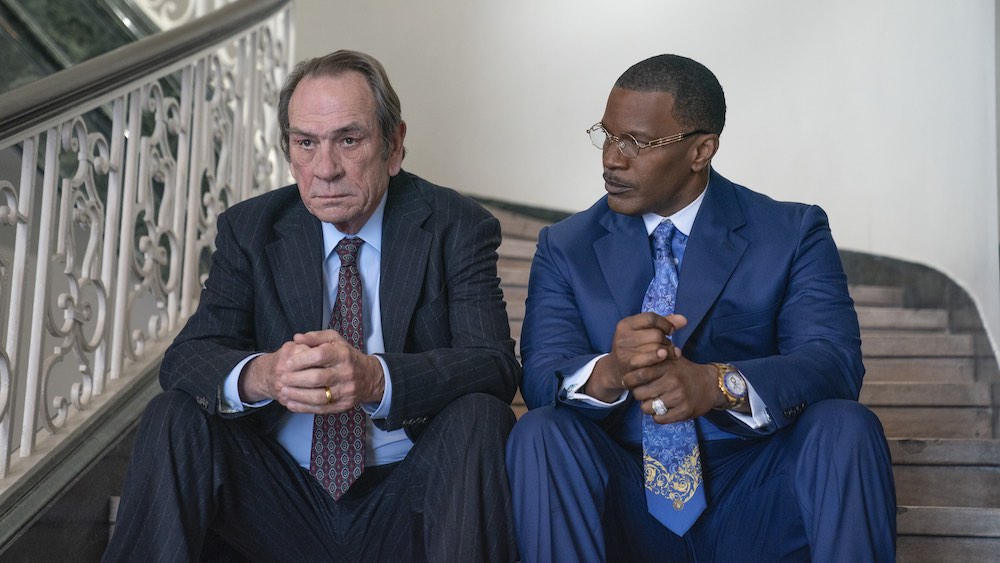
          In 1995, funeral home owner Jerry O'Keefe (Tommy Lee Jones) sued the Loewen Group, an empire-building Canadian company that was devouring smaller American funeral homes. 
       Faced with financial difficulties, O'Keefe, accompanied by his attorney Mike Allred (Alan Ruck), travels to Vancouver to meet with Loewen chief Raymond Loewen (Bill Camp) on his yacht. 
         A deal was made — or so it seemed. O'Keefe would sell several of his funeral homes to Loewen but would keep the profitable burial insurance part of his business. They shook hands. O'Keefe signed the agreement; Loewen didn't. O'Keefe's suit followed.
      Betts could have suffocated the movie in a tangle of legal issues. Instead, she takes an approach more suitable to broad-based entertainment.
   Working from a screenplay she wrote with Doug Wright, author of a New Yorker piece about Gary, Betts builds the movie around her biggest asset, the comic flare and unabashed conviction Foxx brings to the role.
   To sharpen the courtroom conflict, the easily underestimated Gary battles a Harvard Law School graduate (Journee Smollett) brought in to head the Loewen team. Known for her aggressive approach, Smollett's Mame Downs has earned a bitingly descriptive nickname, The Python.
    Infighting among Gary team members, notably between Gary and Ruck's Mike Allred, lights additional sparks. O'Keefe's long-time attorney, Allred regards himself as an expert in contract law. He doesn't easily adjust to working with Gary. Allred hasn't entirely conquered years of Mississippi prejudice.  
   Mamoudou Athie plays Hal Dockins, a young black friend of O'Keefe and recent law school graduate. Hal introduces O'Keefe to Gary and remains involved in the case, a calm counterpoint to Gary's brashness. 
   Hal also makes a discovery that sharpens the case's racial dynamics, which had been in play from the outset. Part of the reason Hal wanted Gary to lead the team involved the make up of Hinds County, Miss., where the trial would be held. Hinds County is more than 70 percent black.
   Jones wisely takes a quietly determined approach. Undemonstrative but forthright, the 75-year-old O'Keefe has a single goal. He wants to protect his fortune for his 13 children and 40 grandchildren.
     Betts keeps the movie from turning into a love fest between Gary and O'Keefe. O'Keefe is Gary's first white client but the two have enough country in them to understand and care about each other. 
    A scene in which Gary, O'Keefe and Loewen meet to discuss a possible settlement is a small classic of gamesmanship -- except O'Keefe doesn't seem to be playing a game, which gives him an edge. He wants what he wants: to drag Loewen down for all the trouble he believes the company has caused him.
   The courtroom scenes are crisply executed, the tension, sufficient, and racial issues add weight to the proceedings.
    Looking back on the movie, I realized The Burial isn't really about a case or a cause. It's not built on outrage nor is it a sardonic take on capitalist greed. Sure, it cheers for the little guy but it runs on Gary's verve; i.e., on Foxx's performance.
  The movie gives Foxx his best showcase since Ray. He wrings every bit of juice from a role he owns from the beginning to the final credits. He looks like he's having a hell of a time; his unleashed brio becomes infectious. 

Wednesday, December 15, 2021

'Spider-Man' takes a big step forward

 
    Everyone who cares about Spider-Man movies probably will have heard about some of the movie’s big “surprises” before they see it. Still, I’m not going to say much about major reveals except to note that they help get this third Tom-Holland edition on track.
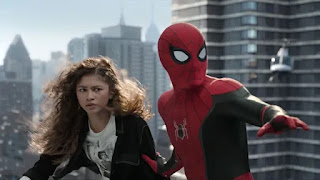
     I wouldn’t call Spider-Man: No Way Home great but it marks a significant improvement over recent editions and creates a bit of nostalgia with visits from previous villains, notably Doctor Octopus (Alfred Molina), Green Goblin (Willem Dafoe), and  Electro (Jamie Foxx). 
    For a while, it seems as if you need a scorecard to keep track of the legion of baddies who turn up, although Molina seems to receive more attention as part of a major sequence on a bridge.
    Welcome back, Doc Ock.
    As for other returnees: Marisa Tomei reprises her role as May Parker, Peter Parker’s aunt. Zendaya and Jacob Batalon return as Parker’s high school pals, one a girlfriend, the other an eager confidant.
   Benedict Cumberbatch shows up as Dr. Strange, the character charged with setting the plot in motion.
   Here's how it works: In the last installment, Spider-Man’s identity was exposed by Mysterio. Spidey must now find a way to restore Peter Parker’s anonymity. 
   To get the job done, Dr. Strange casts a spell. Like many purported cure-alls, Dr. Strange's magic has a weird side effect: It brings characters from the multi-verse into Parker’s life, hence the arrival of all those villains from other dimensions or, if you’re more pragmatic, other movies. 
    Director Jon Watts, who guided Holland's two previous journeys into SpiderWorld, does a serviceable job with the action, which is plentiful and noisy and at one point, evokes woozy memories of Inception.
    If you’re looking for a comic-book story that’s upheld by unassailable logic, No Way Home may disappoint. Instead, the movie tries to ponder a big question: Is evil irredeemable? Better yet, the movie’s conclusion stirs as much emotion as the material allows. 
    Peter Parker isn’t the most assured of superheroes. How could he be? He and his teen pals —Zendaya’s MJ and Batalon’s Ned —are high school seniors who fret over not being admitted to MIT. Even their "safety schools" reject them because Peter Parker (now known to all as Spider-Man) has been getting clobbered by a TV loudmouth (J.K. Simmons). They're victims of guilt by association.
     Heaven forbid, these kids might have to try a community college.
    Oh well, say this: In going backward to acknowledge several generations of movies, Spider-Man takes a welcome step forward.
    Perhaps that's what matters most when it comes to a franchise.
     

Thursday, December 24, 2020

'Soul' puts imagination on display


     Imagine being on the verge of achieving something you've dreamed about your whole life. Jazz pianist Joe Gardner (voice by Jamie Foxx) finds himself in exactly that position in Soul, the latest animated feature from Pixar.  
     Sounds like a serviceable enough premise, but directors Peter Doctor and Kemp Powers quickly pull the rug out from under us, catapulting us from the streets of New York into an alternate reality -- in this case the gateway to the afterlife. 
     Here's how it happens:  Elated at having landed a gig with a renowned jazz combo led by saxophonist Dorothea Williams (Angela Bassett), Joe loses himself in a moment of elation, falls into a manhole, and finds himself on the edge of death.
     Doctor, who directed the much-admired Inside Out, allows his team's imagination to rip as Joe tries to figure out how not to climb the conveyor belt to the Great Beyond. He wants to play that gig more than he wants to ascend into any heavenly realm.

     Doctor and Powers use Joe's quest to cling to earthly life as a vehicle for introducing a variety of characters, the most important of which is voiced by Tina Fey. She's Soul #22, a soul that has no desire to experience earthly existence.
    It's not that Soul #22 hasn't had decent guidance. Souls are instructed by mentors and #22 has had some of the best, including Abraham Lincoln and Mother Theresa. 
     Soul #22 and Joe team up as they juggle their various agendas: It takes a taste of physicality in the form of a slice of pizza to make #22 think life on Earth might not be so bad. 
      The movie also takes us to various other realms that are quickly explained and that are populated by  various characters that provide voice work for Wes Studi, Richard Ayoade, and Alice Braga.
      A confession:  For all of Soul's other-worldly creativity, I hated to see Joe fall down that hole. I wanted to see an animated feature about a jazz musician. 
     I knew that Pixar wasn't going to do a full Ralph Bakshi (if you don't know, look him up), but the opening and some of the music segments of Soul offer jazz and idealized urban landscapes that are so warmly appealing I hated to leave them.
    The movie's jazz score was arranged by John Batiste, familiar from  Stephen Colbert's Late Night. Music for the rest of the movie was written by Trent Reznor and Atticus Ross.
      Not surprisingly, there's a moral to the story. Joe must learn that the pursuit of a single-minded dream can blind one to the small wonders of simply being alive, joys that are available to all of us simple because we're inhabitants of Earth.
    Not many will want to argue with the message and Pixar offers another deluge of creativity. Whatever else they may be, Pixar movies tend to be celebrations of animated artistry and its ability to stir the imagination.

Wednesday, January 8, 2020

When bigotry makes a mockery of truth

Just Mercy tells the real-life story of an Alabama black man who's wrongly sentenced to death.
If Just Mercy, director Destin Daniel Cretton>'s big-screen adaptation of Bryan Stevenson's book of the same name, doesn't move you, I'm not sure what could.

Just Mercy qualifies as the straightforward story about a persistent, Harvard educated attorney (Michael B. Jordan) who moves to Alabama in the 1980s to head a project devoted to representing inmates on death row, as well as others who can't afford legal help.

One of the attorney's clients (Jamie Foxx) has been sentenced to death despite a jury's determination that he deserved life in prison. A shoddy defense completed the frame-up. Foxx's Walter McMillan - a.k.a. Johnny D -- was accused of killing a teenage white girl and the white community in Monroeville — the town where Harper Lee wrote To Kill a Mockingbird -- hungered for someone to punish.

Just Mercy may not brim with groundbreaking insights about racism but it makes us feel the sting of injustice with performances that embody so much determination, pain and emotional truth that the movie rises above anything that might be deemed routine.

Cretton (Short Term 12) charts a course that explores the deep humanity of black Americans who have been wronged by a system that's rigged against them. As Foxx's character says at one point, he was born into a society that regarded him as guilty at birth.

Jordan (of Creed and Black Panther fame) can dominate a scene if he chooses. Here, he avoids any pyrotechnics in playing a young Harvard Law grad who isn't entirely sure of himself but who has decided that there's little point in being a lawyer if the fight for justice isn't at the heart of his practice.

Jordan's Bryan Stevenson can't always approach his work dispassionately. As a young black man, he not only wants to fight injustice; he feels the weight of it. He arrives in Monroe County where Eva Ansley (Brie Larson) has been working as operations director of the Equal Justice Initiative. Although she's not a lawyer, Ansley devotes herself to doing everything in her power to facilitate Stevenson's work.

The movie's themes are embodied in a cast that revolves around Jordan. As a death-row inmate, Foxx can be imposing in his mistrust of the system and tender in the way he helps to calm a fellow inmate (a terrific Rob Morgan) on the eve of his execution.

In some ways, Richardson's story resonates more powerfully than Johnny D's. A Vietnam veteran, Richardson was responsible for a woman's death. He can't escape the burden of his guilt. At the same time, it's clear that this victim of war-related post-traumatic stress doesn't belong on death row. As one inmate puts it, he should be hospitalized.

It's heartbreaking to hear Richardson say that the way people treat him on the day of his execution -- asking if there's anything they can do to help -- is the nicest anyone's been to him in his entire life. When the guards lead him out of his cell, he politely asks permission to say goodbye to his friends, fellow inmates on death row.

It's difficult to imagine a more convincing portrait of a man who has been battered and beaten by the world and by the torment of knowing that he veered out of control.

For his part, Foxx completely inhabits the role of a man who knows he's innocent but who also understands that no one cares. When truth doesn’t matter, cynicism is the inevitable result. Tough and guarded, Walter has adjusted to death row in the only way possible: He expects nothing from anyone.

It falls to Tim Blake Nelson to give a key performance as the convict whose false testimony condemned Johnny D. His face contorted from burns experienced as a kid in foster care, Nelson's account of how he was coerced into lying in court proves chilling.

Cretton chronicles the legal maneuvering required to try to win a new trial for Johnny D. But it's the clearly expressed human toll taken by a corrupted system that creates the movie’s emotional engagement. Cretton allows the movie's ending to go on too long, but even that can't dull the heartbreak of a story about bonds formed by people -- who in a more just world -- never would have met.

Tuesday, June 27, 2017

A baby-faced getaway driver

Baby Driver wants to be hard-bitten, but seems trapped by its sleek style.

Thanks to an error in judgment, Baby (the main character in the new thriller Baby Driver) drives getaway cars for a soft-spoken but ruthless Atlanta crime boss who's skilled at staging robberies. When I saw the trailer for director Edgar Wright's movie, I got excited. Maybe we could add something with real kick to the summer slag heap.

But Wright (Shaun of the Dead) has made a movie that's mostly froth, a crime fantasy posing as a thriller with hard-boiled performances from a cast that includes Kevin Spacey (as a no-nonsense criminal mastermind); Jamie Foxx (as a psychopathic thief); John Hamm (as an exiled Wall Street wheeler-dealer); and Eliza Gonzalez (as the girlfriend of Hamm's character).

None of these characters show much by way of originality; Spacey's performance feels like a bit of a reiteration. As is often the case, he's playing the smartest, meanest guy in the room. Hamm actually was scarier as a ruthless ad man in Mad Men. Here, you get the feeling that he's trying too hard to pull out all the stops.

If Wright wanted a baby-faced character to play Baby, he could have done no better than Ansel Elgort, who has the kind of face that registers boyish innocence. Elgort never loses our sympathy.

So here's the gimmick: Elgort's Baby carries multiple iPods, each loaded with music to fit whatever mood or pursuit in which he happens to find himself. Music also drowns out the hum of tinnitus from which he suffers, a malady acquired in a car accident in which, as a child, he lost his parents.

Baby is devoted to the memory of his late mother, a singer by trade. He's been raised by a foster parent (CJ Jones), an aging deaf man for whom the adult Baby has become chief caretaker.

A ton of music turns Baby Driver into a juke box of a movie featuring tunes from a variety of artists, spanning numerous pop styles. We're talking Blur, R.E.M, Barry White, Martha Reeves and the Vandellas, Queen and more. Baby lives behind a set of earphones.

Wright leavens the proceedings with romance. Baby falls for a waitress (Lily James). Baby indulges a cornball dream in which the two of them will hit the open road with nothing but music, each other and an endless horizon of new possibilities.

Naturally, Doc opposes Baby's departure from the group of rotating felons who carry out his intricate plans. Doc sees Baby as his good-luck charm. He won't let him go.

If you like car chases, you'll get your fill, but for me, even creatively handled car chases have diminishing returns. Here's another movie in which shifting gears becomes a metaphor for assertive expression.

Of all the performances, Foxx's proves the most unsettling. His character -- named Bats -- suggests real danger, as opposed to the kind of faux, pulpy menace everyone else exudes.

If you've seen movies by Quentin Tarantino or Nicolas Winding (Drive), you may find a glib familiarity in Wright's movie, a sense of amoral hipness that, like one of the tires in this film, seems to be losing tread from wear.

For all its attempts at juxtaposing Baby's sweet dreams with the hard-core aspirations of the movie's band of miscreants, Baby Driver has no more staying power than an air kiss. The longer it goes on, the more fleeting its fleetness becomes.

Thursday, December 18, 2014

'Annie' again? Yes -- and updated, too

A wobbly version that too often falters..
The 2014 big-screen edition of the over-exposed musical Annie seems to have been intended as an urban fantasy that's meant to combine the joys of the original with an updated story and a few new songs.

This Annie only occasionally does justice to the original material and, at the same time, fails to stake out enough turf of its own. It's like a third-rate comedy with musical numbers and a spunky 10-year-old kid who wanders through a Manhattan that's imagined with lollipop sweetness.

Annie (Quvenzhane Wallis) now lives in a Harlem foster home. She believes that the parents who left her at a restaurant when she was an infant someday will return.

But Annie isn't only about the need for a girl to shed a harsh Dickensian childhood. It's about the way a plucky waif becomes the instrument by which an ambitious businessman turned politician (Jamie Foxx) can be humanized.

Thanks to some glaring plot contrivances, Annie's taken under wing by Foxx's cellphone billionaire, a corporate baron who also happens to be running for mayor of New York City. Foxx's Will Stark crosses paths with Annie when he keeps her from being hit by a speeding car. Filmed by a bystander, Stark's rescue goes viral.

Why not, asks the billionaire's crass campaign manager (Bobby Cannavale), lift Annie from her hard-knock life and let her live in a gleaming, aggressively modern apartment with a billionaire? Surely, voters will swoon.

The super-rich Stacks has political ambitions, but he's not much of a people person. He keeps himself emotionally isolated, and has a Howard-Hughes-like obsession with germs.

In this version, Wallis takes over from the red-headed dynamo type that usually plays Annie, something the movie accomplishes in an energetic opening sequence that finds Annie pushing a red-headed schoolmate off center stage so that she can present a lesson on FDR to her classmates.

Wallis impressed just about everyone by playing a Louisiana six-year-old named Hushpuppy in Beasts of the Southern Wild. Here, she may be working a little too hard.

Director Will Gluck makes room for the adult cast members, but saddles them with material that's straining to shed its Depression origins.

Cameron Diaz does everything she can to overact as Miss Hannigan, an embittered show-biz reject who takes care of foster children -- for the money, of course.

Both Diaz and Cannavale give the kind of out-sized performances you might expect to see in a children's theater production, and, at times -- though not consistently -- the movie seems to be aimed at the youngest audience segment.

Rose Byrne never quite finds a niche as Stack's assistant.

Look, I like the idea of a multi-ethnic Annie. And why not update material that's been done to death? It's just that Gluck hasn't been able to do it in a truly meaningful and exciting way.

You know the filmmakers have run out of imaginative gas when, toward the end of the movie, they add a helicopter chase sequence. It saves Annie, but not a movie that's too wobbly to ensure that it finds a place in the sunshine -- either today or (as Annie optimistically promises) tomorrow.

Thursday, June 27, 2013

The 'White House' under siege -- again

To say White House Down is dumb doesn't do justice to the movie's rampant preposterousness.
After the mind-numbing and wildly irresponsible Olympus Has Fallen, a movie in which a disgraced Secret Service agent saved the president from North Korean terrorists, comes White House Down, an action movie in which a wannabe Secret Service agent (Tatum Channing) saves another president -- this one played by Jamie Foxx. The danger: A cabal composed of right-wing crazies, disillusioned military types and greedy corporations, some of whom want to wreak havoc with the nation's nukes.

First, a bit of housekeeping: This latest helping of mayhem from director Roland Emmerich (Independence Day) boasts a stronger than usual cast -- at least for a movie that's hellbent on dishing out overheated destruction. Included are Maggie Gyllenhall (as a Secret Service agent), Richard Jenkins (as Speaker of the House); and James Woods (as the retiring head of the Secret Service).

I wish I could say that the presence of these veteran actors enriched a movie that begins credibly enough but quickly collapses into the debris of a ravaged White House.

The plot of this violent PG-13 pig-out exists in a realm beyond stupidity and preposterousness; it can't be described without spoilers, so I'll simply say that trying to connect this movie to anything resembling reality is like trying to anchor an oceanliner with a thimble.

The movie, I've read, is supposed to resemble Die Hard: It places violent action within the closed-space of the White House where Tatum's John Cale -- his daughter (Joey King) in tow -- arrives for a job interview.

King's Emily is upset that her divorced dad missed her talent show, but she's also totally immersed in White House trivia. She seems to know everything about the place.

When the terrorist invasion begins, we learn more about President James Sawyer, who's connected -- via blatant suggestions -- to President Obama. President Sawyer chews nicotine gum to combat his cigarette addiction and has lots of basketball sneakers in his closet, along with the obligatory black shoes. He owns a pair of Jordans.

The major character disclosures are all fairly predictable, and it doesn't take long for Emmerich to make it clear that he's planning not only to stretch credibility but to torture it to the point where it's screaming for mercy: A wild car-chase sequence on the White House lawn stands as a prime example, an attempt to mix action and laughs.

Amid the explosions, you'll find a budding bromance between Tatum and Foxx, who are thrown together as Tatum's Cale tries to protect the president and rescue his own daughter. The girl happened to be in the bathroom when para-military fiends took control of the White House, entering as workmen hired to overhaul the sound system in the White House theater.

Although Emmerich occasionally shifts the action to the plane on which the vice president (Michael Murphy) has been spirited away or to a headquarters outpost in the Pentagon, he sets about wrecking the White House with all the enthusiasm that derelict rock groups once brought to classy hotel rooms.

Look, I have no problem with irreverence when it comes to the presidency or the White House, but I do have a problem with a movie in which we watch thugs put a gun to a child's head and in which political ideas are tossed around as if they were nothing more than one-liners.

Some of the actors take their work seriously; others, less so; and White House Down emerges as an atonal mess that seems to have invested a lot of energy into accurately recreating the White House -- only for the purpose of ripping it to shreds.


Monday, December 24, 2012

'Django Unchained,' also unhinged

A different setting, but it's the same old Tarantino.
Having taken vengeance for the horrors Jews suffered at the hands of the Nazis in Inglourious Basterds, Quentin Tarantino shifts his attention to blacks in Django Unchained, a wild assault on the antebellum South: land of plantations, slavery, sexual perversity, leering sadism and bloody violence.

If you're wondering -- as I am -- why Tarantino has assumed so many vengeful burdens, I'll wonder along with you. I leave it you to decide whether Jews and blacks should be grateful, offended or indifferent to revisionist fantasies conducted on their behalf.

I wasn't a total fan of Inglourious Basterds, but I'd rank it above Django Unchained, another Tarantino exercise in genre eclecticism that twists the past into something as lurid as an exploitation movie -- only one in which the comic elements have ceased being inadvertent and clearly were intended.

Django Unchained borrows from Spaghetti Westerns (notably 1966's Django by Sergio Corbucci), rap music (I'm not kidding), Blaxploitation movies of the '70s and even other Tarantino movies. In assembling the movie's several acts, Tarantino creates a work that's wanton in its excessiveness -- and that includes its two-hour and 46-minute length.

That's an awfully long time to tell a relatively simple story about Django (Jamie Foxx), a slave who's freed by a bounty hunter and who develops into a kind of laconic cowboy hero with whom no one would want to mess.

Those who know Tarantino's movies (and who doesn't?) won't be surprised to learn that Django Unchained lets the N-word flow freely, includes a surfeit of vividly mounted violence and splashes its way through the kind of old-fashioned southern racism that looks indistinguishable from sadism.

Tarantino fans probably won't mind any of this, and those who don't count themselves among the director's devotees may be consoled by performances that include tasty turns from the incomparable Christoph Waltz (as the bounty hunter who frees Django from slavery and makes him a partner) and Leonardo DiCaprio (as a genteel southern slave owner and monstrous example of humanity).

In many ways, Django is a tonal free-for-all, even boasting a scene that may remind you of Mel Brooks. Tarantino depicts a gathering of Klansman as a convocation of dimwits who complain about not being able to see through the eye holes in masks that have been crudely and ineptly made by the wife of a Klansman.

Other scenes seem to transpose familiar Tarantino tropes (exchanges of dialog that play like gunfights) into new settings.

The story seems nothing more than an outline onto which Tarantino grafts numerous riffs. Waltz's Dr. King Schultz, a former dentist turned bounty hunter, liberates Django in the early going. Schultz's motives aren't entirely altruistic; he knows Django can identify a couple of hoodlums he's been hunting. He wants to collect the reward money.

Django and Dr. Schultz work together before heading to Mississippi to rescue Django's wife (Kerry Washington), who was sold to another slaver after the couple was caught trying to run away. Washington's Broomhilde even speaks a little German, a skill that the screenplay makes use of later.

During this phase of the movie, Foxx pretty much holds himself in reserve, saving Django's blossoming fury for a finale in which it emerges with explosive force.

But Foxx carries a big -- and perhaps impossible -- burden here: He's not only playing a character, he's illustrating ideas about the ways in which blacks have been portrayed on screen with a view, one supposes, toward ultimately subverting such stereotypical images.

To rescue Broomhilda, Django and Dr. Schultz must invade the preposterously named Candieland, a massive planation owned by DiCaprio's Calvin Candie, a plutocrat who enjoys watching dogs tear apart runaway slaves, has a black mistress and forces strapping black men to fight to the death for his personal amusement.

Schultz and Django concoct a ruse that gains them entry into Candieland. They pretend to want to buy a fighter of their own. They hope that Candie will include Broomhilda as an add-on, someone with whom the German-born Schultz can enjoy chatting in his native tongue.

Once in Candieland, Django and Schultz also encounter Stephen (Samuel L. Jackson), a house slave whose speech and inflections recall Jules, the character Jackson played in Tarantino's Pulp Fiction. Stephen, who has served the Candie family for years, isn't outwardly subservient, but he knows where his Big House bread is buttered. He remains loyal to his master.

Tarantino builds tension, and some of the scenes in Django Unchained are beautifully executed, DiCaprio, Waltz, Foxx and others at a tense formal dinner in Candieland, for example.

Enjoyable in bits and pieces Django Unchained is another off-the-hook helping of Tarantino. If you want to take the movie seriously, you can argue that Tarantino is playing around with film iconography from several generations of "B" and mainstream movies, although that may make Django Unchained a tough talking entertainment for cinema geeks. You also can look at it as a full-blown exercise in absurdity or as a simple revenge saga.

But whatever it aspires to be, Django Unchained felt a little old hat to me, Tarantino strutting his stuff in another genre playground. And by now, Tarantino movies have acquired an almost clubby aura in which cinematic in-jokes, outré slices of violence and ample helpings of the "MF" word act as signifiers of a brand of movie "cool" that forgives every indulgence and all manner of cruelty, so long as the tables eventually are turned.

But the trouble with revisionist revenge sagas is that they don't really loosen the grip of the past; they take aim at images and play with situations we know from other movies, often standing them on their heads. The whole business is a bit like shooting at ghosts. You make a lot of noise, but, in the end, you have to wonder whether you've actually hit anything.