Showing posts with label Alia Shawkat. Show all posts

Wednesday, August 21, 2024

Alluring surfaces enliven ‘Blink Twice’


  Actress Zoe Kravitz makes her directorial debut with Blink Twice, an energetic, often entertaining variation on a theme in which luxury-hungry women suddenly find themselves living lavishly on an island owned by a tech billionaire played by Channing Tatum.
  Kravitz, who co-wrote the screenplay with E.T. Feigenbaum, understands the need to seduce an audience before letting the other shoe drop. Kravitz optimizes the pleasure offered on a tropical island, where the point is to have a good time with fine food, carefully curated drugs, and no money worries.
   Blink Twice is about being captivated by surfaces that promise ease and pleasure, while ignoring indications that something sinister looms.
   Naomi Ackie, who gave a strong but overlooked performance in Whitney Houston: I Want To Dance With Somebody, plays Frida, an ambitious woman who works for a catering company that's running a fund-raising gala for Tatum's Slater King. 
   King says he's stepping down from his company to reflect. He also wants to atone for an offense that presumably went public but which the film never defines. 
    Laying on the soft-spoken charm, Tatum presents Slater as a model of newly acquired consideration and empathy that he attributes to a recent therapeutic epiphany.
    Posing as a partygoer rather than the help, Frida embarrasses herself when she stumbles. Slater puts her at ease.
     Before you can say "glitz," Frida and pal Jess (Alia Shawkat) are elevated from the ranks of servitude. They find themselves on Slater's private jet, living a fantasy of style and privilege.
      Ackie’s performance also suggests that Frida may have found someone who cares about her. If he owns an island, so much the better. It beats the hell out of gig work.
      Other women have been taken on the trip. Slater is also accompanied by a posse of fun-loving male loyalists, played by Simon Rex, Haley Joel Osment, Christian Slater, and, later, Kyle MacLachlan.
       Geena Davis portrays Stacy, Slater's assistant, the woman who tends to the details that are supposed to make everyone happy while the women compete for Slater's attention. Stacy also makes sure to collect everyone's cell phone upon arrival on the island, where the women are given the same white outfits to wear. 
        Adria Arjona plays Sarah, a woman who begins to suspect that something terrible may be happening, particularly after Shawkat's Alia disappears. Several of the women can't even remember that Alia had been there. 
      Another sign that there's a dark side to paradise arrives in the form of a stern maid (Maria Elena Olivares), whose forbidding look makes it seem as if she might have dropped in from a horror movie. 
        In some sense, Blink Twice needs the audience to be ahead of its characters. We've been schooled to go along with such things as we wait for Slater's true intentions to emerge.
        Despite its upbeat tempo and sustained glamor, the film eventually must deliver what we know is coming -- a serving of horror that steers Blink Twice into the choppy waters of revenge.
        Kravitz could have done more to modulate the movie's propulsive rhythms, and she takes the movie's  opulence beyond the point of diminishing returns. A concluding coda seems as tricky as it is meaningful.
        Still, Kravitz’s increasingly nasty tropical shenanigans glide through a lively one hour and 42 minutes that suggest a career behind the camera may take Kravitz far beyond Blink Twice's island.

Wednesday, December 8, 2021

One week in the life of Lucy and Ricky


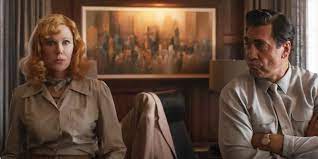
   Writer/director Aaron Sorkin tries to add a chapter to show business history with Being the Ricardos,  a movie built around one apparently pivotal week in the life of the fabled sitcom, I Love Lucy
  For the most part, Being the Ricardos offers an insider's view of  preparation for the 37th episode in a series that regularly attracted 60 million viewers to CBS every Monday night.
   Casting Nicole Kidman as Lucille Ball and Javier Bardem as Desi Arnaz, Sorkin follows several themes through a story that detours to provide a capsule review of Ball's Hollywood career. She never made it to A-list ranks and instead became one of the entertainment's great physical comics.
   So, about those themes: Ball is accused of being a Communist, the Ball-Arnaz marriage wobbles, and Arnaz fights the network over whether the show can continue with a pregnant Ball. 
   It may seem odd to younger audiences but during the 1950s, pregnancy couldn't be mentioned on TV, presumably because it might encourage thoughts about how this essential human condition came about.
   As for politics, the '50s preoccupation with Communism has been dealt with before with cases much more powerful than Ball's. In 1936, she checked a box saying that she was a member of the Communist party, evidently as a way of appreciating the left-wing grandfather who raised her. 
   None of its story lines prove powerful enough to carry the movie. Sorkin hasn't really made clear what he's trying to say -- other than to expose the gap between back-stage and on-camera realities and to tell us that making comedy is a serious business.
    Kidman doesn't seem like an ideal choice for playing Lucille Ball. When she's playing Ball, Kidman seems like ... well ... Kidman — with red hair, of course. 
   As Lucy, though, she perfectly captures the expressions, movements, and voice that made Ball a great comedian. It’s one hell of a feat. 
  Sorkin may have meant for us to fret about potential consequences of Ball's being tainted as a Red, to use the language of the day,  by Radio broadcaster Walter Winchell. 
   Would the papers get hold of the story and run with it? If they did, could the show survive? 
   I won't get into specifics about the way Sorkin resolves the question. All I'll say is that relief comes from an unexpected source and is presented as a triumph. Yippie. Lucy's off the hook.
   How about lamenting the red-bating hysteria that put her "on the hook" in the first place?
   Bardem makes a convicting Arnaz, a womanizing bandleader who found his way to stardom when Ball insisted he be part of her transition from radio to television. Arnaz proved a strong comic partner for Ball with a shrewd appreciation of how to use the show's success to pressure network executives into doing what he wanted.
   The secondary casting is quite good. J.K. Simmons and Nina Arianda play William Frawley and Vivian Vance, the actors who portrayed the Ricardos' neighbors, Fred and Ethel Mertz. 
   Simmons captures Frawley's fondness for alcohol and wit and Vance makes a perfect second-fiddle to Ball, a woman who's not without her resentments about having to be subordinate to Lucy.
   As for the marriage: Arnaz's philandering hardly seems shocking.
   Tony Hale as Josh Oppenheimer, the show's executive producer, and Alia Shawkat, as the only woman writer on the show's staff, both have nice turns.
   To add authenticity and to take care of expository chores, Sorkin includes interviews with some of the show's writers and producers (all played by actors) as seen in their older, reflective years. The wise elders clue us about the reality of bygone days.
   It occurred to me that a truly revealing and far more intriguing movie could have been made about Frawley and Vance. In it, we might have seen Arnaz and Ball through the lens of those indispensable and often neglected performers: “supporting” actors. 
    But what do I know? 
    Being the Ricardos never convinced me that Sorkin's movie was more than a sporadically entertaining look at what amounts to ancient TV historyWithout either the comforts of nostalgia or the urgency of highly focused drama, I was left taking note of how often I could forget it was Kidman playing Lucille Ball and Bardem smacking the congas as Desi Arnaz. 

Thursday, September 20, 2018

He sang, drank and died young

Ethan Hawke directs a movie about country singer Blaze Foley, a man who may not have gotten his due..
Some musicians play the blues. Some live the blues. Some do both.

I guess you could say that Blaze Foley falls into the latter category. Foley, who acquired an admiring reputation among country music aficionados, probably would have drunk himself into an early grave had he not been shot by the son of one of his friends. He died in 1989 at the age of 40.

An actor of estimable intelligence and wide-ranging interests, Ethan Hawke has directed a film about Foley's life and music, both of which find ample expression in Blaze.

Played by singer Ben Dickey, Foley comes off as a bearish man of contradictions: shy, belligerent, gifted and funny. He can wring laughs out of a folksy story or sell the sadness in a song. Foley was known for tunes such as If I Could Fly and Clay Pigeons; his tunes were recorded by artists such as Merle Haggard, Lyle Lovett and John Prine.

As a kind of framing device, Hawke shows singer Townes Van Zandt (played by Charlie Sexton) during a radio interview. The interviewer (a barely seen Hawke) receives an unexpected lesson in the history of Blaze Foley, a singer he's never heard of. Then again, lots of people haven't heard of Foley, who never really occupied country music's center stage.

In some ways, then, Blaze becomes the story of a gifted singer/songwriter who could be as charming as he was off-putting. Just about everything Foley did was accompanied by his three most reliable companions: liquor, cigarettes, and pot.

Hawke also spends time on Foley's relationship with Sybil Rosen (Alia Shawkat), an actress who wrote a memoir about her life with Blaze. It would take quite a woman to keep up with Blaze and Sybil was that woman -- at least until the relationship fell apart. Early on, the two share their romance while living in a Georgia tree house. They met at a Georgia artists colony.

In one of the movie's funniest scenes, Sybil and Blaze visit her Jewish parents, a couple that's not accustomed to people such as Blaze. Worried about having non-Jewish grandchildren, Dad questions Blaze about his commitment to Christianity. Let's just say Blaze's answer wouldn't have evoked cheers from evangelicals.

The real Rosen plays her mother in this scene as an accommodating Blaze and an assertive Sybil deal with a moment that's awkward under the best of circumstances. If you want to stretch your mind a bit try to imagine Thanksgiving dinner at the Rosen household.

Foley's hardscrabble childhood comes into view when he and Sybil visit Blaze's father, a once-feared man who has slipped into senescence in a nursing home. Kris Kristofferson makes an impact in a small role as Foley's father. Age seems to have taken all the mean out of the man.

The best parts of the movie involve music or plain old hanging out. When they're not playing, the musicians talk, telling stories in colorful fashion. It's a pleasure to listen to these guys.

I wish I could say that I didn't get a little tired of all the movie's meandering but Hawke shows no interest in grabbing us by the collar and pulling us through a movie composed mostly of side trips. In one of them, Richard Linklater, Steve Zahn, and Sam Rockwell play Texans who want to push Foley toward stardom. You don't need to be a fortune teller to know that their plan won't work. Foley will find a way to mess things up.

At one point, Foley says that he's not interested in being a star; he wants to be a legend. I don't know if he became either, but for the length of Hawke's film, he's the center of a sauntering look at the life of a man who other musicians respected, who left the world a few songs and a ton of stories -- many of them quite entertaining.