Showing posts with label Tony Hale. Show all posts

Wednesday, December 8, 2021

One week in the life of Lucy and Ricky


   Writer/director Aaron Sorkin tries to add a chapter to show business history with Being the Ricardos,  a movie built around one apparently pivotal week in the life of the fabled sitcom, I Love Lucy
  For the most part, Being the Ricardos offers an insider's view of  preparation for the 37th episode in a series that regularly attracted 60 million viewers to CBS every Monday night.
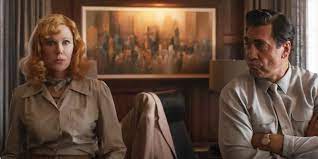
   Casting Nicole Kidman as Lucille Ball and Javier Bardem as Desi Arnaz, Sorkin follows several themes through a story that detours to provide a capsule review of Ball's Hollywood career. She never made it to A-list ranks and instead became one of the entertainment's great physical comics.
   So, about those themes: Ball is accused of being a Communist, the Ball-Arnaz marriage wobbles, and Arnaz fights the network over whether the show can continue with a pregnant Ball. 
   It may seem odd to younger audiences but during the 1950s, pregnancy couldn't be mentioned on TV, presumably because it might encourage thoughts about how this essential human condition came about.
   As for politics, the '50s preoccupation with Communism has been dealt with before with cases much more powerful than Ball's. In 1936, she checked a box saying that she was a member of the Communist party, evidently as a way of appreciating the left-wing grandfather who raised her. 
   None of its story lines prove powerful enough to carry the movie. Sorkin hasn't really made clear what he's trying to say -- other than to expose the gap between back-stage and on-camera realities and to tell us that making comedy is a serious business.
    Kidman doesn't seem like an ideal choice for playing Lucille Ball. When she's playing Ball, Kidman seems like ... well ... Kidman — with red hair, of course. 
   As Lucy, though, she perfectly captures the expressions, movements, and voice that made Ball a great comedian. It’s one hell of a feat. 
  Sorkin may have meant for us to fret about potential consequences of Ball's being tainted as a Red, to use the language of the day,  by Radio broadcaster Walter Winchell. 
   Would the papers get hold of the story and run with it? If they did, could the show survive? 
   I won't get into specifics about the way Sorkin resolves the question. All I'll say is that relief comes from an unexpected source and is presented as a triumph. Yippie. Lucy's off the hook.
   How about lamenting the red-bating hysteria that put her "on the hook" in the first place?
   Bardem makes a convicting Arnaz, a womanizing bandleader who found his way to stardom when Ball insisted he be part of her transition from radio to television. Arnaz proved a strong comic partner for Ball with a shrewd appreciation of how to use the show's success to pressure network executives into doing what he wanted.
   The secondary casting is quite good. J.K. Simmons and Nina Arianda play William Frawley and Vivian Vance, the actors who portrayed the Ricardos' neighbors, Fred and Ethel Mertz. 
   Simmons captures Frawley's fondness for alcohol and wit and Vance makes a perfect second-fiddle to Ball, a woman who's not without her resentments about having to be subordinate to Lucy.
   As for the marriage: Arnaz's philandering hardly seems shocking.
   Tony Hale as Josh Oppenheimer, the show's executive producer, and Alia Shawkat, as the only woman writer on the show's staff, both have nice turns.
   To add authenticity and to take care of expository chores, Sorkin includes interviews with some of the show's writers and producers (all played by actors) as seen in their older, reflective years. The wise elders clue us about the reality of bygone days.
   It occurred to me that a truly revealing and far more intriguing movie could have been made about Frawley and Vance. In it, we might have seen Arnaz and Ball through the lens of those indispensable and often neglected performers: “supporting” actors. 
    But what do I know? 
    Being the Ricardos never convinced me that Sorkin's movie was more than a sporadically entertaining look at what amounts to ancient TV historyWithout either the comforts of nostalgia or the urgency of highly focused drama, I was left taking note of how often I could forget it was Kidman playing Lucille Ball and Bardem smacking the congas as Desi Arnaz. 

Tuesday, November 24, 2020

Bob's Cinema Diary: 11/24/20 -- 'Mosul' and 'Last Call'

Mosul


Mosul, an Iraq-based story that charts the activities of a squad of renegade warriors, takes us into familiar war-time movie turf: Buildings demolished by explosions, civilian lives destroyed, and homeless children wandering bombed-out streets. I don't mean to be callous but it's important to note that director Matthew Michael Carnahan isn't exactly breaking new cinematic ground. Mosul is more of an addition to the canon of intense war movies in the spirit of Ridley Scott's Black Hawk Down. At the same time, it should also be said that Mosul commands attention because of its fresh perspective; the movie tells its story from the viewpoint of Iraqis whose lives have been shattered by war. Set in 2017 and based on a New Yorker article, Mosel pits  a group of rogue fighters against the by-then staggering fighters of Isis. The group's leader (a convincingly tough Suhail Dabbach) has concocted a mission whose purpose doesn’t become clear until the final going. Early on, the team is joined by a young Kurd (Adam Bessa) who gradually blends into the squad, known as the Nineveh SWAT team. Shot entirely in Arabic, it's not always easy to tell who the SWAT team is fighting. But that may be the point: Order has so broken down that it's not always possible to discern who is a friend and who, foe. By the end, you'll know why the men have persisted in their self-defined mission, a touch that seems intended to justify their hardness.  An atmosphere of chaos precludes deep character development. Still, there's something to be said for a movie that tries to shed an American perspective. The fighters in Mosul aren't battling to preserve freedom or for any other abstraction: They're fighting in hopes that they can keep their loved ones alive.

Last Call
When I was young, I regarded Dylan Thomas as the greatest of all poets. But time marched on and took my taste in poetry along with it.  Thomas, though still a worthy poet, appealed to me because he lived hard and died young, a romantic notion to which only the young are naive enough to subscribe. Last Call, a movie from director Steven Bernstein, both feeds and debunks the Thomas myth. Shot in black-and-white with interludes of color, the movie centers on the performance of Rhys Ifans as Thomas, a dissolute artist who spends much of his time in the US in the White Horse bar in Greenwich Village. He also ventures onto college campuses,  reading his poetry (declaiming might be a better word) to adoring college girls. Bernstein adopts what might be called a "poetic" approach to the material. We see Thomas's hallucinations as he spends his day drinking 18 double scotches in the White Horse, giving each drink a name. Enthusiasm marks an early drink, for example. We also see various figures from Thomas's life, notably his severely neglected wife (Romola Garai), the man arranging his tour (Tony Hale), and the doctor (John Malkovich) who understands that Thomas has entered a death spiral. More significantly, Rodrigo Santoro plays the bartender who pours Thomas's scotch and occasionally jabs at the great man's leaky ego. Although the movie runs for about an hour and 48 minutes, it can feel longer because it's like spending a day in a bar. Inebriation proves a mixed drink flavored with charm, intellect, wit, and cruelty. Ifans sometimes seems to be mumbling — albeit quite intelligently. Malkovich adds a serving of wry cynicism, bringing his trademark enunciation to the proceedings. Still, hanging out with drinks -- even those who achieved legendary status -- seldom proves enlightening.  


Thursday, June 20, 2019

Toys are us -- or at least pretty human

Toy Story 4 balances real issues, fun and undisguised sentiment.
What’s an aging toy to do?

That question hovers over Toy Story 4, giving the movie a strange relevance that goes along with the comfort and amusement we associate with toys.

In this edition, Woody -- the familiar cowboy toy voiced by Tom Hanks -- faces a struggle between loyalty and personal fulfillment. Bo Peep (voice by Annie Pots) already has struck out on her own. She’s given up on the idea of belonging to a child. Long separated from the lamp they once called home, Bo and her sheep roam the country as free ... geez ... I almost said beings.

After a brief prologue, director Josh Cooley plunges into a story that takes some odd turns. Bonnie, Woody’s latest “owner,” has been ignoring the cowboy, but Woody continues in his loyalty, even sneaking into Bonnie’s backpack to help her deal with her terrifying first day at school.

During that fateful day, Bonnie makes a toy out of a spork and pipe cleaners. Named Forky and having been granted toy status by virtue of Bonnie’s affection, the newbie springs to life.

Initially, Forky has trouble giving up his previous identity as a disposable piece of trash. Left to his own devices, Forky instinctively leaps into the nearest wastebasket, forcing Woody to rescue him -- not because he cares that much about Forky but because he knows Bonnie will be distraught if she loses a toy she made.

When Bonnie’s family takes an RV trip, the story takes an even weirder turn. Woody and Forky wind up in an antique store where they’re terrorized by four ventriloquist dummies and their leader, a doll called Gaby Gaby (Christina Hendricks). An old-fashioned girl doll with eyelids that drop into a blink, Gabby wants to steal Woody’s voice box to enhance her desirability. If a kid can pull her string and hear Gaby talk — routine doll babble that has nothing to do with her "real" vocal skills — perhaps she’ll be able to fulfill her destiny and find her very own human.

And, no, I can’t believe I’m writing about the motivations of toys, but such is the life of movie critics and children.

The dummies give Toy Story 4 a weird horror-movie tilt — at least for a few minutes. I half wish Disney had gone all the way and really taken Toy Story 4 off the rails, but that, of course, would have been commercial suicide.

Instead, the Pixar team balances the sentimental, the slightly scary and the blatantly emotional in a package that marks a definite improvement of the last installment.

As with all sequels, this one has been accessorized with a few new features, notably two furry toys. Jordan Peele gives voice to Bunny and Keegan-Michael Key does voice work for Ducky. Even better, Keanu Reeves provides the voice for Duke Caboom, a failure-prone motorcycle-riding daredevil. It's one of Reeves’ best performances.

Old standby Buzz Lightyear (Tim Allen) tags along for the ride, taking a bit of back seat to the other characters. But even Buzz receives a showcase moment.

The always reliable Pixar animation can seem a bit creepy — plastic faces that never fully come to life. But what the heck, these are toys. Besides, humans have relatively little to do with this edition; they’re around to give the toys a sense of purpose.

If an adult friend (sans kids) asked me whether he or she should race out to see Toy Story 4, I’d probably shrug. If you must. But parents who see the movie with their kids won’t be bored and Disney always gives enough cartoonish bounce to its endeavors to keep youngsters happy — even if they’re not tuned into what some critics are calling an “existential” edition of Toy Story.

The end credits will help you decide whether Bo Peep and Woody have a future. This may not be as pressing a question as whether artificial intelligence will deprive you of employment or whether climate change will torment your progeny in ways you hardly can imagine, but for a couple of hours, Disney and its fine voice cast help you get caught up in it.

A footnote: I wonder whether kids will realize that they can make Forky at home and without jumping onto any merchandising bandwagon. This could start a massive new trend that cripples sales of movie-related toys: Kids actually making things themselves. What a concept.