Showing posts with label J.K. Simmons. Show all posts

Wednesday, October 9, 2024

An uneven look at SNL’s first show


  Who among us doesn't know what the letters SNL stand for? OK, it's Saturday Night Live, the show that recently celebrated its 50th anniversary. That's half a century of sketches, new comic faces, weekend updates, and cold opens. The show has hooked successive generations of younger viewers and created long-time loyalists.
    Perhaps understanding the place SNL has earned in American culture, director Jason Reitman, working from a script he co-wrote with Gil Kenan, has made Saturday Night, an energized look at the 90 minutes preceding the first time Chevy Chase uttered the keynote words, "Live from New York. It's Saturday Night."
    If you're a committed SNL fan, you may find amusement in Reitman's brisk examination of how producer Lorne Michaels (Gabriel LaBelle) survived turmoil that included the use of drugs on set, personality clashes, and what sometimes looks like a show-threatening helping of amateurism.
   Difficulties seem to compound as air time approaches: John Belushi (Matt Wood) hadn't yet signed his contract, and an NBC executive (Willem Dafoe) threatened to pull the plug in favor of a Johnny Carson Tonight Show rerun.
     If there's a larger point to any of this, it involves Reitman's recognition of a cultural shift. Gone were the days of the jokey brashness of Milton Berle, played here by J.K. Simmons, once known as Mr. Television. SNL pulled off a neat trick: It turned a parodic mindset against the mainstream while becoming part of it.
      The cast is mostly game with a variety of standouts, notably Cory Michael Smith as a self-impressed Chevy Chase. Dylan O'Brian scores as the comically intense Dan Aykroyd; and Tommy Dewey proves mordantly funny as writer Michael O'Donoghue. 
      Kim Matula portrays Jane Curtin with come-what-may ease, and Lamorne Morris appears as Garrett Morris, SNL's first Black cast member. Morris spends most of his time wondering what he's doing on a show no one seems to have a handle on.
       So, is Saturday Night anything more than a big-screen reconstruction of some fabled and some fictionalized moments? Not really.
          For some, the movie will provide a healthy dose of nostalgic pleasure. For me, Saturday Night didn’t generate enough laughs. I didn't buy Wood's scowling John Belushi, and in the end, the movie became a mixed bag: a blur of dizzying camera work and hit-and-miss portrayals of the original SNL cast. 
       Saturday Night aside, my idea of SNL nostalgia has less to do with the show than with watching Belushi in Animal House, Aykroyd in Doctor Detroit, and Chevy Chase in Caddyshack. Those were the days.
        

Wednesday, December 8, 2021

One week in the life of Lucy and Ricky


   Writer/director Aaron Sorkin tries to add a chapter to show business history with Being the Ricardos,  a movie built around one apparently pivotal week in the life of the fabled sitcom, I Love Lucy
  For the most part, Being the Ricardos offers an insider's view of  preparation for the 37th episode in a series that regularly attracted 60 million viewers to CBS every Monday night.
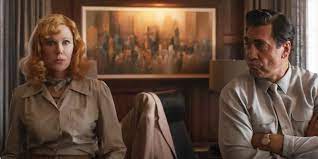
   Casting Nicole Kidman as Lucille Ball and Javier Bardem as Desi Arnaz, Sorkin follows several themes through a story that detours to provide a capsule review of Ball's Hollywood career. She never made it to A-list ranks and instead became one of the entertainment's great physical comics.
   So, about those themes: Ball is accused of being a Communist, the Ball-Arnaz marriage wobbles, and Arnaz fights the network over whether the show can continue with a pregnant Ball. 
   It may seem odd to younger audiences but during the 1950s, pregnancy couldn't be mentioned on TV, presumably because it might encourage thoughts about how this essential human condition came about.
   As for politics, the '50s preoccupation with Communism has been dealt with before with cases much more powerful than Ball's. In 1936, she checked a box saying that she was a member of the Communist party, evidently as a way of appreciating the left-wing grandfather who raised her. 
   None of its story lines prove powerful enough to carry the movie. Sorkin hasn't really made clear what he's trying to say -- other than to expose the gap between back-stage and on-camera realities and to tell us that making comedy is a serious business.
    Kidman doesn't seem like an ideal choice for playing Lucille Ball. When she's playing Ball, Kidman seems like ... well ... Kidman — with red hair, of course. 
   As Lucy, though, she perfectly captures the expressions, movements, and voice that made Ball a great comedian. It’s one hell of a feat. 
  Sorkin may have meant for us to fret about potential consequences of Ball's being tainted as a Red, to use the language of the day,  by Radio broadcaster Walter Winchell. 
   Would the papers get hold of the story and run with it? If they did, could the show survive? 
   I won't get into specifics about the way Sorkin resolves the question. All I'll say is that relief comes from an unexpected source and is presented as a triumph. Yippie. Lucy's off the hook.
   How about lamenting the red-bating hysteria that put her "on the hook" in the first place?
   Bardem makes a convicting Arnaz, a womanizing bandleader who found his way to stardom when Ball insisted he be part of her transition from radio to television. Arnaz proved a strong comic partner for Ball with a shrewd appreciation of how to use the show's success to pressure network executives into doing what he wanted.
   The secondary casting is quite good. J.K. Simmons and Nina Arianda play William Frawley and Vivian Vance, the actors who portrayed the Ricardos' neighbors, Fred and Ethel Mertz. 
   Simmons captures Frawley's fondness for alcohol and wit and Vance makes a perfect second-fiddle to Ball, a woman who's not without her resentments about having to be subordinate to Lucy.
   As for the marriage: Arnaz's philandering hardly seems shocking.
   Tony Hale as Josh Oppenheimer, the show's executive producer, and Alia Shawkat, as the only woman writer on the show's staff, both have nice turns.
   To add authenticity and to take care of expository chores, Sorkin includes interviews with some of the show's writers and producers (all played by actors) as seen in their older, reflective years. The wise elders clue us about the reality of bygone days.
   It occurred to me that a truly revealing and far more intriguing movie could have been made about Frawley and Vance. In it, we might have seen Arnaz and Ball through the lens of those indispensable and often neglected performers: “supporting” actors. 
    But what do I know? 
    Being the Ricardos never convinced me that Sorkin's movie was more than a sporadically entertaining look at what amounts to ancient TV historyWithout either the comforts of nostalgia or the urgency of highly focused drama, I was left taking note of how often I could forget it was Kidman playing Lucille Ball and Bardem smacking the congas as Desi Arnaz. 

Thursday, November 15, 2018

Gary Hart's fall from political grace

The Front Runner doesn't quite make it as a relevant foray into the world of journalism and politics.
In 1987, Gary Hart fell from political grace. Hard.

A sure bet to win the Democratic nomination for the presidency in 1988, Hart was undone by names that suddenly dominated the news, notably, a girl named Donna Rice and a yacht named Monkey Business.

Hart defended himself against charges of marital infidelity by insisting that his private life was no one’s business but his own. He was staunch in his resolve, but couldn't save himself.

Hart’s fall probably is destined to become a footnote in American political history, unless you’re convinced — as some are — that Hart’s story changed journalism and the fate of the US. That’s a heavy burden for one man to carry and it’s also a burden that the movie The Front Runner can’t carry, either.

Based on All the Truth is Out, a fine book by journalist Matt Bai, The Front Runner tries to take an encompassing approach to Hart’s story, leaning toward a view that blames the press — particularly a couple of Miami Herald reporters — for staking out Hart’s Washington, D.C. townhouse in hopes of confirming a dalliance with Rice.

As a result, the press and the national debate became focused on character (or lack of it) instead of the salient issues of the day -- or so the argument goes.

Director Jason Reitman had a hand in writing the screenplay, along with Bai and Jay Carson, a political operative who also works in the entertainment business, having done multiple duties on Netflix's House of Cards. The screenplay makes various points throughout but Front Runner remains frustratingly diffuse.

Hugh Jackman has been cast as Hart. Jackman does as well as possible in conveying Hart’s intelligence, his insistence on not answering certain kinds of questions and his refusal to listen to a staff that knew he was in more trouble than he realized.

The peripheral performances are a mixed bag. Steve Zissis and Bill Burr portray two Miami Herald reporters, narrowly focused guys who see only one side of the journalistic argument: Get the story, let the chips fall where they may.

Mamoudou Athie plays a Washington Post reporter (a composite figure) who agonizes about what his editors want him to ask Hart. Ann Devroy appears as an editor at the Washington Post who claims that the press isn't going too far: Powerful men shouldn’t abuse their power with impressionable young women.

Molly Ephraim has a nice turn as a Hart aide who understands how painful it is for Rice (Sara Paxton) to have been thrust into a maelstrom. Ephraim's character winds up selling Rice out anyway.

I’m an admirer of actor Alfred Molina, but even he can’t overcome the images of Ben Bradlee created by actors in previous movies (Jason Robards in All the President’s Men and Tom Hanks in The Post) — not to mention a couple of documentaries in which the real Bradlee can be seen.

J.K. Simmons, a Reitman regular, plays Hart's campaign manager, a role that could have used some expansion. Still, Simmons conveys the dejection that haunts a man who sees a cause in which he deeply believes going down the drain.

In dealing with Hart’s wife, Lee, who's played here by Vera Farmiga, the movie suggests that Lee and Gary Hart had reached some sort of agreement about how they’d conduct their marriage with Lee stipulating only that she didn’t want to be embarrassed by her husband. After the Rice debacle, Lee Hart found her home in Troublesome Gulch, Co., besieged by reporters. She became another victim.

Nearly everything about The Front Runner plays against unstated ironies. Bill Clinton survived Monica Lewinsky and the current resident of the White House has set a new bar for what we know about the sexual behavior of a president.

If you haven’t read Bai’s book, you should. But the real story of Gary Hart remains unknowable. Was he a hero who stood up for rights of privacy? Was he an arrogant man who believed he had a license to be reckless? Was he really brilliant enough to have altered the course of American history? Did he foresee every important problem we face today?

Reitman does a good job creating the chaotic swirl that surrounds a political campaign. He also inserts enough sardonic humor to make Front Runner entertaining but the movie can't sustain the kind of absurdist kick that Reitman brought to his best movies: Thank Your for Smoking, Juno, and Up in the Air.

If The Front Runner is meant to be taken as a cautionary tale, it arrives 30 years too late. In the current bold-faced clash between powerful politicians and journalists, the Hart story already has been consigned to small print.

Thursday, May 12, 2016

She marches into her daughter's life

Susan Sarandon taps her inner New Jersey in The Meddler.

Marnie Minervini is the kind of person (you probably know at least one) who leaves exceptionally long phone messages. For Marnie leaving a phone message becomes part of a ceaseless monologue in which she expresses her needs and concerns. The major recipient of these lengthy messages is Lori, Marnie's grown daughter.

As a screenwriter trying to recover from a failed romance, the last thing Lori wants is a close and confiding relationship with her widowed mother, who -- by the way -- moved to Los Angeles from New Jersey after her husband died so that she could be closer to her daughter.

You don't need to be a genius to know that The Meddler, a comedy from director Lorene Scafaria, drips with denial, specifically about the death of the most important man in both mother and daughter's lives.

Scafaria takes a mostly mellow approach to a difficult emotional issue by turning Marnie into a woman who can't resist becoming involved in other people's lives. Marnie's method of avoidance involves helping anyone and everyone -- with pretty much anything.

Adopting a near parodic New Jersey accent, Susan Sarandon plays Marnie as a human intrusion. Rose Byrne -- in a nice small performance -- portrays Lori, the daughter who says she wants to escape her mother's suffocating attentions.

Marnie means well. When she goes to an Apple store to buy an iPhone, she can't help but come to the aid of a sales person (Jerrod Carmichael) who wants to attend college, but can't get to classes because he doesn't own a car. Marnie happily becomes his chauffeur and advisor.

And when she meets a young mother (Cecily Strong) who feels deprived because she and her gay spouse never had a "real" wedding, Marnie insists on planning and paying for a big celebration.

Marnie's husband, we learn, left her lots of money, and she doesn't seem reluctant to part with some of it -- so long as it keeps her connected to others.

Marnie also volunteers at a hospital, where she engages in conversation with an elderly woman who may be suffering from dementia, and doesn't seem to understand a word Marnie says. Whoever plays this woman fares better than Michael McKean, as a man who Marnie rebuffs in one of the movie's least believable scenes.

Most of the movie takes place when Lori takes off for New York to work on a pilot for an upcoming show. Marnie must fend for herself, which mostly involves making friends with her daughter's friends. She even starts seeing her daughter's therapist (Amy Landecker)

Sarandon gives a committed and sometimes touching comic performance as a woman whose good intentions are inseparable from her desire to involve herself in the lives of others.

Slowly but inevitably, Marnie begins to stake out her own turf. She opens herself to a relationship with a man, a retired cop played by J.K. Simmons, who has grown a mustache for the role. Maybe Sam Elliott, who usually plays these kinds of attractive older men, was otherwise engaged.

Supposedly a semi-autobiographical work by Scafaria, The Meddler offers intermittent and often sunny amusements as it allows Marnie's incessant chatter to march through the movie like an invading army that's immune to all resistance.

Thursday, March 3, 2016

There's lots of fun in 'Zootopia'

Sometimes fun is the best ambition.

I have no idea whether Zootopia -- the latest animated fantasy from Disney -- will become a classic, but I do know that it scores high on the fun meter.

So three cheers for a story about Judy Hopps (voice by Ginnifer Goodwin), a bunny who aspires to become a cop in the city of Zootopia. Police work has been Judy's ambition since she was a child.

Primed for action and a do-gooder's career, Judy wants to leave the countryside and her family of underachieving carrot farmers.

When Judy arrives in the city, she becomes the first bunny on the Zootopia PD. An unimpressed chief Bogo (Idris Elba), arbitrarily decides that Judy's fit only for parking duty. He doesn't believe a bunny can hold her own on Zootopia's mean streets, hardly a surprising opinion from a water buffalo.

Zootopia is unique because the animals all get along. That's why it's called Zootopia. Predators and prey may not be the best of friends, but the former have learned to refrain from devouring the latter.

While handing out parking tickets, Judy meets Nick Wilde (Jason Bateman), a conniving con artist of a fox who eventually teams with Judy to help crack a case involving the disappearance of 15 mammals.

If Judy can solve the mystery, she'll get herself off parking duty, maintain a position on the force and climb out of Chief Bogo's (you'll pardon the expression) dog house.

Judy and Nick make an odd couple as they learn some shocking news: Some predators suddenly are turning on prey, thereby threatening Zootopia's peaceable social structure.

Disney loads up on animals and voices, but I particularly enjoyed an arctic shrew mobster who'll remind adults in the audience of Don Corleone. Mr. Big, as he's called, is brought to gravelly voiced life by Maurice LaMarche.
Appropriately, I suppose, the Zootopia's DMV is staffed by sloths, a joke that surely will appeal to every adult who's ever endured what seems like an interminable wait at any department of motor vehicles.

The story evolves into a light-hearted police procedural that winds up preaching a lesson about acceptance and free will -- if that's not too grandiose a term for the fact that the animal characters are forced to decide whether to be ruled by instinct or choice.

Directors Byron Howard, Rich Moore and Jared Bush do a fine job of keeping Zootopia amusing for kids and equally enjoyable for the adults who accompany them to theaters.

Disney's animators seem to have had a grand time creating Zootopia -- which consists of districts such as Tundratown, Little Rodentia and Bunnyburrow.

OK, that's a bit theme-parkish, but dividing Zootopia into distinct environments must have kept the animators from getting bored. It also gives Judy and Nick an opportunity to venture into Zootopia's bad neighborhoods.

At various times Judy must prove to herself and the world that she's no dumb bunny; the same goes for this frolic of a movie. The highest compliment I can pay Zootopia? It's no dumb bunny, either.

Monday, February 23, 2015

Another mediocre night with Oscar

Here are some things I'd hoped never to see:

-- A Birdman parody in which Oscar host Neil Patrick Harris appeared on stage in his tighty/whiteys.

-- An Oscar show in which Boyhood won only one award, Patricia Arquette 's statue for best supporting actress.

-- A purported celebration of movies in which the high points belonged to three singers: Lady Gaga, John Legend and Common. Lady Gaga nailed a medley of songs in a tribute to The Sound of Music, and Legend and Common brought the audience to its feet with Glory, the song from Selma that went on to win an Oscar.

With their win, Legend and Common found a platform to give one of the night's best acceptance speeches, even managing to mention the appalling rate at which young black men are being incarcerated.

So what kind of night was it?

You don't need me to tell you that it seemed endless, that an affable Neil Patrick Harris got off to a great start with a rousing musical number and then sank under the weight of a ton of lamely written material.

I'm not an ardent Birdman supporter, so Oscar's finale didn't buoy my spirits, either.

Alejandro Gonzalez Inarritu won best director. Birdman won best original screenplay, and, of course, took home best-picture honors.

I felt sad for Boyhood and Richard Linklater, an indie-oriented director who may not get another shot at an Oscar. I'd have felt better if the Academy had split its votes, giving Birdman best picture and Linklater, best director.

Despite complaints about this year's lack of women and people of color, the Academy of Motion Picture Arts and Sciences does seem to be changing.

Time was movies such as The Theory of Everything (British and a bit middlebrow) and Selma (socially powerful) would have been frontrunners for best-picture honors. Neither was.

And Oscar seems as removed from popular tastes as ever. Julianne Moore's victory as best actress was well-deserved, but I wonder how many people saw Still Alice, a heartbreaking movie about a brilliant college professor forced to deal with early onset Alzheimer's.

Was I upset that Eddie Redmayne, who played physicist Steven Hawking in The Theory of Everything, beat Michael Keaton (Birdman) in the best-actor category? Not really.

I've always liked Keaton, but thought Redmayne had the more difficult role. Despite Hawking's debilitating ALS, Redmayne never failed to show us the man's brilliance, arrogance and wit.

What else but random thoughts are possible during a telecast that tended to stagger under the weight of its own mediocrity?

-- Notable acceptance speeches came from Graham Moore (who won the best-adapted-screenplay Oscar for The Imitation Game) and from Patricia Arquette, who used the stage as a platform to call for wage equality for women.

Moore, who mentioned that he attempted suicide at age 16, encouraged those young people who feel different or alienated to hang in. Their day, he said, will come.

-- I was happy for Alexandre Desplat, who won best original score for The Grand Budapest Hotel, his first Oscar win after eight nominations. Desplat is a great composer of movie music.

-- I wondered if Clint Eastwood applauded when Laura Poitras won the best documentary Oscar for Citizen Four, her movie about Edward Snowden.

-- I was surprised that Whiplash won the Oscar for best editing, but upon reflection remembered that the movie's editor, Tom Cross, made a story about a jazz-obsessed drummer (Miles Teller) feel like an action movie.
Cross did a fine job, but Boyhood, which was shot over 12 years, must have been the more difficult movie to edit.

-- The In Memoriam section put a lump in my throat.

-- It struck me that the best visual effects category consisted of movies that a majority of viewers might actually have seen: Captain America: The Winter Soldier, Dawn of the Planet of the Apes, Guardians of the Galaxy, Interstellar and X-Men: Days of Future Past. Interstellar won.

-- Wouldn't the telecast have been better if Harry Belafonte, Maureen O'Hara, screenwriter Jean-Claude Carriere and animator Hayao Miyazaki had been honored at the big show rather than at a separate Governor's Awards program.

I'd rather have seen them than the chaotic Everything is Awesome production number. The tune -- from The Lego Movie -- was nominated for best song.

-- And who thought it was a good idea that director Pawel Pawilkowski, whose Ida won best foreign-language film, had to compete with the band to finish his acceptance speech?

-- The set? It was arcade gaudy. Maybe that's why Harris occasionally wandered into the audience, a move that mostly fell flat. So did a running gag about Harris's Oscar predictions, which supposedly were being kept under lock and key.

Still, maybe some good came out of the evening. Best supporting actor winner J.K. Simmons (of Whiplash) told people to call their parents.

With Simmons on the case, who needs Jewish mothers?

So what are you waiting for? Go ahead. Put Oscar behind you, and call home.

For a complete list of Oscar winners, click here.

Friday, February 20, 2015

It's almost over -- Oscar season, that is

Birdman and Boyhood in tight race for best picture.
Current wisdom has it that 2015 has given us one of the tightest Oscar races in years. Clear frontrunners have yet to emerge in several important categories, namely best picture, best director and best actor.
That may be true, but I have to confess that even several tightly contested races haven't gotten me psyched for Sunday's Oscars. In truth, the moment I'm most eagerly anticipating is the end of what feels like another interminable awards season.
Having said that, I suppose it's incumbent on me to make a few Oscar predictions, so here goes:


Best Picture
Birdman will win.
The competition has narrowed to a battle between Boyhood and Birdman. It's entirely possible that Boyhood will prove victorious, but Birdman seems to have received a boost of inevitably from victories at the Producers and Directors Guild awards, where it won best picture and best director honors respectively.
Besides, I know moviegoers whose judgment I respect who believe Boyhood doesn't quite live up to its reputation. A little underwhelming, they argue.
I'm going against my gut by picking Birdman, but my gut often finds itself out of alignment with Hollywood thinking.
I hope I'm wrong. I hope Boyhood takes best picture, but I'm prepared for Birdman to fly.
Best possible upset: Selma surprises everyone and wins best picture.


Best director
Alejandro Gonzalez Inarritu
It's not unreasonable to expect a split vote for best picture and best director with Birdman winning best picture and Richard Linklater (Boyhood) winning best director.
A favorable outcome for Linklater might depend on whether the Academy decides that this well-regarded indie director -- who spent 12 years making his movie -- can't go home without some recognition.
But ...
It may be difficult to stop Inarritu since he's already won the Directors Guild award and because his movie bowed much later in the year than Boyhood, which had its premiere more than a year ago last month at the 2014 Sundance Film Festival.
Of course, there's yet another possibility: Inarritu wins best director, but Boyhood snags best-picture honors.


Best Actor
Eddie Redmayne will win for The Theory of Everything.
Lots of folks think Birdman's Michael Keaton will take home Oscar gold for his portrayal of a desperate Hollywood actor trying to make a comeback on Broadway.
Keaton, who hasn't starred in a movie in a while, certainly makes for a better Hollywood story than Redmayne: Veteran actor re-emerges to wow voters or something like that.
But the Screen Actors Guild award went to Redmayne, and actors make up the Academy's biggest voting bloc. Ergo, my pick.
Besides, Redmayne was terrific as physicist Steven Hawking; he deserves credit for keeping Theory of Everything from falling into disease-of-the week sentimentality. He portrayed Hawking's ALS-related disabilities with alarming accuracy, but never lost sight of Hawking's wit, brilliance and humanity.
If there's a dark horse here, it's Bradley Cooper. How could a Cooper victory happen? If Redmayne and Keaton wind up splitting voters, Cooper has a chance.
Besides, even people who don't admire American Sniper concede that Cooper gave one hell of a performance as Navy SEAL Chris Kyle.

Best Actress
We're now crossing into safer terrain for predictions.
Julianne Moore wins the best actress Oscar for her portrayal of a college professor battling a rapidly advancing case of Alzheimer's. This is a strong category, but Moore deserves to win -- not only for her performance in Still Alice, but for a career geared toward excellence -- with a few digressions, of course. Let's not talk about her first movie of 2015: The misbegotten Seventh Son.


Best Supporting Actor
The Oscar goes to J.K. Simmons. Why go against the wave of support Simmons already has received with Golden Globe and SAG awards?
If you think Simmons was scary and intimidating as a sadistic music teacher in Whiplash, you've forgotten his portrayal of a white supremacist in 56 episodes of HBO's Oz.

Best Supporting Actress
Patricia Arquette will win.
Arquette may not have quite as much support as Simmons, but she'll have enough to win an Oscar for her work as an often-frustrated single mother in Boyhood.


Now for some quicker hits:
Look for The Imitation Game to emerge victorious in the best adapted screenplay category. I'm betting that The Grand Budapest Hotel will win best original screenplay for Wes Anderson , although -- for my money -- the movie is more a brilliant display of visual wit than anything else.
I'm going to skip most of the so-called technical categories, except to note that Birdman will win a cinematography Oscar for Emmanuel Lubezki, who also won in that category last year for his work on Gravity. Talk about being on a roll.
As for documentaries: It doesn't look as if anything can stop Citizen Four from taking home an Oscar, although I can't help but wonder whether Academy voters have at least some mixed feelings about Edward Snowden, the film's subject.
I'm thinking the Polish film Ida will win best foreign-language film, although this category can (and has) produced upsets. If I had a vote, it would have gone to Leviathan.
I'll be watching and Tweeting Sunday evening, contributing to the great snarkfest that now accompanies every awards show.
I believe the annual gathering at which Hollywood celebrates itself is fair game for snark.
Let's face it, the lengthy telecast seldom proves entertaining, and the results don't necessarily reveal anything essential about the cultural moment in which we're living.
We watch because ... well ... because we do.
Let's face it, being movie lovers often necessitates putting ourselves in the position of rejected lovers who refuse to take a hint. No matter how many times the Oscar show bores or disappoints us, we always seem to return for more.

Thursday, January 15, 2015

'Boyhood' wins best picture at BFCA awards

The Broadcast Film Critics Association also honored Julianne Moore as 2014's best actress. Moore played a professor suffering from Alzheimer's in Still Alice.
Look, I understand that the awards season can feel interminable. But as a member of The Broadcast Film Critics Association, and as someone who always posts the Association's nominees, I feel I should share this year's winners with you.

The Critics Choice Awards were given out Thursday evening in Los Angeles, the same day as the Academy of Motion Pictures Arts and Sciences announced its nominees. You'll note a few differences.

Here are the winners:

Best Picture – Boyhood
Best Actor – Michael Keaton, Birdman
Best Actress – Julianne Moore, Still Alice
Best Supporting Actor – J.K. Simmons, Whiplash
Best Supporting Actress – Patricia Arquette, Boyhood
Best Young Actor/Actress – Ellar Coltrane, Boyhood
Best Acting Ensemble – Birdman
Best Director – Richard Linklater, Boyhood
Best Original Screenplay – Alejandro G. Iñárritu, Nicolás Giacobone, Alexander Dinelaris Jr., Armando Bo, Birdman
Best Adapted Screenplay – Gillian Flynn, “Gone Girl”
Best Cinematography – Emmanuel Lubezki, Birdman
Best Art Direction – Adam Stockhausen (Production Designer), Anna Pinnock (Set Decorator), The Grand Budapest Hotel
Best Editing – Douglas Crise, Stephen Mirrione, Birdman
Best Costume Design – Milena Canonero, The Grand Budapest Hotel
Best Hair & Makeup – Guardians of the Galaxy
Best Visual Effects – Dawn of the Planet of the Apes
Best Animated Feature – The Lego Movie
Best Action Movie – Guardians of the Galaxy
Best Actor in an Action Movie – Bradley Cooper, American Sniper
Best Actress in an Action Movie – Emily Blunt, Edge of Tomorrow
Best Comedy – The Grand Budapest Hotel
Best Actor in a Comedy – Michael Keaton, Birdman
Best Actress in a Comedy – Jenny Slate, Obvious Child
Best Sci-Fi/Horror Movie – Interstellar
Best Foreign Language Film – Force Majeure
Best Documentary Feature – Life Itself
Best Song – Glory, Common and John Legend, Selma
Best Score – Antonio Sanchez, Birdman


A few notable divergences from Oscar: The BFCA's best animated feature -- The Lego Movie -- was overlooked by the Academy of Motion Picture Arts and Sciences, which didn't nominate it in the animated feature category. Although he didn't win, David Oyelowo (also snubbed by Oscar) was a BFCA nominee for best actor. Oyelowo portrayed Dr. Martin Luther King Jr. in Selma. Selma director Ava DuVernay (overlooked by the Academy, as well) was nominated by the BFCA for best director. She didn't win, either, but made the short list. The BFCA honored Gillian Flynn (Gone Girl) for writing the best adapted screenplay. Flynn, who adapted her own novel, was ignored by Oscar, too.

If you're one of those folks who enter Oscar contests, you may want to peruse the BFCA list as you begin to decide where you'll be casting your votes.

Thursday, October 23, 2014

Drumming to beat the band

Whiplash has enough energy to stock 10 movies.
I've always thought of jazz as an art form that allowed skilled, disciplined musicians a great measure of freedom. But jazz -- like just about everything else -- has been transformed by time and social change.

Music once was mastered in clubs and learned from other musicians now can be studied in conservatory-like situations where highly motivated young people pursue jazz with the zeal and determination you'd expect to find among a group of Harvard MBA candidates.

That's the environment we find ourselves in Whiplash, an exciting and sometimes disturbing debut feature from Damien Chazelle, a director who obtains fine performances from Miles Teller as Andrew, an aspiring jazz drummer, and from J.K. Simmons as Fletcher, an unapologetically judgmental and sometimes sadistic teacher.

Simmons, who portrays Fletcher as if he were a Marine Corps drill instructor, hasn't had this kind of a badass role since he portrayed white supremacist Vern Schillinger on HBO's Oz.

If ever a teacher could create performance anxiety in his charges, it's Fletcher. He leads the school's prestigious first-string jazz band, and takes pride in its ability to win just about every competition it enters.

Teller's Andrew desperately wants to find a place in Fletcher's world. He's the kind of driven kid who'll practice until his hands bleed. He sweats and drums himself to the point of exhaustion. When Andrew plays, it feels as if we're watching an action movie.

Fletcher specializes in pushing his students' buttons, learning about their personal lives and using information he acquires to test their ability to withstand public humiliation. He's quick to make fun of Andrew's English teacher father (Paul Reiser), calling him a failed writer, for example. Simmons sarcastic tirades include a repertoire of homophobic slurs, delivered by him without an apparent second thought.

All of this makes Fletcher frightening. He can be sympathetic when he chooses to be, but he'll turn brutal in a minute, presumably to spur his charges to higher levels of performance.

In a way, Fletcher is a second and much tougher father than Andrew's biological father, who raised the boy alone and seems to display (heaven help him) a degree of sensitivity. Andrew's mom left when he was quite young.

Teller shows us some of Andrew's vulnerability, but he also can be cocky. Andrew grows in confidence as the movie progresses, even dumping his girlfriend (Melissa Benoist) because he knows she'll want more from him than he's willing to give. Nothing takes precedence over drumming.

Of course, there would be no movie if Chazelle didn't build toward a major clash, and when it arrives, it hits the screen with near-explosive force.

I don't know exactly what Chazelle intended, but it's striking to see jazz as a kind of competitive, striver's pursuit for young men, most of them white.

Whatever the movie's messages (intended and unintended), the duel between Simmons and Teller proves mesmerizing, as is the music of Justin Hurwitz, who wrote original numbers for the movie, which also makes use of such jazz classics as Duke Ellington's Caravan.

The idea that artistic excellence can't be achieved without this kind of torment may be baloney. The movie's notion that greatness can be tortured out of students isn't likely to win many converts.

But I wouldn't miss the battle waged by Andrew and his mentor. It's not just about musicians pushing themselves; it's about actors pushing themselves and about the desire to stand-out from the anonymous crowd.

When it's done, you may find yourself arguing with Whiplash, but you won't be able to ignore a movie that feels every bit as driven as its characters.


Friday, April 1, 2011

His mind is stuck in the '60s

There’s something a little drab about The Music Never Stopped, an interesting -- though slender -- story about a young man (Lou Taylor Pucci) who loses his memory of anything after 1969 as the result of a benign brain tumor. * Based on The Last Hippie, an Oliver Sacks’ story, The Music Never Stopped alternates awkwardly realized flashbacks to the '60s with action set in the assisted living facility where Pucci’s character resides. * Pucci’s father (J.K. Simmons) tries to reestablish a relationship with his son, a difficult task because Pucci’s Gabriel, a former musician, only can communicate when he’s immersed in the ‘60s music he loves; i.e., The Beatles or the Grateful Dead. * Dad’s pretty much a big band guy who hated his son’s music and all the countercultural attitudes that went along with it. * Still, it’s Simmons’ Henry Sawyer who finds a music therapist (Julia Ormand) to help reach out to his son. * An equal blend of touching and strained moments, The Music Never Stopped has its virtues, but never quite achieves the expected impact.