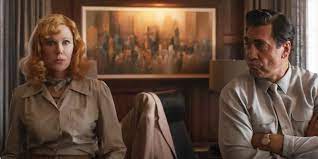
Nicole Kidman has never been timid about her acting choices. She has worked with directors who know how to push limits, notably Stanley Kubrick (Eyes Wide Shut), Lars von Trier (Dogville), and Yorgos Lanthimos, The Killing of the Sacred Deer.
Rocky Mountain Movies & Denver Movie Review
FOR MOVIE LOVERS WHO AREN'T EASILY SWEPT AWAY
Monday, December 23, 2024
A CEO struggles with her sexual desires
Nicole Kidman has never been timid about her acting choices. She has worked with directors who know how to push limits, notably Stanley Kubrick (Eyes Wide Shut), Lars von Trier (Dogville), and Yorgos Lanthimos, The Killing of the Sacred Deer.
Thursday, December 21, 2023
Chaos dominates a sinking ‘Aquaman’
Wednesday, December 8, 2021
One week in the life of Lucy and Ricky
Writer/director Aaron Sorkin tries to add a chapter to show business history with Being the Ricardos, a movie built around one apparently pivotal week in the life of the fabled sitcom, I Love Lucy.
Thursday, December 10, 2020
A musical that's all exclamation points!!!
Garish and bubbly, The Prom makes no attempt to disguise its message, something on the order of the now-familiar yard sign that says, "We believe love is love."
Tuesday, December 17, 2019
The women who toppled Roger Ailes
Charlize Theron, Nicole Kidman, and Margot Robbie lead a #MeToo charge in Bombshell, a story about the ways in which the late Roger Ailes was toppled for abusing his power as the head of Fox News. Ailes not only gave the network its trademark rightward slant, but he also used his position to sexually harass some of the women who worked at Fox.
When Bombshell finally gets around to the serious business of watching Ailes dethroned, the movie makes an impact. Powerful men who use their positions as casting couches deserve to be scorned and Bombshell satisfyingly makes sure that Ailes gets his well-deserved comeuppance.
But Bombshell also is a mixed bag of a movie that swirls is way across the screen as if the ingredients have been put into a soda can and shaken. It’s part the story of Megyn Kelly (Theron) and her gradual disaffection with Aisles; it's part the story of an evangelical working girl (Robbie) who's sullied by the toxic Fox atmosphere and part the story of Gretchen Carlson (Kidman), the woman who sued Ailes for sexual harassment, beginning a series of disclosures that would finish Ailes’ career.
Theron makes Kelly a cool customer, highly capable and sensitive to political intrigue inside and outside the Fox empire. Having once been an Ailes target (she resisted), Kelly mixes control with ... well ... more control.
When we meet, Kidman's Carlson she's on the downside of ambition, on the verge of being banished to the afternoon TV dead zone. Carlson, however, was smart enough to know that if she planned to challenge Ailes, she better have evidence. She taped a year's worth of her conversations with him.
Make-up and impersonation combine to create plausibility as far as Kelly and Carlson are concerned, but there’s a double edge to this approach. So much work has gone into making the actresses look like the real-life characters they’re playing, it’s sometimes difficult not to confuse performance with mimicry. Theron’s acting is exceptional, but she has an unnatural look, something on the order of an anchor mannequin.
Robbie doesn’t have that problem because she’s playing a fictional character. Her Kayla Pospisil is taken underwing (and into the bed) by a lesbian producer (Kate McKinnon) on the Bill O'Reilly show.
The movie initially treats Kayla’s naivete (she's a fundamentalist Christian who seems comfortable in a same-sex dalliance) with straightforward amusement that's in keeping with the nutty spirit that director Jay Roach brings to the movie until he gets serious.
Bombshell begins with one of Kelly's career highlights, the night she asked then-candidate Donald Trump about his women problem at a debate of Republican candidates. After the debate, Trump famously responded by saying that Kelly had "blood coming out of her eyes, out of her wherever." The fight's on, and Kelly begins to feel the pressure.
Kelly eventually retreated, conducting what some saw as a conciliatory interview with Trump. Kelly's husband (Mark Duplass) criticizes his wife for going easy on Trump as she tried to negotiate the choppy waters of career and principle. She says she just wants to stop the flow of Tumper venom that has been directed her.
Swimming in a fat suit, Lithgow’s Ailes proves imposing but he doesn’t seem as in-the-know as we might expect. He comes across mostly as a right-wing pasha.
Ailes’ harassment MO emerges in a meeting between Kayla. Ailes insists that TV is a visual medium. It’s only fitting then that he asks Kayla to standup up and "give him a twirl" (a 360-degree spin) and then to hike her skirt until he’s satisfied that she’s air-worthy. It's obvious that Ailes is more interested in compliance than looks because the ambitious Kayla isn't what you'd call a modest dresser.
There's not much to the rest of the men at Fox. The actor who plays Chris Wallace (Marc Evan Jackson) doesn't look like him. And Richard Kind lands with a thud in a brief appearance as Rudi Giuliani. Look, I’ve seen Rudi Giuliani and ... well ... you know the rest of the statement.
Showing some much-needed gravitas, Malcolm McDowell makes a last-minute appearance as Rupert Murdoch, the ultimate owner of all things Fox.
Roach’s often breezy approach can work against the material. Big Short screenwriter Charles Randolph's screenplay can have a scattered, lightweight feel that takes the edge off what we're seeing.
I'm betting that the industry; i.e., Oscar voters, will find plenty to embrace about Bombshell. It may soothe consciences in a year when the rumbles of #MeToo haven’t settled. But it’s worth remembering that making a movie about sexual harassment isn’t the same as solving the problem. That’s a whole other story.
Thursday, September 12, 2019
'The Goldfinch': a lengthy letdown
Many years ago, Bob Rafelson, the writer-director of movies such as Five Easy Pieces, The King of Marvin Gardens and Blood and Wine, told me something I've never forgotten. In an interview, Rafelson said that the best approach for screenwriters who adapt novels is to concentrate on what he or she most loves about the book and jettison everything else.
As is often the case with sage advice, Rafelson's mostly goes unheeded. If you're looking for evidence, search no further than The Goldfinch, the big-screen adaptation of a Pulitzer Prize-winning 2013 novel by Donna Tartt.
Beautifully shot by cinematographer Roger Deakins and mounted with a clear respect for nearly all other aspects of cinema craft, The Goldfinch nonetheless connects only intermittently. It's possible that director John Crowley and screenwriter Peter Straughan had too much respect for the material. Their movie plays like a dutifully illustrated version of Tartt's novel, a two-hour and 29-minute work that has the look of a prestige offering with built-in Oscar glow that the story never really matches.
The movie's pivotal event occurs when young Theodore Decker (Oakes Fegley) visits the Metropolitan Museum of Art with his mother. As luck would have it, Theodore and his mom happen to be at the museum when it's struck by terrorist bombs. Mom dies, Theodore's odyssey begins, and the source of the story's title is revealed.
Theodore leaves the museum with a small 17th-century painting by Dutch artist Carel Fabritius, a student of Rembrandt. The painting depicts a pet goldfinch that has been chained to its perch. Ironically -- with a capital "I" -- Fabritius perished in an explosion.
The painting becomes the movie's McGuffin, a literary conceit that pushes Theodore into a world that's not always kind to him and which some reviewers of the novel aptly called Dickensian.
The movie contains a ton of plot and many characters. These include the Babours (Nicole Kidman and Boyd Gaines), the Park Avenue couple who take the newly motherless Theodore underwing until the boy's wayward father (Luke Wilson) and his trashy girlfriend (Sarah Paulson) turn up. They drag the boy off to Las Vegas.
In Las Vegas, Theodore meets Boris (Finn Wolfhard), an abused wild child who becomes his only friend and who also introduces him to alcohol and drugs.
Flashbacks to the fateful explosion gradually reveal precisely what happened on the day of the attack, but these hazy backward glances begin to feel tiresome. Crowley also alternates scenes of Theodore as a child with scenes in which Theodore has become a young man played by Ansel Elgort. Boris also crops up as an adult, portrayed by Aneurin Barnard.
Two potential love interests for Theodore also are included: Pippa (Ashleigh Cummings) was in the museum on the day the bombs went off and seems his obvious soulmate. In his early adulthood, Theodore becomes engaged to the Barbours' daughter (Willa Fitzgerald).
Jeffrey Wright gives the movie's most memorable performance as Hobie, an antique dealer who becomes Theodore's mentor. Hobie delivers the speech that announces the movie's theme, a reverence for the immortality of art as contrasted with the fragile mortality of those who create, save and respect it -- and, of course, the rejection of anything that might be considered fake.
Not all the performances come into sharp focus: Kidman portrays a decorous, emotionally reserved woman who also seems to have a genuine affection for Theodore. Wolfhard's Boris enters the movie with the force of a tossed grenade; it's as if he has been added to enliven the proceedings. Fegley's young Theodore can be impish, wounded or rebellious.
And Elgort's tormented and guilt-ridden character (he blames himself for his mother's death) isn't as interesting as his childhood version.
So what to make of all this? Good question and one that the movie's arduous length allows ample time to consider, even when the pace picks up in a third act that's overburdened with thriller-like plot developtments revolving around the painting.
Watchable without being compelling, The Goldfinch leaves us to ponder what this movie, at its deepest level, is all about. If you can't answer that question, you may be forced to consider a sobering possibility: Perhaps that deepest level wasn't reached.
Thursday, January 17, 2019
Nicole Kidman as a ravaged LA cop
In Destroyer, a low-down crime thriller directed by Karyn Kusama, Nicole Kidman's ravaged face almost becomes the movie's subject. When I first saw photos of Kidman as she appears in Destroyer, I found it impossible not to wonder whether she wasn't intent on desecrating her own delicate beauty, something along the lines of what Charlize Theron did in movies such as Monster.
Don't get me wrong, Kidman is a very good actress and, in Destroyer, she dares to take a harrowing journey through a noir hell, paving the road with heavy blocks of guilt, recrimination, and alcohol-induced decay.
Kusama scrambles the story's time sequence as she shows us how Kidman's Erin Bell, an LAPD detective, arrived at such a grim destination.
The approach allows Kusama to introduce a good deal of traditional thriller elements. We meet the cop (Sebastian Stan) with whom Erin goes undercover, setting up the event that drives the plot. We also meet some of the felons with whom the two cops associate, a gallery of thieves, sadists, and enablers led by Silas (Toby Kebbell), a long-haired, thick-lipped psychopath.
Another theme that ripples through the sleaze involves Erin's teenage daughter (Jade Pettyjohn), a 16-year-old who has stopped attending school and who has taken up with a defiant older thug. Erin's ex-husband (Scoot McNairy) doesn't know how to handle the rebellious, obviously self-destructive teen.
The movie opens with the discovery of a body and proceeds as if Erin has opted to investigate a vicious killing. But for Erin, the murder is more than just another case. More can't be said without introducing spoilers.
Kusama (Girl Fight) stages some searingly violent scenes, one involving Erin's confrontation with a wealthy lawyer (Bradley Whitford) who's up to no good. Erin also tries to thwart a robbery, a scene that calls for her to pick up an AR-15 and fire away. When two policemen show up to help, they ask Erin whether they shouldn't ask for additional back-up. Erin can't wait.
"This is a gunfight," she says, demonstrating how Kidman delivers a line that could have sprung from the mouths of Clint Eastwood or Arnold Schwarzenegger.
To bolster the movie's realism, Kusama shows the effects of the physical beatings Erin takes. Put another way, the film's make-up department must have worked overtime. Kidman rises (or sinks, if you prefer) to the occasion as Erin moves through a punishing series of encounters.
The key to the story involves both external and internal factors that chew at Erin's life. She's a wreck and, as has been the case with many big-screen male detectives, we're constantly wondering whether she might find a glimmer of redemption before the movie ends.
Kidman's performance -- Erin walks as if carrying a sack of butchered meat on her shoulders -- suggests defeat: We see it in Erin's bloodshot eyes and in her depleted emotions. Sporting a leather jacket and ill-fitting jeans, Erin has long given up worrying about her appearance. But (and I hate to say it), I never entirely could forget that this was Nicole Kidman made up to look terrible.
Kusama doesn't always handle the movie's various time shifts with aplomb and it sometimes feels as if she's after something more than genre kicks. But Destroyer leaves us adrift in a world so corrupted that it admits almost no ameliorating rays of light and, I'm afraid, no compelling reason (other than furious acting) why we should want to be there.
Thursday, January 10, 2019
This bromance breaks little new ground
If you haven't seen the 2011 French movie The Intouchables, The Upside might pass muster -- or maybe not.
The French original told a humorous, uplifting story that boasted trace elements of topicality. In that movie, a young Senegalese man (Omar Sy) found himself working for a wealthy French traditionalist (Francois Cluzet) who had been paralyzed from the neck down.
Transported to New York City, The Upside, an Americanized version of the same basic story, features Bryan Cranston as Phil, a wealthy author and a defiant quadriplegic who hires a completely unqualified parolee (Kevin Hart) to be his caretaker. It should come as no surprise that these two mismatched urbanites eventually will bond.
As directed by Neil Burger (Limitless, Divergent), The Upside does little to distinguish itself from its predecessor, aside from using Cranston and Hart to boost box-office appeal.
To keep from violating his parole, Dell desperately needs proof that he's looking for work. When he lands a job taking care of Phil, he gets more than he bargained for. Among his duties: He must master the delicate art of catheter insertion.
Hart, who has taken fire recently for homophobic remarks that cost him a gig hosting this year's Oscar telecast, hits some deep notes, expanding on but not forsaking his comic talents. Some of his more convincing moments emerge as Dell tries to placate his former wife (Aja Naomi King) and re-establish a relationship with his young son (Jahi Di'Allo Winston).
We've all become accustomed to American remakes of foreign-language movies, but The Upside follows an overly predictable blueprint as the two men start to influence each other. Dell listens to opera: Phil discovers Aretha Franklin. You get the idea.
The biggest mystery about the movie involves Nicole Kidman, who plays a devoted assistant to Cranston's Phil. A denizen of the business world, Kidman's character oversees Phil's affairs. The question: What is Kidman doing in this movie?
Despite a few stabs at realism, Upside becomes another movie in which a black character helps a white character fight long odds. Not only is Phil disabled, but he's mired in grief over the recent death of his wife and unable to vanquish memories of the hang-gliding accident that robbed him of the ability to fend for himself.
Cranston’s easy command of the screen works to give his character a bit of an edge. Eventually, Phil risks crushing disappointment by agreeing to meet a female pen pal (Juliana Margulies) who might be a suitable candidate for romance.
Hey, it’s January and expectations for new movies isn’t exactly at peak levels, but aside from giving Hart an opportunity to stretch, The Upside seldom turns its formula into a winning one.
Thursday, December 20, 2018
Silly fun -- but only for a while
For perhaps a quarter of its length, Aquaman proves enjoyably silly, but -- for me at least -- enjoyably silly eventually morphed into an impatient question: Would this display of CGI magic, preposterous plotting and accumulating episodes ever end?
Where that point is reached for you in a two-and-a-half hour movie -- or if it's reached at all -- depends on how much-sustained entertainment you find in this overstuffed water ballet.
The origins story for Aquaman has been placed in the hands of director James Wan (The Conjuring), who creates a DC Comics extravaganza that immerses us in an underwater sea world full of dazzling colors, improbable technologies and a battle over who will rule Atlantis, the sunken city of myth.
A reluctant Aquaman (Jason Momoa) becomes a contender for the throne; the son of a surface-dwelling earthling (Temuera Morrison) and an ocean queen (Nicole Kidman), Momoa's character is presented as a longshot for success.
Also vying for the top job: King Orm (Patrick Wilson), another son of Kidman's Atlanna. Put Orm in the arrogant jerk category. He believes he should be king because of his pure bloodlines. Atlanna married his father after leaving her surface-bound husband -- for good and noble reasons, of course.
Momoa's Aquaman boasts a strong physique and a nonchalance about his various battles with evil, which begin with an attack on a group of pirates led by a vicious character named Manta (Yahya Abdul-Mateen II).
I'm not going to try to elaborate on the undersea world because it requires blind acceptance about such matters as how beams of fiery light exist in the depths of the ocean, how residents of Atlantis breathe without gills and ... oh well ... why go on listing all that's silly in this cornucopia of silliness?
Lest Aquaman become lonely, he's accompanied on most of his adventures by Mera (Amber Heard), a redhead who initially regards him as a hopeless case, but who eventually and unsurprisingly accepts him as the rightful king of Atlantis.
The supporting cast finds Dolph Lundgren playing King Nereus, an underwater noble who must decide where to place his loyalties. Willem Dafoe does Yoda-like duty as Vulko, an Atlantis adviser who becomes Aquaman's mentor.
Characters are made to seem as if they're floating in the depths of the sea, their hair flowing upward. How anyone gets a haircut in Atlantis remains one of the movie's many mysteries.
If you're after action, Aquaman tries (boy does it ever) not to disappoint. Wan has included everything from martial-arts combat to battles with monsters to trident vs. trident mega-bouts.
Did I mention that Aquaman's quest sends him a search for a trident that only a true king can possess, a plot device that takes the movie to the Sahara Desert, as well as to a small coastal town in Sicily?
I also forgot to mention that Aquaman's given name is Arthur and that the great triumphant moment of the film centers on Arthur's emergence as Aquaman, trident raised over his sculpted torso in comic-book glory.
Watching the movie is like reading a variety of Aquaman comics in succession, with a little ecological concern tossed in for good measure. At some point, though, you may get bored and wish you could put the books down and reach for a copy of Batman.
There's plenty of visual invention on display, but the eye can't totally silence a question from the mind: How much underwater spectacle does an Aquaman movie need before we start to drown in it?
Thursday, November 8, 2018
A young gay man confronts conversion therapy
The skills of Lucas Hedges are on display in three highly anticipated fall movies: Mid-90s, Boy Erased and Ben is Back. In Boy Erased, the second of these movies to reach the nation's screens, Hedges plays Jared, a young gay man whose religious parents send him to conversion therapy. In Ben is Back, due in December, Hedges portrays a drug-addicted kid whose mother (Julia Roberts) desperately wants to get him off his self-destructive path.
Although his role in the skateboard movie Mid90s is a small one, Hedges -- nominated in 2016 for a best-supporting actor Oscar for Manchester by the Sea -- clearly is having a moment. He deserves it: He should be contributing to movies for a long time.
Boy Erased casts Hedges as the intriguingly conflicted Jared Eamons, a character who can't reconcile his desire to be a normal kid with this sexual inclinations. Sensitive and vulnerable, Hedges never loses touch with the essence of Jared's character: He's a kid who wants to please by doing the right thing.
Jared has been brought up in a fundamentalist Christian environment by his homemaking mother (Nicole Kidman) and his pastor father (Russell Crowe). Unrebellious by nature, Jared takes his faith background seriously.
Boy Erased focuses on what happens when Jared's parents learn that he might be gay and send him to Christian conversion therapy, something he initially approaches with the hope that it will work. Jared wants to be "cured" and he harbors no apparent ill will toward his parents.
Based on a memoir by Gerard Conley -- the model for Jared -- Boy Erased spends much of its time following Jared through conversion therapy where he's guided by Victor Sykes (Joel Edgerton). Part cheerleader and part disciplinarian, Sykes bases his actions on the notion that gayness is a choice that can be unchosen with hard work and rigorous applications of faith.
Sykes is assisted by Brandon (Flea), a guy who approaches his job as if he's a drill sergeant charged with yelling the gay out of the young people who find themselves in this program.
During Jared's conversion therapy, he stays in a motel with his mother, who offers support and who watches the impact the "therapy" has on Jared.
The movie, which marks Edgerton's second directorial effort after 2015's The Gift, doesn't spend a lot of time on the other young people who have been sent to Love in Action, the program in which Jared has been enrolled. Troye Sivan plays a curly headed blonde who tells Jared that he should fake his conversion, get out of Love in Action in one piece and then decide how he wants to live. Britton Sear appears as Cameron, a kid with no ability to articulate what he's going through.
For all of its sincerity in trying to deal with the devastating impact such therapy can have on young people, the movie's most interesting and vividly drawn characters are pushed to the periphery: As Jared's mother, Kidman backs her husband in his faith decisions; she's spent her life as a supporting player in her husband's drama. Gradually, she begins to understand that her heart has room in it for two loves: God and her son.
Crowe receives less screen time but wastes none of it. A Baptist pastor who also owns a Ford dealership, Crowe's Marshall Eamons can't break through the boundaries that have defined his life. When he tells his son that he can't live in his house as a gay man, he's not threatening, he's simply stating what he sees as a bedrock fact of his existence.
Crowe has a strong final scene with Hedges that wisely refuses to resolve this difficult father/son relationship.
Boy Erased isn't the first movie this year to deal with conversion therapy. This summer saw the release of The Miseducation of Cameron Post, which starred Chloe Grace Moretz as a young woman pushed into a program like the one in which Jared finds himself. That movie focused on the way Moretz's rebellious character found kindred spirits to help her survive brainwashing by people who present a friendlier front than those in Boy Erased.
Though quite different in their style and tone, both movies are credible -- if unexceptional -- dramas. The path through conversion therapy offers few surprises. Still, a high-powered cast adds distinction to Boy Erased. Kidman and Crowe do memorable work and Lucas adds another strong performance to his already impressive resume.
Thursday, October 26, 2017
An intriguing start, but where's the payoff?
A skilled surgeon and his anesthesiologist walk down a hospital hallway after performing open-heart surgery. Rather than talk about the operation they’ve just performed, they exchange banalities about their high-priced wristwatches. Later the surgeon, meets with a young man and gives him a gift, an expensive watch. The conversations in these two scenes are conducted without benefit of inflection or emphasis. For all the color the actors bring to their dialogue, they might as well be reciting grocery lists.
In these scenarios, relationships and motivations become blank slates, and we -- the audience -- labor to comprehend the meaning of everything we see.
Are these doctors so insensitive that they can talk about nothing more than the quality of their watches? And what is the relationship of the physician to the young man we've just seen? Could the young man be a son from some now-dissolved marriage? Is this meeting about something stranger than an awkward reunion?
All of this occurs in the opening moments of director Yorgos Lanthimos's The Killing of a Sacred Deer, a revenge saga played out in an atmosphere of provocative obfuscation. Lanthimos, who directed the much-admired but often cryptic The Lobster (2016), has proven himself a master at holding an audience in what might be called "active suspension," a state of heightened attentiveness in which much is suggested but little is clarified.
I'm a partisan of this approach to filmmaking, the kind in which images, music, and performance continually force us to look for meaning. But such filmmaking also can prove risky. Often, it can't be maintained for a two-hour running time. Eventually, the filmmaker must get down to business and create some sort of plot.
It's at this pivotal point that Lanthimos's effort begins to crumble, and we face the slow dawning of an unfortunate realization; the keenness of observation Lanthimos has demanded of us may not yield the hoped-for payoff.
Any actor who works with Lanthimos must adapt to the director's style, something in the way that actors who appear in a David Mamet production must submit to the loaded cadences in which Mamet's characters speak.
In that regard, the actors in The Killing of a Sacred Deer do admirable work. Colin Farrell plays Steven Murphy, heart surgeon and wristwatch enthusiast. Nicole Kidman portrays his wife, Anna, an eye doctor. The Murphy's have two children: Kim (Raffey Cassidy), a teenager, and Bob (Sunny Suljic), a long-haired boy with a near-angelic look.
The mysterious young man mentioned earlier (Barry Keoghan) mixes politeness and threat, a cross between Eddie Haskell, the obnoxiously polite kid on Leave it to Beaver, and serial killer Ted Bundy.
Alicia Silverstone shows up briefly as Martin's mother, a woman who hopes Steven will assuage her loneliness by becoming her lover. Martin eggs her on in this delusion.
Now, if you don't want to know anything more, I suggest you stop here. At the risk of introducing spoilers, I must tell you that Martin poses an increasingly grave danger to the Murphy family. It seems that Martin's father died after Steven operated on the ailing man. Martin blames Steven and aims to settle the score. He informs Steven that if the good doctor doesn't kill either his wife or one of his children, each will become ill and die. How Martin intends to fulfill this malignant promise remains a mystery.
Dipping into Greek mythology and who knows what else, Lanthimos deftly keeps us inside his bubble of suspense, sometimes nudging us toward the comic absurdity of Steven's situation. The security of an affluent family suddenly is threatened, which means -- of course -- that it had no real security in the first place.
Farrell's bushy beard seems to throw his face into a perpetual scowl. Kidman manages to be a credible denizen of Lanthimos's strangely concocted world. Before Steven and Anna make love, Anna sprawls across the bed in her underwear, lies perfectly still and invites Steven to proceed by uttering the least romantic words ever heard in a sex scene; i.e., "general anesthesia." Sex becomes an operation, and Anna seems to be saying, "Have at it. I won't feel a thing."
The movie's best performance belongs to Keoghan who has the capacity simultaneously to alarm and reassure; Martin's twisted sincerity makes it seem as if perfect logic supports the young man's insane plan.
If you want to enlarge your interpretation of the movie, you can view the story as a stage in which karmic forces clash: Steven must be punished for being a successful doctor who may once have been negligent. Or maybe he's being punished for living an affluent life in the movie's unnamed city or for cutting himself off from his emotions or ... You can fill in your own blanks.
Whatever Lanthimos wants to say falls prey to the fact that the movie becomes less intriguing as it goes on, so much so that the denouement of Lanthimos's drama feels abstract and remote rather than shockingly tragic.
Augmented by the cool tones of cinematographer Thimios Bakatakis's lighting, Killing of a Sacred Deer evokes depths it's unable to plumb. In the end, the movie may amount to little more than a complex expression of a familiar adage: Payback's a bitch.
Fair enough, but this could be a case in which a movie's cruelty doesn't hurt enough because its creators can't entirely solve the problem of making the conceptional battle between an arrogant doctor and the evil he arouses into something that comes screaming to life. Lanthimos may have been defeated by his own considerable artistic impulses: Putting a movie under “general anesthesia” risks not being able to rouse it again.
Thursday, June 29, 2017
Too restrained for its own good
There's an alarming gap between style and substance in Sofia Coppola's new movie, The Beguiled, a remake of a 1971 Clint Eastwood film about a wounded Union soldier who finds refuge in a Virginia school for girls during the waning days of the Civil War.
In a sense, Coppola has taken grade "B" material and given it an "A"-grade artistic gloss that sometimes threatens to suffocate the movie's dramatic life.
Not surprisingly, the soldier's presence among these women prompts turmoil as students and teachers try to adjust to a male presence. Some of the students -- notably a character played by Elle Fanning -- are just beginning to discover their sexuality, making the movie a hothouse of suppressed and overt desire, as well as of trust and mistrust.
Too often, though, The Beguiled is a hothouse in which someone forgets to turn up the heat.
Three performances stand out. Colin Farrell plays soldier John McBurney as a cagey fellow with anger simmering beneath a solicitous surface. An excellent Nicole Kidman brings subtle levels of calculation to the role of headmistress Martha Farnsworth, the woman who washes the soldier's partially naked body when he's brought to the school.
Kirsten Dunst's excels as Edwina Danny, a teacher for whom McBurney represents liberating escape from an impending spinsterhood.
Coppola eliminates one of the characters found in director Don Siegel's earlier version, an enslaved woman. That means that Coppola mostly ignores the perverse undercurrents of racism. If you wanted to push the point (and some have), you could call it an elegant form of denial.
Coppola's overly decorous approach elevates atmospherics. Her movie includes a couple of gruesome events but doesn't seem entirely committed to them. No more can said without spoilers.
Every character in The Beguiled, I suppose, must react to a war-time situation in which norms have been upset, but the movie could have used a little more of the bile that ultimately begins to flow.
Thursday, April 6, 2017
Kidman of Arabia (really)
Werner Herzog isn't David Lean, and Nicole Kidman is no Peter O'Toole. I don't mean that as a slam on either Herzog or Kidman, the talented director and fine actress who have teamed for Queen of the Desert, an historical epic about Gertrude Lowthian Bell. Bell, a woman who probably will be unknown to most audiences, was a writer and adventurer who helped Winston Churchill draw the lines that carved up the Ottoman Empire after World War I.
Herzog fans immediately will be struck by the movie's surprisingly conventional style, which (alas) relies heavily on images of Kidman riding camels, on two somewhat listless romances and on the less-than-exciting intricacies of tribal politics among the Arab populations of the empire once controlled by the Turks.
A miscast James Franco portrays Henry Cadogan, Bell's first love. As he whispers his way through a British accent, it's difficult to take Franco seriously. Robert Pattinson, who shows up as T.E. Lawrence at least uses his crooked half-smile to suggest Lawrence's mischievousness.
Damian Lewis plays the third man in Belle's life, Maj. Charles Doughty-Wylie; Bell writes to Doughty-Wylie as she wanders across the desert. Periodically, we hear Kidman reading these letters in hushed tones.
Kidman captures Bell's courage, her confusion when it comes to romance and her determination not to be limited by gender. But Herzog relies on far too many glamor shots of Kidman, who manages to look beautiful even in extreme circumstances of desert heat and dust, not to mention the threat of hostile Arabs, most of whom ultimately are charmed by Bell's tenacity.
Herzog can't be accused of skimping on scenery; many of the desert images are steeped in grandeur, but the movie's swelling musical score feels like something lifted from another era.
Bell supposedly drew up the boundaries of modern Iraq, a skill that may have inspired Herzog to use on-screen maps to follow Bell's progress around the region, an old-fashioned technique that he presents without any trace of irony. Same goes for some of the cornball dialogue in which Bell talks about giving her heart to the desert.
Aside from telling us that Bell -- one of the first women to attend Oxford -- was an early example of feminine assertion, it's not exactly clear what Herzog hoped to say. Such is the price of reigning in idiosyncrasy: Herzog seldom has made a movie this sparkless and generic in its feel.
Thursday, December 22, 2016
A harrowing childhood journey
In a way, Lion risks setting itself up for failure -- or at least for a major letdown.
I say this because the movie's opening act is so compelling that I wondered whether director Garth Davis would be able to sustain its harrowing trajectory. In the early going, Lion feels as if it's en route to becoming a classic movie about an endangered boy, something on the order of the great Brazilian film, Pixote -- if a little less harsh.
Working from a true story, Davis introduces us to five-year-old Saroo (a wonderful Sunny Pawar), a poor Indian boy who's separated from his family after he falls asleep on a decommissioned train. Saroo winds up in Calcutta where his life takes on a Dickensian flavor: He's homeless and defenseless.
Saroo is too young to explain himself to strangers who live 1,600 miles from where his journey began. His difficulties are further complicated by his inability to speak Bengali. He speaks only Hindi.
Even a helpful gesture from a kind stranger works against him. One such bit of help lands poor Saroo in a children's home where cruelty and abuse are the orders of the day.
Cute without being cloying, Pawar anchors this part of the movie -- along with Davis's terrific use of the Indian countryside and the squalid depravations of Calcutta. Watching a totally confused and frightened five year old trying to negotiate the teeming crowds at Calcutta's railways station makes for heartbreaking viewing.
The movie makes a major shift after its Indian sequences. As the result of a charitable intervention, Saroo is sent to Australia where he's adopted by two well-meaning and loving parents, convincingly played by Nicole Kidman and David Wenham. After about a year, Saroo's new parents adopt another Indian boy who has a more difficult time adjusting to life in Tasmania and who's played as a young adult by Divian Ladwa.
The movie's second half deals with Saroo as a young man portrayed by Dev Patel. At this point, what had been a terrific movie becomes a merely good one with the story turning its attention to Saroo's increasing desire to discover his roots. He begins having flashbacks to the early years of his childhood in India, which include memories of his older brother Guddu (Abhishek Bharate) and the mother (Priyanka Bose) he adored and who adored him.
Bharate's Guddu has some responsibility for the way in which Saroo becomes lost, adding another level of poignancy.
During Saroo's period of self-discovery, he turns to the Internet to try to determine precisely where he came from. He stops paying attention to his girlfriend (a superfluous Rooney Mara), and shuts out his parents, refusing to tell them what he's doing. Patel conveys Saroo's torment, but this portion of the movie drags and also misses opportunities to develop additional scenes that might better have dramatized Saroo's struggle as a person suffering from spiritual homelessness.
None of this is to say that you should avoid Lion, which has a payoff that's designed to jerk real tears. And toward the end, Davis does a skillful job of blending Saroo's childhood memories with his adult quest.
Put in terms that risk a bit of reductionism, I'll conclude with this: Lion's Indian segments are a four-star knockout; the rest ... well ... give it three stars.
Thursday, June 16, 2016
A self-absorbed writer and his editor
Genius -- a movie starring Colin Firth, Jude Law and Nicole Kidman -- presents a handsomely mounted but somewhat tepid portrait of the relationship between volatile novelist Thomas Wolfe and his editor Max Perkins.
The gist of the story: Perkins, who also edited the work of F. Scott Fitzgerald and Ernest Hemingway, tolerated Wolfe's alcoholic digressions and emotional outbursts because he believed in the author's talent.
In part, the movie suffers because time hasn't entirely justified Perkins' faith. Novels such as Wolfe's Look Homeward, Angel don't command the widespread attention they once did.
Director Michael Grandage focuses the story on the Perkins/Wolfe relationship during the Depression years, a time when Perkins plied his trade at Scribner's. Wolfe would dump his colossus-sized manuscripts -- all written in pencil -- on Perkins' desk. Perkins then would work with the writer to whittle Wolfe's efforts to more manageable size.
When not ensconced in Perkins' Manhattan office, the movie visits his Connecticut home, where Laura Linney plays the mostly negligible role of Perkins' wife.
The point of these scenes may be to tell us that Perkins preferred the comforts of home and hearth -- he had five daughters -- to the roller coaster ride taken by those who more directly stoke their creativity fires.
Wearing an ever-present fedora, Firth inhabits the character of Perkins with ease and quiet grace, although his performance can feel a trifle sparkless. As the ebullient, life-embracing Wolfe, Law compensates for Perkins' preternatural calm with emphatic expressions of energy.
Wolfe's relationship with a married woman, Kidman's Mrs. Bernstein, mostly demonstrates the devastating consequences of Wolfe's boundless self-absorption.
Grandage's wan drama might have been better had Wolfe's work retained the regard still given to Fitzgerald and Hemingway, played in cameos by Guy Pearce and Dominic West respectively.
Otherwise, Genius -- based on a 1978 biography of Perkins by A. Scott Berg -- needed something that Perkins probably would have insisted on had edited movies instead of books: the infusion of enough urgency to prevent both period and characters from feeling trapped in the past -- as if they're being suffocated by a sepia-hued fog.
Thursday, November 19, 2015
Three characters burdened by the past
Chiwetel Ejiofor, Nicole Kidman and Julia Roberts.
Tell me that those names don't spark interest. Considering the acting power on display in the new thriller, Secret in Their Eyes, you'd expect the movie to strike a mother-load of dramatic pay dirt. Instead, this drably realized and often murky police procedural yields only medium-grade helpings of suspense.
Secret revolves around a Los Angeles-based, anti-terrorism unit in which we find three of the movie's principal characters.
Julia Roberts plays Jess, a team member who suffers a terrible blow when her daughter is raped and murdered, her body unceremoniously tossed into a dumpster.
Joining Jess in what appears to be a delayed quest for justice are Ray, a former FBI agent played by Ejiofor, and Claire, an attorney portrayed by Kidman.
Director Billy Ray wrote the screenplay, which is a loose remake of the 2009 Oscar winning Argentine feature of the same name. That movie played out in the aftermath of Argentina's "Dirty War," a period when dissidents were "disappeared" by a military junta and its henchmen.
This one deals with the kind of post 9/11 jitters in which concerns about terrorism sometimes trump the pursuit of individual justice.
Alternating between the present and 2002, the movie's skittering structure adds unnecessary murkiness to an already complicated plot.
Equally problematic, the characters don't seem richly enough observed for the movie's trio of headliners.
Kidman plays a tightly wound Harvard Law School graduate who eventually becomes Los Angeles DA.
Sans make-up, sporting bangs and a ghastly parlor, a deglamorized Roberts plays Jess, a grief stricken woman who still manages to soldier on with her police duties.
Thirteen years after the murder of Jess' daughter, Ejiofor's Ray -- now out of the FBI -- returns to LA believing that he has located the murderer, a felon who recently has been released from prison. Ray wants to reopen the case.
Most of the movie focuses on Ejiofor's angry, regretful character, a man who nurses a long-standing (and mostly undeveloped) crush on Kidman's Claire. Again and again, other characters tell him, she's out of his league. She's Harvard; he's community college.
We get a glimpse of what Kidman might have delivered in a scene in which she conducts an interrogation. As a grieving mother, Roberts too often is pushed to the film's periphery.
The supporting cast has little room to maneuver, but the always terrific Alfred Molina registers strongly as a DA with an agenda.
If you like surprise twists, you may be satisfied by this downbeat thriller, but taken as a whole, Secret qualifies as a disappointing use of prime acting talent.
Thursday, April 24, 2014
'The Railway Man': off and on track
A young but resourceful British soldier during World War II, Eric Lomax became a prisoner of war, part of the legion of British captives and Asian workers forced to toil on construction of the Thailand to Burma railroad.
The Railway Man -- a movie about Lomax's experiences -- is at its most effective when depicting the brutalizing torture Lomax experienced at the hands of the Japanese after he was caught with a radio and a map.
The Japanese insisted Lomax was trying to communicate with China. In reality, he and his imprisoned pals were listening to war news on a radio that couldn't transmit. Lomax, a long-time train enthusiast, used the map to chart the course of the line.
Colin Firth plays Lomax as a man suffering from post traumatic stress syndrome, a veteran whose experiences -- which included water-boarding -- keep him from fully engaging in his marriage to a Canadian woman (Nicole Kidman). Lomax and Kidman's Patti met in 1980 -- on a train, of course.
Director Jonathan Tiplitzky complicates the story by lacing it with flashbacks -- some springing from Lomax's tormented psyche and some from a recounting of events by one of Lomax's war-time pals, a miscast Stellan Skarsgard.
Kidman's Patti pushes Lomax to share experiences he's kept bottled up since the end of the war. Kidman gives the expected fine performance, but her presence in the film proves a little tangential.
Jeremy Irvine effectively plays the younger Lomax in flashbacks to the war.
Eventually, the post-war Lomax returns to the scene of the Japanese war crimes he endured. He fully expects to kill one of his surviving torturers (Hiroyuki Sanada), a man who's now earning a living conducting what Skarsgard's character refers to as "Bridge on the River Kwai tourism."
The big issue -- no less powerful for being obvious -- involves the conflict between Lomax's understandable desire for revenge and his need for reconciliation.
The big confrontation scene between the British veteran and his Japanese tormenter almost shrinks the movie into a play on film, but Sanada and Firth make it powerful nonetheless.
Thursday, March 14, 2013
Lots of menace with no place to go
Generally, I have mixed feelings when directors from other countries -- particularly those with distinctive styles and edgy concerns -- travel to the U.S. for English-language productions. I root for the their success, but can't help wondering whether something vital will be lost in translation.In his first U.S. movie, the often brilliant and always provocative South Korean director Park Chan-Wook (director of movies such as Oldboy and a trilogy of Vengeance films) completes about three-quarters of the journey to a new culture. Park's Stoker can't quite provide the rich payoff his movie promises -- but that's not to dismiss the film's early going, a virtuoso display of style in which Park creates an atmosphere chilled by impending, perhaps inevitable doom.
Working from a screenplay by Wentworth Miller, Park seems to be riffing on Alfred Hitchcock's Shadow of a Doubt. Both movies make room for an ambiguous character named Uncle Charlie, Joseph Cotton in Hitchcock's movie and Matthew Goode in Park's version of a story about an uncle who shows up after his brother dies in a car accident.
Uncle Charlie works to establish a bond with his niece (Mia Wasikowska), a young woman he's never met before. In fact, she never knew her father (Dermott Mulroney) even had a brother until Charles turns after Dad's death.
As the story progresses, it becomes clear that both mother (a convincing Nicole Kidman) and daughter (perhaps to a lesser degree) are falling under the sway of the preternaturally helpful Uncle Charlie, played with cagy confidence by Goode.
To further complicate matters, Wasikowska's India Stoker is going through the weirdness of her own sexual awakening; the gifted Wasikowska is up to conveying every bit of that weirdness. India displays the normal recalcitrance of an 18-year-old but augmented by something that seems significantly creepier.
There's little question that Park has control over the movie's imagery, its performances and its eerie soundscape, all of which heighten the sense of uneasiness he skillfully creates.
Park tries to maintain ambiguity as he builds toward what should be (but isn't) a whopping and intelligent finale.
Park and cinematographer Chung-hoon Chung find plenty of opportunities to show off their mastery, but the screenplay -- which seems rooted in India's fantasy life and dark capacities -- ultimately doesn't reward our patience.
Park's stylistic flourishes (India likes to arrange shoeboxes in horseshoe shapes) seem designed mostly to keep us off balance. They do, but the danger in this kind of approach (violent but less so than some of Park's Korean movies) is that it sets a high bar for the movie's payoff.
Without going much further, I'll just say that Park doesn't vault over the bar he sets for himself, and many will conclude that, in this case, the result is a little too frustrating, a carefully prepared meal that offers too little by way of real nourishment.
Thursday, October 18, 2012
Sex, sweat and lots of humidity
Director Lee Daniels's new movie The Paperboy, an adaptation of a 1995 Peter Dexter novel, sweats its way through a densely packed and lurid story that can seem both pungent and preposterous -= not to mention a trifle repellent.
What did Daniels have in mind? A wallow in southern-fried sleaze? A story about misapplied justice? A display of weird sexual tension? An opportunity for Zac Efron to spend time lolling about in his underwear?
Daniels, who co-wrote the screenplay with Dexter, dips into a vat full of Southern Gothic ingredients and scoops them onto the screen without straining them through the filter of a carefully developed narrative. What you get are large, often indigestible hunks of movie. The Paperboy is all gristle.
Daniels laces the humid Florida air with several narrative threads. A crusading journalist (Matthew McConaughey) tries to free a convict (John Cusack) who may have been wrongly convicted of murdering a sadistic sheriff. A slatternly woman (Nicole Kidman) corresponds with the convict, believing she has found a soul mate. The journalist's younger brother (Efron) falls for Kidman's Charlotte Bless, seeing himself as her protector.
The actors in The Paperboy are drenched in so much humidity that the movie can feel as it's taking place in a swamp. Of course, some of it does take place in swampy Florida backwaters. The time: 1969.
McConaughey plays Ward Jansen, a Miami reporter who travels to a small Florida town accompanied by a defiant black writing partner (David Oyelowo).
Efron's Jack Jansen, Ward's brother, lives with his father (Scott Glenn) and stepmother (Nealla Gordon). Jack takes advice from the family maid (Macy Gray), a woman who seems to have supplied him with the only form of maternal love he has known. Add a few Oedipal overtones, stir gently and you've got the relationships between Jack and Gray's character.
Gray's Anita Chester narrates the film, but her guidance doesn't help Daniels to keep the narrative from confusion, particularly in the early going when the movie's who's-who list has yet to sort itself out.
Kidman, who embraces her character's slutty vivaciousness, certainly doesn't need to prove her courage, but The Paperboy reminds us that she's up for almost anything. Here, she shares a scene with Cusack (a jailhouse visit) in which both characters engage in some kind of psychic sexual interchange that leaves them damp. The two journalists and Jack, who are also present, look on with amazement. So, probably, will you.
In another scene, Kidman's character urinates on Efron's Jack, apparently to relieve a severe allergic reaction to a jellyfish sting.
For Cusack, The Paperboy marks a stretch; maybe he has a future playing crude men with IQs that seem to dip below the scorching Florida temperatures. He's convincingly raw and frightening.
Daniels always seems to be pushing too hard, and, as he showed in Precious, he often carries things too far. Let's just say that there have been kinder views of McConaughey than the one that shows his naked posterior in a motel room.
But wait: There's more. When Ward and Jack visit a swamp-dwelling miscreant in search of evidence that might help liberate Cusack's character, we watch as the man slices open an alligator and lets its innards fall to the dirt. Oh well, at least Daniels didn't ask anyone to eat the slimy entrails.
If you're looking for something something febrile, the finale of The Paperboy won't disappoint. The same goes for much of the movie's beginning and its middle.
The actors are all game and committed, but Daniels too often leaves them wallowing in this sty of a story. Watching The Paperboy can be like watching someone drown in a bucket of sweat.
Thursday, January 13, 2011
Much to admire about 'Rabbit Hole'
Rabbit Hole, director John Cameron Mitchell’s big-screen adaptation of David Lindsay-Abaire’s Pulitzer Prize-wining 2007 play, is tasteful, unsentimental and often beautifully written.
That’s saying something because the screenplay – also by Lindsay-Abaire -- deals with a subject that easily could have devolved into hand-wringing melodrama: a New York couple attempts to cope with the death of their 4-year-old son.
We meet Howie and Becca – played by Aaron Eckhart and Nicole Kidman -- eight months after their son Danny’s death. I won’t say what happened to Danny because Mitchell plays the movie’s emotional cards slowly and wisely, which should come as a relief to anyone who fears that Rabbit Hole will deliver an emotional clobbering.
Tension arises from the different ways in which Howie and Becca attempt to deal with their son's death. Howie watches a cherished video of his son on his smart phone. It helps him remember happier times. Howie’s untroubled by physical reminders of his son’s existence – drawings pasted to the refrigerator, for example. He seems to treasure them.
Becca, on the other hand, hardly can abide the residual paraphernalia of her son’s lost life. She’s carrying the departed Danny in her head, and it’s all she can do to move on.
Of course, both Howie and Becca attempt to maintain a normal facade in the face of unspeakable tragedy. They put up a brave middle-class front. Their house is neat. Howie seems to be functioning well enough at work. He’s liable to return home in the evening and find Becca puttering over dinner.
Kidman, nearly unrecognizable in the movie’s early scenes, steers clear of any suggestion of glamour, but her portrayal of the sometimes icy Becca not only holds her character’s emotions in check, but also keeps us at bay, and, I think, limits Rabbit Hole’s ability to crack open our hearts. It’s almost as if Mitchell and Lindsay-Abaire have studied the mathematics of grief and allowed their calculations to inform the movie’s structure and all of its various subplots.
Becca’s younger sister (Tammy Blanchard) is involved in a relationship and recently has become pregnant. Both Becca and Howie attend a support group where Howie meets Gaby (Sandra Oh), a woman whose grieving style may be closer to his than Becca’s. Becca’s mother (Dianne Wiest) takes comfort in religion. She also has dealt with the death of a child, an adult son who succumbed to drugs.
In what may be the movie’s best scene, Wiest and Kidman talk about the way grief never ends, but morphs into something easily recalled and somehow bearable: The awful weight of it lessens with the passage of time.
The relationship between Becca and a high school student (no, it’s not at all kinky or sexual) begins in mystery, but eventually assumes an unsatisfying air of contrivance.
Rabbit Hole certainly has its moments. We’re watching a couple of decent people who must learn how to continue living in the face of the unthinkable, but I couldn’t entirely shake the feeling that I was witness to a very good rehearsal of material that had yet to spring fully to life and which generally left me on the outside looking in.
Put another way: I don’t believe that Mitchell has found a way to bring Rabbit Hole from the stage to the screen with all its power intact.