A Million Miles Away, the story of a migrant kid who dreams of becoming an astronaut, touches nearly every base that normally turns me off. It can be simplistic and unabashedly inspirational. But director Alejandra Marquez Abella infuses her film with so much sincerity, it's difficult to resist. Michael Pena stars as real life astronaut Jose Hernandez. Hernandez's story serves as a tale about a persistent kid who works hard to realize his dream and as a celebration of hard scrapple ethnicity. Hernandez's background gives the story its flavor, turning the movie into a triumph not only for an extraordinarily determined young man but for people, who like him, haven't typically been associated with the space program. Once Hernandez becomes an engineer, he and his wife Adela (Rosa Salazar) raise five children. Although he's successful, Hernandez clings to his goal: He keeps applying to NASA. After 12 rejections, he's accepted into a NASA training program, and we see some of its challenges, learning to function under extreme pressure, for example. A Million Miles Away isn't deeply nuanced, but it clearly charts a life that went from a village in Michoacan, Mexico, to farm work near Stockton, Ca. to college. Hernandez eventually landed a job with a government-funded firm dealing with security issues. NASA awaits. It's quite a journey and A Million Miles Away, based on a memoir Hernandez wrote, does everything it can to honor it.
Rocky Mountain Movies & Denver Movie Review
FOR MOVIE LOVERS WHO AREN'T EASILY SWEPT AWAY
Thursday, September 14, 2023
A story that takes flight -- in space
A Million Miles Away, the story of a migrant kid who dreams of becoming an astronaut, touches nearly every base that normally turns me off. It can be simplistic and unabashedly inspirational. But director Alejandra Marquez Abella infuses her film with so much sincerity, it's difficult to resist. Michael Pena stars as real life astronaut Jose Hernandez. Hernandez's story serves as a tale about a persistent kid who works hard to realize his dream and as a celebration of hard scrapple ethnicity. Hernandez's background gives the story its flavor, turning the movie into a triumph not only for an extraordinarily determined young man but for people, who like him, haven't typically been associated with the space program. Once Hernandez becomes an engineer, he and his wife Adela (Rosa Salazar) raise five children. Although he's successful, Hernandez clings to his goal: He keeps applying to NASA. After 12 rejections, he's accepted into a NASA training program, and we see some of its challenges, learning to function under extreme pressure, for example. A Million Miles Away isn't deeply nuanced, but it clearly charts a life that went from a village in Michoacan, Mexico, to farm work near Stockton, Ca. to college. Hernandez eventually landed a job with a government-funded firm dealing with security issues. NASA awaits. It's quite a journey and A Million Miles Away, based on a memoir Hernandez wrote, does everything it can to honor it.
Thursday, February 3, 2022
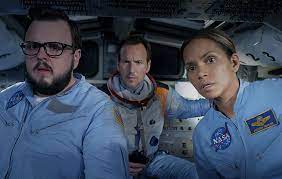
A silly mission to a falling moon
It's not easy to know where to begin writing about a movie such as Moonfall. Director Roland Emmerich's latest helping of sci-fi offers a ragged patchwork of elements, none particularly interesting.
Thursday, July 5, 2018
‘Ant-Man’: An amusing second helping
Ant-Man and the Wasp, the latest movie to spring from the Marvel Universe, falls short in many ways: It has a jangled plot, a trip into a strange Quantum Realm in which characters and creatures float as if immersed in Jello and stretches of talk in which the dialogue isn't likely to evoke comparisons with Shakespeare.
Fortunately, that's not the whole story. This second, big-screen helping of Ant-Man also benefits from what might be deemed a thoroughgoing and entirely welcome lack of cosmic ambition.
Thanks go to Rudd's genial reprise of his role as Scott Land (a.k.a. Ant-Man), enough humor to carry us through the movie's doldrums and a collection of characters who must act as if there's much at stake -- even if there isn't.
Director Peyton Reed, who directed the first installment, also plays fun games with scale as Ant-Man makes the shift from tiny creature to parade-float size. Ant-Man can become as small as ... well ... an ant or as big as a zeppelin, opening the door for Reed and his cohorts to play lots of clever games involving mutable size.
Stretches devoted to exposition may keep the movie from soaring, but it's difficult to resist car chases in which full-sized cars suddenly shrink to Hot Wheels proportions or an action scene in which a PEZ dispenser enlarges to play a significant role.
So what happens? Well, Dr. Hank Pym (Michael Douglas) and his daughter Hope (Evangeline Lilly) believe they can rescue Hope's long-lost mother (Michelle Pfeiffer) from the Quantum Realm, the zone where she disappeared while executing a selfless act of heroism.
Hope also is the Wasp, which means that she has been given wings to flutter and the responsibility of broadening the movie's gender appeal.
Additions to the series include the Ghost (Hanna John-Kamen), a woman who's on the verge of decomposing and who (understandably) would rather remain in one piece. Laurence Fishburne turns up as one of Pym's estranged colleagues, another researcher into the Quantum Realm. Walter Goggins plays a greedy businessman who also has his eye on the Quantum Realm.
Randall Park appears as an FBI agent whose interchanges with Scott provide the movie with a comic motif that it's not afraid to repeat, but which proves amusing enough not to wear out its welcome. Scott, by the way, is being monitored by the FBI because he's been under house arrest for two years. His time of confinement is almost up, but you can bet that he'll find a way to weasel out of his ankle bracelet and join the action before he's officially set free.
Michael Pena turns up as the fast-talking operator of a security company. A veteran of the first installment, Pena makes no attempt to do more than add laughs with his character's frenetic speech. Pena's Luis once shared a cell with Lang, a thief before his elevation to superhero status.
Look, there's little point rattling on about a movie such as Ant-Man and the Wasp. If you see it, you'll find enough humor to stave off a case of Marvel overdose -- and some of that humor has a visual kick, something rare in today's comedies and, therefore, something to savor.
(An aside: Gore Verbinski -- director of several Pirates of the Caribbean movies remains the undisputed master of visually inventive comedy.)
But as far as this edition of Ant-Man is concerned: It's nice to see a Marvel movie that seems intended to amuse us more than it's designed to beat us into submission.
Thursday, March 8, 2018
'Wrinkle' neither folds nor soars
A New York Times article about the 90th edition of the Academy Awards referred to director Ava DuVernay (13th, Selma) as “one of Hollywood’s most aggressive advocates for diversity.” It only takes a few minutes of the big-screen adaptation of A Wrinkle in Time to know that DuVernay has no qualms about putting her convictions on screen.
A somewhat scattered, effects-laden adaptation of a popular novel by Madeleine L’Engle, A Wrinkle in Time stands as both an adventure fantasy and an overdue helping of diverse casting. Its story sends the child of an interracial couple into alternate universes along with her adopted brother and a white teenage boy.
That’s not to say that A Wrinkle in Time takes diversity as its theme. Like many of the Disney movies that precede it, Wrinkle is an ode to the importance of family, as well as a recasting of a typical hero’s journey.
The movie’s main character — a brainy 13-year-old named Meg (Storm Reid) — faces many tests as she tries to establish herself as a warrior for the light; i.e., all that is good in the universe.
DuVernay has said that her movie primarily aims at 12-year-olds and those able to get into a 12-year-old state of mind. As someone for whom 12 barely exists as a memory, I found the movie to be an elaborate helping of children’s theater that proved wanting at the point when it's supposed to reach its emotional crescendo and a little too vague about what constitutes evil in the movie’s visually abundant universe.
I also found the cosmology depicted in A Wrinkle in Time a bit confusing but that may not matter to young audiences willing to go with flow in order to enjoy the movie's various odd sights: a beach where a character who embodies evil (Michael Pena) turns up or a strange cave-like place that's home to Happy Medium (Zach Galifianakis), a character whose name explains his outlook.
Though it brims with varied settings and costumes, the core of A Wrinkle in Time hinges on a simplistic binary battle between the light and the dark, evil being represented by a spidery looking creation that resembles an ink blot.
Three other-worldly beings serve as guides for young Meg’s journey, which involves something called a “tesseract.” As best as I could discern — and with help from Wikipedia — the tesseract is a phenomenon that creates folds in the fabric of space and time, allowing Meg and her companions to travel through the fifth dimension.
These guides are women with (what else?) special powers. Mrs. Whatsit (Reese Witherspoon) can turn herself into what looks like a giant green leaf that carries the movie’s adventurers like a magic carpet. Mrs. Who (Mindy Kaling) is a walking Bartlett’s book of quotations; she dispenses the wisdom of others. Mrs. Which (Oprah Winfrey) seems to materialize out of nothing.
When we first meet Mrs. Which, she’s clad in silver and as tall as one of those balloons in a holiday parade, looming large over everyone else, a visual choice that mirrors Winfrey’s status in the real-life world of media.
Meg’s interplanetary journey is motivated by a devastating loss. Her father (Chris Pine) has been missing for four years as the result of a quest to explore the furthest reaches of the galaxy. Meg was left to make do with her mom (Gugu Mbatha-Raw) and her brother Charles Wallace (Deric McCabe).
Meg journeys into other worlds to locate her scientist father and bring him home because, as we long ago learned from the The Wizard of Oz, no matter how intoxicating alternate realities can be, there’s no place like home.
Levi Miller portrays Calvin O’Keefe, a popular teenager who joins outcast Meg on her trippy pursuits, but his character doesn't seem to have much of a role beyond adding someone with whom younger boys may identify.
First seen in Twelve Years A Slave, Reid provides the movie with a solid center. Initially annoying, McCabe’s Charles Wallace grew on me, particularly when his body was taken over by the IT, a disembodied evil that turns him from a brainiac into a painiac.
The movie’s production team does a good job creating wavy wrinkles in time as Meg travels in the fifth dimension, and the movie certainly doesn't lack for other forms of visual invention. My favorite: a rigidly conformist suburban community where every kid stands in a driveway bouncing a beach ball in unison, a twisted idea of playtime.
I suppose the best fantasies create a sense of wonder that Wrinkle in Time can't quite achieve. It's probably not the keenest of critical insights or the heartiest of endorsements, but after a preview screening and a little reflection, I'd say the movie qualifies as "OK." I'd be lying if I didn't say I was hoping for more.
Thursday, January 18, 2018
'12 Strong': action beats insight
The best war movies generally take a position that gets us beyond strategy, tactics and reflexive expressions of heroism. Considering that, 12 Strong, the story of a Special Force unit that was the first to fight in Afghanistan after 9/11, falls far short of the best in its breed. Though based on a true story, the movie would have been right at home during any summer action-movie onslaught.
Chris Hemsworth, as Capt. Mitch Nelson, leads a group that includes Chief Warrant Officer Hal Spencer (Michael Shannon) and Sgt. First Class Sam Diller (Michael Pena). Trevante Rhodes, recently of Moonlight, also checks in as a sergeant, but proves no more distinctive than any of the other actors in this generically presented group.
When the picture opens, the newly retired Nelson wants to return to action; he can't sit idly by after his country undergoes an attack, which -- at the time -- seemed inconceivable. Sketchy scenes of the soldiers on the home-front are followed by scenes in which the GIs, newly arrived in Afghanistan, try to bond with locals and meet with CIA agents who already were engaged in combat.
As it turns out, Nelson's unit was assisted by forces from the Northern Alliance, in this case, led by General Dostum (Navid Negahban), a warlord who hated the Taliban but could be wary of Americans, as well.
The American soldiers were highly motivated but hadn't been trained for the kind of combat that Dostum knew well. Absent any other way to negotiate Afghanistan's rugged terrain, soldiers were asked to fight on horseback.
Still best known for playing Thor, Hemsworth gives the expected take-charge performance, but the movie doesn't get much from Shannon, who almost always leaves a mark.
The soldiers who fought in some of the world’s worst conditions unquestionably were brave. To make matters even more difficult, they were outnumbered 40 to one. When they wrested control of the city of Mazar-i-Sharif from the Taliban, they made military history.
But that doesn’t mean that their story — based on a book by Doug Stanton — transcends its bounty of action to give us new insights into the war in Afghanistan. Instead, 12 Strong celebrates the usual band-of-bros bravado as director Nicolai Fuglsig garnishes combat sequences with a generous helping of explosions.
For some that will be enough, but the movie fails to lay the groundwork for understanding why, some 17 years later, the war in Afghanistan still rages or what, in the long run, might constitute success in this besieged and battered country.
Thursday, December 15, 2016
Death, love -- and a waste of time
Burdened by a whopping contrivance, Collateral Beauty -- a movie that wants to talk about unbearable grief and the need for human connection -- resembles a luxury passenger liner that sinks soon after leaving the dock.
The luxury reference has to do with the presence of an A-list cast featuring Will Smith, Kate Winslet, Edward Norton, Helen Mirren and Keira Knightley. They're all fine actors, but Collateral Beauty blows the opportunity for great ensemble work by putting the cast into one credibility-challenging or maudlin scene after another.
The story might be viewed as a fable grounded in what may have been intended as a plausible reality, the world of New York advertising.
Smith plays Howard, a hot-shot advertising executive who loses his six-year-old daughter to a rare form of cancer. Mired in grief, Howard completely shuts down. Not surprisingly, his near-catatonic state threatens the life of the agency he founded with his partner (Norton).
The plot's big twist arrives when Norton and two of his colleagues (Winslet and Michael Pena) decide to hire a trio of actors (Mirren, Knightley and Jacob Latimore) to visit the dejected Howard as the embodiment of three abstractions: Death, Love and Time.
Why Death, Love and Time? In the movie's prologue, Howard tells his staff that these are the vital ingredients in selling products. Moreover, since the death of his daughter, Howard has been writing and mailing letters addressed to Death, Love and Time. The letters give voice to Howard's anger at the way all three have betrayed him.
Howard's colleagues have two objectives: They want to save Howard from his depression, and they also want to have him declared incompetent. They'll then be able to sell the company, of which Howard is the majority owner, to an eager buyer.
To achieve their goal, this trio of ad execs also hires a private investigator (Ann Dowd) to photograph Howard talking to Death, Love and Time; the execs then will have these figures digitally removed so that it looks as if Howard is ranting to himself.
When it's not focusing on Howard, the movie doles out other forms of pain. Winslet's character wonders whether she hasn't sacrificed the chance to have a family by spending too much time at the office. Pena's character deals with a recurrence of a long-dormant cancer, and Norton's Whit worries about fixing the screwed-up relationship he has with his young daughter. She won't talk to him because he cheated on her mom.
Putting all of these fine actors into one movie must have seemed like a casting bonanza to director David Frankel (Hope Springs and The Devil Wears Prada). Too bad Allan Loeb's screenplay doesn't play to the cast's strengths: It falls to young Latimore to give the movie's most (and perhaps only) compelling performance.
If all of these actors weren't enough, the movie adds Naomi Harris as a woman who leads a group of parents who've lost children.
The drama comes to a head on Christmas Eve making Collateral Beauty an offering for the season that's intended to mix laughs, tears and greeting card wisdom. Who knows? It might have worked had Frank Capra tried it during the 1930s.
Today, Collateral Damage looks precisely like what it is: a concept that never develops into a real or convincing movie.
Thursday, October 1, 2015
Can this botanist be saved?
In 1979, Ridley Scott made his first journey into to space with Alien, a landmark movie that spawned sequels and turned the universe into a source of abiding terror.
Rather than harboring wondrous possibilities for communication with alien life (see Steven Spielberg's Close Encounters of the Third Kind), Alien , introduced us to acid drooling monsters that hatched inside human bodies.
In 2012's Prometheus, Scott returned to space with a competent movie, but one that failed to gather Alien's cultural steam.
The same might be said about Scott's The Martian, but it's a much better movie than Prometheus, and its view of what awaits us in space may be more realistic; i.e., nothing but hardship and emptiness.
The story centers on a mission to Mars in which an early picture twist leaves botanist Mark Watney (Matt Damon) abandoned on the planet's desolate surface.
Believing Watney to be dead, his companions on the Ares III mission head back toward Earth. Watney must use all his scientific knowledge and ingenuity if he's going to have a chance at survival.
Despite its stark setting, the resultant film goes against the dystopian grain that distinguishes most contemporary sci-fi. The longer The Martian goes on, the more it becomes clear that Scott is making his ode to science. Brain power not brawn gives Watney a chance.
I don't know if the science in The Martian will make scientists happy. I'm hopeful that astrophysicist Neil deGrasse Tyson will weigh in on the subject as he did on Gravity, a movie he didn't like.
But Scott has gone to great lengths to make the movie feel scientifically plausible, and from a dramatic point of view that's more important than turning the screen into a 3D science lesson.
Based on popular novel by Andy Weir, the story also makes us aware of what's happening on Earth. The head of NASA (Jeff Daniels) tries to figure out how to keep his program viable while hatching a rescue plan.
Daniels is joined by Chiwetel Ejiofor and Kristen Wiig in his efforts to determine whether Watney can be saved.
From time to time, we also check in on the crew that's headed back to Earth under the guidance of Commander Lewis (Jessica Chastain). Also on board the spaceship that fled the Martian storm believed to have killed Watney are astronauts played by Kate Mara, Sean Bean, Sebastian Stan and Michael Pena.
Watney, who talks to himself for a long time before he discovers how to communicate with Earth, narrates some of the story. These "chats" add self-reflective humor to the proceedings and don't really intrude on the story, which addresses three important questions: How will Watney deal with problems revolving involving diminishing supplies of food, air and water?
As a piece of filmmaking, The Martian is more clear-eyed than visionary. and it's weighed down by an unnecessary epilogue that follows tense finale with enough white-knuckle potential to satisfy action junkies.
Scott makes witty use of Gloria Gaynor's I Will Survive and other '70s disco music, and receives a strong assist from cinematographer Darisuz Wolski, who makes reasonable -- if not dazzling -- use of 3D.
For the most part, Scott maintains focus. He doesn't suggest that science will save us, but builds an exciting entertainment around the notion that some problems are best solved by knowledge, cooperation and courage bred of necessity.
No weapons required. I'd call that both a profession of faith and a relief.
Thursday, October 16, 2014
Stuck in the mud of war
By April of 1945, U.S. troops had advanced deep into German territory. For Germany, the war already was lost. Humiliation and surrender loomed.
Despite being set on the eve of the impending Allied triumph, the mood of director David Ayer's Fury remains forbidding and dark. Seldom has victory looked quite this grim.
If there's freshness in Ayer's approach, it's found just here: It doesn't really matter whether soldiers are fighting on the first or last day of a war: Many will die. Brutality doesn't stop just because the end is near.
The opening image of Ayer's movie has a haunting, nearly surreal quality. A German soldier rides a white horse onto an open field. We don't know where the soldier's headed or why he's on horse back.
Seconds later, a lone figure springs from a U.S. tank. Don "Wardaddy" Collier (Brad Pitt) leaps on the German officer, pulls him off his horse and stabs him to death.
In one image, Ayer vanquishes any thoughts we might have had about the romance of war.
Fury offers lots more unsettling imagery, sights presumably intended to make us see the war with fresh eyes, to absorb its intensity and fear in ways that we haven't yet experienced. To say Fury has a kind of bleak power may sound like a turn-off, but that's precisely what we're supposed to feel with a movie such as this.
Pitt's performance as an Army sergeant in charge of a war-weary tank crew inevitably will remind audiences of the character he played in Inglourious Basterds, but Pitt's Collier is more complex than Lt. Aldo Raine.
A hardened veteran, Collier parcels out his human impulses sparingly, almost as if he's afraid of tapping out an already depleted supply.
The rest of Collier's crew consists of Boyd "Bible" Swan (Shia LaBeouf), Trini "Gordo" Garcia (Michael Pena) and Grady "Coon Ass" Travis (John Bernthal). Scott Eastwood portrays Sergeant Miles, another member of the crew.
The plot -- hardly a groundbreaker -- begins when a newbie (Logan Lerman) joins Collier's tank crew in what seems a desperate or possibly haphazard move by the Army.
Lerman's Norman Ellison has spent most of the war as a clerk typist. He has no tank training, and makes a reluctant warrior, someone whose unwillingness to kill is seen as a threat by his comrades in arms.
Much of the story involves the ways in which Lerman's character is toughened -- at first against his will and later with vengeful relish.
In Ayer's world, the members of the tank crew are bonded, but they're not always admirable. Bernthal's Travis can seem like a borderline sadist. So does Collier, at times.
The point, of course, is that the savagery of war tends to turn men into brutes regardless of what uniform they happen to be wearing.
The actors all mold their performances to fit the dreary, mud-soaked landscapes that become another character in the hands of cinematographer Roman Vasyanov.
The movie offers up equal amounts of combat and desperation, although there's an interlude in which Collier and Ellison enter the apartment of a couple of German women (Anamaria Marinca and Alicia von Rittberg). The soldiers are in a town that just has been taken. Some of them are looking for sex and spoils.
At first, the scene humanizes Collier, but there's a terrible, growing tension when the rest of the tank crew shows up, wondering why they've been excluded from what appears to be a moment's pleasure and respite.
Ayer made his cinematic bones with viscerally charged movies such as End of Watch, which focused on cops in South Central Los Angeles. He makes full use of his talent for violent immediacy here, bringing it to scene-after-scene.
Fury also reminds us that shocking sights can become routine if seen in abundance: Dead bodies are flatted by tank treads, and the ugliness of war unfolds under dark, apprehensive skies.
The movie's finale involves a terrible battle in which Collier's crew (unbelievably, I think) decides to face an entire SS battalion, a decision that's tantamount to a death sentence. Is it courage or a death wish from soldiers who know they'll never again adjust to normal life? Will anyone survive?
When stripped of all its grim atmospherics, Fury may not seem radically different from lots of other war movies that follow small groups of men into the teeth of war.
But story arc may not be the point here: Ayer seems to be trying to give us a more vividly disturbing picture than the one sometimes associated with the so-called Greatest Generation.
With hindsight, idealism may be possible. On the battlefield, it's a forgotten luxury.
Thursday, March 27, 2014
Cesar Chavez unionizes farm workers
Director Diego Luna, who starred in Y Tu Mama Tambien and who previously directed a small movie called Abel, does a solid job of refreshing memories about Chavez's landmark efforts during the 1960s.
Working from a script credited to Keir Pearson and Timothy J. Sexton, Luna concentrates on the five years in which Chavez (Michael Pena) helped organize the workers who picked grapes for California wine growers.
After deciding he needed to be closer to the workers he was trying to help, Chavez moved his family to the agricultural town of Delano, Ca., and began the arduous work that resulted in the formation of the Farmer Workers Union.
Chavez and coworker Delores Huerta (Rosario Dawson) ultimately found themselves leading a lengthy strike, which the workers ultimately won.
The rest of the supporting cast doesn't make much of an impression. A grower named Bogdanovitch (John Malkovich ) becomes the movie's main bad guy. Wes Bentley makes a brief appearance as a lawyer who helps Chavez. We also see Robert Kennedy (Jack Holmes), who turned up to support Chavez during a 25-day hunger strike that he staged.
Please, a moratorium on actors playing Kennedys. It almost always a distraction.
Chavez's wife Helen (America Ferrera) proves a woman of independent spirit, and, at times, Chavez's devotion to the farm workers causes him to spend less time with his oldest son than he'd like.
Pena portrays Chavez as a regular guy who believed in non-violence and who had no doubt that the farm workers were being exploited. His convictions seem almost inbred, an inseparable part of his being.
At times, Cesar Chavez can feel too routine, and the use of news footage doesn't do much to expand the movie's reach. We don't learn much about Chavez's eight children, and if Chavez had deep personal failings, the movie isn't interested in finding them.
Still, Cesar Chavez is represented as a tireless leader who wrought major changes and whose story deserves to be told. Viewed as an expansion of the voices represented in American movies, I'd call it a start. Let's hope it's not the finish.
Thursday, January 10, 2013
Heavy gunfire, but 'Gangster Squad' misses
Sitting through Gangster Squad is a bit like watching a bad Brian DePalma movie, maybe a low-grade version of The Untouchables. I felt cheated. If I'm going to watch bad De Palma, I'd prefer that it be directed by De Palma rather than by Ruben Fleischer , best known for 30 Minutes or Less and Zombieland.
Perhaps because he's dealing with so many familiar elements, Fleischer relies heavily on style to spiff up the story of a small squad of LA cops who use rogue methods to take down famed gangster Mickey Cohen. Gangster Squad, we're told at the outset, was inspired by a true story, but the movie's shamelessly enhanced dramatic oomph made me wonder whether inspiration hadn't trumped accuracy.
According to the movie, Cohen attained so much power in post-war LA that he threatened to take control of the city, a feat he accomplished by showering the police and select judges with equal amounts of bribery and threat. In defiance of the Chicago mob, Cohen also attempted to corner the market on all West Coast bookmaking. He might have succeeded, too, had it not been for the Gangster Squad, a group of LA cops who worked deep undercover, never receiving credit for their efforts.
In telling what could have been a rewardingly sleazy LA tale, Fleischer and screenwriter Will Beall put a lot of second-rate dialog in the mouths of many thinly drawn characters. The movie is so pulpy, the Tommy Gun blasts practically scream out for "blam! blam!" exclamation points.
If you've read anything about Gangster Squad, you already know that the movie was scheduled for earlier release, but was delayed because it once contained a shooting scene at the famed Grauman's Chinese Theatre. Not surprisingly, such a scene (now gone) seemed in poor taste after the Aurora multiplex shootings, although I wonder if it would have been in any better taste had that execrable bit of real-life violence never occurred.
Offensive levels of violence aside, Gangster Squad represents a significantly wasted opportunity, mostly because Fleischer has assembled an impressive cast.
A sneering Sean Penn plays Mickey Cohen. Josh Brolin leads the Gangster Squad of the title. He's joined by Ryan Gosling, Giovanni Ribisi, Michael Pena, Robert Patrick and Anthony Mackie, all of whom play cops recruited to put Cohen out of business.
That's a strong enough roster to make the movie's by-the-numbers script even more distressing. It's like asking a professional all-star team to play pick-up games in the park.
Emma Stone joins this heat-packing boys' club as Cohen's girlfriend, a woman who falls for Gosling's character, a jaded cop who doesn't sign up for the Gangster Squad until he sees an innocent shoe shine boy gunned down in the streets. Hey, even the most cynical cop has his standards.
The Gangster Squad is formed when the LA police chief (a bearish Nick Nolte) decides that the only way to topple Cohen is to fight fire with fire, an idea as unoriginal as the way I've just expressed it. Nolte's William Parker encourages his squad of renegades to step outside the law and wreak havoc on a Cohen empire built on profits from prostitution and gambling. Essentially, this means that they smash a lot of furniture, kick in doors and stuff like that. When they're about to shoot a bunch of bad guys, they say things such as "Light 'em up."
Fleischer seems to have encouraged over-the-top acting, particularly from Penn, who turns in one of his least interesting performances as the rapacious, sadistic Cohen. Fully embracing Cohen's darkest impulses, Penn makes the gangster seem so repulsive, you wonder why his own men don't bump him off.
There's no skimping on violence with the number of bullets almost matching the number of cliches in a script that scrambles film noir and western conceits while making a feeble attempt to raise an embarrassingly obvious moral question: Is it OK for cops to turn to savagery in pursuit of a good cause? Adjustment issues faced by World War II vets -- notably Brolin and Gosling's characters -- receive short, simplistic shrift.
Little about the dialog is subtle or nuanced, so the actors are forced to work awfully close to the surface. Brolin rages; Gosling does cool; Ribisi (as the 1940's-style techno geek) raises issues of conscience; Patrick acts as if he's just wandered in from the set of a B-western; Mackie remains calm under fire; and Pena is stuck in the tag-along role.
Fleischer may have wanted to make a movie in which everything comes across as pure and unadulterated -- a clash of boldly drawn big-screen archetypes. It mostly doesn't work, and Gangster Squad earns its stripes as the year's first disappointment. I suspect it won't be the last.
Thursday, September 20, 2012
A gut-wrenching LAPD drama
In End of Watch, director Robert Ayer pours on lots of gritty, convincing resolve as he takes us inside the world of two Los Angeles police officers. This mostly episodic look at patrolling partners (Jake Gyllenhaal and Michael Pena) covers a variety of tensely portrayed situations and makes it clear that these young cops are as hooked on the excitement of the streets as the gang bangers they frequently confront.
With his head shaved and eyes glaring, Gyllenhaal plays Brian Taylor, a former Marine who provides the movie with an opening narration that establishes these cops as guys who brook no nonsense when they put on their uniforms. Meet them in a bar, you'll like them. Meet them in an alley, and you may be sorry.
Pena, a terrific actor who finally gets a major chunk of screen time, plays Mike Savala, a Mexican-American cop whose wife (Natalie Martinez) is pregnant. Pena creates a tough, likable working-class hero.
When Taylor and Savala aren't battling crime or helping people in trouble, they're bantering in their black-and-white. They're comfortable trading ethnic jibes, cops who are more loyal to each other than to any outside group.
At one point, Taylor tells Savala that he finally has met a woman with whom he can talk, something he's been craving. Enter Anna Kendrick as Janet, the woman who steals Taylor's heart.
Ayer doesn't spare us graphic violence, and some scenes in End of Watch are super-tense. When the cops enter houses with their guns drawn, they have no idea what they might be facing. At such times, End of Watch works on the gut.
Perhaps for leavening, Ayer introduces us to a bit of off-duty life when Taylor joins Savala at a quinceanera, and there are obligatory scenes at the station house where the men receive their daily assignments. Taylor and Savala also get crosswise with an older cop (David Harbour).
At some point, Ayer needs to introduce a story line. Dropped into all the action is a tale in which Taylor and Savala stumble into the world of Mexican drug cartels and become targets for a hit.
Some of the action is seen from the viewpoint of a mini-documentary that Taylor is filming. There's also footage supposedly taken by gang members. By now the use of feigned amateur video has become as stale as the average car chase. Ayer just as effectively could have employed an edgy, hand-held style without putting video cameras into the hands of his characters.
The looming presence of the drug cartels leads to a bullet-riddled finale marked by a level of violence that goes way over the top. I don't know if it's realistic, but it feels too much like an attempt to further juice the already juiced proceedings, making us wonder whether Ayer, who wrote the script for Training Day, isn't more interested in visceral excitement than authenticity.
Still, End of Watch holds you in its grip. It does a good job convincing us that the cops who work in gang-dominated neighborhoods aren't all that different from soldiers in a war zone. Had the movie gone a step further and done more to remind us that the same goes for most of the residents of those same neighborhoods, End of Watch would have been even better.