Showing posts with label Ezra Miller. Show all posts

Monday, June 19, 2023

A ‘Flash’’ too long’ -- but there's Keaton


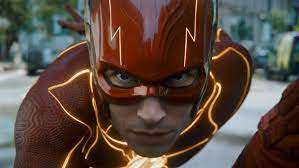
The first thing to know about The Flash is that it's 144 minutes long. Go ahead, sigh. I did. I begin here because this overstuffed helping of DC Comics chaos has trouble sustaining engagement beyond maybe the first hour and a half of its two-hour and 24-minute run time. A little more than halfway through, I started looking at my watch as I wondered how much more director Andy Muschietti (It) would throw into this frenzied whirl of a movie. The answer: a lot. We're talking Batman, supervillain Zod, Supergirl, time travel, and even two Flashes, both played by Ezra Miller, the actor who has had his
 share of legal troubles. You can look up Miller's woes, but I hope that he's able to straighten out his life and continue his career. Here, Barry Allen (a.k.a. The Flash) encounters a younger version of himself when he travels back in time. When we first meet Barry, he's troubled because his mother (Maribel Verdu) has been murdered, a crime for which his father (Ron Livingston) has been arrested. The movie's big kick involves the appearance of Michael Keaton, who reprises his role as Batman. I thought donning Batman’s cape weighed Keaton down; he's playing a reluctant, weary Batman, but Keaton’s work exceeds cameo levels and his presence registers as a plus. An early scene in which babies are vaulted through the sky (a baby shower of sorts) is almost weird enough to justify a look but Miller's high-strung performance wears thin as the movie wears on — and it does wear on. Despite its title, the last thing The Flash does is race quickly across the finish line. Keep an eye on Sasha Calle (Supergirl), though. She has enough edge to cut through  the flying bric-a-brac, self-referential nods, noisy action, and plot overload. *

*A brief confession: As someone who grew up reading DC comics (not Marvel), I keep rooting for the DC characters, but prefer them when seen as individuals not part of a repertory company of superheroes. Fingers crossed for next time. 


Thursday, November 15, 2018

An overstuffed 'Fantastic Beasts' movie

There are pleasures in the second Beasts movie, but it spends too much time running in place.
Back in the Pleistocene days of my youth, vendors at ballparks had a standard cry, "Get your scorecard here. Can't tell the players without a scorecard." We're talking about the days before mammoth scoreboards boasted screens the size of buildings. In my youth, the assumption was that if you arrived at the ballpark, you most likely came to watch the game.

I begin my review of Fantastic Beasts: The Crimes of the Grindelwald this way because I wish someone had handed me a character roster before I saw the movie. Not only did I have to remember characters from the first movie in the series, but I had to track new additions.

All this by way of saying that this edition of Fantastic Beasts is a bit of a muddle that advances the series' overarching story only by a couple of inches -- and takes 134 minutes to do it. Obviously, a planned five-part series can't deliver its biggest bang in episode two, but a little more end-of-picture satisfaction would have been welcome. At the end of Beasts, I felt as if the story had worked up lots of sweat but mostly had been running in place.

Director David Yates, working from a screenplay by J.K Rowling -- she of the sacred word -- is asked to juggle a variety of plot points that revolve in a dizzying orbit around Newt Scamander (Eddie Redmayne), the series' ostensible main character, a wizard devoted to studying magical zoology. Some of Scamander's creatures live in a magical suitcase that the diffident wizard carries with him at all times.

Grindelwald, you'll learn, is an evil wizard played by a Johnny Depp, whose normal complexion has been augmented with enough white make-up to create the impression that pallor and villainy have become synonymous. Grindelwald seems to be a fairy tale Hitler, a fascist who wants to save the world with wizard pure blood before muggles (humans) screw things up entirely. The movie is set in the 1920s.

The movie opens with Grindelwald escaping from prison and moving to Paris. Among other pursuits, Grindelwald is trying to find Credence Barebone (Ezra Miller), a baffled young man who's eager to find out who his parents were. Another returning figure from the first installment, Credence seems morbidly depressed.

Then there are our old friends Jacob Kowalski (Dan Fogler) and Queenie Goldstein (Alison Sudo). She reads minds. He doesn't mind. The couple provides much of the comedy you'll find in The Crimes of Grindelwald, aside from some of the better visual flourishes.

Redmayne, who seems to be wandering through the movie, eventually encounters a middle-aged Dumbledore (Jude Law) who asks him to confront Grindelwald, something Dumbledore himself can't do because he and Grindelmore once were more than brothers and friends -- or some such. Hmm.

Law, by the way, comes closest to calming the movie down to tolerable levels. His Dumbledore seems a welcome pillar of simplicity in a screenful of visual over-abundance.

Other participants in this pre-Potter farrago are Katherine Waterston as Tina, a former Auror; i.e., a wizard chosen to fight crime. Zoe Kravitz turns up as one of Newt's former classmate's at Hogwarts; the fabled school makes a rather brief but welcome appearance in what I'm choosing to call Beasts II, following on the heels of 2016's Fantastic Beasts and Where to Find Them.

Crimes of Grindelwald probably qualifies as one of those critic-proof movies that fans will support, even if they quibble with some of its choices and there are pleasures to be had from Philippe Rousselot's cinematography, from the scale of some of the movie's more elaborate settings and from some of its visual invention.

Somewhere in all this Rowling bric-a-brac, a serious confrontation between good and evil lurks. If I had a magic wand, I'd wave it and order all concerned to please get on with it.


Thursday, November 16, 2017

Superheroes unite to save the world

Justice League may not be great, but it registers as OK.

When I was a kid, the only thing I liked about getting haircuts involved the well-stocked stash of comic books that the neighborhood barber kept in his establishment. I consoled myself about the discomfort of itchy hair down the back and ungodly applications of hair tonic by visiting Gotham and Metropolis or maybe even Smallville, the town where Superboy was still finding his superhero legs.

I took solace for my impending misery in Clark Kent's square-jawed righteousness as a mild-mannered reporter for the Daily Planet and in Batman's colorful gallery of villains -- the Penguin and Joker. I loved the blocky apartment buildings that defined the urban landscapes of the cities where these Manichean dramas unfolded.

These were comics made for the clickety-clack of typewriter keys, for Clark Kent's fedora and for the overwrought prose of melodrama: "The Batman, having lost his way on a lonely by-road, stops before a lone house to ask directions. Suddenly, from the house comes a scream of a wild beast in pain ...."*

I get no such kick from the current wave of comic-book movies, which typically contain bloated action sequences that rely heavily on CGI, so much so that the villain in League of Justice, the latest entry from DC Comics, is a CGI creation called Steppenwolf. In tones that sound as if they've been augmented to suggest sonic boom, Ciaran Hinds provides Steppenwolf's voice.

Justice League, which brings together a quintet of superheroes (Batman, Cyborg, Flash, Wonder Woman and Aquaman) can be judged decent by current standards and it certainly represents an improvement over the somber and self-serious Batman v Superman: Dawn of Justice (2016).

This episode has been directed by Zack Snyder, who ceded control to screenwriter Josh Whedon when Snyder, who directed Batman v Superman, left the production to be with his family after the death of a daughter.

The resultant movie isn't nearly as dark as Batman v Superman and pretty much functions as a foundation for the next installment, as well as a lively introduction to several superheroes who are new to the big screen.

Early stages of the story involve Batman's attempts to assemble a crew to fight Steppenwolf, a villain in horned-helmet who's trying to gather three mysterious boxes so that he can unleash their power and bring about (what else?) the apocalypse.

This set-up requires the movie to do some quick backup work in the form of abbreviated origin stories for Flash (Ezra Miller), Cyborg (Ray Fisher) and Aquaman (Jason Momoa).

We already know Wonder Woman (Gal Gadot) and, of course, Ben Affleck's Batman. Not quite as gloomy as he was in the previous movie, Affleck's aging Batman isn't exactly charismatic, either.

These early sections work well and include the usual amount of extended action, which often seems more aimed at satisfying audience appetites for noise than advancing the story.

The main problem with the movie involves its villain, an off-the-rack menace who commands minions of flying, bug-like demons who feed on fear.

Gadot, who earlier this year established Wonder Woman as one of the best comic-book franchises, acquits herself well as a member of the emerging Justice League. Equally engaging is Miller, who has been given the lion's share of the movie's wisecracks. Another welcome presence, Momoa turns Aquaman into a tattooed rogue whose attitude ranges from casual to cynical.

The story unfolds against a backdrop of doom. Since Superman's death in Batman v Superman, villainy has erupted and the world has lost its knight in shining armor. Henry Cavill, who plays Superman, is listed in the movie's credits, but I won't tell you more about how the Man of Steel figures into the story.

The movie's superheroes must hold their egos in check and unite to conquer evil; saving the world proves to big a task for any single superhero. "Stronger together" didn't quite carry Hilary Clinton to the heights she hoped to scale and it doesn't totally work for Justice League, either, but the movie has entertaining elements and enough superhero chemistry to keep the DC wheel spinning toward the next movie.
*I have this quote on a Batman comics cover and linked to it. The link didn't take and I couldn't find the source again, but you get the idea about the overheated prose.

Thursday, June 11, 2015

Emma Bovary arrives on screen -- again

Though not without its virtues, this Madame Bovary falls short.

The story of a blossoming woman stuck in a lifeless marriage in a provincial French backwater certainly has the potential to speak to modern audiences as both an early feminist drama and a biting social critique of bourgeois narrowness.

Begin there in thinking about the latest adaptation of Gustave Flaubert's Madame Bovary, a semi-successful attempt to transfer Flaubert to the screen.

Bored and filled with inchoate romantic longing, newly married Emma Bovary tries to divert herself with wanton material acquisitions (fine dresses and fancy furnishings) that mire her in debt. She also engages in affairs that she hopes will provide an escape route from her country-doctor husband, a decent fellow of simple tastes and limited ambition.

There's no faulting the production values that director Sophie Barthes brings to the task of adapting Flaubert for the screen. Working with cinematographer Andrij Parekh, Barthes creates the feeling of isolation and monotony that awaits Emma on the dawn of each day, the numbing emptiness of life at the bottom rungs of the middle class.

Given the standard of her time, Emma is supposed to be happy to have a husband and provider, but she's reluctant to resign herself to a compromised existence far from the civilities of Rouen, the city that beckons and taunts her with its opera and high culture.

The screenplay by Barthes and co-writer Felipe Marino must make omissions and condensations, and although I haven't read Madame Bovary since college, it struck me that Barthes and Marino have done a defensible job of focusing Flaubert's story for the screen. Flaubert devotees may disagree, particularly when it comes to the omission of Emma's child.

In this edition, Emma Bovary is played by Mia Wasikowska, who -- I think -- only intermittently fixes our attention. Some reviewers have pointed out that Wasikowska is perfect for the role because she makes no effort to elicit our sympathies. Still, Wasikowska's performance can be seen in as a study in only sporadic connection.

Employing a variety of accents and styles, the supporting cast acquits itself well enough.

In a generally subdued atmosphere, Rhys Ifans stands out as Monsieur Lheureux, a merchant who senses Emma's vulnerability, sells her as much luxury merchandise as possible (on credit) and then pushes her into a ruinous, debt-riddled corner.

As Charles Bovary, Henry Lloyd-Hughes plays a character who, by definition, is a bit of a cipher. Ezra Miller portrays Leon, a youthful law student who falls for Emma. Under different circumstances, he would have made a good match for her.

Emma initially rebuffs Leon. She does, however, have an affair with the disreputable Marquis d'Anderveilliers (Logan Marshall-Green). Of course, Emma expects too much of the relationship.

Paul Giamatti brings his usual avidity and a bit of grubbiness to the role of Monsieur Homais, an ambitious pharmacist who pushes Dr. Bovary into performing a supposedly ground-breaking operation on poor, club-footed villager. The operation, of course, does not go well.

Not without its virtues, Madame Bovary dwells on Emma's suffocating provincial surroundings, perhaps to emphasize that the constraints of her rote existence have alienated her from her natural self.

If Barthes succeeds in creating a plausible 19th century environment, she also manages to dull the movie's edge. The damp streets and uninviting interiors aren't enough to carry the day.

By the end, I felt as if I were re-familiarizing myself with elements of Flaubert's plot without penetrating the agonizing and acutely observant heart of a great story.

Thursday, September 27, 2012

Wallflowers of the world unite!

A misfit kid finds his comfort zone.

The Perks of Being a Wallflower is a better-than-average teen movie enhanced by elements that might have had difficulty finding their way into a similar movie 20 years ago: a major gay character, incidents of high-school homophobia and teen suicide, to name a few.

In adapting his own young-adult novel for the screen, director Stephen Chbosky tries for a mixture of humor and low-key drama. He succeeds in finding a bit of both in a movie whose success may depend on how much you can identify with a young man who -- at the movie's outset -- is keenly aware that he has 1,385 days until he graduates from his suburban Pittsburgh high school. (Somehow, I don't think counting is likely to make the time go faster.)

Logan Lerman (Percy Jackson & The Olympians) plays Charlie, a high school freshman who finds a much-needed comfort zone with a group of his school's self-proclaimed misfits. Charlie hangs out with Patrick (Ezra Miller), a comfortably gay student, and with Patrick's brash half-sister Sam (Emma Watson of Harry Potter fame). This trio of outsiders form credible bonds of friendship, and Charlie gradually begins to fall for Sam.

Set in the early '90s, Wallflower is a coming-of-age tale punctuated by well-documented problems of adolescence. Charlie, for example, is dealing with the recent suicide of a friend. Patrick has agreed to conceal his affair with a star football player, and the perky, rebellious Sam frets about getting into college. At one point, a precocious fourth member of the group (Mae Whitman) decides to declare herself Charlie's girlfriend.

Those who haven't read Chbosky's book won't know that the story harbors a major secret. Revealed toward the movie's end and hinted at in flashbacks, this secret can feel as if Chbosky is not only trying to be topical, but is doing the thematic equivalent of piling on, adding yet another problem to Wallflower's already large collection.

For me, Miller gives the most notable performance. Not many saw Miller's terrific work in the polarizing We Need to Talk about Kevin, but those who did will recognize that this young actor has range and appeal that far outshines the rest of Wallflower's able cast.

Adults don't play a major role here. Dylan McDermott is cast as Charlie's dad; Kate Walsh plays his mom, and Paul Rudd has a nice turn as a high school English teacher who forms a bond with Charlie, loaning him books.

As teen movies go, Wallflower tends to dwarf its recent competition, but I'd be remiss if I didn't report that I've grown a little weary of big-screen adolescence, and for all its attempts at putting on a fresh face, Perks can't entirely shake a feeling of familiarity. That may not (and probably shouldn't) breed contempt, but it could make you wonder whether American movies ever will graduate from high school.


Thursday, March 29, 2012

A powerful look inside a mother's torment

We Need to Talk About Kevin isn't for everyone, but this look at a reluctant mother is provocative and haunting.

Director Lynne Ramsey’s We Need to Talk About Kevin had a run on last fall’s film festival circuit, opened commercially in New York and Los Angeles in December of 2011, but only now is beginning to circulate around the country. In conjunction with November's Starz Denver Film Festival, Ramsey and screenwriter Rory Kinnear visited Denver to talk about a movie that involves a killing rampage at a high school. Gifted and unapologetic about her choices, Ramsey made it clear that she understood that some people might reject her movie on its face.

It’s important to take note of the words “on its face” because We Need to Talk About Kevin is not really about a young man who kills fellow students at his high school, although that horrific event does reverberate throughout the story, giving it an extremely disturbing edge.

Unsettling, yes, but I can't agree with a woman who at a festival screening of the movie said We Need to Talk About Kevin never should have been made. There are very few "shoulds" when it comes to art. Many artists like to explore the extremes of human behavior because they know that such extremes often push toward difficult truths. If nothing else, We Need to Talk About Kevin is a movie of extremes.

Based on a novel by Lionel Shriver, We Need to Talk About Kevin has no interest in explaining school murders, which may be unexplainable anyway. What distinguishes both the novel and Ramsey’s movie is a willingness to take a highly subjective look at the main character Eva (Tilda Swinton in the film), a mother who can’t accept her son. Eva probably never wanted to be a wife and mother, and she's forced to re-evaluate her life after her son (Ezra Miller) commits a horrible crime.

Courageously, Ramsey has done what few filmmakers who adapt novels for the screen are willing to do: She has taken only what most intrigued her about Shriver’s dense fiction and discarded the rest. This approach probably was essential because Shriver told the story through a series of letters written by Eva. What remains is a riveting account in which past and present mingle as the movie works its way toward the climax we know is coming.

Ramsey and cinematographer Seamus McGarvey create powerful imagery -- and if you pay attention -- you’ll soon become aware that you are not receiving a rounded, clear-eyed portrait of a troubled family: You’re getting the view from inside of Eva’s head -- and it’s not a pleasant one.

Swinton makes a perfect Eva, a woman who has stepped into a life in which she feels like a stranger. Eva gave up a career as a travel agent to become a wife and mother, but We Need to Talk About Kevin is not a feminist tract that decries Eva’s loss of independence; it’s a mesmerizing, intimate examination Eva’s life as a mother who deals with a child who (for reasons that movie never fully explains) is a handful from day one.

Roll a ball to little Kevin, and he refuses to return it. He just sits there. Long after most kids are toilet trained, Kevin continues to poop in his pants, an act of willful disobedience.

On some level, Kevin knows that he is not a wanted child. He perceives his mother’s rejection and misses no opportunity to punish her for it. Like many a misguided child, Kevin's also smart enough to see through the facade of suburban life that’s supposed to shield people from their demons.

Only Kevin and his mother share this twisted intimacy. Kevin’s dad Franklin (John C. Reilly) takes a boys-will-be-boys attitude toward Kevin, insisting (even when the evidence is overwhelming) that things are OK. Eva and Franklin’s second child (Ursula Parker) somehow seems to have escaped from the family’s loop of rage, denial, frustration and lack of fulfillment: It’s as if she’s been dropped into this nightmare from a more much more pleasant dream.

Swinton’s masterful performance turns Eva into a witness as much as a participant in her life. Eva’s encountering an awful truth, so it’s not surprising that Swinton often looks stunned and shattered. Try as she may, Eva can’t change what seems to be an indestructible part of her nature, a resistance to being Kevin’s mother.


Ramsey’s casting is spot-on: Reilly’s perfect as a deluded dad. The actors who play Kevin as a boy (Rock Duer and Jasper Newell) are equally good, as is Miller, who takes over when Kevin becomes an adolescent.

Ramsey, whose last movie was the equally difficult Morvern Collar (2002), is alert to the satirical possibilities in even the darkest material. She doesn't approach her characters with soggy sympathy but with a cool - even cruel -- eye.

Ramsey made We Need To Talk About Kevin for very little money. She and her crew had to work fast. I think the haste served the material, which also boasts provocatively fragmented storytelling, remarkable sound design and a haunting score by Jonny Greenwood.

In a community that lives with the memory of Columbine, some may wish to avoid the provocations and occasional horror of We Need To Talk About Kevin. I wouldn’t try to argue anyone out of such a position.

But those who see We Need to Talk About Kevin will find a fevered nightmare with humor nipping at its edges. For me, We Need To Talk About Kevin stands as a small masterpiece of subjective cinema; its febrile tremors infiltrate, challenge and ultimately haunt the mind. And know this: We Need to Talk About Kevin is not an exercise in social realism; it's an exercise in emotional realism: rampant, dark and unafraid.