Rocky Mountain Movies & Denver Movie Review
FOR MOVIE LOVERS WHO AREN'T EASILY SWEPT AWAY
Tuesday, November 25, 2025
An overloaded 'Knives Out' mystery
Wednesday, December 15, 2021
Swan Song sings an edgeless tune
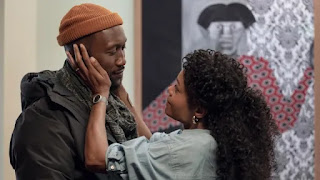
In Swan Song, Mahershala Ali plays a dying man who has been given the opportunity to be replaced by a clone. If Ali's Cameron opts for cloning, his wife (Naomi Harris) and young son (Dax Rey) won't know that he passed away. For them, life will continue seamlessly.
Wednesday, April 28, 2021
Bob's Cinema Diary: 4/30/'21 -- 'Outside Story,' 'Percy vs. Goliath' and 'Four Good Days’'
The Outside Story
Movies don't get much more streamlined than Outside Story, a look at a man (Brian Tyree Henry) who locks himself out of his Brooklyn apartment, interacts with his neighbors, and wonders whether he should have broken up with his girlfriend (Sonequa Marin Green). Henry's Charles seems to be a nice guy, a film editor who specializes in assembling visual obituaries of celebrities. The key to the movie involves Henry's performance as a stressed-out but nice New Yorker who has encounters with a cop (Sunita Mani), a neighborhood kid (Olivia Edward), and an older woman (Lynda Gravatt) whose husband recently died. Director Casimir Nozkowski, who also wrote the screenplay, has a nice feeling for the idiosyncrasies of neighborhood relationships but he can't prevent the material from feeling a bit thin. Henry, currently on view in Godzilla vs. Kong, holds the movie together. Although the movie contains some conflict, the stakes feel pretty low -- which can be viewed as a blessing or a severe limitation or perhaps a bit of both.
Percy Vs Goliath
After seeing Christopher Walken miscast as an Irish farmer in Wild Mountain Thyme, I was dubious about Percy Vs Goliath, the story of a Canadian farmer who takes on the Monsanto in a prolonged court battle over patent rights involving canola seeds. But damn if Walken doesn't pull it off, doing credible work as Percy Schmeiser, a farmer who inadvertently planted Monsanto GMO seeds that had blown onto his property from a neighbor's farm. The result: a prolonged suit. Roberta Maxwell portrays Schmeiser's wife Louise. Zach Braff signs on as the small-town lawyer who represents Schmeiser, and Christina Ricci appears as an environmental activist who encourages Schmeiser to challenge Monsanto. She also helps him take is story global with a visit to India. The story of a little man fighting a major corporation isn't exactly fresh but director Clark Johnson does a good job presenting complicated issues as Schmeiser's case makes its way to the Canadian Supreme Court.
Familiarity may not always breed contempt, but it can breed fatigue when it comes to movies. Glenn Close and Mila Kunis play mother and daughter in an addiction drama about a young woman (Kunis) nearly ruined by drugs. Kunis' Molly wants to make another stab at kicking her habit so she asks her mother, Close's Deb, to take her in. This time she really means it -- or so she says. Director Rodrigo Garcia doesn't skimp on realism: Kunis has been given rotting teeth and a distressingly scrawny look. Deb blames Molly's addiction on the doctors who prescribed an Oxycontin regimen after a skiing injury. Since then, Deb has left her husband (Joshua Leonard) and her two kids. The title stems from the offer Molly receives from a detox doctor: If she can stay clean for four days, he'll give her a shot that will keep her from getting high on heroin. If she takes the shot before her system has been cleansed, she could die from its effects. Close and Kunis deliver strong performances but the movie can't escape the dogged quality of the storytelling. It's difficult not to feel a bit guilty about wanting a fresh charge from an addiction movie, particularly one based on a true story. Still, we feel a bit like Deb feels when Molly shows up at her door after 14 failed attempts at rehab. What? You want us to go down this movie road again?
Thursday, November 19, 2020
Performances elevate 'Hillbilly Elegy'
What could be more uplifting? A young man overcomes poverty and a host of family issues that include his mother’s self-destructive bouts with addiction. Despite what seem like insurmountable obstacles, this young man manages to attend college and obtain a law degree from Yale. He ascends, yes, but he never forgets his Kentucky and Ohio background. Warts and all, he honors his family.
Thursday, September 6, 2018
She's the afterthought in his life
The complicated relationship between a husband and wife moves to the forefront of The Wife, Swedish director Bjorn Runge's adaptation of a 2003 novel by Meg Wolitzer. The movie centers on the Castlemans, a couple brought to convincing life by Jonathan Pryce and Glenn Close.
When the movie begins, Pryce's Joe Castleman is awaiting word on whether he has won the Nobel Prize for literature. He does and the movie then shifts to Oslo, Norway where Joe, his wife and his grown son (Max Irons) have gone to celebrate Joe's success.
Of course, that's not the end of the story, but only the beginning of a slow revelation of the secret behind Joe's literary triumph. For those unfamiliar with the story, I'll say no more except to note that Close's Joan Castleman seems to have taken responsibility for every mundane aspect of Joe's exalted life, tasks she carries out despite Joe's penchant for philandering.
As events in Oslo unfold, Runge shows us flashbacks to various stages of the couple's relationship, which began when Joe, married to someone else at the time, taught writing at the college level. Joan (played as a young woman by Close's real-life daughter Anne Starke) was one of his prize students. At the time -- the 1950s -- prospects for emerging female writers seemed dim and Joan sacrificed her talent on the altar of Joe's ego.
Importantly, the movie shows us that Joan, though definitely exploited, was complicit in her fate. For reasons of her own, she loyally subordinated herself to Joe's ambitions. No one can do such a thing without paying a price, and Joan's resentments ripple through Close's finely tuned performance.
For his part, Pryce conveys the egotism and occasional cruelty of a famous Jewish-American writer. His relationship with his son, an aspiring author, reeks of authoritarianism and neglect. Joe isn't kind when talking about his son's writing, disguising his lack of compassion as an insistence on high standards.
Strong hints of threatening disclosures run throughout the movie. Christian Slater plays a wily journalist who has been trying for years to write Joe's biography. He wants Joan to help him topple Joe from his throne, a lofty perch built on the pile of critically acclaimed books the author has published.
Despite building toward an inevitable showdown between Joe and Joan, The Wife never quite feels revelatory. But Pryce and Close add undeniable polish to this peek into literary lives -- both fulfilled and wasted.
Thursday, November 6, 2014
Music, heroin and fatherhood on the fringe
Jazz pianist Joe Albani, who went by the name of Joe Albany, died in 1988 at the age of 64. Albany spent most of his adult life as a musician and heroin addict, not always in that order.
No slouch wannabe, Albany established his reputation playing with such greats as Charlie Parker and Miles Davis. That alone might have made for a good movie.
But Low Down, which only touches on Albany's jazz life, turns out to be another kind endeavor, one that focuses on Joe's faltering attempts at fatherhood.
Based on a memoir by his daughter, who also had a hand in writing the screenplay, Low Down introduces us to Albany during the 1970s.
At the time, he was living a marginal life in the kind of seedy Los Angeles dives that writer Charles Bukowski memorialized, single-room occupancy hotels where the clientele was sometimes too drunk or stoned to notice much of anything.
Director Jeff Preiss, who worked as the cinematographer on the Chet Baker documentary Let's Get Lost, tells the story through the eyes of Albany's 13-year-old daughter Amy (Elle Fanning).
Albany -- played by John Hawkes -- bobs in and out of the story, sometimes sober, sometimes not. At times, he allows heroin to disconnect him from music, yet we never doubt his seriousness as an artist.
Hawkes (The Sessions, Martha Marcy May Marlene and Winter's Bone) is too good an actor to serve up a series of junkie cliches. He gives us a father who's gentle and bright with his daughter and who's imbued with a kind of tolerance for himself and others.
Joe obviously has little idea about how to be a father, but he leaves no doubt that he loves his daughter, and Fanning does justice to a teen-ager who's trying not to be overwhelmed by her father's indulgences or by an alcoholic mother (Lena Headley), made viperous by booze and bitterness.
Obviously, Amy isn't living a normal teen life; she's exposed to prostitutes and to a strange but gentle fellow (Peter Dinklage) who lives in the basement of the dump where her dad crashes.
If there's a surprising performance here, it's given by Glenn Close, who plays Joe's mother and Amy's grandmother, a tough woman who chain smokes, takes no guff, and takes care of her granddaughter when her father can't. She appreciates her son's talent, but fears for him.
Fanning observes her father, his friends and the life he's fallen into with baffled curiosity, and Hawkes can feel almost airborne as Joe floats through some awfully dreary days.
The movie floats a bit as well; it's steeped in a kind of '70s filmmaking style in which the truth of every scene often takes precedence over any narrative arc.
I don't know what else to say to give you an idea about this movie, but it might help if I conjectured a bit. I think John Cassavetes would have liked and admired Low Down -- at least, I hope he would have.
Friday, January 27, 2012
A gender-bending story set in the 1890s
How you react to Albert Nobbs, a project that Glenn Close reportedly spent two decades trying to bring to the screen, depends almost entirely on how you react to Close in the title role; she's playing a woman posing as a man in 19th Century Ireland. Close, who played the role on stage in the 1980s, brings the project to the screen under the direction of Rodrigo Garcia (Mother and Child and Nine Lives). As written by Close and John Banville and based on a novella (Celibate Lives) by George Moore, Albert Nobbs feels as meticulously crafted as Close's make-up. But here's the thing: I couldn't buy Close as a woman successfully passing as a man. Maybe it's her delicate facial features. Whatever the case, Nobbs looks like a strange version of Close, pinched into a constricted, almost neutered impression of a man. The screenplay tells us that Nobbs decided -- partly for economic reasons -- to pose as a man, but the movie also serves as commentary on how some people have responded to societies bound by rigid gender-role conventions. While working at a hotel, Nobbs meets Hubert Page, a house painter played by Janet McTeer, who brings robust conviction and humor to her role as another woman posing as a man. McTeer's Hubert essentially steals the picture from the deeply repressed and fussy Nobbs, who dreams of opening a tobacco shop. Hubert lives with a woman who loves and accepts him; he suggests that Nobbs also might be able to find some semblance of normal life. Nobbs then turns his attention to Helen (Mia Wasikowska), a co-worker at the hotel. There's genuine poignancy in watching Nobbs, a man of limited imagination, pursue a dream that we know is beyond his reach. At its best, Albert Nobbs stirs emotion, but I never entirely shook the distracting awareness that I was watching Close create an illusion that didn't quite convince.
*For the record, not everyone shares my view of Close's performance, certainly not the members of the Academy of Motion Picture Arts and Sciences who nominated her for a best-actress Oscar. The Academy does agree on McTeer, though. She was nominated in the best-supporting actress category.