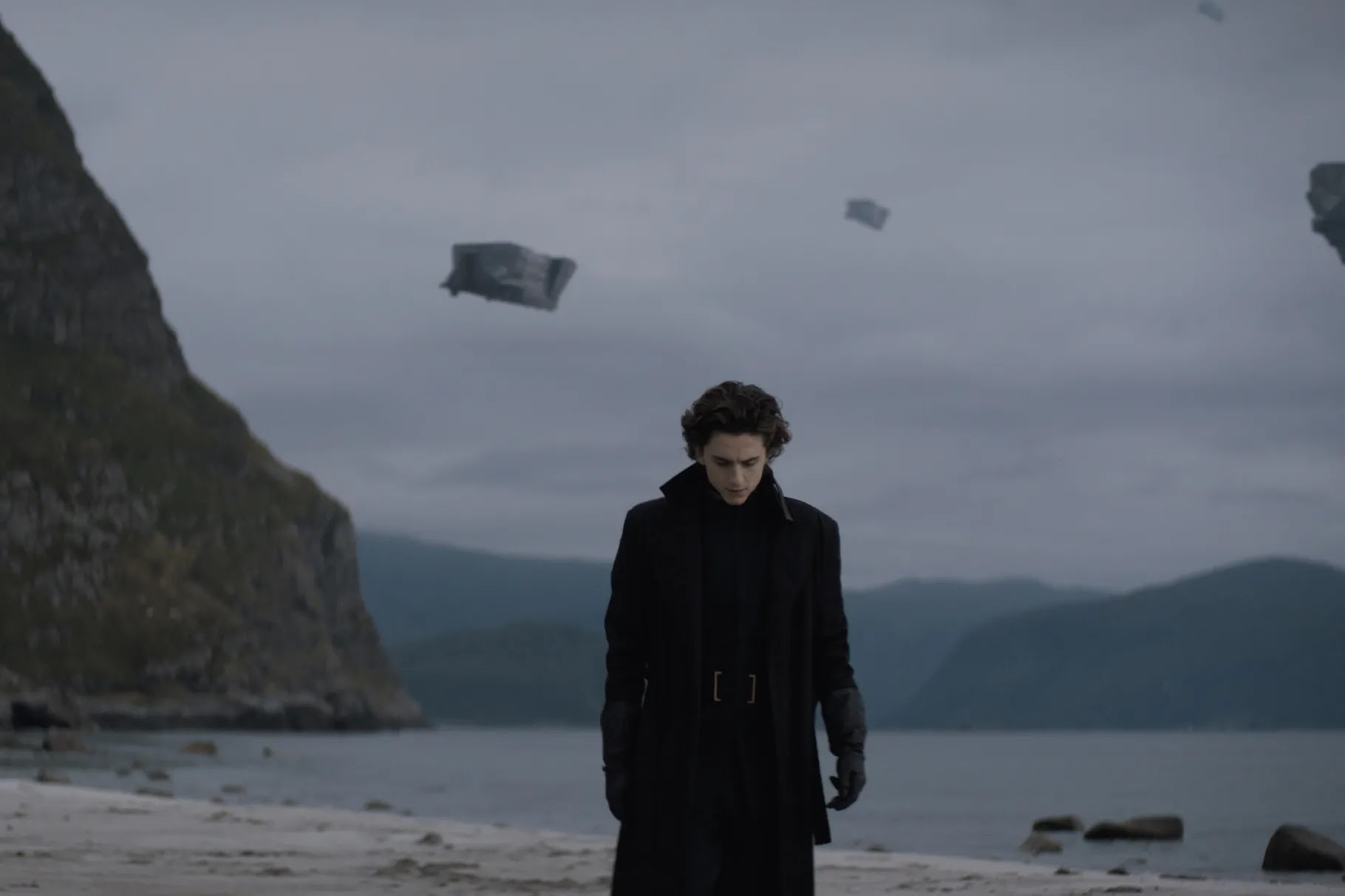
On the surface, Norwegian director Joachim Trier's Sentimental Value seems poised to tell a conventional family story. That might have happened had Trier not placed his characters against a backdrop that includes theater, film, and acting, a choice that deepens questions his film raises about the complicated nature of father/daughter relationships.
Rocky Mountain Movies & Denver Movie Review
FOR MOVIE LOVERS WHO AREN'T EASILY SWEPT AWAY
Wednesday, November 19, 2025
Joachim Trier's complex family drama
On the surface, Norwegian director Joachim Trier's Sentimental Value seems poised to tell a conventional family story. That might have happened had Trier not placed his characters against a backdrop that includes theater, film, and acting, a choice that deepens questions his film raises about the complicated nature of father/daughter relationships.
Monday, February 26, 2024
'Dune: Part II': a stunning epic
Huge in scale, long in the telling (166 minutes). and sporting arcane references from author Frank Herbert's landmark 1965 sci-fi novel, Dune: Part II has arrived. Don’t fret. Director Denis Villeneuve, who released Part One in 2023, delivers a movie with enough visionary heft and action to justify its epic scope.
Wednesday, October 20, 2021
Sand and sci-fi in other-worldly ‘Dune’
Here's the essence of what needs to be said about director Denis Villeneuve's long-awaited adaptation of Dune, the 1965 Frank Herbert novel that has acquired classic status among many sci-fi enthusiasts.
Thursday, July 16, 2020
A war-time ordeal brought to the screen
Another character (Lech Dyblik) explains the movie’s title. With the boy watching, he paints a small bird’s wings white and then releases it. Quickly, the bird is torn apart by a flock of blackbirds, an inescapable metaphor for the savagery of bigotry that has engulfed the world.
Thursday, September 8, 2016
A revenge film and a bold British musical
The Norwegian movie, In Order of Disappearance, has a regrettably familiar undertow, perhaps a result of the pervasive influence of the Coen Brothers and Quentin Tarantino. Following a schematic structure in which various sections are introduced with titles, director Hans Petter Moland takes us through a series of revenge killings carried out by a snow plow driver (Stellan Skarsgard). The driver's son, we quickly learn, was mistakenly killed in a drug-related crossfire. Skarsgard has the chops to make us believe that an apparently ordinary man has the grit to carry out such a relentless mission. A character called The Count (Pal Sverre Hagen) becomes the most colorful villain in the piece, a brutal fellow who's constantly being frustrated by mundane problems, arguments with his former wife (Brigitte Hjorth Sorensen) and concerns about getting his kid to school on time. With a movie such as this, much of the kick stems from how Skarsgard's Nils dispatches his prey, but additional complications ensue: Rather than focusing on Nils, the unsuspecting Count decides that a rival Serbian gang must be muscling in on his territory. A weary looking Bruno Ganz portrays an aggrieved Serbian gang boss who's also trying to avenge the death of a son. A desolate snowbound setting gives the entire enterprise frosted chill, and the movie manages to hold our interest despite its somewhat derivative feel. Credit veterans Skarsgard and Ganz for giving In Order of Disappearance weight it otherwise might have lacked.
AN ENGLISH MUSICAL BASED ON SERIAL KILLINGS
Forget the photo that accompanies this short review. The British actor Tom Hardy appears in only one scene in London Road, a musical based on a series of 2006 killings that terrorized Ipswich, a town in Suffolk, England. A forklift operator named Steven Wright (never seen in the movie) was convicted of murdering five prostitutes during a six-week period that attracted tabloid interest and set the Ipswich townsfolk on edge. Rather than follow a thriller path, the screenplay by Alecky Blythe explores the impact of the killings on the town -- both before and after the killer is apprehended. It's hardly surprising that the townsfolk begin to regard one another with suspicion or that some of their judgmental attitudes about prostitution are put on display. First produced as a play, London Road makes a reasonably good transition to the screen under the guidance of director Rufus Norris. Composer Adam Cook's urgent score fits the movie's fleet 91-minute length. London Road is further distinguished by the fact that much of the dialogue (including moments in which actors speak directly to the camera) derives from real interviews with Ipswich residents. In sum, not quite the groundbreaker it must have felt like on a London stage, but still worth a look.
Thursday, June 30, 2016
Spies in a world shorn of honor
Almost any John le Carre novel has the potential to yield an intelligent, big-screen thriller. Adapted from a 2010 le Carre novel, Our Kind of Traitor proves the point, deftly luring us into a world populated by Russian mobsters, British academics, and British intelligence agents, all of them operating against backdrops that extend from Marrakech to Paris.
Perfectly timed to compete with the bloated drivel of summer, Our Kind of Traitor reminded me of the kind of movie pleasures I'd lately been missing, namely characters who find themselves in situations they couldn't possibly have anticipated and which prove morally taxing.
Early on, we meet Perry (Ewan McGregor) and his wife Gail (Naomi Harris), a couple vacationing in Marrakech in hopes of reviving a sagging marriage. Self-sufficient professionals, Perry and Gail are dining in a restaurant when Gail abruptly leaves to handle a business matter.
Left alone, Perry is approached by a convivial Russian (Stellan Skarsgard) who invites him to have a drink with his companions, a surly looking bunch. Perry reluctantly accepts, and soon finds himself accompanying Skarsgard's Dima to a party full of temptations, mostly in the form of drugs and women.
Because Dima belongs to the Russian mafia, these temptations come with obvious forebodings: Perry's crude, tattooed associates make no attempt to conceal their carnal appetites.
Full of robust charm and confidence, Dima assures Perry that he needn't be alarmed. He calls him "professor." He overpowers Perry's resistance with loudly expressed charm.
Of course, Dima has an ulterior motive. He wants Perry to transport a memory stick to London. As the man who launders Russian mob money, Dima says he'll name prominent Brits who are in cahoots with Russian crime czars. In return, he wants asylum for himself and his family.
The rest needn't be revealed here, but director Susanna White and screenwriter Hossein Amini treat le Carre's work kindly in a story that focuses on characters who are trying to get out of predicaments rather than penetrate secret inner sanctums.
Once Perry agrees to transport the memory stick, he's in over his head. A British operative (Damian Lewis) pushes Perry to become even more involved, arguing that he holds the key to saving Dima and his family.
Of course, betrayals and bureaucratic fumbles abound, as well as subterranean motivations in which money trumps anything resembling patriotism or honor.
In Dima, Our Kind of Traitor finds a terrific character. Entirely engaging, ebullient and tough, Dima makes no bones about having dirty hands. Yet, we understand Perry's fascination with him. Dina suggests something bigger and more life-affirming than his circumstances might have us believe, a deep understanding of the world's ways. He also knows how to use truth as weapon.
But it's not only plot and performance -- McGregor's best in a while -- that makes Our Kind of Traitor so intriguing; it's the movie's knowledge, acquired from le Carre, that the rot of barbarism can be found beneath the civilized veneer of societies that run on murderous greed. That attitude carries us past the movie's improbabilities and coincidences -- if not to greatness then at least to sustained interest.
In le Carre's fallen world, as made clear in the movie's gripping opening, there's always a chance that the purity of a snow-covered field will be stained with the blood of a beautiful innocent.
Thursday, April 24, 2014
'The Railway Man': off and on track
A young but resourceful British soldier during World War II, Eric Lomax became a prisoner of war, part of the legion of British captives and Asian workers forced to toil on construction of the Thailand to Burma railroad.
The Railway Man -- a movie about Lomax's experiences -- is at its most effective when depicting the brutalizing torture Lomax experienced at the hands of the Japanese after he was caught with a radio and a map.
The Japanese insisted Lomax was trying to communicate with China. In reality, he and his imprisoned pals were listening to war news on a radio that couldn't transmit. Lomax, a long-time train enthusiast, used the map to chart the course of the line.
Colin Firth plays Lomax as a man suffering from post traumatic stress syndrome, a veteran whose experiences -- which included water-boarding -- keep him from fully engaging in his marriage to a Canadian woman (Nicole Kidman). Lomax and Kidman's Patti met in 1980 -- on a train, of course.
Director Jonathan Tiplitzky complicates the story by lacing it with flashbacks -- some springing from Lomax's tormented psyche and some from a recounting of events by one of Lomax's war-time pals, a miscast Stellan Skarsgard.
Kidman's Patti pushes Lomax to share experiences he's kept bottled up since the end of the war. Kidman gives the expected fine performance, but her presence in the film proves a little tangential.
Jeremy Irvine effectively plays the younger Lomax in flashbacks to the war.
Eventually, the post-war Lomax returns to the scene of the Japanese war crimes he endured. He fully expects to kill one of his surviving torturers (Hiroyuki Sanada), a man who's now earning a living conducting what Skarsgard's character refers to as "Bridge on the River Kwai tourism."
The big issue -- no less powerful for being obvious -- involves the conflict between Lomax's understandable desire for revenge and his need for reconciliation.
The big confrontation scene between the British veteran and his Japanese tormenter almost shrinks the movie into a play on film, but Sanada and Firth make it powerful nonetheless.
Thursday, April 3, 2014
Nymphomanic: Volume II, the punishment
Not content with one sexually explicit movie, Danish director Lars von Trier has issued the provocatively titled Nymphomaniac in two volumes.
Volume 1 dealt with a nymphomaniacal woman (Charlotte Gainsbourg) who told her story to an older man (Stellan Skarsgard) who adopted an Olympian view of her sexual history.
Seen in flashbacks, the young Joe (played by Stacy Martin) learned to express her power through sex, a risky business to be sure.
Together both volumes total more than four hours, making Nymphomaniac a contender for the longest sex movie yet -- if, indeed, it's really about sex.
In Volume II, the adult Joe takes over the story, and von Trier more clearly marks his territory by pushing her toward punishing extremes.
What happens? Joe -- who has lost all sexual sensation -- submits to torment from a sadist (Jamie Bell) who ties her down and beats her up. In the process, Joe proves that she's a careless mom and renounces those who would judge her at a meeting of sex addicts.
She also sleeps with two black men who face each other naked in what looks like a duel of semi-erect penises.
Toward the end, Joe hooks up with an extortionist (Willem DaFoe) and acquires a wily protege (Mia Goth).
All this is recounted in flashbacks as Joe finishes telling Skarsgard's Seligman how she wound up bloodied in an alley, which is how he discovered her at the beginning of Volume I.
In Volume I, Von Trier punished some of the characters: He does so again, but this time, the torment extends to the audience.
The shock of explicitly presented sex having been depleted in the first volume, we're left to watch Gainsbourg's Joe demean herself, take a prideful stance toward her activities and ultimately commit one final act of self-assertion.
Whatever von Trier had to say seems to have been said in the first movie. Volume II doesn't add much, except for those who want to speculate about von Trier's aims with yet another movie that seems designed to provoke without explanation.
As for what motivates Joe: It may be nothing more than von Trier's desire to put her through a variety of degrading situations and then try to defend himself by glossing it all with a feminist veneer.
As my grandmother might have said, "Oy."
Thursday, March 20, 2014
Lars Von Trier's sexual odyssey
An older man discovers a woman lying in an alley. She's been badly beaten. He takes her home, puts her in his bed and begins nursing her back to some semblance of health and stability. She, in turn, tells him her story.
The set-up is nothing if not conventional, but when you know that I'm describing the opening of director Lars Van Trier's Nymphomaniac: Volume I, you'll understand that the movie has no intention of following a familiar arc.
As best as can be gleaned from Volume I -- reviewers have not yet had access to Volume II -- Von Trier has decided to explore female sexuality by pushing one woman's story to nymphomaniacal extremes.
We soon learn that Joe (Charlotte Gainsbourg), the bruised woman from the alley, has taken an aggressively pro-active approach to sex, taking up with what seems a never-ending stream of men. Joe's relationships are brought to us in a variety of flashbacks in which Stacy Martin plays Joe as a young woman.
This being Volume I, we're left to surmise what might have brought Joe to her moment of degradation in that damp back alley.
The screenplay makes Joe her harshest critic; her rescuer (Stellan Skarsgard) seems a man of infinite patience. He steadfastly refuses to judge Joe. Instead, he gives her quasi-philosophical pep talks as they sit around his monkishly spare apartment.
Skarsgard's Seligman rambles on about fishing and other matters. He loves Izaak Walton's The Compleat Angler, and tries to connect fly fishing to Joe's story.
This gives Von Trier an opportunity to create some beautiful fishing and stream imagery, which adds a sense of mystery, but doesn't exactly prove revelatory in terms of our understanding.
Principal among Joe's relationships is her intermittent connection with Jerome (Shia LaBeouf). As a girl, Joe asks Jerome to take her virginity. He obliges. She then runs into him at various times during the story.
Some of the movie has a near-comical tone. At one point, Joe and a girlfriend take a train ride. They compete over who can score the most conquests on the train.
Given her rampant sexual activities, it's hardly surprising that Joe becomes something of an expert on penises. Perhaps that's why Von Trier includes a series of shots of penises of varying types and description.
Is he suggesting that, for Joe, men have been reduced to this essential bit of equipment? Is he mocking male genitalia by calling attention to their strangeness when abstracted from the rest of the body?
We also learn about Joe's upbringing as the movie progresses. She tells us her mother was emotionally frigid. Her father (Christian Slater) seems to have been an understanding fellow who introduced his daughter to the wonders of nature. Von Trier punishes his apparent decency with a cruel death scene.
Von Trier also makes room for an appearance by Uma Thurman, who plays the wife of a misguided husband who believes that Joe's in love with him. Thurman's character arrives at Joe's apartment moments after her fleeing husband, who thinks he's about to move in.
To make matters even more bizarre, Thurman's character -- named in the credits as Mrs. H -- brings her two sons on her journey of revenge. How else to complete the humiliation of this poor sap, a man who apparently has misread everything about Joe?
Did Volume I leave me as eager for Volume II as I was for the next episode of Breaking Bad? Hardly. I'll certainly watch Part II, but I can't say I'd feel deprived if I didn't.
The movie's provocative title, its occasional obtuseness and its artful visual gestures may well create a mixed reaction for those who aren't entirely put off by the excessive nudity, sex and blunt language.
For me, though, the most shocking thing about Nymphomaniac, Volume I is that I didn't have a stronger reaction to it. Perhaps Volume II will light a stronger fire.
Tuesday, November 22, 2011
Von Trier hears the sweet call of doom
After 1996's Breaking the Waves , von Trier became a regular on the festival circuit, sometimes connecting (Dogville) and sometimes missing the mark (Antichrist). Those, of course, are my assessments. Von Trier enthusiasts will have their own favorites, and nothing he does ever will please his many detractors.
Last May, von Trier may have bitten the festival hand that feeds him. He was barred from the Cannes Film Festival after making ridiculous comments about Hitler, Naziism and Albert Speer. He was attempting, I think, to position himself in the land of outrageous opinion. He also seemed to be making a joke, the humor of which eluded just about everyone who heard him. Von Trier clearly would be better off letting his movies speak for him.
And in his latest movie -- Melancholia -- the director speaks loudly and with no small amount of pomp, delivering a message steeped in romanticized doom. No slouch when it comes to pessimism, von Trier imagines not only the destruction of individual characters, but of the entire planet. He seems to think that this might not be such a bad thing. After all, life -- with its pointless rituals and stupid striving -- doesn't amount to much anyway.
Melancholia uses a kind of sci-fi backdrop to enlarge the scale of its inquiries. A planet 12 times the size of Earth is heading directly for our tiny planet. If this approaching planet -- bearing the metaphoric name Melancholia -- doesn't change course, it's a total wipeout for Earth and its creatures.
The opening of Melancholia boasts some of the most astonishing images of the year, sights on a par with the great work that Terrence Malick did in the cosmic segments of Tree of Life. Most of the von Trier's best imagery occurs in this prologue, a series of images that summarize the entire movie in graceful slow-motion, all to the strains of Wagner's prelude to Tristan and Isolde.
In the first half of Melancholia, von Trier takes us to the wedding of Justine (Kristen Dunst) and Michael (Alexander Skarsgard). The couple becomes late for their very elegant reception when their limo gets stuck in the forest. Watching a massive white limo trying to negotiate a tiny wooded road clues us to von Trier's comic sense of absurdity. What could be sillier than celebrating a new beginning as the cosmic wrecking ball approaches? Like the limo on that impossible road, it's a bad fit.
As is often the case, the director offers some stiff competition for the all-too-familiar irritations of his hand-held camera. The bride's mother (Charlotte Rampling) makes sneering comments about the futility of marriage. She's divorced from Justine's father (John Hurt), who drinks too much and seems to wallow in warm sentimentality. The bride's boss (Stellan Skarsgard) proves to be an obnoxious ad man who insists that Justine invent an advertising slogan before the reception concludes.
Justine's sister Claire (Charlotte Gainsbourg) bravely tries to keep things going while her husband (Kiefer Sutherland), the sap who's paying for the nuptials, complains about the bride's irresponsibility. In conventional terms, he's absolutely right: At one point, the bride abandons the groom to make love to a stranger on the golf course surrounding the lavish estate where the wedding reception is being held.
That’s pretty much the pattern. The reception – punctuated by all manner of small social hostilities – takes place under the shadow of the irresistible doom to which Justine finds herself drawn. Justine has fallen under the spell of melancholia (with a small "m"). Try as she may, she can't make herself conform to what she probably sees as the frivolous demands of the wedding. (I guess she didn't trust her doomy instincts enough to forgo the whole thing in the first place.)
Dunst keeps the audience off guard as a deeply disturbed woman who's obviously suffering from powerful inner turmoil. Dunst gives one of those courageous, all-out performances that looks as if it probably left her spent.
Part II -- named for Claire -- involves the opposing ways in which the two sisters -- Justine and Claire -- cope with what they think will be the end of the world. Having had her erotic flirtation with death, Justine seems increasingly ready to consummate the affair. Beset by fear, anxiety and concern for her young son, Claire resists.
For his part, Sutherland's John attempts to reassure his wife and young son (Cameron Spurr) that the approach of the planet should be regarded as a scientific adventure, not a portend of doom. In a von Trier movie, he's a walking demonstration of the failure of rationality.
Unfortunately, the movie's second half slows down considerably. By the time von Trier's apocalyptic denouement arrives -- and I found myself rooting for it -- you'll either have yielded to Melancholia or you'll have headed for the exits. I was alternately entranced, bored and dubious.
It falls to Justine to sound what could be von Trier's motto: "All I know is life on earth is evil." I don't think even the obnoxious behavior of the wedding guests justifies such a sweeping conclusion, but von Trier never has been one for cinematic restraint, and his final images are as compelling as those that opened the movie.
I can't give this one a clear yes or no. If nothing about Melancholia sounds alluring, stay home. I wouldn't think of arguing you out of your easy chair. Otherwise, cue the Wagner, try to keep from smirking at the movie's more ridiculous parts, and, by all means, let the apocalypse rip.