Showing posts with label Rebecca Ferguson. Show all posts

Friday, March 6, 2026

A coda to the 'Peaky Blinders' series


    Peaky Blinders: The Immortal Man serves as a sufficiently honorable coda to a series created by
Steven Knight and starring Cillian Murphy. The series spread over 36 episodes, beginning in 2012 and concluding in 2022. 
   During its run, the series found deep and surprising moments for a cast that created indelible characters, even when the stories began to feel a bit repetitive.
    Before watching the one-hour and 52-minute movie version now playing in select theaters and bowing on Netflix on March 20, I viewed the entire series. It definitely helps to have some of the Peaky Blinders details in mind when you see this movie version. 
   Another caution: You'll probably miss some of the characters who made the series so memorable. Too bad many of them had the misfortune of dying before The Immortal Man begins.
     I'm not sure how director Tom Harper, a series  veteran, and show creator Knight, who wrote The Immortal Man, could have topped the brilliant conclusion to the sixth season. What they offer echoes past achievements more than it surpasses them.
    So where does The Immortal Man begin? Tommy has withdrawn into rural isolation with his loyal associate, Johnny Dogs (Packy Lee), serving as a helpmate. Essentially, Tommy has given up on the world.
    The world, however, has moved on. The story has entered the 1940s. Britain is embroiled in World War II, and Tommy's recently discovered son, Duke (Barry Keoghan), who entered the series during its final year, runs the Peaky Blinders gang with little regard for any gangster ethos.
   Untamed and reckless, Duke must be saved from himself, which means Tommy needs to put aside the biography he's writing and return to Birmingham to reestablish the sense of family that has all but vanished from the gang.
   Tommy initially resists the call to return, even when his sister (Sophie Rundle) pleads for a comeback. He changes his mind when Kaulo (Rebecca Ferguson), the twin sister of Duke's late mother and a Romani Gypsy seer, visits. Tommy, as immersed in his belief in the power of curses as ever, must meet his destiny. 
   One of the problems with a movie version of Peaky Blinders is that the characters can't develop the novelistic complexity the longer format not only allowed but often used to maximum effect. We really got to know the characters, even those we came to fear or despise.
    The plot builds on a trend established in the final season. Fascists in Britain pose a threat to a country that's already under bombardment. Tim Roth portrays Beckett, a Nazi sympathizer involved in a German counterfeit currency scheme that's meant to undermine Britain's already shaky economy and lead to the country's collapse.
    The third act resolution of Tommy's efforts to thwart the plot deftly build tension and excitement. At times, though, the movie overdoes things. A fight between Tommy and Duke finds them wallowing in the mud of a pigsty, for example. 
   During the final season, Tommy's ambition had already begun to curdle into resignation. His inner torment intensified. Now, Tommy is a bit of a dead man walking, a depleted husk of a man who lives among ghosts but has been denied the peace of joining them. He eventually dons his trademark cap and long overcoat, but much of the old juice has drained away.
     Beyond that, the key idea of family connection, with all its tests, contortions and possible betrayals, was stronger in the series, partly because the theme here is more stated than deeply felt.  
     A familiar question arises. Can Tommy find redemption? Tommy's attempts to foil a Nazi plot offers him an opportunity to do something good in the world, the best a man such as Tommy, who has accumulated a large body count, can hope to achieve.
   Whatever you think about this addition to the Peaky Blinders catalog, I can't imagine that devotees -- even those who wind up being mildly disappointed -- won't want to see it. 
    When a graying Tommy rides into Small Heath on a black horse, the movie offers a mix of nostalgia and stirring imagery: A lone savior comes to the rescue of those who lack the will to get the job done. Sure we've seen it before, but this, after all, is Tommy Shelby.
     As a series fan, I'm glad to have seen The Immortal Man, primarily because Tommy Shelby has earned his place in gangster lore as a keenly intelligent but brutal man whose thoughts remain hidden but whose eyes reveal the echoes of the poetry that haunts his damaged soul. 


Wednesday, January 21, 2026

'Mercy': Lost in a digital daze


   In the movie Mercy, Rebecca Ferguson portrays a character named Judge Maddox, an AI creation that operates with algorithmic rigidity.
   Mercy benefits from a bit of topicality as it tries to determine whether AI is capable of gathering data, assessing facts, and determining the probability of guilt or innocence faster and better than any jury could. 
    Considering its attempts to be thematically weighty, it's disappointing that Mercy quickly devolves into one more scattershot thriller. A potentially rich premise becomes an excuse for a fragmented, digitally enriched collection of familiar plot elements and intermittent action.
    Shackled to a chair throughout most of the movie, Chris Pratt plays Chris Raven, a Los Angeles cop accused of murdering his wife (Annabelle Wallis). Given 90 minutes to prove his innocence, Raven has access to all the information Mercy, the movie's digital justice system, has gathered.
    Aside from an understandable desire to avoid execution after his 90 minutes expire, Raven wants to convince his teenage daughter (Kylie Rogers) that he didn't murder her mother.
    Director Timur Bekmambetov, working from a screenplay by Marco van Belle, uses Raven's agitated inquiries to weave his way through segments that provide hurried tours of Raven's troubled marriage, his alcoholism, and his troubles with anger management. 
     The plot also loads up on red herrings, introducing the possibility of massive damage thanks to stolen chemicals, a potential bomb attack, and the revenge-seeking suspects who populate an overly complicated plot.
    Mercy unfolds in a near future that includes flying motorcycles and assorted techno junk. A crime-riddled Los Angeles has been divided into sectors where the city's law-abiding residents are separated from those who might threaten them. Just what we needed, more dystopia.
     Watching the immobilized Pratt act from a chair from which Raven sees the judge and the projections the system shows him eventually becomes repetitive. Most of the time, Raven seems to be sifting through evidence to prove his innocence. It almost feels as if he's watching the same movie we are -- only he squirms more than we do.
    Themes about the oppositional struggle between AI and humans are swallowed by a plot that relies on a surfeit of twists that feel arbitrarily introduced during the movie's third act, which suggests that maybe humanity and AI can coexist.
    Neither gut instinct nor logical rigor is required to conclude that Mercy, which moves quickly through its 100-minute running time, squanders its chance to be taken seriously.


Wednesday, October 8, 2025

An explosive 'House of Dynamite'

 
    Terse and chilling, director Kathryn Bigelow’s A House of Dynamite tackles a situation most of us would prefer not to contemplate: a nuclear attack on a major American city.
    Working from a screenplay by Noah Oppenheim, Bigelow divides her movie into three sections, each offering a different vantage point on the same brief time during which a missile hurtles toward the US.
    Few in the movie’s large ensemble of military and civilian characters are psychologically prepared for an event that probably will kill 10 million people in the initial blast. Scores of additional deaths from fallout are sure to follow. The missile's origins are unknown, but it's headed for Chicago.
     Those familiar with previous Bigelow hits such as Zero Dark Thirty (2012) and Hurt Locker (2008) know she’s skilled at sustaining tension, and A House of Dynamite  stands as confirmation of her ability to rivet attention. In keeping with an intensely concentrated approach, Bigelow shorthands character development, opting instead to put her characters to the test.
    How quickly can they accept that they’re not dealing with a routine exercise? How good are they at handling  fear? Can they react reasonably under intense pressure?
     A strong and well-selected cast includes Rebecca Ferguson as a White House Situation Room official, Gabriel Basso as a Deputy National Security Advisor, Jared Harris as the Secretary of Defense, and Idris Elba as the President of the United States. Tracy Letts portrays a folksy general who commands personnel who scan banks of monitors. A FEMA official (Moses Ingram) tries to prepare an evacuation response.
     House of Dynamite employs too many actors to name them all. Many roles are relegated more to function than revelation. Still, Ferguson, Harris, and Elba convey the emotions accompanying concern for those outside the security perimeter, seen in glimpses that remind us that most people are unaware of a pending Armageddon.
      Snippets of story detonate along the way. A Major General at a remote outpost (Anthony Ramos) falls into despair when his crew fails to intercept the missile. The Secretary of Defense grapples with the fact that his daughter lives in Chicago, the targeted city. An expert on North Korea (Greta Lee) watches a reenactment of the Battle of Gettysburg with her son when she's called for advice.  
       This contrast between two kinds of horrible warfare may be a bit on the nose for a movie that avoids extraneous observation, but A House of Dynamite mostly meets its subject head-on.
      Given current preoccupations — wars in Gaza and the Ukraine, National Guard troops in major cities, and a government shutdown — A House of Dynamite may seem a little out of sync with today's worries.
    Perhaps that’s the point. Bigelow’s movie serves as a sobering tap on the shoulder from someone intent on reminding us that other dangers lurk. Heaven forbid that one day a missile makes a mockery of the quotidian unfolding of what, for most of us, will begin as just another day. 
 

Monday, February 26, 2024

'Dune: Part II': a stunning epic


 Huge in scale, long in the telling (166 minutes). and sporting arcane references from author Frank Herbert's landmark 1965 sci-fi novel, Dune: Part II has arrived. Don’t fret. Director Denis Villeneuve, who released Part One in 2023, delivers a movie with enough visionary heft and action to justify its epic scope.
  I thought Villeneuve's initial effort represented a marked improvement over David Lynch's 1984 sci-fi foray into Duneland, making the most of a drama steeped in intrigue and boasting enough bizarre-looking characters to sustain several otherworldly parade floats.
   More action-oriented than Part One and benefiting from cinematographer Grieg Fraser's stunning desert imagery, Part Two tells a story even non-fans should be able to follow as opposing planets in a vast galactic empire vie for control of melange, a rare spice that serves as an emblem of power.
   In this edition, we spend more time with the Fremen, desert dwellers of Arrakis, the planet where spice is mined and refined and where the heartless Harkonnen have become an occupying force.
    Much of the movie involves efforts by Paul Atreides (Timothee Chalamet) to earn a place among the Fremen. Paul wants to join their fight against the Harkonnen, led by the blubberous Baron Harkonnen (Stellan Skarsgard).
   Eventually, the Baron unleashes his nephew Feyd-Rautha, a sneering, sadistic villain brought to frighteningly sharp life by Austin Butler.
    Villeneuve keeps a large supporting cast from swamping the various throughlines. A dust-covered Javier Bardem adds humor to his portrayal of Fremen leader Stilgar. Dave Bautista brings bulky menace to the role of Beast Rabban, another Harkonnen sadist, and a subdued Christopher Walken turns up as the emperor who presides over a vast planetary imperium. Josh Brolin returns as Paul's one-time mentor.
    With all that out of the way, let's get to the heart of the movie, provided by Chalomet and Zendaya, who plays the Fremen warrior Chani, a young woman dedicated to ridding the Fremen of oppressive colonial rule. 
     Paul, who earns the Fremen name Usul, and Chani fall in love, allowing the movie to raise questions about Paul’s loyalties. Is he for Fremen freedom or will he use their belief in him to augment his power? Can the aristocratic Paul be trusted by the justifiably suspicious masses?
    Much is made about whether Paul might be the messiah some of  the more fervent Fremen have been awaiting, allowing the movie to touch on additional issues concerning the dangerous ways religious and political aspiration can corrupt each other.
    The stakes may be starkly drawn, but characters are nicely shaded. Rebecca Ferguson returns as Paul's mother, encouraging his ambitious side and sometimes finding herself at odds with her son.
     Part Two thrives on scale, booming set-pieces (a gladiatorial battle with, alas, a crowd that looks CIG-generated), and the summoning of giant sandworms that live beneath the surface of Arrakis and are the source of melange, the spice with near-miraculous powers.
       For all its intricacies, betrayals, and plotting, the story retains its thematic resonance. What moral prices must be paid to control the spice.
      Now, after almost six hours of movie, Dune isn't finished. Questions remain for Paul, Chani, and the entire empire. Expect Part Three. I find that a bit dispiriting. If a story can't be told in six hours, maybe it's a miniseries.
      But the world of Dune remains intriguingly complex, full of characters whose roles shift and evolve. Credit Villeneuve with filling the screen with enough exotic flavor and bold action to keep Dune vividly alive through two helpings. 
      There's no reason to think he couldn't do the same in a third.


Monday, July 10, 2023

Tom Cruise on another action-packed mission


 Let me get this off my chest about Mission: Impossible — Dead Reckoning Part One. Any movie that's two hours and 43 minutes long and calls itself "Part One" wrinkles my brow. If two hours and 43 minutes isn't enough to tell a Mission: Impossible story, how did Citizen Kane manage to be so scintillating, colorful, and richly alive in a mere one hour and 59 minutes?
 OK, now back to reality.
 Mission: Impossible - Dead Reckoning Part I boasts some of the best action footage you'll see this year. Moreover, a strong cast adds enough nuance to keep the story from seeming like an excuse to vault from one dizzying set piece to the next.
 This edition takes a topical turn with writers Erik Jendresen and Christopher McQuarrie, who also directs, injecting artificial intelligence into the plot. 
 A brief explanation: An artificial intelligence called The Entity has the potential to control everything. Because AI knows no allegiances, many people want to control The Entity, either living in its good graces or harnessing it for evil.
  Not Ethan Hunt, the character played by Tom Cruise. Hunt, the IM agent who has been defying death since Cruise brought him to life in 1996 aims to kill The Entity. He has no interest in using it, which means he's the defender of humanity's right to be ... well ... human, a value that fits nicely with the series’ preference for stunts over CGI-created effects.
   Cruise, who just turned 61, looks a bit longer in the tooth than he did when Hunt undertook his first mission. Still, longer in the tooth for Cruise, who does his own stunts, isn't quite the same as longer in the tooth for anyone else and he deepens Hunt by adding layers of doubt and regret.
    Two major additions add spark. Hayley Atwell signs on as Grace, a pickpocket who'll end up working with Ethan. Esai Morales portrays Gabriel, a villain who makes no bones about his evil designs on The Entity and who is connected to Hunt's past in ways that presumably will be explored in the next movie.
    A variety of actors make return visits, notably Rebecca Ferguson as Isla Faust, a sometime antagonist and sometime ally of Hunt whose smile suggests that she's crushing on him. Ving Rhames and Simon Pegg reprise their roles as part of the IM crew, and Henry Czerny shows up as a former IM boss who still keeps a hand in intelligence.
   Enough about the cast, which is large and which, over time, has developed characters that rival the Marvel Universe for interconnection and overlap. 
   In these moves, action goes a long way toward defining character, so it's worth mentioning of a few highlights. 
   Dead Reckoning opens with a tense prologue on a Russian submarine and then serves up a battle in the Arabian Desert, a suspenseful scene in Abu Dhabi International Airport, a clever Roman car chase in which Cruise and Atwell are handcuffed to each other in a Fiat, and  a white-knuckled motorcycle ride that finds Hunt driving over a cliff.
   A  literal cliffhanger of a finale puts us aboard a speeding train headed for a demolished bridge while leaning into vertiginous thrills.
   Much of what happens in the movie is motivated by the need to find two halves of a key that can unlock mysteries that the movie pretty much keeps to itself. Using a key as a MacGuffin seems less imaginative than we expect from Mission: Impossible movies, almost Indiana Jones-ish. 
   But everyone wants the key and we'll have to wait until next year to learn what it will reveal about The Entity.
   Now, it's time to offer an addendum to my opening paragraph.
   Look, I prefer forms of storytelling that are more economical and richer; I wouldn't want to call this IM screenplay a model of efficiency. 
  At the same time, I wasn't bored. Going in, I knew the movie was two hours and 43 minutes long, so I occasionally checked my watch to see how McQuarrie was handling all the globe-hopping as he barreled toward an ending.
   Reservations about length aside, I'll look forward to Part Two. My anticipation has less to do with learning the secrets of The Entity than with knowing that Cruise and his team can be relied on to deliver the action-packed goods -- with enough style and sophistication to keep the series humming at high levels.


Wednesday, October 20, 2021

Sand and sci-fi in other-worldly ‘Dune’


     Here's the essence of what needs to be said about director Denis Villeneuve's long-awaited adaptation of Dune, the 1965 Frank Herbert novel that has acquired classic status among    many sci-fi enthusiasts.   
   Far more comprehensible than David Lynch's 1984 version, as well as more visually expansive and better acted, Villeneuve's Dune seems designed to please the novel's legion of fans. If it does, that's no small achievement.
    Beyond that, the movie shouldn't overly confound those who know nothing of the Dune universe. It also stands as a worthy testament to what the visual imagination can achieve when trying to bring a complex work of fiction to the screen.
   Herbert's lengthy novel may have made a better mini-series than a feature, but Villeneuve's version (actually only half of the story) benefits from being seen on the largest screen possible in a theater with a sound system geared to rattling brains inside pop-corn munching skulls.
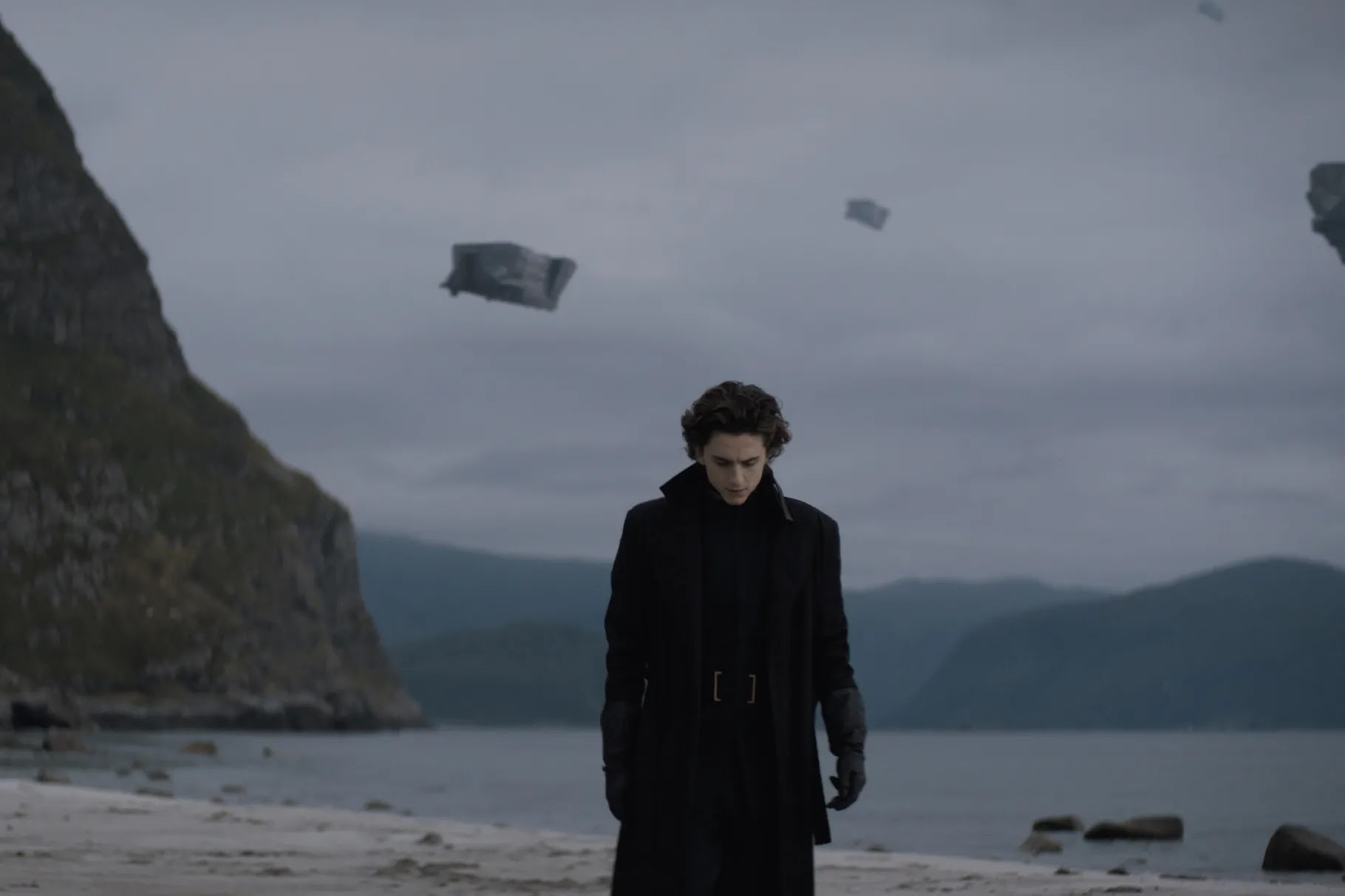
   Villeneuve successfully creates a fantasy world in which vehicles resembling helicopters flutter multiple sets of wings and vast expanses of a desert planet stretch endlessly toward the  horizon. It's possible that Dune makes the most expressive use of sand in any movie since Lawrence of Arabia.
  Still a word of caution: There's something inherently frustrating about a two-hour and 35-minute movie that ends by telling us we've just witnessed "the beginning."
   The thing that separates Dune from other sci-fi ventures is it's pervasive strangeness, an otherworldly quality reflected in the movie’s costume design and in the names of its characters. 
   Young Paul Atreides (Timothee Chalamet) may be the longed-for Kwisatz Haderach. (Don’t ask).
   Paul's mother  Lady Jessica (Rebecca Ferguson) is the concubine of Paul's father Duke Leto (Oscar Isaac) and a member of the Bene Gesserit, women with special powers.
   Stellan SkarsgÃ¥rd appears as the obscenely bloated Baron Vladimir Harkonnen, the story's villain.
   I'll torture you with no more of these names. I mention them because they suggest that Dune is more than a hunk of sci-fi with rich ecological and anti-mechanistic ambitions. A distinctive cult flavor evokes comparisons with works such as Lord of the Rings, at least in the impact Dune has had on devotees. 
  Two additional characters register in the movie's sea of eccentricity. Jason Momoa plays Duncan Idaho, an engagingly robust warrior on whom Paul has a man crush. Josh Brolin portrays Gurney Halleck, Paul's combat instructor. Each adds manly heft.
   The plot amounts to a mash-up of mythologies, the most notable involving expectations that a messiah figure will provide some form of salvation. 
    Early on, the House of Atreides — one of many — has been assigned custodianship of the planet Arrakis. Arrakis, we learn, is the source of the spice melange, essential to interplanetary travel, longevity and more.
  Previously, the planet was ruled by the Harkonnen, foul warriors who exploited Arrakis and its native population, the Fremens. A fierce desert-like people who know how to live with the planet's terrifyingly enormous sand worms, the Fremens add Middle Eastern flavor.
   Of course, it doesn’t take long for us to understand that the House of Atreides is under grave threat. Perhaps the woman Paul dreams of -- the Fremen warrior Chani (Zendaya) — will help save the day if Villeneuve gets to make the rest of the story. 
    Villeneuve's epic left me looking forward to more and eager to learn how much sway Dune still holds in the pop-cultural imagination. I know people, now quite grown, for whom Dune was a formative read of youth.
     That wouldn't be me. Perhaps that's why I watched Villeneuve's richly realized world with appreciation, even if I sometimes felt more like an impressed tourist than someone who had fully invested in this sci-fi saga.


Thursday, August 19, 2021

A less-than-memorable 'Reminiscence'

   Few genres have proven as consistently intriguing as film noir. At the same time, the lingering influences of noir have created movies that display their noir trappings in such blatant fashion that they border on parody. 
   Sadly, that's the case with Reminiscence, a sleekly mounted mix of sci-fi and noir tropes set in a climate ravaged Miami where the streets are perpetually flooded.
    Hugh Jackman stars in a story built around a gimmick. Jackman's Nick Bannister operates a business in which clients don a headset, climb into a tank, and take guided trips through their memories. 
    An intolerable present has created a need for escape into the past -- and clients are eager to pay for it. 
    Director Lisa Joy (a showrunner for HBO's Westworld) makes it seem as if Jackman is watching a movie. The memories of his clients experience are visible to him in hologram form, turning him into a voyeur who peers into other people's lives.
     Thandiwe Newton plays the savvy Watts, a woman who assists Nick in his business and plays the role of devoted sidekick when the going gets rough and violent -- as it must.
    This being the world of noir, a femme fatal must become part of the tale. One day, Nick is about to close up shop when a customer pounds on the door. Enter Mae (Rebecca Ferguson), a woman who might as well be carrying a sign that says, "I'm beautiful and dangerous." 
    Nick is jolted.
     So are we -- by the flagrantly cliched feeling of the moment, followed by a later scene in which Mae sings a sultry version of Where or When, a song with lyrics that mirror the movie's time-warped themes. ("It seems we stood and talked like this before.")
     When Mae suddenly disappears, Nick sets out to find her, delving into her past in the bargain. His journey carries him into an underworld of drugs and shady characters and a plot that's too convoluted to engage.
      Grimly obsessive as Nick, Jackman may not wish to press this one into his book of indelible memories. Ferguson seems stuck playing a type rather than a character.
     Among the more colorful miscreants Nick encounters: Saint Joe (Daniel Wu),  a drug czar who hangs out in a New Orleans nightspot, and Cyrus Booth (Cliff Curtis), a corrupt cop who supplies most of the movie's menace and who participates in a big fight scene with an underwater finale.
    A powerful businessman (Brett Cullen), his wife (Marina de Tavira), and creepy son (Mojean Aria) also figure into the proceedings, slimy rich types who have enough money to avoid the worst of dystopian existence.
    Joy strains to create a Bladerunner vibe, but a generic quality and the lead characters to go with it prove too much to overcome.
    Nick narrates the story, delivering lots of second-rate dialogue that has the ring but not the sting of noir. 
   "Nothing is more addictive than the past," he says at one point.
   Not in this movie.


Thursday, November 7, 2019

'Doctor Sleep:' a sequel we didn’t need

Ewan McGregor stars in a labored rendition of Stephen King’s follow-up to The Shining.
Perhaps as a way of establishing its bona fides, Doctor Sleep makes what struck me as strained references (I'll reveal no more) to The Shining, the movie it follows some 39 years after its release. I won't say more, but I begin this way because, for me, Doctor Sleep stands as an act of imposture, an attempt wring more from a story that already had been told. Of course, it's difficult to call the movie a ripoff: The movie stems from a 2013 sequel that Shining author Stephen King himself wrote.

In this overlong edition — the movie clocks in at 2 1/2 hours — Ewan McGregor plays a grown-up version of Danny Torrance, the kid from the original movie. Adrift in alcohol and dereliction, Danny winds up in a small New Hampshire town, where he joins AA and tries to make peace with the terrifying visions in his head. He receives help from an AA pal (Cliff Curtis) and from his mentor, played in the original by Scatman Crothers and in the sequel by Carl Lumbly.

To give the movie a plot, Danny hooks up with Abra Stone (Kyliegh Currran), a girl who has mighty shining powers; i.e., she can see things in other dimensions and project herself into distant places without leaving her bedroom. She also sees visions that scare her and are supposed to do the same to us.

The dread, in this case, stems from a traveling band of folks led by Rose the Hat (Rebecca Ferguson), a woman whose extra-long life is sustained by sucking the life out of those with the ability to shine. Zahn McClarnon plays Crow Daddy, Rose’s devoted number two.

Lest the supply of demonic fiends runs short, Rose recruits a young blond woman (Emily Alyn Lind to her evil cause. It doesn’t take long for Lind’s character, who's given the charming nickname of Snakebite Andi, to become as bad as the rest of the group.

What any of this has to do with Stanley Kubrick’s 1980 original seems marginal, although by the end, director Mike Flanagan transports the story to Colorado for a big showdown between Danny and Rose at the fabled Overlook Hotel, which like lots of ‘80s real estate, has become a mere shadow of itself. Danny must save Abra and rid the world of this pesky group of soul-sucking demons.

More muddled than the usual King offering, Doctor Sleep can at times seem ridiculous as it groans under the weight of having to connect with its predecessor. The movie's title, by the way, derives from Danny’s ability to help the aging slip gently into death after he lands a job at a hospice. Just like falling asleep he assures the dying.

Stuck playing a character battling his inner demons, McGregor doesn’t do much to fill the movie’s center. Ferguson, embodying a series of adjectives -- sexy, demonic, vicious and snide — deserves credit for hitting the right notes.

I’m not going to belabor this one. Shining fans seeking a second helping probably will give the movie an initial boost, but even diehards will have to admit that Flanagan (Oculus) doesn’t have Kubrick’s visual sense nor can he imbue his movie with the brooding grandiosity that made the original seem like a major movie.

I don’t know if The Shining should be called a classic, but it still has some sway. This one? Just another day at the multiplex — or maybe considering its length, a day and a half.

Wednesday, December 20, 2017

Not the greatest movie musical

The Greatest Showman feels like a generic version of a big-screen musical.

A musical about P.T. Barnum -- a man whose name has become synonymous with all-American hucksterism -- might be a welcome addition to the current moment of hyperbole and rant. But The Greatest Showman, which stars Hugh Jackman as Barnum, isn't that movie.

Torn between mild criticism of Barnum's ability to sell anything and a view of Barnum as a champion of those who are different (he invented the circus sideshow), The Great Showman lands a middling blow.

Director Michael Gracey, an Australian who thus far has done lots of work in commercials, turns out a generic musical that features lots of bubbly music from a quartet of songwriters that include two lyricists from La La Land (Benj Pasik and Justin Paul). I never thought the music in La La Land reached knock-out levels; the same goes for the music in The Greatest Showman, which feels like a musical that has been engineered to hit all the appropriate notes -- from buoyancy to lyricism to foot-stomping rigor.

But the calculation is impossible to ignore as we learn the story of Barnum, a man from the wrong side of the tracks who married upward. Michelle Williams portrays Charity Barnum, a character who doesn't allow her affluent upbringing to stand in the way of her unwavering support for Barnum, a lower-class striver who wants to prove that he can give Charity the kind of life her snooty family regards as her birthright.

As the story develops, Barnum opens a circus/museum in New York City. He acquires a variety of acts -- from the diminutive Tom Thumb (Sam Humphrey) to a bearded lady (Keala Settle) with a robust singing voice.

The movie also shows how Barnum develops a relationship with the more artistically oriented Phillip Carlyle (Zac Efron). Barnum persuades Carlyle to join his circus as an investor and partner. Carlyle quickly falls for a trapeze artist named Anne (Zendaya), but class strictures and the racial prejudice of his family limit Carlyle's willingness to acknowledge his feelings publicly.

Once he establishes himself as a circus impresario, Barnum decides that he needs to class-up his act: he brings Swedish songstress Jenny Lind (Rebecca Ferguson) (a.k.a., the Swedish Nightingale) to the states for a series of concerts that make a ton of money.

Tempted by an opportunity to elevate his status, Barnum turns his back on the unusual people who helped him become rich. He devotes all his time to Lind, wrecks his marriage and eventually sees his fortunes reduced to nothing.

Will he come back? Does the circus have three rings?

Of course, Barnum eventually transcends his vanity and again becomes a champion for the purity of family love and for those society sees as "different," all of which plays like the hooey that Barnum tried to sell to the rude and scoffing multitudes of his day.

Jackman knows how to occupy the center of a musical and does so with verve, style and unflagging command. Efron holds his own as a sidekick. Williams and Ferguson, along with Zendaya, give the movie some welcome female presence.

The retro 1800s production design keeps pace with the performances, but a ton of effort and expense can't elevate The Greatest Showman to the upper levels of the movie musical pantheon. It's gaudy, overproduced and, for the most part, more committed to spectacle and shine than anything of lasting worth.

Thursday, March 23, 2017

More alien dangers from space

Entirely predictable, Life generates tension -- but not much else.

Life arrives in theaters as another Alien clone -- only like most derivative movies, it's not nearly as good as the original.

The best thing about Life may be its depictions of the crew of an international space station floating through extravehicular missions or taking care of daily tasks in the space-station's gravity-free environment. Gliding through the station's narrow corridors looks like it might be fun -- at least for 10 or so minutes.

The story follows a standard alien-on-spacecraft arc. The crew finds carbon-based life in soil samples from Mars -- or something like that. The science officer brings the simple, single-cell creature to life by feeding it glucose. What begins with wonder and awe quickly sours as this simple cellular creature develops into a predatory, octopus-like monster with a face that may remind you of the deep-space monster in Alien.

Once the monster makes its predatory intentions clear, the crew must fight for its life -- and to keep this creature away from Earth. The creature is dubbed Calvin by school children on Earth where the discovery initially is celebrated.

Director Daniel Espinosa ably turns the tension crank as he mixes two marquee names -- Jake Gyllenhaal and Ryan Reynolds -- with a lesser known cast, making Life an ensemble piece in which no single character really stands out. British actor Ariyon Bakari makes a bit of an impression as the station's chief science officer.

Movies such as Life can't really work if we're not repelled by the alien creature's eating habits. The monster's tentacles probe the throats of its victims as it embraces them with a combination of waving tentacles and what appear to be stingray-like wings. Someone describes the creature as a deadly mixture of muscle, brain and eye, which is pretty much what the movie tries to be -- albeit with intermittent success.

Much attention has been given to creating a credible space station, which helps with plausibility. Life offers no wild-eyed futuristic version of space travel, but takes place in the bland near-future.

Don't forget, though, it was the industrial strength cynicism of the original Alien, as well as its hideously vicious creature, that made for such a compelling experience. Life offers tension, but without much of an accompanying vision to elevate it. Gyllenhaal's character voices distaste for life on a conflict-riddled Earth, but that's about it for philosophical musing.

As the story progresses and the fatalities mount, Gyllenhaal's presence increases -- but without creating any special impact. The ship's medical officer (Rebecca Ferguson) also receives more attention.

Terror about making contact with another form of life hardly constitutes a novel story line, and the movie's conclusion proves relatively easy to outguess.

It's possible that Life will turnout to be a placeholder or maybe a warm-up act for Ridley Scott's soon-to-be-released Alien: Covenant. I was hoping for more.