Showing posts with label Baz Luhrmann. Show all posts

Thursday, June 23, 2022

A splashy 'Elvis' from director Baz Luhrmann


    It's entirely possible that Baz Luhrmann's Elvis is exactly the movie the director wanted to make. Luhrmann (Moulin Rouge!, Australia, The Great Gatsby) tells stories in heaving rushes of narrative that rely on speed and visual flair as much as on content. 
     Luhrmann doesn't seem to know the word "enough." He specializes in excess. His movies aren't lifelike; they're supercharged and episodic -- and in the case of Elvis, a collection of conjoined themes careen off the screen.
    Luhrmann's distinctive style turns Elvis into a whirl of a movie that swivels and pivots in much the same way that Elvis did on stage.
     The movie’s style also mirrors Austin Butler's performance as Elvis, perhaps the first major rock icon, the all-American boy who dipped into Black culture and emerged a superstar. 
    Boosted by near-hallucinogenic close-ups of his face, Butler charms, sweats, and gyrates his way through a performance that he improbably pulls off without seeming like an Elvis impersonator. His work feels fresh and that's a hell of an achievement.
    Still, there’s risk in filling the screen with so much verve: To put it another way: There's a whole lot of shaking' goin' on (to quote a non-Elvis rock anthem) but you may find yourself wondering  what underlies Luhrmann's vigorously drawn sketch-book of a movie.
      Energy carries Elvis a long waybut the movie also can be viewed as a big splash into what ultimately may be the shallow end of the pool. Oh well, the splash can be fun.
      To some extent, Elvis is held together by a narration provided by the man who made Elvis into a phenom, the Dutch-born huckster who called himself Col. Tom Parker. 
    Tom Hanks plays Parker with a weird accent, added girth, and an ever-present cigar. The movie portrays Poker as a devil who tried to steal Elvis's soul in return for bringing his carnival  skills to the promotional effort that pushed Elvis to the American center stage.
    Scuzzy, ingratiating, and conniving, Parker emerges as a weird curiosity. This might be the first time I've been puzzled by Hanks's acting choices. His sleazy, parade-float approach to Parker threatens to capsize the movie, even as it underscores Luhrmann's point: Parker helped Elvis achieve fame while thwarting The King's artistic development 
    Parker led Elvis into sugar-coated Hollywood movies, and, in his later years, chained him to Las Vegas where he sometimes seemed a near parody of himself, Elvis as the ultimate Elvis impersonator.
     But let's go back to the beginning. Elvis starts on a fast track, offering scenes in which young Elvis (Chaydon Jay) revels in the Black music of Tupelo, Mississippi. As a kid, Elvis was inspired by gospel and when he moved to Memphis, he received advice from B.B. King (Kelvin Harrison Jr.) 
     Luhrmann treats Elvis's forays into Black culture more as inspiration than appropriation. Young Elvis heard and felt the music and answered its call -- or some such.
     After hooking up with Parker, Elvis starts as a low-billed member of a country music review built around Hank Snow (David Wenham) and Jimmie Rodgers Snow (Kodi Smit-McPhee). It doesn't take long for Elvis to light flames of desire among the teenage girls who screamed at his every move.
      Luhrmann spews exclamation points as the movie offers its rendition of  social commentary: Stodgy folks objected to Elvis's sexualized moves, perhaps because they stemmed from observing Black performers. 
     None of this is fully explored in Luhrmann's collage of a movie: References to the assassinations of Martin Luther King and Bobby Kennedy are grabbed at like rings on a merry-go-round. 
     Parker understood the resistance to Elvis and tried to sanitize him.  He even convinced Elvis to join the Army in 1958. (The movie doesn't point out that Elvis was drafted and never made a fuss about fulfilling his military obligation.)
      Of the supporting players, few stand out. Richard Roxburgh plays Elvis's father, the man who became his manager but who cow-towed to Parker. Helen Thomson makes a bigger impression as Elvis’s mother, a God-fearing woman whose death shattered Elvis. 
      While serving in Germany, Elvis met Priscilla (Olivia DeJonge), the woman who became his wife. She, too, gets short shrift.
       A 1968 TV Christmas special receives much attention. A rebellious Elvis decides to defy Col. Parker and the show's sponsors who want him to don sweaters for what they hope will be a family-oriented holiday treat. 
      Despite Elvis's insistence on doing the show his way, he was lured to Las Vegas by Parker who used Elvis's contracts with hotel owners to negotiate his way out of gambling debts. 
       Elvis's fate was sealed. He wanted to tour the world. Instead he gained weight, popped pills, and worked hard to haul his star power from the wreckage Parker helped create.
       And, oh yes, the music. Luhrmann includes contributions from Stevie Nicks, Chris Isaak, Gary Clark Jr., Shonka Dukureh, Doja Cat, Les Greene, Ann Nesby, Kacey Musgraves, Elvis, Butler, and others. 
       Luhrmann's approach to the music tells you something about the movie, which can be viewed as a tribute to eclecticism orchestrated by Luhrmann as if he were wielding an electrified baton.
       Elvis rushes across the screen like a wave that refuses to break, carrying great chunks of bio-pic detail and pop-cultural riff in its foamy wake.
      But at two hours and 39 minutes, Elvis overstays its welcome and the movie can't entirely escape the downside of too much frenzy, which, alas, is too much frenzy.  
     Call my reaction "mixed." Elvis can't be called deep or definitive, but there's plenty to enjoy in the story of a star who couldn't stand still and a movie that follows suit.    
  

Thursday, May 9, 2013

A 'Gatsby' full of razzle dazzle

Baz Luhrmann goes way over the top to tell a classic American story.


Director Baz Luhrmann has accomplished something close to extraordinary in his vivid, dizzying and ultimately misguided version of The Great Gatsby. He has taken F. Scott Fitzgerald's iconic 1925 novel -- a classic of American literature -- and turned into as glossy and colorful an extravaganza as might have been seen in the days when big-screen spectacles were drenched in three-strip Technicolor.

Put another way: Luhrmann's Gatsby has the glamour-laden production values of a musical -- only one in which somebody forgot to write the songs.

Luhrmann, who already has proven himself a maestro of overstatement in works such as Moulin Rouge! and Romeo & Juliet, has added 3-D to this version of Gatsby, presumably to give the movie a sense of immersive depth. The 3-D images might be the only depth you'll find in this showy, anachronistic and occasionally cartoonish version of the Gatsby story.

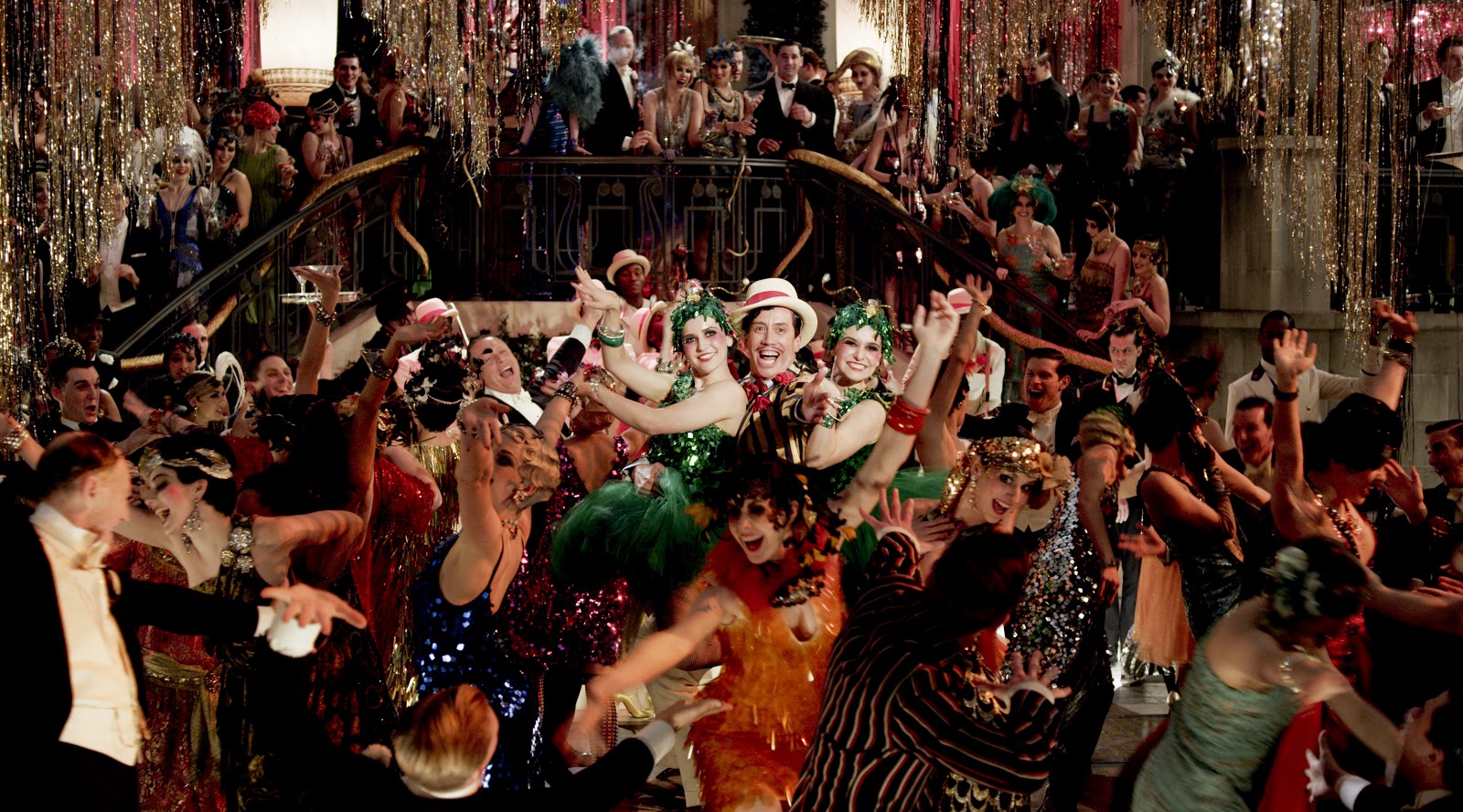
In Luhrmann's hands The Great Gatsby has become a frenzied display of technique, much of it devoted to creating the bacchanalian delirium that turned Gatsby's fabled parties into a magnet for New York's high-living crowd. Are we talking Gatsby or outtakes from the Playboy Mansion? You be the judge.

Fitzgerald, of course, told the story through a narrator named Nick Carraway, a Midwesterner who travels to New York and rents a small cottage next to Gatsby's ostentatious Long Island mansion. Nick meets Gatsby because of Gatsby's long-standing and unquenchable love for a woman named Daisy, who happens to be Nick's cousin. Nick is supposed to serve as a go-between for Gatsby and Daisy.

When we meet Daisy, she's already married to Tom Buchanan, Yale graduate and certifiable lout who indulges his libido with Myrtle (Isla Fisher), a low-class mistress from Queens.

Luhrmann uses some of Nick's narration (i.e., Fitzgerald's prose), even allowing pieces of it to wander across the screen in the form of typescript that floats above the fray.

But fidelity to text is hardly the point here: Luhrmann hasn't recreated America of the 1920s. He has invented a dreamscape all his own; the movie -- which mixes rap and Gershwin on its sound track -- isn't so much an evocation of the past, but a visit to an alternate universe stocked with jiggling flappers, feverish jazz musicians and a Jewish gangster played by an Indian actor (Amitabh Bachchan) who seems to have wandered into the story from some multi-cultural universe of the 21st century.

Luhrmann's Gatsby is a bold, vividly realized and distressingly literal retelling of a story that has been put on film before, but never with so much loudly trumpeted artifice and self-conscious daring; the soundtrack arrives complete with musical contributions from Jay Z and Beyonce.

Of course, Luhrmann has made alterations to the story (Nick tells the tale from some sort of rehab facility where he's struggling with alcoholism and regret), but changes to Fitzgerald's story are the least of the problems. Most of those center around the fact that Luhrmann has taken the events of the novel -- always secondary to Fitzgerald's prose -- and added so much technologically created upholstery that everything collapses into it.

Only those who do not own television sets can have escaped prior knowledge that Leonard DiCaprio portrays Jay Gatsby, the hopeful and deluded man who spends a lifetime trying to recreate his past so that he can become a suitable suitor for Daisy, a member of the upper classes to which the low-born Jay longingly aspires.

Looking as if he's posing for a fashion ad in the Sunday New York Times magazine, DiCaprio projects the calm of a man who's willing to create a storm to attract the beautiful Daisy who lives across the bay from him. And, yes, Gatsby spends an inordinate amount of time staring across the dark waters of Long Island Sound at the luminous green light that glows on dock of the Buchanans' East Egg home. The symbolism is inescapable: The light represents everything that remains visible but out of reach for Gatsby.

Gatsby is one of those amorphous figures who tries to create a new version of himself, but only can achieve it by associating with and profiting from the corruption and crime that leads to quick wealth. He has obscene amounts of money, but his affluence never can equal the more seasoned wealth that people such as the Buchanans have come by as a birth right.

Daisy is played by Carey Mulligan, who seems entirely too grounded for the part of a dreamy fantasy girl. A scowling Joel Edgerton portrays her husband Tom, polo player and former Ivy League jock, a man with a smash-mouth personality. In Luhrmann's hands, these pivotal characters seldom seem like plausible people; they move through the movie carrying the weight of the literary archetypes that they seem to represent.

As for Nick, the narrator ... well ... let's just say that Tobey Maguire rises to the challenge of making him as uninteresting as most narrators are, the man who floats outside the story, fascinated by it but unattached to its core.

Of all the characters, only Daisy's friend Jordan Baker -- played by Elizabeth Debicki -- seems to fit into a recognizable universe.

By now, I'm sure you've caught my drift; Luhrmann's movie is more about production design than about the distorting powers of the American dream. Its rewards have more to do with vintage cars, sprinting camera movements and glitzy overstatement than with the tragic undertow of Fitzgerald's story.

A confession of sorts: I watched The Great Gatsby with a sense of sustained amazement at Luhrmann's capacity for emotional amplification, but presenting an entire movie in an over-the-top style doesn't leave much by way of wriggle room.

I suppose sales of Fitzgerald's much-purchased novel will enjoy an inevitable boomlet because of Luhrmann's movie, but I'd be willing to bet that this Gatsby has more influence on American fashion than on the country's intellectual, emotional or cultural life.

In that sense, Luhrmann may have found the key to bringing Fitzgerald's film-resistant novel to the screen. Luhrmann may not get at much that feels real or substantial, but his Gatsby sure as hell is dressed for success.