Showing posts with label Bill Burr. Show all posts

Wednesday, October 7, 2026

Sorkin takes another run at Facebook


    Judging by Aaron Sorkin's The Social Reckoning, few the world's ill can't be linked to Facebook. An overstatement on my part to be sure, but Reckoning scowls at Facebook for abetting dangerous political extremism, wrecking young lives with cyberbullying, and allowing Jan. 6 rioters to post about their assault on the Capitol.

   Social Reckoning isn’t entirely wrong in its assertions, but Sorkin, working from his own screenplay, has drained much of the suspense from a story built around two characters, a Wall Street Journal reporter (Jeremy Allen White) and a Facebook whistleblower (Mikey Madison).

   Madison’s Frances Haugen began as a true-believing coding engineer intent on saving Facebook from abandoning its professed desire to become the world’s town square.

   By the time the movie opens, Facebook already has attained trillion-dollar status, and Facebook chief Mark Zuckerberg (Jeremy Strong) has become an autocratic sphinx mired in capitalist tunnel vision.

   Much of the movie follows the guidelines of a journalistic procedural as White’s Jeff Horwitz, who won a Pulitzer Prize for his reporting, tries to get the goods on Facebook.

   Madison’s Haugen holds the key to Horwitz’s success; Haugen has access to important computer files, but she’s wary of breaking the law by giving them to Horwitz. She initially alerts Horwitz to the story, expecting that his investigative skills will be sufficient to obtain the needed evidence.

    Sorkin has a knack for depicting work-place vibes. The supporting cast rounds out Facebook’s headquarters. Billy Magnussen portrays the smiling head of PR.  Bill Burr plays a hard-boiled former employee, now a consultant who tries to steer Zuckerberg toward social responsibility. Betty Gilpin signs on as Horwitz’s brusque boss.

    The main events, which take place between 2019 and 2021, are undergirded by scenes devoted to a rehearsal in which a crisis manager (Wunmi Mosaku) tries to humanize Zuckerberg for a pending Congressional hearing, no easy task with a man whose deadpan expression never seems to have been interrupted by anything as foreign as a smile.

    The story culminates with a Congressional hearing at which Hougen testifies, leaving us to assume that the problems the movie raises are the bedrock on which Sorkin has built an old-fashioned expose.

     Facebook, the movie contends could have been more responsible, but it would have come with a cost. If the company had refused to post obviously false or inflammatory content, it would have had to accept a one percent loss in profits, one exec says. Zuckerberg declined.

     As is the case with many Sorkin efforts, Reckoning bolsters a talky screenplay that brims with the kind of clever repartee that distinguishes the Sorkin brand, but here can feel a bit formulaic.

     White plays Horwtiz as a good guy and persistent reporter. Madison ably depicts a young woman who’s wrestling with her conscience, but, by the end, it’s difficult to feel as if the movie has reckoned with anything more than a point of view that’s clearly established at the outset.

     Enough of this. I needn’t tell you that Facebook, now Meta, still operates as do the company’s other businesses, which include Instagram, Messenger, and What’sApp.

     As for Zuckerberg, he was one of the tech honchos who late last month was  summoned to the White House to discuss AI … er … I mean Super Intelligence. It all makes you wonder whether any movie involving tech ethics can avoid feeling like yesterday’s news.


Thursday, February 17, 2022

A former solider and a dog hit the road


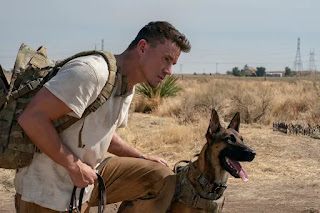
A debilitated Army Ranger (Channing Tatum) and a Belgian Malinois travel from the Pacific Northwest to Arizona so that the dog can be present at the funeral of her handler, a soldier killed in an auto accident. That's basically all there is to Dog, a comedy that buries its heart beneath the hard-core exterior of a physically and emotionally scarred combat veteran. Sound like a formula job? It is, but Tatum, who co-directed with Reid Carolin, proves amiable enough to hold any scathing criticism in abeyance. Tatum plays Briggs, a 
struggling young man who's told by an officer that he can "get back in the game" if he successfully escorts the dog -- named Lulu -- to her handler's burial. Essentially a buddy movie, Dog features various episodes in which the mostly inept Briggs encounters a variety of folks:  a pair of aging hippies, a San Francisco cop, and a couple of women with "healing powers." Supporting cast is mostly irrelevant but includes a few notables: Jane Adams as a woman who knows how to relate to the dog and comedian Bill Burr as a cop with little regard for the elitist attitude of former Rangers. In one of the movie's more unfortunate episodes, Briggs pretends to be blind so that he can obtain a free room in a luxury hotel for himself and his purported "guide dog." The dog sees a man in Arab dress in a hotel lobby and attacks. Possible? Seems unlikely to me. Tatum spends much of his time behind the wheel of his Ford Bronco. He talks to Lulu, who displays varying degrees of interest in his verbal barrages. In short: You never doubt where Dog is heading. More interested in lump-in-the-throat emotion than credibility, Dog is pretty much the movie you'd expect. That means it's likely to please those who choose to tag along with Briggs and Lulu. 

Thursday, November 15, 2018

Gary Hart's fall from political grace

The Front Runner doesn't quite make it as a relevant foray into the world of journalism and politics.
In 1987, Gary Hart fell from political grace. Hard.

A sure bet to win the Democratic nomination for the presidency in 1988, Hart was undone by names that suddenly dominated the news, notably, a girl named Donna Rice and a yacht named Monkey Business.

Hart defended himself against charges of marital infidelity by insisting that his private life was no one’s business but his own. He was staunch in his resolve, but couldn't save himself.

Hart’s fall probably is destined to become a footnote in American political history, unless you’re convinced — as some are — that Hart’s story changed journalism and the fate of the US. That’s a heavy burden for one man to carry and it’s also a burden that the movie The Front Runner can’t carry, either.

Based on All the Truth is Out, a fine book by journalist Matt Bai, The Front Runner tries to take an encompassing approach to Hart’s story, leaning toward a view that blames the press — particularly a couple of Miami Herald reporters — for staking out Hart’s Washington, D.C. townhouse in hopes of confirming a dalliance with Rice.

As a result, the press and the national debate became focused on character (or lack of it) instead of the salient issues of the day -- or so the argument goes.

Director Jason Reitman had a hand in writing the screenplay, along with Bai and Jay Carson, a political operative who also works in the entertainment business, having done multiple duties on Netflix's House of Cards. The screenplay makes various points throughout but Front Runner remains frustratingly diffuse.

Hugh Jackman has been cast as Hart. Jackman does as well as possible in conveying Hart’s intelligence, his insistence on not answering certain kinds of questions and his refusal to listen to a staff that knew he was in more trouble than he realized.

The peripheral performances are a mixed bag. Steve Zissis and Bill Burr portray two Miami Herald reporters, narrowly focused guys who see only one side of the journalistic argument: Get the story, let the chips fall where they may.

Mamoudou Athie plays a Washington Post reporter (a composite figure) who agonizes about what his editors want him to ask Hart. Ann Devroy appears as an editor at the Washington Post who claims that the press isn't going too far: Powerful men shouldn’t abuse their power with impressionable young women.

Molly Ephraim has a nice turn as a Hart aide who understands how painful it is for Rice (Sara Paxton) to have been thrust into a maelstrom. Ephraim's character winds up selling Rice out anyway.

I’m an admirer of actor Alfred Molina, but even he can’t overcome the images of Ben Bradlee created by actors in previous movies (Jason Robards in All the President’s Men and Tom Hanks in The Post) — not to mention a couple of documentaries in which the real Bradlee can be seen.

J.K. Simmons, a Reitman regular, plays Hart's campaign manager, a role that could have used some expansion. Still, Simmons conveys the dejection that haunts a man who sees a cause in which he deeply believes going down the drain.

In dealing with Hart’s wife, Lee, who's played here by Vera Farmiga, the movie suggests that Lee and Gary Hart had reached some sort of agreement about how they’d conduct their marriage with Lee stipulating only that she didn’t want to be embarrassed by her husband. After the Rice debacle, Lee Hart found her home in Troublesome Gulch, Co., besieged by reporters. She became another victim.

Nearly everything about The Front Runner plays against unstated ironies. Bill Clinton survived Monica Lewinsky and the current resident of the White House has set a new bar for what we know about the sexual behavior of a president.

If you haven’t read Bai’s book, you should. But the real story of Gary Hart remains unknowable. Was he a hero who stood up for rights of privacy? Was he an arrogant man who believed he had a license to be reckless? Was he really brilliant enough to have altered the course of American history? Did he foresee every important problem we face today?

Reitman does a good job creating the chaotic swirl that surrounds a political campaign. He also inserts enough sardonic humor to make Front Runner entertaining but the movie can't sustain the kind of absurdist kick that Reitman brought to his best movies: Thank Your for Smoking, Juno, and Up in the Air.

If The Front Runner is meant to be taken as a cautionary tale, it arrives 30 years too late. In the current bold-faced clash between powerful politicians and journalists, the Hart story already has been consigned to small print.