Showing posts with label Channing Tatum. Show all posts

Thursday, October 9, 2025

The thief who lived in a toy store


   Roofman, the story of a thief who broke into McDonald's restaurants, gaining entry from their roofs and hauling off a small fortune, leans heavily on Channing Tatum. Tatum's challenge: to create a smart, appealing criminal who's considerate of those who fall into his sphere. 
   Tatum's Jeffrey Manchester doesn't use politeness as a branding gimmick. He's not trying to dub himself as  "The Thief who Cares." He's aware that he's stepping out of bounds, but has no desire to hurt anyone. 
   Based on Manchester's real-life story, Roofman requires Tatum to remain likable throughout. I'd say he succeeds in what might be his most memorably appealing screen performance yet.
    The story doesn't dwell on Manchester's larceny. Early on, Manchester is caught in North Carolina. He's sentenced to a whopping 45 years in prison, partly because of kidnapping charges stemming from one of his signature moves.
    If they happened to be present, Manchester locked McDonald's employees in store freezers. He sometimes gave them coats so they wouldn't freeze. In the movie, he calls 911 to arrange for their rescue as soon as he flees.
   Working from a screenplay he wrote with Kirt Gunn, director Derek Cianfrance (Blue Valentine and The Place Beyond the Pines) respects the basics of Manchester's story, but his movie intrigues with a tone that falls between unadorned realism and lighthearted absurdity.
  Once imprisoned, the keenly observant Manchester contrives a clever escape. He then flees to Charlotte, where he holes up in an unlikely spot, a Toys R Us store. 
    Manchester's ingenuity blossoms. He learns how to survive in the store by eating lots of candy. He sets up his own surveillance system using baby monitors while disarming the store's video recording capabilities. He builds a comfortable enough hideout to keep him in the store for six months, a long time to spend in the company of Tickle Me Elmo dolls.
   Eventually, Manchester ventures out of the store. He's attracted to one of the its employees (Kirsten Dunst's Leigh), a single mom who's struggling to make ends meet.
    Manchester quickly becomes enmeshed in Leigh's life, attending her church, donating toys (stolen, of course) to the church's Christmas drive, and eventually impressing her daughters. It takes time, but he even wins over Leigh's balky teenage daughter by buying her a seriously used car and teaching her how to drive.
   He's discovering the joys of family, and he's good at it, perhaps by way of atoning for having become estranged from his former wife and three kids.
   Additional support comes from Peter Dinklage as the martinet manager of the Toys R Us store. LaKeith Stanfield signs on as one of Manchester's former Army pals, a character who figures in some late-plot maneuvering. 
    Other actors come off as drop-ins. These include Uzo Aduba, as one of Leigh's churchgoing friends, and Juno Temple, as the girlfriend of Stanfield's character.
   Set in 2005, the movie includes a few retro touches, but Cianfrance gives it a lived-in feel that allows the chemistry between Tatum and Dunst to grow during the time that Manchester lives without being recognized. A hide-in-plain-sight kind of guy, he never alters his appearance.
  Manchester, of course, puts himself in a terrible bind. Using a fake name, he deceives people he cares about. The point is made without underlining. His ruse isn't without cruelty. Maybe that's Manchester's biggest flaw; he's sincere but not perceptive enough to fully understand the impact he's having on those he encounters. He's not good at consequences.
    Interviews with the real people from the Manchester tale pop up during the end credits, mostly confirming the story's slant about a good guy who committed crimes. Roofman isn't up for moral finger wagging. That may trouble some, but it makes Roofman a welcome oddity, an enjoyable movie that avoids the usual true-crime cliches.

Wednesday, August 21, 2024

Alluring surfaces enliven ‘Blink Twice’


  Actress Zoe Kravitz makes her directorial debut with Blink Twice, an energetic, often entertaining variation on a theme in which luxury-hungry women suddenly find themselves living lavishly on an island owned by a tech billionaire played by Channing Tatum.
  Kravitz, who co-wrote the screenplay with E.T. Feigenbaum, understands the need to seduce an audience before letting the other shoe drop. Kravitz optimizes the pleasure offered on a tropical island, where the point is to have a good time with fine food, carefully curated drugs, and no money worries.
   Blink Twice is about being captivated by surfaces that promise ease and pleasure, while ignoring indications that something sinister looms.
   Naomi Ackie, who gave a strong but overlooked performance in Whitney Houston: I Want To Dance With Somebody, plays Frida, an ambitious woman who works for a catering company that's running a fund-raising gala for Tatum's Slater King. 
   King says he's stepping down from his company to reflect. He also wants to atone for an offense that presumably went public but which the film never defines. 
    Laying on the soft-spoken charm, Tatum presents Slater as a model of newly acquired consideration and empathy that he attributes to a recent therapeutic epiphany.
    Posing as a partygoer rather than the help, Frida embarrasses herself when she stumbles. Slater puts her at ease.
     Before you can say "glitz," Frida and pal Jess (Alia Shawkat) are elevated from the ranks of servitude. They find themselves on Slater's private jet, living a fantasy of style and privilege.
      Ackie’s performance also suggests that Frida may have found someone who cares about her. If he owns an island, so much the better. It beats the hell out of gig work.
      Other women have been taken on the trip. Slater is also accompanied by a posse of fun-loving male loyalists, played by Simon Rex, Haley Joel Osment, Christian Slater, and, later, Kyle MacLachlan.
       Geena Davis portrays Stacy, Slater's assistant, the woman who tends to the details that are supposed to make everyone happy while the women compete for Slater's attention. Stacy also makes sure to collect everyone's cell phone upon arrival on the island, where the women are given the same white outfits to wear. 
        Adria Arjona plays Sarah, a woman who begins to suspect that something terrible may be happening, particularly after Shawkat's Alia disappears. Several of the women can't even remember that Alia had been there. 
      Another sign that there's a dark side to paradise arrives in the form of a stern maid (Maria Elena Olivares), whose forbidding look makes it seem as if she might have dropped in from a horror movie. 
        In some sense, Blink Twice needs the audience to be ahead of its characters. We've been schooled to go along with such things as we wait for Slater's true intentions to emerge.
        Despite its upbeat tempo and sustained glamor, the film eventually must deliver what we know is coming -- a serving of horror that steers Blink Twice into the choppy waters of revenge.
        Kravitz could have done more to modulate the movie's propulsive rhythms, and she takes the movie's  opulence beyond the point of diminishing returns. A concluding coda seems as tricky as it is meaningful.
        Still, Kravitz’s increasingly nasty tropical shenanigans glide through a lively one hour and 42 minutes that suggest a career behind the camera may take Kravitz far beyond Blink Twice's island.

Wednesday, July 10, 2024

A romcom mashup that sputters


   Fly me to the moon or so goes the lyric. On second thought, if it means sitting through the mashup of romcom moves, intrigue, and satire that's being peddled in the new comedy Fly Me to the Moon, I'll happily remain on Earth.  
  Scarlett Johansson and Channing Tatum star in roles that seem intended to evoke memories of the comedies of yesteryear -- updated with a dose of conspiratorial thinking on the part of screenwriters Keenan Flynn, Rose Gilroy, Bill Kirstein, and director Greg Berlanti.
  Fly Me to the Moon isn't meant to be taken too seriously, but it often feels slight, and inconsequential, a big-screen bauble hasn't been polished enough to shine.
  Johansson plays Kelly Jones, an unscrupulous marketer who's recruited by a shadowy government agent (Woody Harrelson) to help sell the public on NASA's Apollo 11 mission, which, in 1969, landed the first humans on the moon.
  As the Apollo launch chief stationed in Cocoa Beach, Fla., Channing's Cole Harris resists efforts to commercialize the mission. He gradually yields, accepting   the idea that putting astronauts on cereal boxes will help provide much-needed support for NASA funding.
   The movie attributes Cole's all-business attitude to the seriousness of the task and to a past tragedy. He was the launch director of Apollo 1, which resulted in the deaths of three astronauts.
   Harrelson's Moe Berkus has more in mind than elevating NASA's popularity. He involves Kelly in a scheme to set up a faux moon landing that he plans to televise regardless of what the real astronauts accomplish. Berkus refuses to risk losing what he views as an ideological battle with the Soviets.
   Blather about a faked moon landing isn't new, but little of the movie's maneuvering passes the credibility test, and the romance between Kelly and Cole poses no threat to the likes of Clark Gable and Claudette Colbert or any of the other great romcom pairings.
   At the same time, a lively Johansson brings plenty of verve to a role that allows her to employ a variety of accents. Channing's character, on the other hand, seems to have been written in ways that minimize some of the actor's strengths, notably charm and good humor.
    The supporting cast adds little. Anna Garcia portrays Kelly's assistant, and Jim Rash plays the deluded director Kelly hires to fake the moon landing. A frustrated director of commercials, Rash's character is waiting for Hollywood to recognize his brilliance.
   The movie wastes Ray Romano as a NASA engineer and the movie's resident sadsack.
    The Apollo astronauts, of course, reached the moon. This one? If not a case of crash and burn, its overlong two-hours and 11 minutes hardly rocket to new heights.
    

Thursday, March 24, 2022

No knockout for this rumble in the jungle


      Action, comedy, and romance are the hallmarks of many movies.
     The Lost City serves up generous amounts of each of these  ingredients yet still feels no more than adequate, possibly because the movie -- which pairs Sandra Bullock and Channing Tatum -- doesn't provide its stars with anything that doesn't feel a little too familiar. 
    In itself, such a limitation might not be fatal but the movie also fails to sustain the comfort that sometimes makes formula movies not only tolerable but desirable, a feeling akin to stepping into a well-worn but comfortable pair of shoes.
     Bullock plays Loretta Sage, a successful author of romance novels who's sick of writing them. She's also sick of the model (Tatum) who has been posing for all of her book covers. 
    Tatum’s Alan appears on covers as Loretta's star creation, Dash, an adventurer with shoulder-length locks and a pumped-up body. Women love the books and swoon over Dash.
    Early on, Loretta is kidnapped and hauled off to a jungle island by a pampered rich guy (Daniel Radcliffe) who's given the unlikely name of Abigail Fairfax. 
    Fairfax's goal echoes that of many other villains: He's looking for lost treasure. He drags Loretta into the search because her late husband was an archaeologist and because a couple of ancient symbols appeared in one of Loretta's novels. 
    Neither provides much of a reason for kidnapping but then there isn't much reason for anything in The Lost City -- other than to dish out entertainment that floats in the wake of better movies -- from Romancing the Stone to Raiders of the Lost Ark.
     The initial kidnapping occurs while Loretta is on a book tour that has been arranged by her manager (Da'Vine Joy Randolph) and another tag-along character (Patti Harrison as Loretta's social media manager.)
      Determined to rescue Loretta, Tatum's Alan follows. The two eventually find themselves tromping through jungles with motorcycle-riding thugs following in hot pursuit. 
      Among the movie's "big" moments: Channing bares his butt in a scene in which Loretta picks leaches off Alan's exposed body. Given a full frontal view (unseen by the audience), Loretta marvels over the size of Alan's ... well ... you know.
     Early on, the movie shows promise. Alan (in full Dash regalia) upstages Loretta during a tour appearance and when she disappears, he enlists the help of a mercenary played by Brad Pitt. 
     Had Pitt -- decorated with tattoos and a pony tale -- been in more of the movie, Lost City might have found a sweet spot. Pitt's Jack Trainer, a warrior and mediation master, has the skills of an adventurer that, for Alan, don't go beyond posing for book covers.
     Sadly, Pitt's appearance amounts to a slightly swollen cameo. That leaves Bullock and Tatum with the task of gradually igniting the sparks of romance.
     OK. No need to go overboard with negativity. The movie's comic byplay scores as passable. Moreover, the movie doesn't want for exotic locations. (Most of the filming was done in the Dominican Republic.)
    Adam and Aaron Nee (Band of Robbers) handle directing chores in breezy if not buzz-worthy fashion. 
   But the main attractions are Bullock and Tatum. They know how to work the material but the material ... well ...  that's another story and not a particularly inspired one.

Thursday, February 17, 2022

A former solider and a dog hit the road


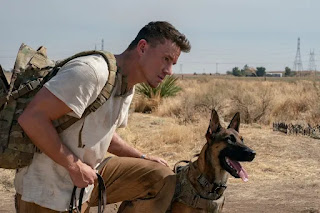
A debilitated Army Ranger (Channing Tatum) and a Belgian Malinois travel from the Pacific Northwest to Arizona so that the dog can be present at the funeral of her handler, a soldier killed in an auto accident. That's basically all there is to Dog, a comedy that buries its heart beneath the hard-core exterior of a physically and emotionally scarred combat veteran. Sound like a formula job? It is, but Tatum, who co-directed with Reid Carolin, proves amiable enough to hold any scathing criticism in abeyance. Tatum plays Briggs, a 
struggling young man who's told by an officer that he can "get back in the game" if he successfully escorts the dog -- named Lulu -- to her handler's burial. Essentially a buddy movie, Dog features various episodes in which the mostly inept Briggs encounters a variety of folks:  a pair of aging hippies, a San Francisco cop, and a couple of women with "healing powers." Supporting cast is mostly irrelevant but includes a few notables: Jane Adams as a woman who knows how to relate to the dog and comedian Bill Burr as a cop with little regard for the elitist attitude of former Rangers. In one of the movie's more unfortunate episodes, Briggs pretends to be blind so that he can obtain a free room in a luxury hotel for himself and his purported "guide dog." The dog sees a man in Arab dress in a hotel lobby and attacks. Possible? Seems unlikely to me. Tatum spends much of his time behind the wheel of his Ford Bronco. He talks to Lulu, who displays varying degrees of interest in his verbal barrages. In short: You never doubt where Dog is heading. More interested in lump-in-the-throat emotion than credibility, Dog is pretty much the movie you'd expect. That means it's likely to please those who choose to tag along with Briggs and Lulu. 

Thursday, August 17, 2017

A caper movie, country style

Director Steven Soderbergh has fun with Lucky Logan, a heist movie set in West Virginia.
It's a bit of a stretch to think that anyone has been eagerly waiting to see Daniel Craig, the current James Bond, play a hillbilly safecracker from West Virginia. But Craig does just that in Steven Soderbergh's Logan Lucky, a caper movie in which a group of West Virginia rednecks stage a robbery at the Charlotte Motor Speedway during the Coca-Cola 600, a NASCAR race held on Memorial Day weekend.

Those who try to mine veins of importance from Logan Lucky, which was written by Rebecca Blunt, may find themselves straining. Logan Lucky stands as an enjoyable -- if slight -- caper comedy build around odd ball casting that creates much of the movie's appeal -- that and Soderbergh's understanding of how to freshen a formula.

An unlikely duo of Channing Tatum and Adam Driver play brothers. Tatum's Jimmy Logan is a beleaguered construction worker who loses his job for not reporting a pre-existing health condition; he has a limp. Jimmy's brother Clyde (Driver) works as a bartender despite having a prosthetic lower left arm, a souvenir from his military service in Iraq.

Jimmy would like to spend more time with his daughter after his divorce from Bobbie Jo (Katie Holmes). But Bobbie Joe and her husband (David Denman) plan to move to a swankier town, leaving Jimmy with a great need for money if he wants to maintain a relationship with his daughter (Farrah Mackenzie), a child who participates in beauty pageants.

With no legitimate prospects in sight, Jimmy uses the code word that his brother knows signals trouble. "Cauliflower."

The rest of the movie follows a pleasingly predictable pattern in which Jimmy assembles the crew he needs to pull off the heist. One of Jimmy's primary partners in crime is Joey Bang (Craig), a felon whose participation presents Jimmy with an obstacle. Joey's in jail. Jimmy contrives a scheme to get Joey out of the slammer so that he can put his larcenous plan in motion.

Jimmy's sister (Riley Keough) plays a role in pulling off a robbery that allows Soderbergh to revel in West Virginia color, sometimes in ways that seem a trifle self-conscious.

To further complicate matters, Joey insists that his participation is contingent on Jimmy involving Joey's two brothers (Jack Quaid and Brian Gleeson), a couple of guys who probably never will be mistaken for MENSA candidates.

Two additional performances are worth mention. Seth MacFarlane shows up as Max Chilblain, a British race car impresario, and Hilary Swank makes a late-picture appearance as a cop who's trying to nab the thieves.

Like many heist movies, Logan Lucky requires a healthy suspension of disbelief, and it's tough to avoid not thinking of the movie as a kind of knockoff of Soderbergh's Ocean's series, only with dirt under its fingernails.

I enjoyed Logan Lucky, even though I was seldom unaware that I was watching actors tapping into their inner rednecks. As it stands, the cast seems to be having the kind of good time that transfers to an audience.

A couple of clicks toward even more weirdness and Logan Lucky might have landed Soderbergh in Coen Brothers territory. Now that really would have been something to behold.

Thursday, February 5, 2015

'Jupiter' ascends, Wachowskis sink

A muddled fantasy that pours on the visual stimulation.

Get ready for a list of strange ingredients:

-- Inter-species gene-splicing.
-- Something called "recurrence," a mysterious process that resembles reincarnation.
-- Aliens who want to conquer Earth to boil down the human population in refineries designed to produce a life-extending substance for those greedy aliens.
-- A young woman who cleans toilets in Chicago, and doesn't know that she's actually a queen.

Ok, take a breath. The idea here is to let you know that these and many additional incongruities populate Jupiter Rising, the latest muddle of a movie from the Wachowski siblings (Andy and Lana).

As visually dense as it is dramatically unsophisticated, Jupiter Ascending doesn't so much flop as splatter, sending fragments of story flying toward incoherence.

Any initial excitement about the movie probably stems from the Wachowskis success with the Matrix trilogy, movies that created their fan base. It remains to be seen whether that fan base has sufficient strength to help Jupiter Ascending get off the ground.

A short summary of the plot probably is unavoidable. Mila Kunis plays Jupiter Jones, the daughter of a Russian immigrant family living in Chicago. Various aliens are tracking Jupiter, who happens to have been born with the exact DNA of the late queen of an alien civilization.

Jupiter's royal genetic heritage threatens the offspring of the late queen, a group of ambitious siblings want the Earth for themselves. If Jupiter's genetic heritage allows her to be recognized as a royal, she inherits the Earth.

Take another breath. There's more.

How about a dutiful alien protector? Channing Tatum portrays Caine Wise, a stoic alien warrior with a few wolf genes, a goatee and shoes that allow him to lift off the ground and fly. Think super Air Jordan's. Caine rushes to Jupiter's aid when villainous aliens try to kill her.

Once on the run, Caine introduces Jupiter to Stinger (Sean Bean), an alien with bee genes mixed into his make-up. I can't remember whether it matters, but bees never sting royals, the caste to which an unknowing Jupiter belongs.

Now, about the late queen's competitive offspring, foul creatures that they are:

Balem (Eddie Redmayne) wants the Earth badly. So good in The Theory of Everything, Redmayne here lends his talents to a movie so addled it might have been dubbed The Theory of Absolutely Nothing. Redmayne tries his best to be menacing, interrupting his barely audible whispering with occasional bursts of anger.

Then, there are Kalique (Tuppence Middleton), the sister in the group, and Titus (Douglas Booth), the obsequious brother who tries to advance his cause by staging a ceremonial marriage to Jupiter in some intergalactic cathedral.

Meanwhile -- and there are a lot of meanwhiles in Jupiter Ascending -- Jupiter falls for Caine. He resists her because he knows that no lowly gene-spliced guy can hope to aspire to romance with a royal.

Perhaps trying to emulate the episodic leaps of a Star Wars movie, the Wachowskis shift the action from Jupiter to other locations without establishing much sense of where the hell they're dragging us, and the action set pieces extend beyond any reasonably supportable length.

At one point, Jupiter must establish her legitimacy by obtaining some sort of official validation, a process that enables the Wachowskis to assemble a mini-satire on bureaucracy that boasts a cameo from Terry Gilliam. Gilliam's no stranger to visually bloated movies himself -- although, he's better at it than the Wachowskis. Remember Brazil?

As Jupiter, Kunis brings little to the role. Tatum, who knows how to give a real performance (see Foxcatcher), isn't asked to do much beyond striking a heroic pose. He battles strange looking creatures and pretends as if he's flying through he air in an ice-skater's crouch.

Now, if Jupiter Ascending were a flat-out comedy, its visuals might be more interesting. But as a bit of sic-fi that aspires to Dune-like complexity, it lacks enough consistency to be taken seriously.

Ornate spaceships, for example, pass in review like floating art objects. They seem unrelated to any plausible technology.

To be fair, I did spend some time wondering how the Wachowskis achieved some of the movie's more impressive effects, but I spent even more time wondering why they had bothered to create them in the first place.

It would be wrong to suggest that the Wachowskis suffer from some horrible talent deficit: It's more apt to say that as writer/directors, they make fabulous production designers.

Thursday, November 20, 2014

Wrestling with a difficult subject

Acting helps elevate weighty Foxcatcher.
Insular and insistently strange, Foxcatcher -- a new film from director Bennett Miller -- tells the twisted story of John E. du Pont, a super-rich heir to the massive du Pont fortune. I found Foxcatcher a difficult movie with which to connect, partly because of its willfully myopic approach to world about which most of us know very little.

In the mid-1980s, du Pont decided to make himself a force in the world of Olympic wrestling. He aspired to be a coach and leader of men in a sport that emphasized strength and agility -- neither of which he seemed to possess in any substantial quantity.

Based on a true story, Foxcatcher -- the movie is named for du Pont's Pennsylvania estate -- is partly about the ways in which a deluded rich man tried to buy his way into a fantasy version of himself.

To date, Foxcatcher's biggest talking point has centered on Steve Carell, who plays du Pont, and who looks nothing like the Steve Carell we're familiar with from other movies.

Made unrecognizable by a large false nose, Carell talks in soft tones. The strange rhythms of his speech and his impenetrable affect make for a character who's blatantly unconcerned about what anyone thinks.

Perhaps that's the idea. Constantly degraded by his dominating mother (Vanessa Redgrave), du Pont -- a published ornithologist and noted philanthropist -- identifies himself as a patriot and wrestling enthusiast. He says his friends call him Eagle or Golden Eagle, but we can assume he picked those names himself. He doesn't seem to have any friends.

Du Pont is the kind of weird fellow whose money protects him from being tagged as a self-important nutcase. Sans his fortune, he might have been found mumbling to himself on a street corner.

In the early going, Miller (Capote and Moneyball) concentrates on the relationship between du Pont and gold medalist Mark Schultz (Channing Tatum).

Feeling neglected by an indifferent world, a nearly impoverished Schultz becomes an easy target for du Pont, who invites him to move onto his Pennsylvania estate and train for the 1988 Olympics in Seoul.

Du Pont also pursues -- and eventually corrals -- Schultz's brother Dave (Mark Ruffalo), another gold medal winner and respected wrestling coach.

The relationship among the three men gives the movie a smoldering undertone that touches on sibling rivalry, absent fatherhood and perhaps even deeply repressed homosexuality. That's an outline more than a description: Foxcatcher opens a basket full of issues, some of which never are particularly well-defined.

Although he presents himself as a dumb jock, Mark seems to understand that he's latched onto a good thing. He's under the wing of someone who admires him and supports him financially. Du Pont also introduces Mark to dissolute pursuits (alcohol and cocaine) that, for a time, turn his head.

Although Dave is the most centered of all the characters, he, too, is caught in du Pont's web. He wants to provide his wife (Sienna Miller) and two kids with a stable home, something neither he nor Mark had as kids. He likes living on du Pont's estate, where he's been given his own house.

All three actors dig deeply into their roles, although Tatum gives the most complex and tormented of all the performances. Don't bother reading that sentence again. It should not come as news to you that Tatum (Magic Mike) can act.

If you don't know how this story ends, I'm not about to tell you.

But I think Miller intends for us to play the movie back in our minds in ways that demand a re-evaluation of each performance in light of the movie's conclusion.

You'll notice that I haven't said much about wrestling. That's because Foxcatcher isn't really a sports movie; it's a study of three different men -- how they mingled and goaded one another.

And when we do see wrestling, it's clearly meant to be more than a sport. Near the movie's opening, Tatum and Ruffalo are seen grappling with each other in a training session. Although both actors appear to have gotten in shape for their roles, Tatum and Ruffalo seem less like athletes than animals, lumbering beasts locked in primal combat.

I found Foxcatcher a bit boring at times, possibly because it feels so sealed off from the natural flow of life. Its intensely observed scenes don't always have a payoff.

Despite the excellence of the acting and the obvious weightiness of Miller's approach, Foxcatcher left me wondering. Can a movie be based on a true story without ever feeling entirely real?

Thursday, June 12, 2014

'22 Jump Street' -- more of the same

... and that's precisely what fans seem to want.
What to say about 22 Jump Street, a movie that has no business existing?

22 Jump Street, of course, is a sequel to 21 Jump Street, another movie that had no reason to exist -- but managed to be funny in a silly sort of way.

Maybe I've answered my own question: The movie exists so that a talented group of filmmakers can have some fun with an idea that has virtually no reason for being, other than to cash in on fondness for the first edition.

In its blatantly rowdy second helping, this Jump Street comedy provides another showcase for the ever-shlubby Jonah Hill and the ever-hunky Channing Tatum. They give us another round of mismatched cops in the middle of a bromance that flirts -- for comic effect -- with possible gayness in their buddy bonding.

Here, in fragmented form, is what I have to say about the whole thing:

-- I didn't find 22 Jump Street consistently hilarious, but audiences probably will. Look for the movie to kick box-office butt, even though its major innovation involves little more than promoting our hapless undercover cops from high school to college.

-- The movie's level of self-mockery extends through the closing credits. 22 Jump Street continuously lets us know that it's aware that it has no business existing, other than to repeat the formula that made the first movie successful.

At times, the characters even say their new adventure will be exactly like the previous one. It is: Our less-than-dynamic duo tries to catch drug dealers who operate on a college campus.

-- Tatum is funnier than Hill. As the dumber of this unlikely duo, Tatum proves more reliably amusing than Hill, who tends to be whiney and, at times, (heaven help us) sincere.

-- Directors Christopher Miller and Phil Lord, who did the original and who also directed the extremely popular Lego Movie, seem to believe that they can make the movie work with the kind of raunchy humor they brought to the first installment. Many will agree with this approach.

-- The MacGuffin here is a new drug called WhyPhy, but the plot is too preposterous even to recount.

-- Ice Cube again proves that an entire career can be constructed around a scowl. He plays the exasperated boss of the underground unit in which Hill's Schmidt and Tatum's Jenko work.

-- The supporting cast adds little, aside from the under-used Keith and Kenny Yang, real-life twins who do a great job of speaking in unison.

As for the rest: Amber Stevens plays an art major who's impressed by Schmidt's willingness to participate in a poetry slam. Wyatt Russell portrays Zook, the school quarterback who becomes best friends with Jenko, who fits surprisingly well into both football and frat life.

-- Yes, it's the old sitcom ploy of reversing a defining element from the first edition. Last time, Hill proved unexpectedly popular in high school: This time, Tatum finds himself surprisingly attuned to college life, presuming, of course, that your idea of college life centers on never opening a book.

-- Oops. I forgot to mention that Jillian Bell does good work as an offensively prudish student.

A movie such as 22 Jump Street can be judged in two ways: Against some defensible standard of humor and wit or against the standard that the movie's audience wants to see upheld.

By the second measure, 22 Jump Street delivers. Because nothing but the movie's overblown gunplay drove me crazy, I'm willing to leave it at that.

Thursday, June 27, 2013

The 'White House' under siege -- again

To say White House Down is dumb doesn't do justice to the movie's rampant preposterousness.
After the mind-numbing and wildly irresponsible Olympus Has Fallen, a movie in which a disgraced Secret Service agent saved the president from North Korean terrorists, comes White House Down, an action movie in which a wannabe Secret Service agent (Tatum Channing) saves another president -- this one played by Jamie Foxx. The danger: A cabal composed of right-wing crazies, disillusioned military types and greedy corporations, some of whom want to wreak havoc with the nation's nukes.

First, a bit of housekeeping: This latest helping of mayhem from director Roland Emmerich (Independence Day) boasts a stronger than usual cast -- at least for a movie that's hellbent on dishing out overheated destruction. Included are Maggie Gyllenhall (as a Secret Service agent), Richard Jenkins (as Speaker of the House); and James Woods (as the retiring head of the Secret Service).

I wish I could say that the presence of these veteran actors enriched a movie that begins credibly enough but quickly collapses into the debris of a ravaged White House.

The plot of this violent PG-13 pig-out exists in a realm beyond stupidity and preposterousness; it can't be described without spoilers, so I'll simply say that trying to connect this movie to anything resembling reality is like trying to anchor an oceanliner with a thimble.

The movie, I've read, is supposed to resemble Die Hard: It places violent action within the closed-space of the White House where Tatum's John Cale -- his daughter (Joey King) in tow -- arrives for a job interview.

King's Emily is upset that her divorced dad missed her talent show, but she's also totally immersed in White House trivia. She seems to know everything about the place.

When the terrorist invasion begins, we learn more about President James Sawyer, who's connected -- via blatant suggestions -- to President Obama. President Sawyer chews nicotine gum to combat his cigarette addiction and has lots of basketball sneakers in his closet, along with the obligatory black shoes. He owns a pair of Jordans.

The major character disclosures are all fairly predictable, and it doesn't take long for Emmerich to make it clear that he's planning not only to stretch credibility but to torture it to the point where it's screaming for mercy: A wild car-chase sequence on the White House lawn stands as a prime example, an attempt to mix action and laughs.

Amid the explosions, you'll find a budding bromance between Tatum and Foxx, who are thrown together as Tatum's Cale tries to protect the president and rescue his own daughter. The girl happened to be in the bathroom when para-military fiends took control of the White House, entering as workmen hired to overhaul the sound system in the White House theater.

Although Emmerich occasionally shifts the action to the plane on which the vice president (Michael Murphy) has been spirited away or to a headquarters outpost in the Pentagon, he sets about wrecking the White House with all the enthusiasm that derelict rock groups once brought to classy hotel rooms.

Look, I have no problem with irreverence when it comes to the presidency or the White House, but I do have a problem with a movie in which we watch thugs put a gun to a child's head and in which political ideas are tossed around as if they were nothing more than one-liners.

Some of the actors take their work seriously; others, less so; and White House Down emerges as an atonal mess that seems to have invested a lot of energy into accurately recreating the White House -- only for the purpose of ripping it to shreds.


Thursday, February 7, 2013

'Side Effects,' an intriguing thriller

Seven Soderbergh's latest movie (and possibly his last) proves involving right up until its less-than-credible last act.
Director Steven Soderbergh has said that the thriller Side Effects will be his last big-screen venture. The 50-year-old, Academy Award-winning director recently told New York Magazine that he plans to spend much of his time painting. Soderbergh didn't rule out theater or a television series, but said that he wouldn't continue as a filmmaker while he felt as if he were "running in place."

In place or not, Soderbergh certainly has been running; he has made 26 features since rocking and transforming the independent film world with 1989's Sex, Lies, and Videotape. As it progressed, Soderbergh's career seemed to divide between star-driven mainstream movies and more idiosyncratic fare. He has had franchise success (the Oceans Eleven movies), won a best-director Oscar for Traffic (2000), and challenged commercial wisdom with Che (2008), a four-hour, two part look at the revolutionary life of Che Gueverra. Most recently, he scored a box-office victory with Magic Mike, an upbeat look at the world of male strippers.

Intriguing and deftly made, Side Effects doesn't always tell the most believable of stories, but it's easy to overlook plausibility issues, right up until the movie's unfortunate and less-than-credible last act.

It may be stretching the point, but Side Effects struck me as a middle-ground helping of Soderbergh, a movie lodged somewhere between the director's mainstream and more specialized efforts. This time, Soderbergh roots his thriller in a culture that frequently over-uses or abuses prescription drugs. All of us are bombarded with drug advertising, and we've read about doctors who receive consultancy money from pharmaceutical companies looking to steer patients toward one drug or another.

At the outset, Side Effects looks as if it's going to be an expose -- perhaps even a heavy-handed one -- about the social and personal perils of America's drug obsession. But Soderbergh quietly shifts gears on us, moving his movie into more classical thriller terrain.

Early on, the story centers on Emily Taylor (Rooney Mara), a young woman whose husband (Channing Tatum) has just finished a four-year prison sentence for insider trading. Once a Wall Street golden boy, Tatum's Martin Taylor tries to rehabilitate his professional life, but soon realizes that he has other problems.

Emily seems severely depressed. She has trouble relating to others, and at one point, she drives her car into the wall of a parking garage. This apparent suicide attempt brings her into contact with a British psychiatrist (Jude Law), who lives in New York City with his wife (Vinessa Shaw) and young stepson.

Law's Dr. Jonathan Banks eventually puts Emily on a new antidepressant called Ablixa. The drug seems to work -- until it doesn't. The potentially dangerous side effects of Ablixa help put the thriller elements of screenwriter Scott Z. Burns's story into motion. Burns, by the way, wrote the screenplay for Contagion, also directed by Soderbergh.

It's impossible to tell more without tipping the movie's hand, so I'll simply say that Soderbergh increasingly concentrates on Law's character as the psychiatrist finds himself foundering in troubling ethical and legal waters.

It takes time to understand why Mara, last seen in the American version of Girl With a Dragon Tattoo, seems a bit drab. Stick with her. Law excels as an empathic psychiatrist who also needs money. He's taken a $50,000 consulting fee from the company that manufactures Ablixa.

At one point in the story, Dr. Banks meets with the psychiatrist who previously treated Emily, a crisply efficient Catherine Zeta-Jones. Zeta-Jones's character ultimately has more to do with propelling the plot than with creating insight into any of the ethical or psychological issues the movie raises.

If Side Effects really is Soderbergh's swan song, it stops short of qualifying as a totally triumphant conclusion. I don't think I'd rank it as one of the best movies in a career that frequently has balanced entertainment with social significance (Erin Brockovich and The Informant) and that has seen the director employ a dazzling variety of approaches in movies such as Kafka (1991), King of the Hill (1993), Schizopolis (1996) and Bubble (2005).

Obviously, it's not easy to fit Soderbergh into any pigeon hole, which is part the reason I hope he doesn't remain a retired filmmaker.

Soderbergh's Behind the Candelabra, the story of Liberace, will play on HBO later this year. But if Side Effects really does turn out to be Soderbergh's final theatrical release, I can understand why.

Directing can become an exhilarating but exhausting exercise in cunning and craft. And every movie presents all sorts of steep challenges -- funding and logistics, to name but two. On top of that, Soderbergh often serves as his own cameraman.

No wonder he's tempted to seek the nourishing solitude of an artist's studio, where he can tend to his creativity in ways that keep it from -- in his words -- "running in place."

Thursday, June 28, 2012

The chaotic world of male strippers

Soderbergh strips away plot and indulges in atmospherics -- and male stripping.

When I read that director Steven Soderbergh was making a movie about male strippers, I scratched my head, but figured that Soderbergh -- who has had both commercial (Ocean's Eleven) and artistic successes (Bubble) -- deserved the full benefit any doubts I and others might have about Magic Mike, a movie starring Channing Tatum.

I carried that accepting attitude into the movie's preview screening, but, sad to say, Magic Mike too often comes across as a lively hunk of junk cinema that does little more than titillate the demographic at which it seems to be aimed, the kind of women who consider watching male strippers a fun night out with the girls.

Not surprisingly, the talented Soderbergh sets the scene well, establishing the environment around a Tampa club called Xquisite, which is run by an oily impresario of beefcake who calls himself Dallas (Matthew McConaughey). McConaughey, who knows how to play sleazy, gives himself fully to the role of an ex-stripper who aspires to move his club from Tampa to Miami and who offers his strippers equity share in the business.

A variety of intentionally hockey strip numbers serve as showy highlights, although they tend become repetitive as the strippers play with male stereotypers -- from firemen to cowboys to cops to sailors.

A whisper of a story emerges when Mike takes a newcomer (Alex Pettyfer) under his wing. We see how Pettyfer's Adam -- a.k.a. The Kid -- learns to be an effective stripper and how he begins to enjoy a life that gives him money, women, notoriety and fun -- at least within the small, strip-club world.

It's probably a mistake to think of Magic Mike as episodic; it's really an immersive movie in which Soderbergh takes us into a world where the men are sex objects and, for the most part, seem to embrace the role.

Tatum, who at age 18 worked as a stripper, is credible as the kind of guy who has irons in many fires. Mike sees himself as a budding entrepreneur, and he hopes one day to start a custom furniture business. To date, he's gotten by on hustle, good looks and charm. He's one of those guys who seem to be dancing on air.

Adam's sister (Cody Horn) would like to see her 19-year-old brother on a more normal path and occasionally serves as the movie's scold, a role not even she takes all that seriously. Horn's Brooke is more concerned about her chaotic younger brother than about the propriety of stripping.

At about an hour into the movie's 110 minutes, I noticed two things. First, the air-conditioning in the theater where the preview screening was being held seemed to be flagging, not a good thing on a day when temperatures had reached 105 degrees. Even worse, the movie began to show its need for a stronger story.

The best Soderbergh can do is to introduce a secton in which Adam gets himself into trouble feeding ecstasy to a sorority girl. The incident further prompts Mike to wonder whether his life isn't a tad empty. Mike'a attempts to make a genuine connection with a woman he seems to see regularly (Olivia Munn) go nowhere. She sees him only as a sexual diversion.

Soderbergh opts for a naturalistic acting style that allows for plenty of hemming and hawing. The cast seems comfortable enough, although some of the strippers (Adam Rodriguez and Joe Manganiello) receive little attention, aside from Manganiello who is seen using a pump to ... er ... enhance his on-stage appeal.

Soderbergh doesn't judge anything that happens, suggesting only that young men outgrow this sort of thing (Mike) or turn it into a marginal form of show business (Dallas) or go along for the ride as long as it lasts (Adam).

There's no point moralizing when a substantial part of the audience will be attending for the beefcake alone, but Soderbergh could have said something a little more trenchant than what we find here.

The world of the male stripping ultimately isn't all that interesting, and this is a case in which what could have made for a lively and unusual backdrop basically becomes the entire movie.


Thursday, March 15, 2012

An unlikely (but funny) return to high school

I can't imagine that the world's population has been trembling with anticipation at thought of a 21 Jump Street movie. Who among us spends significant time yearning to revisit '80s television, even with a series that spawned Johnny Depp's mega-career? Beyond that, the idea of undercover cops re-enrolling in high school to smash a drug ring doesn't pulsate with originality. And who wants to return to high school under any circumstances?

All this by way of saying that the big-screen rendition of 21 Jump Street should have been a notable dud rather than an amusing (if intentionally silly) attempt to cast a parodic spell over a TV show that took itself fairly seriously.

21 Jump Street teams Jonah Hill and Channing Tatum as screw-up police officers who are assigned to a unit that investigates youth crime and which is run by a scowling police captain played by Ice Cube .

You can tell that the movie is more interested in comedy than credibility because Hill and Tatum -- in defiance of the imperatives of any known gene pool -- try to pass themselves off as brothers once they're assigned to a school.

Directors Phil Lord and Christopher Miller (Cloudy With a Chance of Meatballs) have one exceptionally smart trick up their sleeves. The script, based on a story by Hill and screenwriter Michael Bacall, flips the script on Hill and Tatum. Hill's Schmidt, a scorned nerd in high school, discovers that he actually fits into the the politically sensitive school environment of the 21st century. Suddenly, he's cool. Tatum's Jenko, a much-admired jock when he attended the high school, seems like a dumb oaf when seen through an updated contemporary lens. He gets roped into going to band practice, and is forced to figure out a way to fake his way through advanced chemistry.

Hill has plenty of comic experience, but Tatum -- usually cast as a gooey-eyed hunk in movies such as The Vow -- handles his comic assignment with surprising aplomb, playing a character who can be dumb and dumber all by himself.

Beyond that, Hill and Tatum work well enough together to keep the movie from tumbling into the usual garbage heap of crude, intentionally stupid humor. Their growing bromance seems heartfelt, encouragement that it's possible to outgrow high school prejudices.

The supporting cast includes Brie Larson, as a high school drama student who thinks Schmidt's cool, and Dave Franco, brother of James Franco, as a high-school wheeler-dealer, who traffics in a drug that's supposed to break new ground in hallucinogenic experience.

I could have done without the movie's noisy attempts at action, which include a mind-numbing car chase, and not all of the jokes connect, but 21 Jump Street is the kind of movie that's best summed up by the collective sigh of relief it seems to have engendered from the critical community. And in fairness, it should be noted that the primary audience for a movie such as this probably will be ready and willing to forgive a few wrong turns.

Thursday, February 9, 2012

'The Vow' makes a pledge to formula

Amnesia, heartbreak and romance make for a too-familiar Valentine's Day entertainment.
It's not exactly high praise -- at least from my point of view -- but The Vow, a romance starring Rachel McAdams and Channing Tatum, resembles a big-screen adaptation of a Nicholas Sparks' novel. Maybe that's because McAdams appeared in the big-screen adaptation of Sparks' The Notebook, and Tatum starred in Dear John, another adaptation of a soggy Sparks' romance.

Whatever the reason, the comparison should be enough to warn off those who shy away from romance that has been lacquered with formulaic glaze, (For the record, IMDB lists five writers as having had something to do with the screenplay, and, in case it isn't already obvious, it's not derived from a Sparks' novel. It's just Sparks-like.)

The movie begins by telling us that its story was inspired by "true events," which could be taken as a way of saying, "Look, what you're about to see is calculated and maybe a little sappy, but what can we do? It's inspired by a true story? Don't blame us. Blame reality."

McAdams and Channing play a husband and wife whose lives are ripped apart when she suffers amnesia after a terrible auto accident, chillingly depicted near the movie's outset.

The rest of the story centers on the way Tatum's Leo tries to re-establish his relationship with McAdams' Paige. His task is made more difficult by the fact that she remembers everything that happened to her before she became involved with him.

Additional complications are added by the suburban family from which Paige had been estranged. Because she doesn't remember turning her back on her parents (Sam Neill and Jessica Lange), she now feels most comfortable spending time with them and with her sister (Jessica McNamee). Leo's left out in the emotional cold.

Paige even thinks she might still be in love with a former fiancé (Scott Speedman), a lawyer with whom she broke up before dropping out of law school, moving to Chicago, becoming a sculptor and marrying Leo.

McAdams and Tatum fulfill their genre obligations well enough with Tatum going the extra mile by revealing (to the squealing delight of a female-dominated preview audience) his bare butt.

Overall, I'd say that The Vow is one of those movies that has a difficult time touching the heart because you feel as if you've seen it even before the opening credits roll. The Vow is also the kind of romance that's geared to offer maximum reassurance, not only because it's devoted to formula but because it's obsessed with surfaces: No matter how bad things get, everyone always seems pretty well put together.

Put another way: Few people have been propelled through the windshield of a car and emerged looking as good as McAdams.


Thursday, January 19, 2012

She kicks butt -- and means it

Director Steven Soderbergh stops making sense, and opts for action.


The other night I was looking at Angelina Jolie's body, not an uncommon activity for male moviegoers, but my motivations had nothing to do with prurient fantasy. Watching Jolie at the 69th Golden Globes, I couldn't help thinking to myself, "God, that woman is thin."


I mention this because Jolie has appeared in a variety of movies -- notably the Lara Croft series -- that emphasize her physical prowess. Seeing the elegantly dressed Jolie at the The Golden Globes, I had a difficult time believing in her action-hero chops.


But Gina Carano, the star of director Steven Soderbergh's new thriller Haywire? She's a whole other story.


According to a fan site, Carno's a 145-pound kickboxer. Carano not only looks as if she can deliver a punch, she actually does deliver many of them, often in rapid, punishing succession.


I probably never would have heard of Carano had Soderbergh not cast her in a thriller that's notable for ... well ... Carano, as well as for some protracted, bruising action, much of it cleverly conceived.


Of course, it doesn't hurt that Carano happens to be attractive or that she's able to hold the center of an action-oriented thriller. So, if you want to see a woman who fights -- and means it, Haywire definitely fills the bill.


But beware, the plot of the movie can go as haywire as the title, and, as a colleague suggested after a preview screening, you run the risk of wearing yourself out if you try to follow it too closely.


Carano plays Mallory Kane, a woman who works for a private espionage agency. In Soderbergh's globe-hopping story, Mallory is pursued by a variety of foes, some of whom pounce on her with sudden fury.


For those who want to know a little more, I'll take a shot: Someone wants Mallory dead. Displeasure with Mallory has something to do with a Barcelona-based job in which she was hired to rescue a Chinese journalist (Anthony Brandon Wong).


Upon returning from Barcelona, Mallory is given another assignment by her boss (Ewan McGregor). He tells her that he has a really easy job for her. Reluctantly, she travels to Dublin to hook up with a British agent (Michael Fassbender). There, Mallory discovers that she's the target of an elaborate assassination plot.


Fassbender, who played a sex addict in Shame, again finds himself between a woman's legs - only this time he's subjected to strangulating punishment during a fight in a hotel room that does more damage than six drunken rock bands.


To carry out his cinematic mission, Soderbergh has hired a large and impressive cast that includes Michael Douglas, Antonio Banderas, Channing Tatum and Bill Paxton. Don't get to worked up, though, most of these actors appear in what amount to extended cameos.


Soderbergh also gets tricky with the movie's structure. He has Carano tell the early part of the story to a befuddled young man (Michael Angarano) whose car she commandeers. Her tale is told in a series of flashbacks that feature chases on foot, excruciating brawls, and rooftop scrambles. All of this concludes with a car chase in the woods that's both novel and harrowing.


When Mallory has finished her story, the narrative shifts to the present, building toward a finale that's both pointed and a little confounding. I know that sounds impossible, but that's how it is.


Part of me wants to say that Soderbergh and screenwriter Lem Dobbs have steeped the movie in needless complication and purposeless confusion. Sure, Haywire shows off Soderbergh's ability to handle action, but when set pieces become a movie's main attraction, you have to wonder why a little more care wasn't spent on storytelling.


"But wait," the Soderbergh fan in me says. Maybe there's another way to look at it. Maybe Soderbergh is offering a wry commentary on the way most Hollywood action movies are packaged and sold. Couldn't almost every action movie be called Haywire? Aren't they all wild collections of set pieces thrown around plots that make little sense? And was my colleague right? Maybe it's wrongheaded of me to want to know what motivates any of these characters.


Oh well, Whatever Soderbergh had in mind, he's found the right woman for the job. Put another way, you come away from the movie believing that Carano easily could kick Jolie's butt -- and maybe even take on her share of punks with names like Bruce, Arnold and Sylvester.


Besides, there's one thing I know for sure: McGregor has the worst hair cut I've seen in a movie in a long time, especially for someone who's not playing a death-row prisoner who's about to be fried.