Showing posts with label Catherine Keener. Show all posts

Thursday, October 3, 2024

'Joker: Folie a Deux' -- dread with music


   Director Todd Phillips' Joker (2019) plunged into the heart of the rot-infested Gotham, where Arthur Fleck became the Joker, a maniacal misfit whose life had turned into an agonized scream, sometimes disguised as hysterical laughter. The result was scary, haunting, and grim.
   To deliver a sequel, Phillips has made a bold choice.   Joker: Folie a Deux adds musical numbers as part of the soundtrack and as performances. The story also  brings Joker (Joaquin Phoenix) into contact with Lee (Lady Gaga), the character who, in other movies, will evolve into Harley Quinn. 
   If you want an alternate title for Folie a Deux, try Psychopath, the Musical.
   Phillips opens the movie in Arkham, a fortress-like prison for the criminally insane. Amid a population of bereft inmates, a skeletal Arthur awaits trial for murder -- six of them.
   In the film's early going, Arthur seems weirdly withdrawn, a canny strategy on Phoenix's part. Arthur's eerie detachment fits the dark mood established by Hildur Gudnadottir's pounding, ominous score, reprised from the first movie.
    The screenplay lays the groundwork for Arthur's trial. Arthur's lawyer (Catherine Keener) wants to employ an insanity defense. She'll argue that the vicious Joker lives inside poor Arthur's tormented psyche. Arthur doesn't connect to this alternate self and hardly remembers his murderous outbursts. Abused as a child, Arthur's a wimp who can't accept his fiendishness -- or so his lawyer says.
      Gotham's district attorney (Harry Lawtey) argues otherwise; he dismisses talk of Arthur's alternate personality as hooey.
    As a Joker fan, I was predisposed to appreciate the inventiveness Phillips might bring to this sequel, which punctuates the movie's encompassing bleakness with musical numbers that evoke memories of a bygone Hollywood era.
   Phillips pays homage to musicals when Arthur watches a scene from 1953's The Band Wagon featuring the song, That's Entertainment; a number that's later performed by Gaga to highlight a theme found in both movies: the exploitative tendency to bestow celebrity status on notorious criminals.
   Lee and Arthur meet in Arkham, where she's serving time for arson. Lee belongs to a musical club that's supposed to help broken inmates heal. A prison guard (Brendan Gleeson) arranges for Arthur to join the group. Not only is Lee a fan of the Joker, but she's a kindred spirit, a lover of chaos.
    The match may not be as fortuitous as it seems. Arthur thinks he's finally met a woman who can pierce the thick walls of his loneliness, the prison he lives in whether he's behind bars or not. The poor sap wants love; Lee craves thrills.
    Phoenix adds sorrowful undertones to Arthur's edgy unpredictability. Gaga, who delivers lovely vocals, turns Lee into a thrill-seeker looking for a playmate. 
    Phoenix sings in a reedy yet effective style that's applied to songs such as When You're Smiling, an anthem for the Joker whose face is plastered with a lipstick smeared rictus. At one point, he fantasizes about appearing on TV with Lee, giving Phoenix and Gaga an opportunity to perform a duet.
    A movie that opens with a mock Looney Tunes cartoon has no interest in settling for formula. Whatever you think of Folie a Deux, it's impossible to accuse Phillips of taking the easy way out.
     He also tries to give the movie some moral weight. Leigh Gill delivers a brief but affecting performance as Gary Puddles, a witness in Arthur's trial. Puddles testifies about the harrowing consequences faced by those who come into Arthur's orbit.
    Familiar themes -- turning violence into entertainment and the twisted narcissism that craves celebrity -- remain, but Phillips, who wrote the screenplay with Joker co-author Scott Silver, doesn't generate enough story to keep the movie from losing steam.
    Folie a Deux begins to peter out about three-quarters of the way through its two-hour and 18-minute running time. Courtroom scenes undercut the dread that festers during Arthur's imprisonment, and the film's ending ... well ... let's just say, the movie ends.
    Reservations aside, I want to conclude with an addendum. This edition of Joker may not entirely work, but it's daring, ambitious, and ungainly in crazy  ways. Phillips' bold choices don't all pay off, but they beat the fan-serving rehash that might have been.
     

Thursday, March 10, 2022

He brings quips on his time-travel trip


     Hints of Back to the Future waft through The Adam Project, a story in which a time traveler meets his younger self and tries to spare humanity from the oppressive future in which the movie begins.
     Working from a screenplay credited to four writers,  director Shawn Levy (Free Guy and Night at the Museum: Battle of the Smithsonian) does his best to freshen a formula that relies heavily on Ryan Reynolds's already established ability to be charmingly snide. 
       The well-received Free Guy (not by me) paves the way for  a  Levy/Reynolds collaboration that lacks the intricate maneuvers of the first movie but probably will please some fans. 
       Me? I’m lukewarm.
     Levy tries to give his movie a satisfying emotional core; i.e., a sentimental conclusion with wholesome messages attached, one strengthened by the presence of Mark Ruffalo as Adam’s father, a physicist who assures his son that he really did love him.
       Forgive the past tense here. Blame time travel.
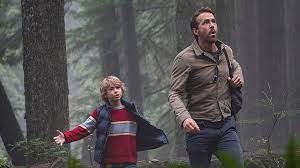
       A strong cast that also includes Jennifer Garner, Zoe Saldana, and Catherine Keener adds appeal to a movie that employs action and special effects to show Reynolds's Adam Reed stealing a spaceship in 2050, plunging through a worm hole, and landing in 2022, the year in which he was 12. 
    Walker Scobell portrays young Adam, a quick-witted kid who's bullied at school. He may not be furious with his fists but he's seldom at a loss for words, a quality that sets up lots of verbal byplay between the two Adams.
      In 2022, young Adam is ensconced in middle school. He lives with his recently widowed mom (Garner). She’s confused about how to deal with a kid who can't always avoid trouble.  
     So why is the adult Adam racing through time? He wants to find his wife (Saldana) to alter a future in which she will fall prey to an evil corporate titan (Keener) who’s up to no good no matter what period in which she lands.
    Amid the somewhat generic action, Levy delivers bromides  about mother/son love and father/son reconciliation, not to mention the way lovers are destined to find each other in whatever time they live.
     The supporting cast helps elevate the proceedings, which lean heavily on Reynolds's ability to be the cynical guy who eventually learns that a heartfelt statement can be better than a quip. 
      No point, delving into plot mechanics. Know, though, that some of the interchanges between the two Adams are amusing and the movie establishes itself as amiably familiar, which -- I guess -- is better than stunningly awful.
     Or, as the clerk at the DMV shouted to the long line of license seekers, “Next.”

Thursday, May 3, 2018

A big fight over a tiny house

Catherine Keener stars in a story about a Connecticut woman's battle to save her home.
The issue of eminent domain receives a modest work-out in Little Pink House, a real-life drama in which Catherine Keener portrays a paramedic who takes on powerful economic interests in order to retain ownership of her Connecticut home.

Keener plays Susette Kelo, a woman who works long and hard to buy a house overlooking the water at a spot where the Thames River meets the Long Island Sound. Kelo renovates the house, paints it pink and settles in for her own version of happily-ever-after.

For Susette, the Little Pink House is more than a place to live; it represents a dream fulfilled.

But the town of New London has other plans for Kelo's property. Spurred on by the state's governor, a non-profit development corporation led by a character named Charlotte Wells (Jeanne Tripplehorn) wants to develop the property in the Fort Trumbull neighborhood where Kelo and others have lived — some for most of their lives.

Tripplehorn’s Charlotte believes that development ultimately will help the town’s poorer residents. She mixes social and corporate concerns in hope that Pfizer — the drug company then on the verge of its Viagra boom — will select Kelo's neighborhood as a site for expansion. In Wells' version, the city wins. Pfizer wins. Everybody’s happy — except, of course, the homeowners who don’t want to move.

Eventually, a lawyer (Giacomo Baessato) who’s part of a non-profit group takes Susette’s case, pushing it all the way to the US Supreme Court. Kelo and cohorts lost the case. In a 2005 ruling, the court established that the city's plans did not violate public use clauses of either Connecticut or US law. Put another way, the court decided that economic interests can, in some cases, serve to benefit the public.

Keener makes Susette believably life-sized, although the movie diverges a bit to chronicle Susette’s romantic relationship with the local owner of a small business (Callum Keith Rennie).

I wondered if director Courtney Moorehead Balaker could have infused the movie with a little more outrage, fury springing from the clash of values that animates her film.

The point may not come as a shock but it's worth restating: New London's battle over real estate demonstrates that individuals face an uphill battle when it comes to fighting interests with big bucks behind them.

*
*A footnote: The land at the heart of this battle reportedly still remains vacant. Pfizer went in another direction. In the end, it's appropriate to ask, did any of the movie's characters win anything?

Thursday, February 22, 2018

Sorting through the stuff of life

Nostalgia boasts a strong cast, a willingness to carry some heavy emotional weight and an anthology-like structure. But (and you probably knew there was a "but" coming), the movie plays like a collection of ideas and monologues fueled by a sincerity that isn't quite the same as insight or hard-won dramatic truth. Several semi-linked stories ponder the relationship between memory and the possessions people accumulate over a lifetime. John Ortiz portrays an insurance assessor who puts a price tag on such things; he begins by meeting with an elderly man (Bruce Dern) who's going through an evaluation of his belongings. Next, we meet a widow portrayed by Ellen Burstyn. When her home was destroyed by fire, she managed to save only one thing, a baseball autographed by Ted Williams. The ball was one of her late husband's cherished possessions. The movie's longest segment involves Jon Hamm as a savvy but compassionate trader of collectibles. After his parents move into an assisted living facility, Hamm's character finds himself helping to dispose of the things they've left behind. He also lands in the middle of a tragedy involving his sister (Catherine Keener) and her husband (James LeGros). The movie sometimes confuses the maudlin and the meaningful, proving of interest only for a cast that deserved a more unified and incisive screenplay. Screenwriter Alex Ross Perry (Queen of the Earth, Listen Up Philip) doesn't get the job done, leaving director Mark Pellington (Arlington Road, The Mothman Prophecies) to lean heavily on his actors. Otherwise, Nostalgia comes off as a kind of dramatic estate sale, a look into the lives of characters who are stuck contemplating the stuff of their lives -- and doing it much too literally.

Tuesday, July 1, 2014

Begin again? -- not exactly

Director John Carney, who gave us the irresistibly charming quasi-musical Once, trods on familiar turf with Begin Again, a movie about two characters seeking rebirth and authenticity in the often brutal music business.

Mark Ruffalo provides the most compelling reason to see Begin Again -- which represents a mild falloff from its predecessor, which went on to become an award-winning Broadway play.

Ruffalo mixes rage and ruin in his portrayal of Dan, a down-on-his-luck music producer who once had a big career.

After Dan, who's drinking his way toward total failure, is fired from the record company he helped found, he hooks up with Gretta (Keira Knightley), a singer/songwriter who's trying to recover from a broken relationship with her boyfriend (Adam Levine), a singer whose career is on the rise.

Gretta, we fear, may become a cliche, the totally supportive girlfriend who's left behind by her boyfriend's success.

Dan's marriage already is in the tank. His former wife (Catherine Keener) seems chilly toward him, and his teen-age daughter (Hailee Steinfeld) isn't wowed by him either.

A cheerfully amusing James Corden plays Gretta's only real pal, a street musician.

There's no shame in gimmickry in a movie such as Begin Again, so it didn't bother me that Dan decides to make a record with Gretta. Improbably, all of the tunes are recorded on location in Manhattan using lots of ragtag equipment.

Begin Again was screened a while ago, and, frankly, I don't remember much about the tunes, something that wasn't true of Once.

Carney deserves credit for avoiding the worst romantic cliches, but Begin Again feels ever-so-slightly corny and out of tune. I wouldn't expect to see another Broadway musical, but then who'd have thought the Dublin-based Once -- which had the advantage of taking us by surprise -- would become a theatrical hit?

Thursday, November 15, 2012

Precise music, sloppy lives

A great cast does its best to elevate A Late Quartet.
Sometimes I wonder if even Christopher Walken knows where his line readings are headed? Walken, of course, has acquired the reputation of being an actor who specializes in characters who challenge expectation and defy most ideas of normality. But not always. A Late Quartet, a movie about a string quartet that faces a major crisis, provides welcome proof that Walken is not only a highly capable actor, but an extremely sympathetic one. The movie takes the burden of weirdness off Walken's shoulders, something that should come as a relief to both the actor and his audience..

Walken plays Peter Mitchell, the group's cellist and elder statesman. When Peter tells the other members of the unimaginatively named quartet -- The Fugue -- that he has been diagnosed with Parkinson's, troubles begin to threaten the group's 25-year history.

Conflicts quickly arise among the musicians: two of whom (Philip Seymour Hoffman -- as the second violinist -- and Catherine Keener -- as the violist) enter a shaky period in their marriage. To add further complication, professional jealousy starts to poison the atmosphere: The second violinist thinks it's time for him to change places with the first violinist (Mark Ivanar.)

You can tell from a quick perusal of the bold-faced names in the preceding paragraph that A Late Quartet boasts a terrific cast, all of whom are in expectedly fine form.

It's hardly surprising that Hoffman, most recently seen in The Master, gives a strong performance as Robert Gelbart, a husband who believes that his wife, Juliette, is not supporting his quest to play first violin. He's also in conflict with Ivanar's character over the quartet's approach to music, which very much has been determined by the first violinist's highly controlled personality and his preference for technical mastery over free-flowing passion.

The story needed no further wrinkles, but the screenplay has Ivanar's character giving violin lessons to Alexandra (Imogen Poots), daughter of Robert and Juliette. Alexandra harbors a good deal of resentment toward her parents, another dynamic in what turns out to be a script that tries to hit a few too many melodramatic notes.

Director Yaron Zilberman builds the movie around all of these personal tensions, as well as around the group's efforts to master Beethoven's challenging Opus 131.

I know a musician who remained unconvinced (perhaps even bothered) by the fake playing that this talented quartet of actors must attempt. But there's no faulting the cast for the way it inhabits each character.

Hoffman captures Robert's restlessness, volatility and disappointment; Keener excels as a woman who too often has been called upon to become a stabilizing influence on the group; Walken brings a sad sense of resolve to the role of a recently widowed man who's about to lose the skill that has carried him through life. Less well-known than the others, Ivanar more than holds his own.

Zilberman's approach to the material is fairly straightforward, but the screenplay he co-wrote with Seth Grossman, isn't always sure-handed. The story comes dangerously close to farce as the result of an affair that Poots's Alexandra initiates with Ivanar's character.

If you're looking for deep insight into chamber music, you may be a bit disappointed, but the notion that disciplined classical musicians can lead particularly sloppy lives is not without interest, and a screenplay would have to have been awfully bad to defeat a quartet of actors this good.