Showing posts with label Haley Lu Richardson. Show all posts

Friday, March 4, 2022

A meditative helping of low-key sci-fi


   Korean-born director Kogonada has a keenly developed aesthetic sense. In After Yang, a futuristic story in which a family loses a companion -- an android known as a technosapien -- Kogonada sustains a meditative mood that gets into your head and under your skin.
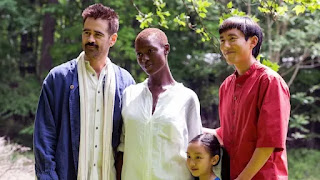
   The movie has a story of sorts. Android Yang (Justin H. Min) has been purchased as a companion for the adopted Chinese daughter (Malek Emma Tjandrawidjaja) of Jake (Colin Farrell) and Kyra (Jodie Turner-Smith). 
   When Yang breaks down, young Mika becomes distraught. Her parents purchased Yang to be a companion and to help school young Mika in Chinese culture.
   What's a dad to do? Try to get Yang repaired, of course. 
   Turns out Yang was purchased as a refurbished model and the company that issued Yang's warranty has gone out of business. Jake tries an unauthorized repairman (Ritchie Coster), who says Yang might be equipped with spyware. He gives Jake Yang's memory chip (or something like it) and suggests that he review its contents before deciding whether to repair Yang or let the technosapien "decompose."
    Jake then consults a professional (Sarita Choudhury) who helps him browse Yang's memory. He learns about Yang's connections beyond the family, notably with a young woman (Haley Lu Richardson) who once worked as a barista.  
    Kogonada's movie falls mostly on Farrell's shoulders. Jake sorts through Yang's memories, a task that forces him to ponder the relationship between memory and humanity. 
    Even as Jake's inner turmoil is suggested by a restrained Farrell, the movie operates under a transfixing calm. After Yang floats by easily, challenging assumptions about ethnicity and other matters. Complex issues rise like bubbles in a stream.
   If you're waiting for a knock-out plot development, you may still be waiting after the end credits roll. Kogonada  (Columbus) looks at big issues through a narrow gauge, the design of the home occupied by this family, the driverless car with plants growing in it (we see only the car's interior), and the delicacy with which Farrell approaches brewing a cup of tea.
    Kogonada leaves it to us to decide what to make of the way Jake and his wife connect as parents too busy to fully relate to their child and each other.  It's not only Mika who misses Yang; the family doesn't quite know how to function without him.
    Making a movie of subtly shifting tones is a gamble that doesn't always pay off and Kogonada offers little by way of explanation of how humanity has arrived at this multi-cultural, multi-racial point. 
    Still, I found it impossible to watch After Yang without getting caught in its quiet flow. 

Wednesday, April 17, 2019

'The Chaperone,' a lukewarm period piece

In 1922, a wife from staid Wichita, Kansas, accompanies 15-year-old Louise Brooks to New York City where the young Louise continues studying dance. Played in The Chaperone by Elizabeth McGovern, the wife eventually returns to Wichita -- albeit in a somewhat revised version of her early-picture self. Brooks, portrayed by a vibrant Haley Lu Richardson, achieves movie stardom and a notorious reputation that turns her into an icon. Director Michael Engler sets up a familiar conflict in this fictionalized account of Brooks' teen years: Brooks' free-spirited volatility bumps against the strictures of middle-class life. Norma, who vainly tries to teach Louise propriety, has problems of her own: Her husband (Campbell Scott) has been unfaithful to her with another man. Richardson captures Brooks' unbridled energy and McGovern's character wrestles with her long-repressed impulses. Norma's desires are awakened by a handyman (Geza Rohrig) who works at the Catholic orphanage where Norma was raised and where she hopes to learn the identity of her biological mother. As the title suggests, the movie focuses mostly on the chaperone, a shame because Norma isn't interesting enough to compete with Richardsons' Brooks. Based on a novel by Laura Moriarty, Julian Fellowes' screenplay provides Norma with a dramatic arc of her own, but The Chaperone escorts us through a period piece that's often too lukewarm to simmer, much less to boil.


Thursday, March 14, 2019

Another YA weepie hits the screen

I learned something about cystic fibrosis watching Five Feet Apart, a YA weepie that follows in the footsteps of The Fault in Our Stars. But aside from information gleaned about the disease and empathy generated for those who suffer from it, I was left with another yawn of a young adult romance, this one about a love that can't be consummated: Fear of infection keeps two hospitalized young lovers from being able to touch each other. Sparked by a bubbly performance by Haley Lu Richardson , the movie never really conquers the formula that dominates it. As the over-organized Stella, Richardson paints a portrait of a normal teen in every respect save one: She has a terrible disease. After the two principals -- the other is played by Cole Sprouse of TV's Riverdale -- pass through the obligatory irritation stage, they fall in love. This being YA fiction, bases must be touched: You probably won't be surprised to learn that Stella is given a wise-cracking gay pal (Moises Arias). Director James Baldoni occasionally delivers emotional realism but the screenplay builds toward a melodramatic finale that either will have you reaching for a handkerchief or recoiling at its undisguised manipulations -- or maybe both.

Thursday, August 23, 2018

These waitresses have spunk

Support the girls ably mixes comedy and desperation
Regina Hall of Girls Trip lands a welcome leading role in Support the Girls, a comedy set in a Texas restaurant called Double Whammies. I don’t know if the two Whammies are meant to suggest boobs and butts, but the movie makes no secret of the fact that the scantily clad waitresses of Double Whammies are as much of an attraction as the burgers and brews.

Playing Lisa, the restaurant's manager, Hall functions as an exasperated mother hen who cares about the young women who work for her. Early on, Lisa organizes a car wash to pay for the defense of one of her employees, a young woman who faces legal difficulties after running over her abusive boyfriend.

A bit of sad, self-awareness underlies Hall’s performance. Older than the women who work for her, Lisa knows that she no longer can compete when it comes to turning the heads of her leering customers, a group of men that she keeps in check with a zero-tolerance policy toward harassment.

Setting the story over a single day in Lisa’s hectic life, director Andrew Bujalksi gives us plenty of atmosphere and lots of colorful characters; the spunky Maci (Haley Lu Richardson) and Danielle (Shayna McHayle) make the biggest impressions in an ensemble of cheeky (no pun intended) young actress who compose the movie's impromptu sisterhood.

If Bujalksi had been looking for an alternate title for his movie, he might have tried Lisa’s Very Bad Day. His screenplay follows Lisa through a series of catastrophes — small and large: an attempted burglary at the restaurant, an argument with her boss (James Le Gros) and an incident that suggests irreconcilable differences with her a husband (Lawrence Varnado), a guy who spends his most of his day staring at a computer screen.

Informal and sassy, Support the Girls might have looked like a pilot for a sitcom, but Bujalski obviously feels for these characters. He understands the indignities that lurk in their workplace, as well as the collegial support it takes to keep from surrendering to them.

Some of Double Whammies' customers may want to objectify the restaurant’s waitresses, but Bujalski never does. He keeps them funny without sacrificing their humanity.

Thursday, August 24, 2017

A drama set in Columbus, Ind.

Columbus makes modern architecture as important as its characters.

The director who calls himself Kogonada (not his real name) previously has made short films inspired by directors such as Ozu and Wes Anderson. Kogonada's debut feature -- Columbus -- premiered at the 2017 Sundance Film Festival, where it received mostly glowing reviews.

Kogonada's love of Ozu shows in Columbus, a movie in which the camera often remains stationary and in which the actors, for the most part, perform with admirable restraint.

The movie is named for Columbus, Indiana, a city known for its modern architecture, buildings from the likes of Eero Saarinen, I.M. Pei and James Polshek sit improbably in the heart of this small Midwestern city.

Columbus and its architecture become a character (perhaps the most interesting character) in Kogonada's story about two people moving in opposite directions.

Casey (Haley Lu Richardson) has graduated high school but is stuck. She feels obligated to remain in Columbus to take care of her mother, a recovering meth addict played by Michelle Forbes.

John Cho portrays a Korean-born translator who arrives in Columbus because his father, an architecture scholar, has collapsed and fallen into a coma. Unlike Casey, Cho's Jin needs to come to grips with his past, not move away from it. He hasn't spoken to his father for a year.

It should be apparent from the opening shots that Kogonada has a strong compositional sense that's bolstered by cinematographer Elisha Christian's ability to bring calm, ravishing light to almost every scene.

As the story evolves, Casey and Jin develop a flirtatious friendship. She works in the town library and derives pleasure and solace from the town's architecture. Jin claims to have no interest in architecture, which probably has something to do with his inability to feel anything about his father's impending demise.

Kogonada adds two additional characters to the mix, an associate of Jin's father (Parker Posey) and one of Casey's library co-workers (Rory Culkin). The conversations tend toward the intellectual; these characters evidently are accustomed to channeling their feelings into thoughts that they can share more easily than emotions.

Richardson, last seen in M. Night Shyamalan's Split, plays a coming-of-age role, and Cho conveys the weariness of a man who has been fighting his demons for a long time. Both do fine work.

Always great to look at, Columbus nonetheless can feel boring, studied and overly composed, so much so that it made me hope that Kogonada would loosen the arty cords that may be binding him and that sometimes constrict this otherwise promising work.

Thursday, January 19, 2017

He has personalities to spare

James McAvoy helps give M. Night Shyamalan's Split its charge.

First things first. Apart from The Sixth Sense, I'm not much of an M. Night Shyamalan fan. Having said that, I also have to say that Shyamalan's latest qualifies as a better-than-average horror/thriller, a movie that at its best, exhibits a nightmarish intensity.

Mostly set in a basement occupied by a loner with Dissociative Identity Disorder; i.e., multiple personalities, Split provides actor James McAvoy with a dream vehicle.

McAvoy acts out a variety of his character's 23 different personalities -- all set around a situation in which McAvoy's Kevin abducts three high-school girls and holds them as prisoners. Kevin declares his hostages "sacred food," and, in one guise or another, administers to them or scares the daylights out of them.

The kick of the movie involves the way these young women (Jessica Sula, Haley Lu Richardson and Anya Taylor-Joy) discover Kevin's various personalities, which include a nine-year-old boy named Hedwig, a prissy schoolmarmish woman and a guy who seems to regard himself as the caretaker of Kevin's underground domain. The precise location of Kevin's lair is part of the movie's mystery.

When Kevin meets with his mostly sympathetic psychiatrist (Betty Buckley), he usually appears as Barry, a flamboyant fashion designer. Buckley's character carries the burden of expanding the movie's reach. Her character believes that those suffering with D.I.D. may hold the key to a dimly understood form of human transformation.

Of the young women, only Taylor-Joy's Casey receives much by way of background; her story -- seen in flashback -- involves horrific experiences with an uncle who helped turn her into a dejected outsider.

None of this is to say that Split doesn't have exploitative elements: The girls all wear short skirts and sometimes less, the movie's climactic scenes probably push a little too hard and not all of Split proves credible.

Still, McAvoy, with shaved head and predatory grin, approaches his perverse task with obvious relish, and Shyamalan whips up plenty of tension -- even in the face of some predictable twists and turns.

January, of course, isn't known as prime territory for quality movies, but Split is creepy enough to satisfy the folks who like this sort of thing.

Stick around for the epilogue that begins during the end credits. It contains a surprise.

Thursday, March 17, 2016

No medal for this profane comedy

A classic one-joke movie, The Bronze offers a few chuckles, but can't overcome the unpleasantness of its main character, a one-time Olympic gymnast (Melissa Rauch) whose career stalled with a Bronze medal. Years later, Rauch's Hope Ann Greggory has become an embittered, profanity-spewing woman whose personality is stuck in adolescence, complete with an ever-present pony tale, carefully arranged bangs and a refusal to wear anything but her Olympic warmup suit. Working from a script co-written by Rauch and her husband Winston, director Bryan Buckley seldom gets past a stream of profane humor delivered by Rauch in clipped staccato bursts. The joke, of course, is that Hope Ann Greggory looks like a pert cheerleader, but curses like an unrepentant sailor. Unable to move on with her life, Hope lives with her father (Gary Cole), a mailman who tolerates her massively annoying assaults. The story shifts gears when Hope is asked to train a rising star (Haley Lu Richardson). Thomas Middleditch plays the owner of the aging gym where Hope trains Richardson's character; Sebastian Stan portrays the egotistical coach of the US women's gymnastics team. A sex scene staged like a gymnastic routine serves as a comic high point, but the movie ultimately does precisely what you expect; it sells out its nasty side for a bit of soggy redemption. The Bronze might have worked as a skit, but can't make the cut as a movie.