Showing posts with label Colin Farrell. Show all posts

Wednesday, October 29, 2025

Seeking redemption in a city of neon


    Director Edward Berger is best known for his stunning remake of All Quiet on the Western Front (2022) and his box office hit Conclave (2024). Both movies qualify as well-made conventional offerings, movies dealing with battlefield horror during World War I and political intrigue within the Catholic church on the cusp of selecting a new pope.
  Berger's latest, Ballad of a Small Player, represents a shift, a movie that can be viewed as an adventurous -- if not entirely successful -- spiritual journey. I'm talking about religion, but about the journey of a desperate man who -- not entirely willingly -- seeks his freedom.
   The story centers on an Irishman (Colin Farrell) on the run. Having landed in Macau, Farrell's character adopts an upperclass British accent and becomes a regular at the baccarat tables. He calls himself Lord Freddie Doyle, but he’s slippery enough to slide off the screen.
    Berger veers from what could have been a standard noir offering, opting instead for high-gloss glamor; he revels in Macau's neon lure, and the charged sense of hope that animates a city that has been called the Las Vegas of Asia. Ballad of a Small Player might be the most brightly lit noir ever.
    Doyle’s troubles center on money, beginning with an unpaid hotel bill of $145,000 Hong Kong dollars that launches his compulsive attempt to win enough  to pay off his debts, including money he stole from an elderly British woman.
    A British investigator (Tilda Swinton) arrives in Macau, threatening to turn Doyle over to the authorities if he doesn’t return the money he stole. Doyle — who sweats a lot — does his best to evade her. Despite significant evidence to the contrary, he  continues to believe he can win enough at baccarat to solve his problems. 
     Farrell sinks into the role, creating a tragic figure — a compulsive gambler who has no control over his life, but tries to convince himself that he’s master of his fate. 
      It's obvious to us that Doyle can't beat the odds, a point that's reinforced by an older woman (Deanie Ip) who plays against Doyle at the baccarat table. An oracle of misfortune, she immediately pegs Doyle's as a hopeless loser. At the same time, he meets Dao Ming (Fala Chen), a loan shark who becomes an increasingly mysterious ally and a pivotal figure in moving the story.
       Once Berger sets the pieces in place, he turns his movie into a modern fairy tale that makes room for references to Hungry Ghosts — insatiable creatures of the afterlife — the unexplained appearance of a large sum of money, and a near-magical turnaround in Doyle’s sagging fortunes.
       Working from a screenplay credited to Rowan Joffe and Lawrence Osborne, who wrote the novel on which the movie is based, Berger doesn’t bother to dot every “i” or cross every “t." He pushes the movie into a metaphoric world in which Doyle must redeem himself by paying off his debts, both financial and spiritual. At times, the story feels as if it’s unfolding in a neon-lit dreamscape.
      That’s a big burden not only for Doyle but for a movie whose themes are expressed in ways many will find obscure and confusion, meaning dropped into a color-drenched mess.
       I understand that point of view, but I'm also glad to see Berger, like the hero of his movie, overreach. In so doing, he sounds surprising notes and finds moments of strange resonance. I'm eager to see where he goes next.

Wednesday, September 17, 2025

A great big beautiful bore


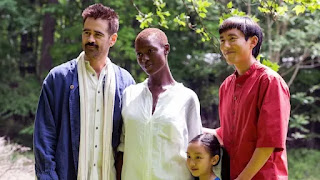
  Kogonada (he goes by a single name) directed Colin Farrell in a low-key helping of sci-fi called After Yang (2021), a quietly realized movie about an android who becomes a companion to a father's adopted daughter. 
   Considering After Yang's off-kilter lilt, it's hardly surprising to see Kogonada put a fairy-tale spin on a big-screen romance starring major Hollywood names, Farrell and Margot Robbie.
   From the start, it's clear that A Big Bold Beautiful Journey shouldn't be taken literally. Working from a screenplay by Seth Reiss, Kogonada abstracts the ingredients of romance into a series of scenes meant to depict stages that his characters must go through before love can blossom.
     Setting formula aside can be rewarding, but Beautiful Journey doesn't allow Farrell or Robbie to create the credibility and chemistry any romance requires, regardless of form.
     Theatrical but lifeless, Beautiful Journey plays like a series of scenes lifted from an acting class. Put another way, the movie feels self-conscious and contrived. Too often, Kogonada's fantasy flatlines.
      So how does all this happen? Early on, Farrell's David rents a car from a mysterious agency that insists he take an older vehicle with a GPS added. David drives to a wedding, where he meet's Robbie's Sarah. It turns out that Sarah has rented a car from the same agency. 
      Soaked in rain, these early scenes feature colorful umbrellas. They may not enhance the story's charm but they sure make it feel soggy.
       After the wedding, Sarah's car won't start and the two wind up taking a purportedly magical road trip on which the GPS dictates numerous stops. At several of these stops,  a free-standing door (many incongruously placed in rural settings) must be opened. Sarah and David walk uneasily  into these pre-determined spaces, revisiting moments in their pasts that have impeded their ability to form meaningful relationships.
      In scenes in which David returns to high school, he's pushed into a musical (How to Succeed in Business Without Really Trying) in which he once played a starring role. The moment has some energy, but it also strains to make a point: Rejection in high school can create lingering pain.
      The point is clear: Before they can find fulfillment, David and Sarah must overcome internal barriers. Early on, we learn that David has been closing himself off from intimate relationships. Robbie's Sarah makes no bones about her resistance to love. She has a habit of cheating, thus destroying any attempt at sustained intimacy.
       None of this rings true, and instead of creating a magical aura, the movie drifts through patches of boredom.
      A supporting cast adds little. Kogonada casts Kevin Kline and Phoebe Waller-Bridge as the agents at a car rental facility that's so obviously lacking in realism, it makes us suspect more weirdness than the movie ever delivers.
       Kogonada tries for tears when he inserts when Sarah finally copes with the death of her mother (Lily Rabe), but little about A Big Bold Beautiful Movie clicks. 
      As for that sound you hear in the row behind you, It could be someone sighing over the movie's poignancy or it might be light snoring.


Wednesday, October 26, 2022

A tale that takes an unexpected turn


   Colin Farrell and Brendan Gleeson, who appeared together in In Bruges (2008), reunite in The Banshees of Inisherin, the story of two former friends living on a fictional island off the coast of Ireland.
   Martin McDonagh, who directed In Bruges, locates Banshees'  characters on an island where the residents seem to regard the mainland as if it were another world. It is: Engulfed by civil war, Ireland feels more than a boat ride away from isolated Inisherin.
    A simple conceit drives the story. Once best friends, Gleeson's Colm suddenly and without explanation stops talking to Farrell's Padraic. We suspect that Padraic committed some terrible slight. He must have done something.
    That's not the case. Colm refuses to acknowledge Padraic's existence for no apparent reason at all.
    Faced with loneliness and beset by consternation, Padraic won't take "no" for an answer. Again and again, he presses Colm to explain his sudden change of heart.
     Eventually, Colm, an obstinate rock of a man, tells Padraic’s sister Siobhan (Kerry Condon) that his former pal, is just too dull for sustained companionship.
      Siobhan counters. Padraic always has been dull so why shun the poor fellow now?
      Farrell excels as the good-hearted and insistently sincere Padraic, a guy whose social milieu consists of his farm and animals, most notably a pet donkey called Jenny.
    Padraic gives Jenny access to the cottage he shares with his sister, which -- not unexpectedly -- annoys her.  Siobhan yearns for better things and bristles under the weight of her island confinement.
     Later, we learn that Colm -- despite his stoicism and silent smoking -- is fighting a losing battle. Facing his own mortality, he realizes that he has accomplished nothing. He wants to devote the rest of his life to writing music for the fiddle he plays with a few other musicians at the town pub, the only place on Inisherin that accommodates any public gatherings.
      With the clock ticking, Colm has no time for distractions.
      At first, McDonagh seems to have made another movie steeped in colorful turns of phrase and Irish rue. But hints of darkness soon cast  a bit of a pall over the proceedings.
       The local policeman (Gary Lydon) sadistically abuses his son Dominic (Barry Keoghan). An old woman (Sheila Flitton) makes pronouncements of doom.
       The supporting actors excel, although Condon -- as the short-tempered, literate, and essentially decent Siobhan -- proves exceptional. Siobhan realizes that sustained isolation leads to unbearable desperation.
      The landscapes of Inisherin are stark, the ocean forbidding, and just about every aspect of life feels irrevocably meager.
      When the movie takes its darkest turns, we realize that McDonagh has serious intentions. In a fit of understated rage, an increasingly frustrated Colm pledges that every time Padraic talks to him, Colm will chop off one of his own fingers. 
        I won't tell you how the story arrives at its chastening conclusion but McDonagh takes us to places we hardly could have anticipated when the movie began.
        Fine performances and McDonagh's commitment to the odd edges of his material enables The Banshees of Inisherin to amuse, shock, and get under the skin, a bitter Irish chill of a movie.
        But more than an expression of Irish parochialism, this quasi-folk tale shows how tragic results can spring from something that borders on the trivial, irreparably altering the way life stumbles onward when something happens that can’t be made right.

Wednesday, July 27, 2022

'Thirteen Lives' tells an amazing story


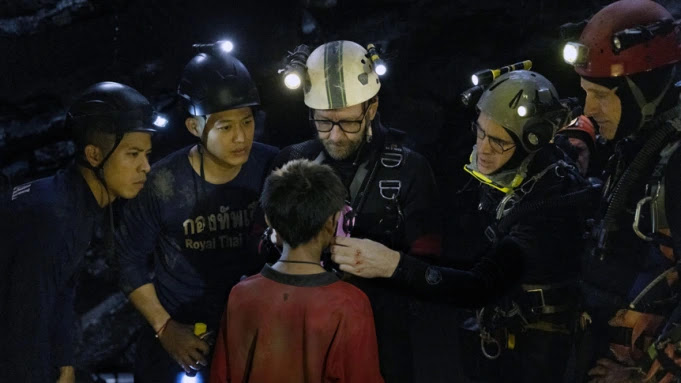
   Ron Howard's Thirteen Lives can be regarded as a procedural; i.e.,  a straightforward account of a story in which 12 boys and their soccer coach were stranded in a flooded cave in Thailand. 
   The event -- which happened in 2018 -- captured the world's attention as a team of divers combatted monsoon rains while trying to locate the boys and figure out how to extricate them from the cave.
   So, a procedural, yes, but one that tells an incredible story about a team of international divers and Thai Navy Seals who, after 18 days guided the boys to safety. 
   Difficult to begin with, the task became nearly impossible because the boys had to be equipped with diving gear that would enable them to breathe as the divers navigated treacherous waters and narrow passageways. 
   Howard introduces five divers played by Colin Farrell, Viggo Mortensen, Joel Edgerton, Tom Bateman, and Paul Gleeson
 Mortensen and Farrell receive the most attention as divers who don't always agree. The story also deals with tensions between Thai authorities, the Thai military, and the foreigners who arrived to help. 
  The Thai characters aren't especially well-developed but neither are the principal divers, who are given sketchy backgrounds. 
    The characters spend little time interacting with one another in ways unrelated to the rescue mission, so it's up to the actors to suggest deeper character traits. Credit Mortensen, Farrell, and Edgerton with doing as much as they can in this regard.
    Howard and cinematographer Sayombhu Mukdeeprom up the dramatic ante with rescue sequences that involve a decision that's best discovered in a theater, presuming you don't already know it. 
   The movie's underwater scenes must have been difficult to film but they tend to become slightly repetitive as divers make multiple trips through tunnels of the cave to save the boys.
    I expected an emotionally richer film from Howard whose filmography includes the gripping Apollo 13. He's working with a subject that seems firmly located in his wheelhouse but Thirteen Lives proves more resolute than inspiring.
   I don't think it's a spoiler to say that we know the outcome of such a well-known story from the outset. Aside from becoming international news, the rainy season rescue also is the subject of Rescue, a well-regarded 2021 documentary. But whatever its limitations, Thirteen Lives still has an amazing story to tell.

Friday, March 4, 2022

A meditative helping of low-key sci-fi


   Korean-born director Kogonada has a keenly developed aesthetic sense. In After Yang, a futuristic story in which a family loses a companion -- an android known as a technosapien -- Kogonada sustains a meditative mood that gets into your head and under your skin.
   The movie has a story of sorts. Android Yang (Justin H. Min) has been purchased as a companion for the adopted Chinese daughter (Malek Emma Tjandrawidjaja) of Jake (Colin Farrell) and Kyra (Jodie Turner-Smith). 
   When Yang breaks down, young Mika becomes distraught. Her parents purchased Yang to be a companion and to help school young Mika in Chinese culture.
   What's a dad to do? Try to get Yang repaired, of course. 
   Turns out Yang was purchased as a refurbished model and the company that issued Yang's warranty has gone out of business. Jake tries an unauthorized repairman (Ritchie Coster), who says Yang might be equipped with spyware. He gives Jake Yang's memory chip (or something like it) and suggests that he review its contents before deciding whether to repair Yang or let the technosapien "decompose."
    Jake then consults a professional (Sarita Choudhury) who helps him browse Yang's memory. He learns about Yang's connections beyond the family, notably with a young woman (Haley Lu Richardson) who once worked as a barista.  
    Kogonada's movie falls mostly on Farrell's shoulders. Jake sorts through Yang's memories, a task that forces him to ponder the relationship between memory and humanity. 
    Even as Jake's inner turmoil is suggested by a restrained Farrell, the movie operates under a transfixing calm. After Yang floats by easily, challenging assumptions about ethnicity and other matters. Complex issues rise like bubbles in a stream.
   If you're waiting for a knock-out plot development, you may still be waiting after the end credits roll. Kogonada  (Columbus) looks at big issues through a narrow gauge, the design of the home occupied by this family, the driverless car with plants growing in it (we see only the car's interior), and the delicacy with which Farrell approaches brewing a cup of tea.
    Kogonada leaves it to us to decide what to make of the way Jake and his wife connect as parents too busy to fully relate to their child and each other.  It's not only Mika who misses Yang; the family doesn't quite know how to function without him.
    Making a movie of subtly shifting tones is a gamble that doesn't always pay off and Kogonada offers little by way of explanation of how humanity has arrived at this multi-cultural, multi-racial point. 
    Still, I found it impossible to watch After Yang without getting caught in its quiet flow. 

Tuesday, March 1, 2022

Can a despairing Batman still fight crime?


       Shrouded in darkness and despair, Gotham City has become a crime-ridden disaster zone.
     Batman -- or should we say The Batman -- is riven by doubt, unsure that battling one villain after another has done anything to win the war on crime.
     Such is the grim environment director Matt Reeves (Cloverfield and a couple of Planet of the Apes movies) creates in The Batman, a movie whose Neo-noir ambitions overshadow attempts at comic-book verve. 
     Robert Pattinson's despairing Batman seems as likely to take a suicidal jump off a tall building than to leap to the rescue of an endangered stranger. 
     And in his Bruce Wayne identity, Pattinson looks like a refugee from a Grunge rock band, a shaggy-haired rich kid unsure of his place in an irredeemably corrupt city.
     Batman is more isolated than ever. The cops view him as a vigilante and intruder. Only detective James Gordon (Jeffrey Wright) regards Batman as an invaluable crime-fighting resource. 
     Reeves and co-writer Peter Craig have concocted a plot that plays out against the light-starved cinematography of Greig Fraser. If you live in Gotham City, you don't need a weather report; you can bank on rain and a near-morbid gloom. 
      A couple of things need to be said early on. It's possible to view The Batman as a cousin of director Todd Reid's The Joker, although it contains nothing quite as daring or startling as Joaquin Phoenix's performance. It's also a clear descendant of Christopher Nolan's The Dark Knight, only meaner.
     Moreover, dystopian visions  -- even when as well-executed as the one created by production designer James Chinlund -- aren't as shocking as they once were. A three-hour running time -- makes for a long wallow in the darkness of a movie that's hot for rot.
      Is that appropriate? We’re living through an extremely disturbing — some would say dire moment — but The Batman is not a response to global crisis; it’s a step in the evolution of a comic book character filmed before events sent people scurrying to find Moldova on a map.
      However it may be seen, the movie loads up on villainy. Principal villainous duties fall to Paul Dano (masked until the movie's finale) who plays The Riddler, a serial killer introduced when he murders Gotham's mayor. 
     An emotionally wounded maniac, The Riddler has lost all tolerance for hypocrisy, which means he's basically unfit for life in society.
      We also meet The Penguin (an unrecognizable Colin Farrell), who looks as if the might have been recruited from Al Capone's old gang. 
      The movie also includes conventional mob figures. Carmine Falcone (John Turturro) wields behind-the-scenes power in Gotham. He knows everyone's dirty secrets and uses them to make sure that he controls Gotham's lucrative corruptions.
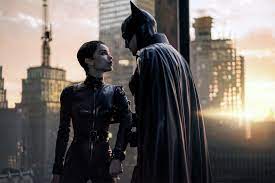
      If you're looking for rays of light, you'll find some in the performance of Zoe Kravitz, whose Selina Kyle is in the process of emerging as Catwoman.
      Selina flirts with the impassive Batman but he's hidden in his creaky redoubt of uncertainty. He's too busy looking for reasons to carry on to pause for either sex or love.
     Reeves doesn't skimp on action. Fight scenes and an old-fashioned car chase satisfy the need for speed.
     At its best, The Batman drips with shuddering dread. Too bad the movie concludes with a half-hearted attempt at a hopeful resolve, a letdown after so much dark commitment.
     I wish I could say that The Batman was a triumph. It's not. But it's no schlocky misfire either. Reeves asks us to join Batam as he tries to determine whether his work has meaning. 
     Maybe it's a stretch, but I wondered whether Reeves hasn't ----- in that way -- made us partners in the effort to keep a franchise alive, to keep Batman functioning in a badly compromised world. He probably has.
     Of course, I recognize that you may have more important things to worry about -- at least I hope you do.

Thursday, January 23, 2020

Cast lifts familiar British gangster movie

Director Guy Ritchie may not be breaking new ground in The Gentlemen, but his actors provide the movie with some juice.
If the year were 1999 instead of 2020, director Guy Ritchie’s The Gentlemen might have seemed more inventive. Ritchie, you'll recall, made his cinematic bones with 1998’s Lock, Stock and Two Smoking Barrels, a fresh-feeling foray into a netherworld occupied by British gangsters.

In this outing, Ritchie again goes gangster but the verve that once defined Ritchie's style now feels a little proforma, something on the order of the difference between an arranged marriage and a spontaneous love affair.

After striking out with King Arthur (2017), it’s not surprising that Ritchie sought comfortable ground — and, to be fair, The Gentlemen derives a fair measure of entertainment from a spot-on cast.

Notable among a large ensemble is Hugh Grant, playing a sleazy, gay private detective with traces of cockney in his accent. Colin Farrell adds more color as Coach, a character who trains boxers and occasionally dips into the dark arts required to settle matters in the criminal world.

Add an unflappable Charlie Hunnam to the mix. Hunnam rides shotgun to Matthew McConaughey, who plays Mickey, a pot czar who pays off fading aristocrats for the privilege of building vast underground grow houses on their property.

Now another American (Jeremy Strong) wants to buy Mickey's vast empire so that he can reap illegal gains and be ready to capitalize when marijuana goes legit. Tired of life in the fast lane, Mickey may be willing to sell.

A Chinese gangster named Dry Eye (Henry Golding) also would like to purchase Mickey’s business, an ambition that sets off fireworks, notably a raid on one of Mickey’s mammoth facilities.

To add structural pizazz, Ritchie frames the story by having Grant’s character try to extort money from Hunnam’s character, using a screenplay to convince Ray to pay up. The screenplay gambit proves a bit much, even in a movie that's not afraid to display its cinematic self-consciousness.

True to its title, The Gentlemen is mostly an all-guys affair, although the dashing Mickey has a greyhound sleek wife (Michelle Dockery) who runs a garage staffed by many female mechanics. Mickey, we're told, relies on her judgment.

It takes time to get all the characters straight and to fully appreciate The Gentlemen, you need a taste for a narrative that hopscotches through the proceedings, sometimes creating confusion. You also may find yourself wondering whether any of these characters possibly could exist outside a Guy Ritchie movie.

Still, there’s pleasure in watching actors sink into juicy roles as we wait to see who among these felons will emerge as the king of the gangster jungle. In January, that may as good as we get.

Wednesday, March 27, 2019

An elephant flies but 'Dumbo' doesn't soar

Director Tim Burton takes a crack at a classic Disney story.

I first saw Dumbo as a child in one of its re-releases, but haven’t seen it since, although I did watch selected clips on YouTube as I readied myself for director Tim Burton's new live-action remake.

Even with only a brief refresher, it’s clear that the Burton-directed Dumbo doesn’t match the great set pieces of the 1941 original, falling short in such crucial areas as humor, charm, and enchantment.

In telling the story, Burton has taken what Disney accomplished in 64 minutes and turned it into a 112-minute live-action feature with a CGI Dumbo. To expand on the original, the movie’s screenplay makes a deeper foray into the human world that the animated version wisely minimized.

The story begins when a World War I veteran (Colin Farrell) returns home. Newly widowed, Farrell’s Holt Farrier joins his two children (Nico Parker's Milly and Finley Hobbins' Joe) as he tries to resume his career as the star of a horse act in the Medici Circus, a rundown show that travels the US offering typical circus fare and what its mildly sleazy ringmaster (Danny DeVito) calls a "fake freak show."

Absent some of the musical numbers that enlivened the 1941 movie and including a less-than-impressive bow to the original’s famous Pink Elephant fantasy sequence, Dumbo occasionally yields to Burton’s darker instincts, though not entirely.

Dumbo also uses its story to illustrate what it seems to regard as the exploitative rise of the theme-park era, an interesting twist considering that Disney isn't exactly unfamiliar with theme parks.

Michael Keaton, who worked with Burton on Beetlejuice and a couple of Batman movies, plays a con man who wants the flying baby elephant to become the centerpiece of his new theme park, Dreamland. Keaton’s character doesn’t amount to much more than a weird hair cut and a faux accent. I wasn't sure what he was trying to do in giving the movie its hiss-boo villain.

As a veteran who lost an arm in the war, Farrell seems a bit lost. The kids are ... well ... Disney-style kids. They replace Timothy, the mouse of the original who encouraged Dumbo to fly on his own, putting aside the feather that the elephant believes enables him to flap his big ears and take flight. The feather helps explain how Dumbo discovers he can fly in the first place.

If you’ve forgotten, Dumbo's over-sized ears initially cause him to be scorned but eventually solidify his special place in the world.

Burton finds flashes of emotion in the story of a baby elephant separated from his mother -- Mrs. Jumbo -- tugging on the same heart-strings as the first movie, although I doubt whether you'll need to bring a full box of tissues to the new addition.

The CGI Dumbo isn’t as endearing as his predecessor, but Burton’s movie isn't particularly sweet nor does it allow the director fully to give himself over to his weirder impulses. An awful lot of energy seems to have gone into the film’s retro production design, and Danny Elfman's score strains to achieve a level of enchantment that the story doesn't always deliver.

Dumbo winds up taking us on a journey without the kind of surprises or stirring uplift that mark Disney at its best. I wouldn't say live-action versions of animated classics shouldn't be made, but this could be one case in which Disney might have done well to pass.

The original includes some dated material -- crows portrayed in racially stereotypical ways, for example -- but the bold creativity of Disney's animators still impresses. That makes the original feel fresher than much of what Burton and his team have created some 77 years later.

Thursday, November 15, 2018

Too embattled to wallow in grief

Viola Davis leads a strong cast in Widows, a caper movie with plenty of cynical undertow.
In Widows, director Steve McQueen flirts with high-concept formula but never allows it to overwhelm the movie's gritty undertow.

Written by McQueen (Hunger, Shame, and 12 Years A Slave) and Gillian Flynn (Gone Girl), Widows wraps pungent characterizations around a caper-film spine. If the plot strains at times, a fine cast and McQueen's scaldingly cynical view of life in Chicago keep the proceedings percolating.

Viola Davis stars as Veronica Rawlings, a woman whose criminal husband (Liam Neeson) dies in the film's barreling, violent prologue. Neeson's Harry and four colleagues are the in the midst of a robbery when they're killed.

Harry leaves Veronica with a pile of trouble. A local gangster (Brian Tyree Henry) claims that Harry owed him $2 million. He's holding Veronica responsible for the debt.

Henry's Jamal Manning also wants to shift to a new kind of crime. He's running for alderman because he believes it's time that he had the opportunity to dip his crust of bread into the municipal gravy that the Irish too long have sopped up. Manning's brother (Daniel Kaluuya) serves as his happily brutal enforcer.

In a related plot thread, Colin Farrell plays Jack Mulligan, the incumbent who's running against Manning. Mulligan is the son of a corrupt former Chicago alderman (Robert Duvall) with a sour disposition and a strong commitment to holding political turf his family has dominated for years.

So how is Veronica going to pay off Harry's debt? As it turns out, Harry left Veronica plans for a major heist that could yield as much as $5 million. Because all of Harry's henchmen were killed in the movie's explosive opening, it falls to Veronica to gather the surviving widows into an impromptu gang, pull off the heist, settle Harry's debt and divide the remaining spoils.

Everyone in Veronica's crew suffers from need. Linda (Michelle Rodriguez) signs on because she's lost her store to rapacious creditors. Alice (Elizabeth Debicki) is one step away from becoming a full-time escort, saved only by the largess of a wealthy financier (Lukas Haas) who makes her his mistress. Amanda (Carrie Coon) has been left with an infant.

Jacki Weaver shows up as Alice's unapologetically sleazy mother, and Cynthia Erivo adds last-minute energy as a woman recruited to drive the getaway car.

A women's perspective gives the movie's crime and political theater a considerable boost. Think of Widows as feminism without speeches, a genre piece featuring female characters with real agency.

It's hardly surprising that Davis proves impressively steely as a woman who misses her husband's tender embraces but proves tough enough to lead her cronies through dangerous terrain. Displaying iron-willed resolve, Veronica takes charge of her gang of widows, no easy task with this group of independent-minded women.

Widows has enough on its mind to keep from becoming one more helping of multiplex fodder. McQueen wisely lets Davis lead the way as a widow who shouldn't be messed with -- even in a world in which felons and politicians often are indistinguishable.*

*I want to reiterate that I welcome comments, particularly those that expand our knowledge about particular films or films in general. But -- and this is the point of this footnote -- I don't publish anonymous comments. Over the years, I've found that many readers have worthwhile things to say and should in no way be reluctant to take credit for their comments. So, sign your name and chime in.

Friday, November 24, 2017

Denzel Washington as a savant attorney

Roman J. Israel, Esq. makes room for moments that are so thought-provokingly enjoyable that the movie, which can't be called a success, may be more interesting than movies that would have garnered more praise. Denzel Washington creates one of his more memorable characters, a legal savant whose values and tastes are firmly stuck in the 60s. Washington's Israel sports an afro, baggy-ill fitting pants, and glasses a couple of sizes too big. Directed by Dan Gilroy (Nightcrawler), Roman J. Israel, Esq. is at its best when it's focused on this misfit of a man whose heroes include Bayard Rustin and Angela Davis. A key story element arrives early: Israel has spent 36 years working for a famous lawyer. Israel has been the backroom brains for William Henry Jackson, an attorney who knew how to handle himself in a courtroom. Jackson suffers a heart attack and slips into a coma, igniting a plot that brings Israel into touch with a hot-shot attorney portrayed by Colin Farrell. Farrell's George Pierce has been asked to dissolve Jackson's firm, which -- unbeknownst to Israel -- has never turned a profit. Israel also meets a civil rights activist (Carmen Ejogo). She sees past Israel's strange behavior and finds a righteous man. The plot puts Israel into a position in which he must decide how righteous he really is, a development the movie doesn't seem to know how to explore. For roughly half of its two-hour and 9-minute running time, Roman J. Israel, Esq. complies scenes that don't quite cohere. It's almost as if Gilroy, who also wrote the screenplay, can't figure out precisely what he wants to say. He compensates by giving Washington some scorching dialog and with a bit of cinematic daring, even employing some throwback style to evoke a feeling of '60s cinema. Roman J. Israel, Esq. emerges on one of the year's true oddities, a film that stumbles but, before it falls, hits notes you're not likely to hear anywhere else.*
As was the case with Wonder, I had a conflict with the preview screening of Roman J. Israel, Esq. and caught up with the film after its opening.

Thursday, October 26, 2017

An intriguing start, but where's the payoff?

Another strange movie from the director of The Lobster.

A skilled surgeon and his anesthesiologist walk down a hospital hallway after performing open-heart surgery. Rather than talk about the operation they’ve just performed, they exchange banalities about their high-priced wristwatches. Later the surgeon, meets with a young man and gives him a gift, an expensive watch. The conversations in these two scenes are conducted without benefit of inflection or emphasis. For all the color the actors bring to their dialogue, they might as well be reciting grocery lists.

In these scenarios, relationships and motivations become blank slates, and we -- the audience -- labor to comprehend the meaning of everything we see.

Are these doctors so insensitive that they can talk about nothing more than the quality of their watches? And what is the relationship of the physician to the young man we've just seen? Could the young man be a son from some now-dissolved marriage? Is this meeting about something stranger than an awkward reunion?

All of this occurs in the opening moments of director Yorgos Lanthimos's The Killing of a Sacred Deer, a revenge saga played out in an atmosphere of provocative obfuscation. Lanthimos, who directed the much-admired but often cryptic The Lobster (2016), has proven himself a master at holding an audience in what might be called "active suspension," a state of heightened attentiveness in which much is suggested but little is clarified.

I'm a partisan of this approach to filmmaking, the kind in which images, music, and performance continually force us to look for meaning. But such filmmaking also can prove risky. Often, it can't be maintained for a two-hour running time. Eventually, the filmmaker must get down to business and create some sort of plot.

It's at this pivotal point that Lanthimos's effort begins to crumble, and we face the slow dawning of an unfortunate realization; the keenness of observation Lanthimos has demanded of us may not yield the hoped-for payoff.

Any actor who works with Lanthimos must adapt to the director's style, something in the way that actors who appear in a David Mamet production must submit to the loaded cadences in which Mamet's characters speak.

In that regard, the actors in The Killing of a Sacred Deer do admirable work. Colin Farrell plays Steven Murphy, heart surgeon and wristwatch enthusiast. Nicole Kidman portrays his wife, Anna, an eye doctor. The Murphy's have two children: Kim (Raffey Cassidy), a teenager, and Bob (Sunny Suljic), a long-haired boy with a near-angelic look.

The mysterious young man mentioned earlier (Barry Keoghan) mixes politeness and threat, a cross between Eddie Haskell, the obnoxiously polite kid on Leave it to Beaver, and serial killer Ted Bundy.

Alicia Silverstone shows up briefly as Martin's mother, a woman who hopes Steven will assuage her loneliness by becoming her lover. Martin eggs her on in this delusion.

Now, if you don't want to know anything more, I suggest you stop here. At the risk of introducing spoilers, I must tell you that Martin poses an increasingly grave danger to the Murphy family. It seems that Martin's father died after Steven operated on the ailing man. Martin blames Steven and aims to settle the score. He informs Steven that if the good doctor doesn't kill either his wife or one of his children, each will become ill and die. How Martin intends to fulfill this malignant promise remains a mystery.

Dipping into Greek mythology and who knows what else, Lanthimos deftly keeps us inside his bubble of suspense, sometimes nudging us toward the comic absurdity of Steven's situation. The security of an affluent family suddenly is threatened, which means -- of course -- that it had no real security in the first place.

Farrell's bushy beard seems to throw his face into a perpetual scowl. Kidman manages to be a credible denizen of Lanthimos's strangely concocted world. Before Steven and Anna make love, Anna sprawls across the bed in her underwear, lies perfectly still and invites Steven to proceed by uttering the least romantic words ever heard in a sex scene; i.e., "general anesthesia." Sex becomes an operation, and Anna seems to be saying, "Have at it. I won't feel a thing."

The movie's best performance belongs to Keoghan who has the capacity simultaneously to alarm and reassure; Martin's twisted sincerity makes it seem as if perfect logic supports the young man's insane plan.

If you want to enlarge your interpretation of the movie, you can view the story as a stage in which karmic forces clash: Steven must be punished for being a successful doctor who may once have been negligent. Or maybe he's being punished for living an affluent life in the movie's unnamed city or for cutting himself off from his emotions or ... You can fill in your own blanks.

Whatever Lanthimos wants to say falls prey to the fact that the movie becomes less intriguing as it goes on, so much so that the denouement of Lanthimos's drama feels abstract and remote rather than shockingly tragic.

Augmented by the cool tones of cinematographer Thimios Bakatakis's lighting, Killing of a Sacred Deer evokes depths it's unable to plumb. In the end, the movie may amount to little more than a complex expression of a familiar adage: Payback's a bitch.

Fair enough, but this could be a case in which a movie's cruelty doesn't hurt enough because its creators can't entirely solve the problem of making the conceptional battle between an arrogant doctor and the evil he arouses into something that comes screaming to life. Lanthimos may have been defeated by his own considerable artistic impulses: Putting a movie under “general anesthesia” risks not being able to rouse it again.

Thursday, June 29, 2017

Too restrained for its own good

Sofia Coppola's The Beguiled : lost in an arty haze.
There's an alarming gap between style and substance in Sofia Coppola's new movie, The Beguiled, a remake of a 1971 Clint Eastwood film about a wounded Union soldier who finds refuge in a Virginia school for girls during the waning days of the Civil War.

In a sense, Coppola has taken grade "B" material and given it an "A"-grade artistic gloss that sometimes threatens to suffocate the movie's dramatic life.

Not surprisingly, the soldier's presence among these women prompts turmoil as students and teachers try to adjust to a male presence. Some of the students -- notably a character played by Elle Fanning -- are just beginning to discover their sexuality, making the movie a hothouse of suppressed and overt desire, as well as of trust and mistrust.

Too often, though, The Beguiled is a hothouse in which someone forgets to turn up the heat.

Three performances stand out. Colin Farrell plays soldier John McBurney as a cagey fellow with anger simmering beneath a solicitous surface. An excellent Nicole Kidman brings subtle levels of calculation to the role of headmistress Martha Farnsworth, the woman who washes the soldier's partially naked body when he's brought to the school.

Kirsten Dunst's excels as Edwina Danny, a teacher for whom McBurney represents liberating escape from an impending spinsterhood.

Coppola eliminates one of the characters found in director Don Siegel's earlier version, an enslaved woman. That means that Coppola mostly ignores the perverse undercurrents of racism. If you wanted to push the point (and some have), you could call it an elegant form of denial.

Coppola's overly decorous approach elevates atmospherics. Her movie includes a couple of gruesome events but doesn't seem entirely committed to them. No more can said without spoilers.

Every character in The Beguiled, I suppose, must react to a war-time situation in which norms have been upset, but the movie could have used a little more of the bile that ultimately begins to flow.


Thursday, November 17, 2016

J.K. Rowling unleashes 'Beasts'

This prequel to the Harry Potter series isn't as fantastic as one might have hoped.

The box-office numbers for Fantastic Beasts and Where to Find Them probably will be big. If ever there was a time when the country was primed for fantasy, this is it.

Wait. I take that back. When it comes to movies, our escape-hungry country always seems primed for fantasy.

So here comes J.K. Rowling of Harry Potter fame to hook us into another series of movies designed to transport us into a world of wands and wizards.

Rowling's new series -- yes, two more are in the offing -- takes place in 1926, long before Harry Potter was even born -- much less learning his trade at Hogwarts.

This prequel to the Harry Potter series follows the adventures of Newt Scamander, a wizard who's writing what will become one of Hogwarts standard texts.

Early on, Scamander heads to the US as part of his plan to save and preserve magical creatures of which you will see many.

But here -- as I see it -- is the rub: The movie is only half successful.

Fantastic Beasts, which stars Eddie Redmayne as Scamander, is rich in set design and special effects. The movie's faux but nonetheless impressive atmospherics evoke the sooty streets of Manhattan during the 1920s.

But Beasts is poor, perhaps even impoverished, when it comes to character development and propulsive storytelling.

For some, the movie's visual abundance will be sufficient reward. Strip away a strong dose of Potter affection, though, and what you're left with is a big, muddled movie in which Redmayne shuffles his way toward the next two movies.

Redmayne imbues the main character with a diffidence that makes you wonder whether the actor -- despite tousled hair and just the right look -- was fully able to connect with an ill-defined role.

As one expects, Rowling fills the screenplay with jargon. The American version of Muggles, for example, are called No-Majs (no magics), sadly deficient humans who simply get on with their lives.

Despite the movie's wizardly bias against normal folks, Scamander is open to keeping human company; he even acquires a human sidekick (Dan Folger), a portly, good-natured factory worker and aspiring baker who becomes involved in the story through a baggage mix-up.

Meanwhile, a supposedly do-gooder group led by Mary Lou Barebone (Samantha Morton) presents opposition to witches; an evil Wizard, Geller Grindelwald, looms; and Manhattan is ravaged by a mysterious, fog-like dark force that reduces buildings to rubble.

The rest of the cast includes Katharine Waterston, as Tina Goldstein, a wizard who's on the outs with the American magic establishments; Alison Sudol as Tina's sister Queenie, a strawberry blond who reads minds; Colin Farrell) as Percival Graves, an American wizard whose motives are obviously suspect.

Have I mentioned Credence (Ezra Miller), a mope of a young man who as been adopted by Mary Lou and who skulks his way through the movie?

Part Dickensian tale about a cruel woman who adopts children for her own purposes, part cartoonish display of creatures too numerous to count and part guide to the way the magical world functions on US shores, Fantastic Beasts struck me as an often charmless addition to the Rowling oeuvre. She wrote the screenplay.

Some of the creatures -- a kleptomaniacal Niffler that looks like a platypus and a reedy Bowtruckle that Scamander keeps in his jacket pocket -- provide fun, perhaps to mitigate the impact the movie's scarier creatures might have on younger children.

James Newton Howard's musical score works to make the movie seem more enchanted than director David Yates can make it.

Absent the built-in affection that helped carry the Harry Potter movies past their rough spots, Fantastic Beasts ultimately must stand on its own.

Sequels will follow. Let's hope that they're more engaging than this over-stuffed first edition. Consuming it, left me with a bad case of fantasy indigestion.

Thursday, May 26, 2016

When the absurd becomes normal

The Lobster takes us to a strange hotel where the guests search for mates.

If you're looking for the kind of movie that dutifully works its way toward a conclusion you can see coming from several multiplexes away, you may want to skip The Lobster, a film from Greek director Yorgos Lanthimos. Lanthimos marches -- or in the case of The Lobster -- crawls to a different drummer, immersing us in worlds that slowly reveal their secrets.

The movie takes place in what looks like the near future. Newly divorced David (Colin Farrell) has taken his dog to a hotel that imposes strange rules on its guests. The main rule allots each guest 45 days to find a mate or be turned into an animal -- of his or her choosing, of course.

The pressure on hotel guests can be felt from the start because in this society, being single has been classified as a crime.

As near, as we can tell, the transformations from human to animal aren't meant to be taken on a strictly metaphorical level. At various times, we see animals wandering the hotel grounds. We, of course, realize that we're looking at former guests who didn't make the cut.

Somewhere near the hotel, there's a city, which Lanthimos later will visit. Life there proceeds in reasonably normal fashion, but only married people are allowed to live in the city.

At the hotel, David meets two additional male guests, equally miserable fellows played by Ben Whishaw and John C. Reilly.

When not thinking about finding a mate, the guests hunt with tranquilizer guns. Their prey: loners who live in the woods beyond the hotel, people who -- if shot -- give the successful hunter an important extra day to continue searching for a spouse. And, oh yes, mates must share at least one common trait, like being short-sighted, for example.

It may occur to you that The Lobster wants to be a weird commentary on mating and dating, which transpires in near-mechanistic fashion at the hotel; everything feels depersonalized.

There's more to the plot, but I won't reveal it here, except to say that at one point, David joins the loners who are led by a woman of severe temperament (Lea Seydoux). She tells them that loners may masturbate at will, but aren't allowed to touch one another. With awful punishments looming, no one wants to get crosswise with the leader.

Among the loners, short-sighted David meets a short-sighted woman played by Rachel Weisz; a romance begins to take shape.

Now, it may not sound like it, but deadpan humor runs through the movie; Lanthimos wrings emotion out of human interaction in ways that are both bizarre and funny.

When Reilly's character is caught masturbating, he's punished by being forced to insert his hand into a toaster. It's so weird that we chuckle, even as we wince. People actually submit to this?

Farrell does a fine job as David, going soft around the middle and maintaining an even -- if morose -- keel. If David doesn't find a mate and must be turned into an animal, he selects a lobster. He says they live long and remain fertile throughout their existence. Thus, the movie's title.

If you check the credits, you'll see that some of the characters have been named for their defining characteristics, as in Reilly's Lisping Man and Whishaw's Limping Man. Angelika Papouila raises the movie's fright level as one of the hotel's most successful hunters, a woman with no feelings. Her name: The Heartless One.

Olivia Colman shows up as the hotel's manager, a host whose crisp efficiencies suggest a cross between a school principal and a prison warden.

It's impossible to predict whether you'll enjoy The Lobster or be driven crazy by it. Lanthimos (Dogtooth) may not care into which group you fall.

The movie's insistent strangeness throws human relationships into a Kafaesque stew and stirs, letting us know what happens when humans (both the hotel guests and the rebel loners) are jammed into a world governed by absurd rules.

Comparisons to known realities probably are encouraged.

Thursday, December 19, 2013

The story behind 'Mary Poppins'

Emma Thompson proves the highlight of Saving Mr. Banks
The late Walt Disney was no stranger to the public eye. As the regular host of many of his company's TV shows, Disney became an avuncular presence in America's living rooms: He was the super nice neighbor, the friendly guy at the corner store, as well as the man who helped sell America on dreams.

In the new movie -- Saving Mr. Banks -- Disney is played by Tom Hanks, who tries hard to be as Disneyesque as possible. But it's not really Uncle Walt who occupies the center of a movie about how author P.L. Travers's Mary Poppins became a Disney classic.

That spot belongs to Travers, played with a major helping of disdain by Emma Thompson.

From the start, Thompson's Travers expressed disbelief and mistrust about Disney's motives. She very much doubted that Hollywood would do justice to her story.

But Travers also needed money, and her agent pushed her toward Disney, warning her that she might lose her London home if she didn't make a deal.

Travers agreed, but insisted on having final script approval. She also ruled out the inclusion of any animation. (Here, Disney bested her: He managed to get a chorus of animated penguins into the movie, which starred Dick Van Dyke and Julie Andrews.)

Disney and Travers couldn't have been more different. True to his folksy ways and easy informality, Disney insisted on calling Pamela Lyndon Travers by the diminutive, "Pam." Travers was appalled. She insisted that Disney call her Mrs. Travers.

Even with Thompson expressing Travers's distaste for all things Disney, the screenplay by Kelly Marcel and Sue Smith comes off as a somewhat bland and sanitized version of Hollywood history. Disney, who died of lung cancer, tried to hide his addiction to cigarettes from the public. The film acknowledges Disney's nicotine cravings, but not much more.

The movie is at once a rudimentary guide to the making of a much-beloved family movie and a look at Travers' difficult early life in the Australian outback.

Her charming father (a fine Colin Farrell) was a hopeless alcoholic: Her mother (Ruth Wilson) became his unlucky wife. Annie Rose Buckley plays the younger Travers in flashbacks that alternate -- often in ungainly fashion -- with the story of Disney's fitful attempt to bring Mary Poppins to the screen, a goal he accomplished in 1964.

If there's any compelling reason to see this movie, Thompson supplies it. She's flinty and aloof as Travers, although she she does thaw by the end, at least a litte. Travers eventually overcomes some of her resistance to the cuddly Disney machine, partly because she strikes up a friendship with her Disney-supplied chauffeur (Paul Giamatti). He has a disabled daughter who loves Travers's books.

Travers objected when Disney proposed turning her story into a musical, so it's no surprise that she exasperated Robert and Richard Sherman (B.J. Novak and Jason Schwartzman), the brothers hired by Disney to write the Mary Poppins' score.

Despite Thompson's performance and a bit of behind-the-scenes allure, Saving Mr. Banks -- directed by John Lee Hooker (The Blind Side) -- is only intermittently entertaining and not entirely devoid of that once inevitable hallmark of many Disney efforts: sentiment.

Those who've been hankering to know exactly how Chim Chim Cher-ee entered the big-screen musical vocabulary will find out -- along with a variety of other things that rank low on the scale of cosmic importance, but -- then again -- what doesn't? I watched. I shrugged.

Friday, March 8, 2013

Murky plot sinks 'Dead Man Down'

A disappointing thriller from a strong collection of talent.
If you're interested in movies, Dead Man Down seems difficult to ignore. The movie marks the U.S. debut of Danish director Niels Arden Oplev, who directed the Swedish edition of the enormously popular The Girl with the Dragon Tattoo. On top of that, the movie stars Noomi Rapace, the gifted actress who worked with Oplev to create the pivotal (and unforgettable) character of Lizbeth Salander in the original Dragon Tattoo series.

The rest of the movie's cast -- Colin Farrell, Terrence Howard, Isabelle Huppert, F. Murray Abraham and, very briefly, Armand Assante -- suggests we're in for a movie with strong performances and a multi-national flavor.

But Dead Man Down -- which was written by J.H. Wyman and which is set in New York City -- proves to be a murky affair, an overly complex story that revolves around Manhattan real estate, mobsters (domestic and Albanian), explosive violence and an odd, evolving relationship between Farrell's Victor and Rapace's Beatrice, a beautician whose face has been badly scarred in an automobile accident.

Dead Man Down puts a variety of revenge-driven forces into play, turning itself into a puzzle of a movie that bets that we'll stick with it until its loose-ends are tied at the end. But in this case, we're asked to make our way through a thick pile of narrative sludge as Dead Man Down heads toward its ultra-violent resolution.

Part of the problem involves the characters. Farrell, who's in almost every frame, portrays an emotionally withdrawn, recessive man who works for a mobster named Alphonse (Howard). It takes time for the screenplay to get around to explaining what Victor really wants, and Farrell can seem as inert as he is mysterious.

Victor and Beatrice live in separate but neighboring apartment buildings. She watches him from her balcony and decides -- with encouragement from her mother (Huppert) -- that she ought to meet this mysterious fellow. As it turns out, Beatrice has a vengeful agenda of her own, which can't be described here without adding significant spoilers.

Suffice it to say that the movie's dreary mood extends to the performances. Rapace fares better than the others, remaining interesting despite the fact that she's playing a character that doesn't compute, but Howard, whose work I almost always enjoy, never seems to find a handle on his character.

Huppert portrays a happy woman who speaks more French than English, Assante is limited to one scene, and an equally underutilized Abraham pops in an out of the story as Victor's uncle.

The movie tries to make use of the fact that Victor -- a native of Hungry who was trained as an engineer -- has technical skills, but little about the character sticks, and in the end, Oplev resolves the plot's many conflicts with an overblown and preposterous display of violence.

Although Dead Man Down generates a bit of visual interest, it's noir musings mostly come off as leaden, unbelievable and more than a little confusing.

Disappointing as it is, Dead Man Down does boast at least one distinction: It may be the first neo-noir movie to figure out a way to work Tupperware into its plot.

Thursday, October 11, 2012

One psychopath too many?

A movie that criticizes itself as it goes along, but is most notable for its wild performances.
Generally speaking, one psychopath should be enough for any movie. That rule, however, doesn't apply if you're writer/director Martin McDonagh (In Bruges) and you're determined to make movie devoted to the principle that nothing succeeds like excess.

To say that Seven Psychopaths is over-plotted misses the point because the point is a ton of over-plotting that propels a large cast of characters through one wild scenario after another.

To keep the movie percolating, McDonagh has hired an ace cast of oddball actors: Colin Farrell, Sam Rockwell, Woody Harrelson and Christopher Walken, all of whom have plenty of offbeat credibility.

The result is a Los Angeles-based movie that hums along, dropping in stories within stories, tying them all together in scenes that take place in the desert and find the characters debating over how to conduct a proper gun battle.

Farrell plays Marty, a screenwriter who has a title for movie -- Seven Psychopaths -- but no story to go with it. His pal Billy (Rockwell) seems to know a good deal about psychopathy and offers to help.

As it turns out, Billy runs a dog-stealing racket with his buddy Hans (Walken), a strangely philosophical fellow whose wife (Linda Bright Clay) has been hospitalized for cancer.

Harrelson enters the story as a mobster whose dog -- a Shih Tzu named Bonny -- has been stolen by Billy.

The screenplay makes room for appearances by Harry Dean Stanton (as a Quaker who's trying to avenge his daughter's death); Long Nguyen (as a Vietcong veteran seeking revenge for the May Lai massacre), and Tom Waits (as a guy who -- along with his girlfriend -- played by Amanda Warren -- sets out to eliminate as many serial killers as possible). Did I mention that Waits appears in almost all of his scenes carrying a bunny?

True to its hip nature, the movie contains dollops of self-criticism. At one point, Hans complains about the the way women tend to be shortchanged in these kinds of movies. Too bad he's right because one of these women is Abbie Cornish, who plays the girlfriend who junks Marty early in the film. Gabourey Sidibe (familiar from Precious) has a cameo as a woman Harrelson's character tries to blame for losing his dog.

For once, it's not Walken who gives the movie's most outrageous performance. That honor goes to Rockwell, who's playing a wacked-out guy with enough lose screws to fill ten trash pails. That's not to say that Waken doesn't quietly walk off with his share of scenes, probably because he's smart enough not to try to out-wacko Rockwell.

Seven Psychopaths is fun -- until it isn't, and it requires a high tolerance for self-conscious writing, for performances that try a bit too hard to be outlandish and for the kind of movie-mad post-modernism that makes its hipness as difficult to ignore as a loud tie.

McDonagh's movie can be seen as a satirical take on violent genre movies, as a violent genre movie or as a movie that, in its best moments, makes you laugh in spite of yourself.

Thursday, August 2, 2012

Action makes hash out of 'Total Recall'

This remake of a 1990 movie is more muddled than mind-bending.
The remake of 1990's >Total Recall is a cluttered, unsatisfying attempt at dystopian sci-fi that ultimately loses itself in a blur of action, much of it presented in a visually confused jumbles.

Like the original, this revamp is based on a Philip K. Dick short story (We Can Remember It For You Wholesale), but the 2012 edition tends to brood more, partly because it replaces Arnold Schwarzenegger with Colin Farrell. Farrell plays Douglas Quaid, a factory worker who's part of the great lumpenproletariat that serves the wealthy in what's left of humanity after a series of devastating wars at the end of the 21st Century.

Farrell's Douglas Quaid lives in The Colony, a futuristic slum that's located in Australia. The Colony is home to legions of drones who staff assembly lines in the affluent United Federation of Britain. Workers from The Colony commute to the United Federation via a kind of super-subway called The Fall, which travels through the Earth at breathtaking speeds.

After missing out on a promotion, Quaid decides to spice up his humdrum life by visiting Rekall, a facility that enables its customers to live out any fantasy they choose -- and to retain a memory of it. With Rekall, illusions become indistinguishable from real experience.

Quaid opts for a spy fantasy, but before his illusory journey gets rolling, he learns that he's not really a worker bee, but a highly trained real spy who's being pursued by the Chancellor of the Federation (Bryan Cranston), one of the least ominous villains in quite some time.

The rest of the story puts a confused Quaid into a situation in which his certainty about everything -- including his identity -- is undermined. His wife (Kate Beckinsale) may not be his wife. If a young woman Quaid meets as he flees his pursuers (Jessica Biel) seems familiar, maybe it's because he's had dreams about her.

Of course, there's also a resistance, led by a character named Mathias, played by Bill Nighy, who demonstrates -- with very little screen time -- that an interesting actor can survive in the middle of a movie full of futuristic bric-a-brac. Aside from Nighy, I wouldn't call any of the performances distinctive.

The best thing about the movie are its CGI enhanced settings, which -- at their best -- are reminiscent of the dystopian sleaze of Blade Runner, another movie inspired by a Dick story. Neither The Colony nor The United Federation look entirely real, but they're interestingly realized, as are various forms of futuristic transportation, notably hover cars.

But when it comes to overall impact, Total Recall's mixture of turgid exposition and frantic chases miss the mark, and if memory serves me, the original movie was better directed by Paul Verhoeven than this one is by Len Wiseman, who previously wrote and directed a couple of Underworld movies.

Look, you know a movie's misfiring when you half wish the actors and story would get out of the way so you could better explore the worlds that the filmmakers have created. Wiseman avoids the kind of mind-bending wooziness that would have made the movie more challenging, subordinating Dick's heady themes to a ton of brain-numbing action that tends to make us indifferent about the movie's outcome.

An FYI: The original was rated R and included a trip to Mars; the remake is earthbound and rated PG-13.


Thursday, January 20, 2011

Talk about taking the long way home

Director Peter Weir makes the suffering on this journey feel all too real

In the movie 127 Hours, James Franco plays Aron Ralston, a young Colorado man who freed himself from entrapment in a Utah canyon by cutting off his right arm. In director Danny Boyle’s gripping story of survival, Ralston is outfitted with a variety of equipment: a battery powered light, a video camera and a knife, among other hiking and rock climbing paraphernalia.

It in no way diminishes Ralston’s story – or Boyle’s achievement -- to note that the movie The Way Back tells the story of a survival journey that was unaided by any technology other than a knife. I’m being a little unfair because The Way Back takes place well before a lot of the high-tech gadgetry available to Ralston even existed. But that may be why The Way Back succeeds in showing us – in forcefully primal ways – what it’s like to grapple with the merciless brutalities of nature.

Based on a true story, The Way Back focuses the incredible tale of a group of men who in 1940 hiked 4,000 miles to escape a Siberian gulag. Consider that number for a second: 4,000 miles, a distance I’d view as an ordeal in an airplane, never mind on foot. The men traversed all kinds of forbidding landscapes in their quest for freedom, and director Peter Weir’s movie works as an amazing testament to their desire to survive and be free.

Not all of those who escaped the gulag made it to safety. Ultimately, three of the men crossed the Himalayas into India while another – an American – headed for Lhasa in Tibet in order to find his way back to the U.S.

The story begins when Janusz (Jim Sturgess) is sentenced to 20 years in a Siberia prison camp for being a spy. The Soviets tortured Janusz’s wife in a successful attempt to force her to betray her innocent husband. Once in the prison camp, Janusz quickly realizes that there are at least two dangers: The guards and the vicious criminal prisoners, those who’ve been sent to the gulag for theft and murder as opposed to supposed political activity.

The escape elements of the story couldn’t be simpler. After making sure that we understand the grim horrors of the gulag – freezing temperatures, inhuman work details and scarce food – Weir stages the escape that sets up the rest of the movie. Joining Janusz and cohorts in his trans-continental trek are an American – known only as Mr. Smith (Ed Harris) and a Volka (Colin Farrell) -- a Russian criminal whose torso sports more tattoos than the average American athlete.

Weir probably doesn’t do enough to individualize the characters, but he certainly knows how to make their physical torments seem real. A gaunt looking Harris, for one, looks as if he’d spent years fighting a losing battle with the elements.

With an able assist from cinematographer Russell Boyd, Weir paces his traveler/heroes in some of the most arresting landscapes ever filmed. You feel overwhelmed by the terrain, some of it photographed in long shots that emphasize the isolation of the men, as well as their vulnerability.

About half way through, the travelers are joined by a young woman (Saoirse Ronan) who’s also on the run. At first Mr. Smith, the most emotionally guarded of the men, refuses to take her along, but even he eventually develops respect for a girl of undeniable spirit and physical courage.

The cast handles the variety of accents well, and The Way Back becomes a visually impressive journal of a trip that only the heartiest of souls possibly could have survived. The movie’s ending doesn’t reach the emotional heights for which Weir may have been aiming, but this story of survival makes for a stark reminder of what it’s like to have to claw one’s way toward the next day, maybe even toward the next step.