Showing posts with label Kogonada. Show all posts

Wednesday, September 17, 2025

A great big beautiful bore


  Kogonada (he goes by a single name) directed Colin Farrell in a low-key helping of sci-fi called After Yang (2021), a quietly realized movie about an android who becomes a companion to a father's adopted daughter. 
   Considering After Yang's off-kilter lilt, it's hardly surprising to see Kogonada put a fairy-tale spin on a big-screen romance starring major Hollywood names, Farrell and Margot Robbie.
   From the start, it's clear that A Big Bold Beautiful Journey shouldn't be taken literally. Working from a screenplay by Seth Reiss, Kogonada abstracts the ingredients of romance into a series of scenes meant to depict stages that his characters must go through before love can blossom.
     Setting formula aside can be rewarding, but Beautiful Journey doesn't allow Farrell or Robbie to create the credibility and chemistry any romance requires, regardless of form.
     Theatrical but lifeless, Beautiful Journey plays like a series of scenes lifted from an acting class. Put another way, the movie feels self-conscious and contrived. Too often, Kogonada's fantasy flatlines.
      So how does all this happen? Early on, Farrell's David rents a car from a mysterious agency that insists he take an older vehicle with a GPS added. David drives to a wedding, where he meet's Robbie's Sarah. It turns out that Sarah has rented a car from the same agency. 
      Soaked in rain, these early scenes feature colorful umbrellas. They may not enhance the story's charm but they sure make it feel soggy.
       After the wedding, Sarah's car won't start and the two wind up taking a purportedly magical road trip on which the GPS dictates numerous stops. At several of these stops,  a free-standing door (many incongruously placed in rural settings) must be opened. Sarah and David walk uneasily  into these pre-determined spaces, revisiting moments in their pasts that have impeded their ability to form meaningful relationships.
      In scenes in which David returns to high school, he's pushed into a musical (How to Succeed in Business Without Really Trying) in which he once played a starring role. The moment has some energy, but it also strains to make a point: Rejection in high school can create lingering pain.
      The point is clear: Before they can find fulfillment, David and Sarah must overcome internal barriers. Early on, we learn that David has been closing himself off from intimate relationships. Robbie's Sarah makes no bones about her resistance to love. She has a habit of cheating, thus destroying any attempt at sustained intimacy.
       None of this rings true, and instead of creating a magical aura, the movie drifts through patches of boredom.
      A supporting cast adds little. Kogonada casts Kevin Kline and Phoebe Waller-Bridge as the agents at a car rental facility that's so obviously lacking in realism, it makes us suspect more weirdness than the movie ever delivers.
       Kogonada tries for tears when he inserts when Sarah finally copes with the death of her mother (Lily Rabe), but little about A Big Bold Beautiful Movie clicks. 
      As for that sound you hear in the row behind you, It could be someone sighing over the movie's poignancy or it might be light snoring.


Friday, March 4, 2022

A meditative helping of low-key sci-fi


   Korean-born director Kogonada has a keenly developed aesthetic sense. In After Yang, a futuristic story in which a family loses a companion -- an android known as a technosapien -- Kogonada sustains a meditative mood that gets into your head and under your skin.
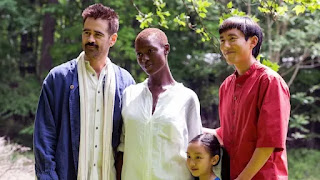
   The movie has a story of sorts. Android Yang (Justin H. Min) has been purchased as a companion for the adopted Chinese daughter (Malek Emma Tjandrawidjaja) of Jake (Colin Farrell) and Kyra (Jodie Turner-Smith). 
   When Yang breaks down, young Mika becomes distraught. Her parents purchased Yang to be a companion and to help school young Mika in Chinese culture.
   What's a dad to do? Try to get Yang repaired, of course. 
   Turns out Yang was purchased as a refurbished model and the company that issued Yang's warranty has gone out of business. Jake tries an unauthorized repairman (Ritchie Coster), who says Yang might be equipped with spyware. He gives Jake Yang's memory chip (or something like it) and suggests that he review its contents before deciding whether to repair Yang or let the technosapien "decompose."
    Jake then consults a professional (Sarita Choudhury) who helps him browse Yang's memory. He learns about Yang's connections beyond the family, notably with a young woman (Haley Lu Richardson) who once worked as a barista.  
    Kogonada's movie falls mostly on Farrell's shoulders. Jake sorts through Yang's memories, a task that forces him to ponder the relationship between memory and humanity. 
    Even as Jake's inner turmoil is suggested by a restrained Farrell, the movie operates under a transfixing calm. After Yang floats by easily, challenging assumptions about ethnicity and other matters. Complex issues rise like bubbles in a stream.
   If you're waiting for a knock-out plot development, you may still be waiting after the end credits roll. Kogonada  (Columbus) looks at big issues through a narrow gauge, the design of the home occupied by this family, the driverless car with plants growing in it (we see only the car's interior), and the delicacy with which Farrell approaches brewing a cup of tea.
    Kogonada leaves it to us to decide what to make of the way Jake and his wife connect as parents too busy to fully relate to their child and each other.  It's not only Mika who misses Yang; the family doesn't quite know how to function without him.
    Making a movie of subtly shifting tones is a gamble that doesn't always pay off and Kogonada offers little by way of explanation of how humanity has arrived at this multi-cultural, multi-racial point. 
    Still, I found it impossible to watch After Yang without getting caught in its quiet flow. 

Thursday, August 24, 2017

A drama set in Columbus, Ind.

Columbus makes modern architecture as important as its characters.

The director who calls himself Kogonada (not his real name) previously has made short films inspired by directors such as Ozu and Wes Anderson. Kogonada's debut feature -- Columbus -- premiered at the 2017 Sundance Film Festival, where it received mostly glowing reviews.

Kogonada's love of Ozu shows in Columbus, a movie in which the camera often remains stationary and in which the actors, for the most part, perform with admirable restraint.

The movie is named for Columbus, Indiana, a city known for its modern architecture, buildings from the likes of Eero Saarinen, I.M. Pei and James Polshek sit improbably in the heart of this small Midwestern city.

Columbus and its architecture become a character (perhaps the most interesting character) in Kogonada's story about two people moving in opposite directions.

Casey (Haley Lu Richardson) has graduated high school but is stuck. She feels obligated to remain in Columbus to take care of her mother, a recovering meth addict played by Michelle Forbes.

John Cho portrays a Korean-born translator who arrives in Columbus because his father, an architecture scholar, has collapsed and fallen into a coma. Unlike Casey, Cho's Jin needs to come to grips with his past, not move away from it. He hasn't spoken to his father for a year.

It should be apparent from the opening shots that Kogonada has a strong compositional sense that's bolstered by cinematographer Elisha Christian's ability to bring calm, ravishing light to almost every scene.

As the story evolves, Casey and Jin develop a flirtatious friendship. She works in the town library and derives pleasure and solace from the town's architecture. Jin claims to have no interest in architecture, which probably has something to do with his inability to feel anything about his father's impending demise.

Kogonada adds two additional characters to the mix, an associate of Jin's father (Parker Posey) and one of Casey's library co-workers (Rory Culkin). The conversations tend toward the intellectual; these characters evidently are accustomed to channeling their feelings into thoughts that they can share more easily than emotions.

Richardson, last seen in M. Night Shyamalan's Split, plays a coming-of-age role, and Cho conveys the weariness of a man who has been fighting his demons for a long time. Both do fine work.

Always great to look at, Columbus nonetheless can feel boring, studied and overly composed, so much so that it made me hope that Kogonada would loosen the arty cords that may be binding him and that sometimes constrict this otherwise promising work.