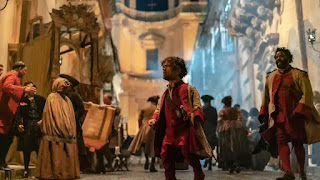
Some characters never vanish. Consider Cyrano de Bergerac. The witty, eloquent outsider has been pining for Roxanne since Edmond Rostand's play debuted in 1897.
Rocky Mountain Movies & Denver Movie Review
FOR MOVIE LOVERS WHO AREN'T EASILY SWEPT AWAY
Wednesday, December 29, 2021
Dinklage gives 'Cyrano' wit, heart, and bite
Some characters never vanish. Consider Cyrano de Bergerac. The witty, eloquent outsider has been pining for Roxanne since Edmond Rostand's play debuted in 1897.
Thursday, December 14, 2017
Gary Oldman's finest hour
The most striking thing about Darkest Hour, the story of how Britain teetered on the edge of defeat in World War II but regained its moral resolve, involves Gary Oldman's make-up and performance as Winston Churchill. Although he seems the least likely of actors to tackle Churchill, Oldman and makeup artist Kazuhiro Tsuji pull off a near miracle. They give us a Churchill who's domineering, insecure and witty, but also a man sagging as the weight of decision falls on his shoulders.
There aren't many sure bets these days, but it seems certain that Oldman will be nominated for a best-actor Oscar for what he has done in a movie directed by Joe Wright (Pride and Prejudice and Anna Karenina).
Wright directs with a sure if somewhat heavy hand, underscoring the momentous nature of nearly everything that happens in Darkest Hour. The major question before Churchill and his war cabinet: Should Britain negotiate some sort of peace agreement with Herr Hitler, as Churchill refers to the Austrian paperhanger?
The alternative: battle until victorious or until the last British warrior falls.
We all know how the story turns out, but at its best, Darkest Hour -- which depicts some of the events leading up to the civilian evacuation of British soldiers from the beaches of Dunkirk -- reminds us that history only looks inevitable when viewed through a rearview mirror.
In 1940, it was by no means certain that Britain could withstand the German onslaught. The US had yet to enter the war, and Hitler's armies were toppling one European country after another.
Audiences that have seen Dunkirk already are prepped for Wright's movie, which recreates behind-the-scenes haggling among the anti-Churchill forces. Neville Chamberlain (Ronald Pickup), who Churchill replaced as Prime Minister, wanted to stave off destruction by negotiating with Hitler. Stephen Dillane appears as Viscount Halifax, a Chamberlain ally who was even more anxious to capitulate than his friend.
King George VI (in a fine, subtle performance from Ben Mendelsohn) had doubts about Churchill, whom he both feared and mistrusted -- at least during the early days of Churchill's Prime Ministership.
Wright doesn't pay a great deal of attention to the women in Churchill's life. His wife Clementine (Kristin Scott Thomas) bolsters Churchill's ego when it begins to flag. Lily James plays Elizabeth Layton, Churchill's secretary, a young woman he initially intimidates but whom Churchill eventually sees in human terms.
Some scenes are as hokey as Churchill is bombastic. Besieged by doubts late in the movie, Churchill takes a ride on the underground (supposedly his first ever) to mingle with the people, listen to their views and draw on their strength.
Of course, Churchill was a large man -- both physically and in importance. The movie is at its best when Oldman delivers important Churchill speeches ("We shall fight on the beaches, etc.") and when peppering his performance with Churchill's many peculiarities: He couldn't abide single-spaced typing, drank whiskey with his breakfast and throughout the day and seldom could be seen without a cigar.
So the verdict is mildly mixed. Darkest Hour isn't as great as the historical moment it depicts but Oldman's performance certainly rises to the occasion.
Thursday, April 7, 2011
'Hanna' unleashes more girl power
The movie’s most important gimmick can be found in its title character. Sixteen-year-old Hanna (Ronan) comes equipped with the kind of identity that earns respect in movies. She’s a carefully trained killer, a deadly helping of girl power served in an action context.
Ronan’s Hanna may have an Alice in Wonderland face, but she’s not likely to show up at any tea parties. She can take on multiple foes, out run even the most determined of pursuers, speak a variety of languages, and hunt game before breakfast. Did I mention that she handles weapons as deftly as other kids text?
Raised in a Finnish forest by a rogue CIA agent (Eric Bana), Hanna has been well schooled in the survival arts. She has been taught to anticipate danger and to defend herself.
In fairness, it must be said that Ronan elevates Hanna above the script’s abundant absurdity, giving her an eerie determination that makes this disorienting and far-fetched thriller more compelling than it deserves to be. When Hanna leaves the isolation of the forest, she’s like an alien trying to understand a new planet.
But Ronan can’t totally make up for the script’s lack of logic, unless you buy the idea that references to fairy tales excuse a multitude of sins, particularly a lack of plausibility.
I’m not over-interpreting: Wright makes explicit references to classic fairy tales, beginning with an illustrated edition of Red Riding Hood that Hanna peruses in an early scene and culminating in a showdown in an abandoned German amusement park where Wright offers one last grandly overstated chance to equate evil with a wolf.
Having passed beyond the age of the brothers Grimm, we must look for our ogres, witches and wicked stepmothers in the one place that reliably supports big-screen villainy: the secret corridors of government. Hanna must square off against a CIA bureaucrat (Cate Blanchett) who combines the bite of the Big Bad Wolf with the cunning of a wicked witch.
If Ronan is able to take Hanna beyond gimmickry, Blanchett – a gifted actress who need not apologize for anything she does – fares less well. Her Marissa, an all-business killer, is a predator, right down to her bleeding gums. She’s arch, vicious and burdened by a wavering Southern accent.
Wright, who directed Ronan in Atonement and who also directed a big-screen version of Pride and Prejudice, this time forsakes literary adaptation for a kinetically charged fantasy in which Hanna spends nearly the entire movie on the run. When Hanna decides she’s ready to leave the forest, she’s captured by Marissa’s troops. After she escapes, she heads for Berlin, where she’s supposed to reunite with Bana’s character.
En route, Hanna faces a variety obstacles. Notable among these supporting menaces: Tom Hollander’s Isaacs, a freakish blond killer whose looks and intonations suggest a level of perversity so ingrained, it has become casual.
At heart, Hanna is little more than a glorified series of chases with one interlude offering a bit of relief. Hanna latches onto a normal family that’s touring Morocco in a battered van. Hanna does her best to make friends with the family’s teen-age daughter (a lively Jessica Barden), but Hanna has not learned much about social interaction.
The movie doesn’t sit still for long, and Hanna soon finds herself back in motion, traversing borders with an ease that defies logic. She also runs a lot, an activity that has prompted comparisons to director Tom Tykwer’s 1998 Run Lola Run. Unlike Tykwer’s streamlined effort, Wright’s Hanna loads up on plot, boosting its adrenalin level with a throbbing Chemical Brothers score that amounts to musical fist pumping.
At the end of a movie, it’s sometimes interesting to imagine what might be next in the life of its main character. For Hanna, that question only can be answered in movie terms. What’s next? The only thing I could think of for this wholly unreal character was a sequel.
Put another way: I don’t think there are any proms or SATs in young Hanna’s future.

