Rocky Mountain Movies & Denver Movie Review
FOR MOVIE LOVERS WHO AREN'T EASILY SWEPT AWAY
Tuesday, March 1, 2022
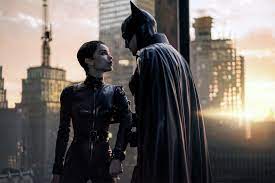
Can a despairing Batman still fight crime?
Thursday, July 13, 2017
An inter-species fight for survival
Has it come to this? Do we humans have so little faith in ourselves that we must look to apes for inspirational leadership? We are talking, of course, about Caesar, the ape given life by actor Andy Serkis and state-of-the-art digital effects in two previous Planet of the Apes movies.
In its latest edition -- War for the Planet of the Apes -- Caesar becomes a figure as large as Moses, a primate who must lead his fellow creatures out of the hostile wilderness created by murderous humans.
In this edition, the vile humans are represented by an American colonel, Woody Harrelson mainlining a mega helping of the same madness that gripped Marlon Brando in Apocalypse Now. Harrelson's character holds the ape population hostage, turning them into forced laborers in what he views as a last-ditch effort to save mankind from the simian onslaught.
In case we don't get the similarities to Brando's Colonel Kurtz, the movie makes a wryly intended reference to "Ape-Pocalypse Now," but I think most audiences will have caught on without the visual prompting.
Harrelson pulls out as many stops as he can find to portray the evil Colonel who knows how to give his sadism a nearly convincing rationale, and the movie doesn't flinch when it comes to showing us the suffering inflicted on the apes that have been imprisoned in the Colonel's concentration camp.
Director Matt Reeves leaves little room for us to doubt where our rooting interests are meant to lie. The movie clearly sides with Caesar and his cohorts: an orangutan named Maurice (Karin Konoval) and an associate named Rocket (Terry Notary) among them.
Caesar faces the movie's greatest challenge: He must resist the call for personal vengeance against the Colonel, who's responsible for the death of Caesar's wife and his oldest son. Is Caesar a big enough personality to embrace such a noble cause?
Caesar is aided by a chimp called Bad Ape (voice by Steve Zahn), an escapee from a zoo who knows where to find the Colonel's hideous compound.
The special effects work obviously reaches superior levels, and the visual environment is convincing enough to carry a movie about the war between apes and humans. It's possible that performance capture -- the process by which an actor's motions are digitally translated into computer-generated apes -- never has been so effectively used, so much so that Reeves can include many close-ups of Caesar's saturnine countenance.
Perhaps to keep War from being entirely one-sided, we meet an orphan girl (Amiah Miller). She's taken in by the apes and cared for in a humane fashion.
Those left among the human population are devolving, losing their ability to speak. The apes, on the other hand, are progressing, beginning to master speech. For the moment, all but two of them communicate with sign language. But we know they'll soon be prattling away like the creatures already endowed with the capacity for speech.
The movie takes place 15 years after the lethal outbreak of simian flu, which has decimated humanity. No wonder Colonel is furious.
The settings -- from snow-covered landscapes to remote redoubts -- give the movie a chilled, desolate feeling. This "Ape-pocalypse" isn't exactly a ton of fun, obsessed as it is with its own seriousness. And if you don't like pounding drums, you'll hate Michael Giacchino's score.
The battle sequences are compelling enough, although Reeves's insistently grim approach tends to overwhelm the movie's small attempts at humor.
The point, of course, is that humans have disrupted the Edenic serenity of the planet. Screenwriter Mark Bomback elevates the idea of self-sacrifice in service of a worthy cause, something that human beings have trouble achieving in both the movie and in real life.
In the conclusion to this trilogy of most recent Planet of the Apes reboots, people become the last place to look for real expressions of humanity, which makes War for the Planet of the Apes either a powerful cautionary tale or one very expensive helping of misanthropy.
Thursday, July 10, 2014
Man vs. ape: Can there be a winner?
The screenplay for Dawn of the Planet of the Apes is smart enough to make you wonder whether the movie's intelligent apes didn't have a hand in writing it. This sequel maintains the overall arc of the revitalized series, pitting man (or at least some men) against ape (or at least some apes).
But if we take the apes as metaphors for the natural environment, the one which we tend to intrude upon and despoil, the movie becomes deeper, more resonant.
Director Matt Reeves not only peppers his screenplay with ideas, he tells a story that can be enjoyed on the most rudimentary of levels.
So where exactly are we in the evolutionary saga of the human and ape populations? We're in the near future just after a terrible Simian Virus has wiped out a substantial part of humanity.
A group of survivors -- perhaps numbering in the hundreds -- has assembled in a ruined quarter of a devastated San Francisco.
The apes, who have attained various levels of intelligence and some of whom have developed the ability to speak, live in the Muir Woods, where they've constructed an elaborate wooden village and are in the process of developing an ethos: Apes don't kill apes.
The apes do, however, kill deer: They hunt for food with spears and evidently are carnivorous. They also have family structures and a form of governance.
The apes are led by Caesar (Andy Serkis), a leader devoted the ape population. Caesar has strength, but also a reflective sense of sadness about where the world has been and where it seems to be headed.
The potential for additional trouble arises when the San Francisco humans launch an expedition into the Muir Woods. They hope to reactivate a power plant that's badly needed to maintain the city's supply of electricity and to keep matters from returning to total barbarity.
The mission includes a trio that has formed an impromptu family in the wake of the virus that has taken away husbands, wives and children. There's Malcolm (Jason Clarke), his girlfriend (Keri Russell) and Malcolm's son (Kodi Smit-McPhee).
The apes reluctantly agree to allow the mission to proceed, but Koba (Toby Kebbell) objects. It's understandable, maybe even justifiable: Koba -- a victim of cruel human experiments in the last movie -- has no reason to trust mankind.
Eventually, Koba sets himself up in opposition to Caesar, and we know that an eventual battle looms. The clash between Koba and Caesar allows Reeves & company to serve up some strong action while also examining the role of guns in building a civilization, as well as what happens when a society is fractured by two opposing narratives.
That conflict, of course, inevitably pits Koba and his marching minions against Dreyfus (Gary Oldman), a human who takes responsibility for wiping out the apes and protecting humanity.
Reeves (Cloverfield and Let Me In) handles the action, effects and story with great aplomb, developing a sense of mystery and awe from the outset -- with help from Michael Giacchino's powerful score.
The San Francisco-based battle sequences don't disappoint: They're even coherent.
To its credit, Dawn of the Planet of the Apes, which follows 2011's Rise of Planet of the Apes, doesn't entirely resolve the conflict between all its warring impulses. The movie does what few blockbusters would dare: It leaves us with a lingering, sorrowful feeling about the possibility of resolution.
Thursday, September 30, 2010
A remake that sticks close to the original
We’ve seen so many vampire movies lately that these blood-sucking creatures of the night have come to seem like neighbors, a bit more remote perhaps but also distressingly familiar. It’s worth remembering, then,that the Swedish movie, Let the Right One In (2008), was one of the strangest,most original and emotionally resonant of all the vampire movies to hit the
screen within the last several years.
Built around the torments of a lonely boy living in the chill of what seemed an endless winter, Let the Right One In echoed with the sadness of something that felt like eternal soullessness. The 12-year-old boy at the movie’s center was caught in a trap that never allowed the kind of triumphant release we’ve come to expect from horror movies.
Now comes the inevitable American remake, and the surprise, I suppose, is that Let Me In (a slightly altered title) doesn’t betray everything about its bleak predecessor. A little more vivid, a little more graphic and significantly less ambiguous than the Swedish original, Let Me In nonetheless follows a course that’s steeped in horror – not only the shock of bloody attacks – but also of being caught in an unbreakable cycle of deterioration and woe.
Kodi Smit-McPhee's Owen lives with his single mom (Cara Bouno) in a nondescript apartment complex in what seems to be a small town in the middle of nowhere, the kind of remote place where the cold invades bones.
One evening, a man (Richard Jenkins) and his daughter (Chloe Moretz) move into one of the apartments. Director Matt Reeves (Cloverfield) quickly establishes that there’s something different about 12-year-old Abby. Abby doesn’t wear shoes, even in the cold. She doesn’t attend school. She seems tougher (and smarter) than most 12-year-old girls. And maybe the man who accompanies her isn’t her father.
Reeves mostly follows the lead of the original in a story that deals with the way Owen is bullied at school. His mom – intentionally photographed in ways that never allow her to emerge as a full presence -- doesn’t understand her son’s loneliness. His father isn’t around. He’s one of those kids left to cope with difficult situations without adult help.
Reeves slowly develops the relationship between Owen and Abby, and for those who haven’t seen the Swedish original, the movie may seem a revelation, the antithesis of the garish shock machines that typify most American horror, as well as a kind of commentary on alliances formed at a time when one is too young to make significant decisions.
It’s no surprise that Jenkins gives a fine performance. Same goes for Elias Koteas, who plays a cop. But the movie couldn’t possibly work if its two young actors weren’t up to the task. Smit-McPhee, who played the boy in the unrelentingly grim big-screen adaptation of Cormac McCarthy’s The Road, has a wounded quality that’s perfect for the movie, and Moretz, last seen as a profanity-spewing dynamo in Kick-Ass, projects just the right amount of eerie resolve.
If there must be remakes of foreign movies, Let Me In probably qualifies as a model for how it should be done. The movie may be have moved from Sweden to the U.S., but in a way location hardly matters. The story really takes place in the land of loneliness and in the bruised areas of the human heart.


