It's easy to see why director Olivier Assayas may have been drawn to Giuliano Da Empoli's novel about the machinations behind Vladimir Putin's rise to power in post-Soviet Russia. We seem to relish behind-the-scenes looks at powerful institutions, perhaps hoping that we'll enjoy the contradictory pleasures of savoring and condemning the rot we find.
Rocky Mountain Movies & Denver Movie Review
FOR MOVIE LOVERS WHO AREN'T EASILY SWEPT AWAY
Saturday, May 16, 2026
A look behind the Kremlin's walls
It's easy to see why director Olivier Assayas may have been drawn to Giuliano Da Empoli's novel about the machinations behind Vladimir Putin's rise to power in post-Soviet Russia. We seem to relish behind-the-scenes looks at powerful institutions, perhaps hoping that we'll enjoy the contradictory pleasures of savoring and condemning the rot we find.
Tuesday, November 25, 2025
An overloaded 'Knives Out' mystery
Thursday, August 14, 2025
Spike Lee's vibrant 'Highest 2 Lowest'
Not many filmmakers would venture into territory that requires reimagining a film by the great master Akira Kurosawa. Korosawa’s 1963 High and Low, based on a 1959 novel by Ed McBain, may not be the director’s best film but it’s marked by troubling ethical questions and a daring approach that kept star Toshiro Mifune off screen for much of the movie's second half.
Wednesday, June 4, 2025
Wes Anderson's grand scheme movie
I use a notebook during screenings to keep track of specifics -- dates, locations, and colors. Things like that. If my handwriting were better these notes would be more useful, but even as they drift toward indecipherability, they serve as a memory aid.
Tuesday, December 5, 2023
A satiric story about a writer's dilemma
American Fiction director Cord Jefferson’s adaptation of a novel by satirical author Percival Everett introduces us to a character who wrestles with problems that blur the boundary separating common sense from absurdity.
Wednesday, November 8, 2023
An unsung civil rights hero
Tuesday, March 1, 2022
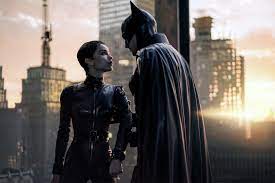
Can a despairing Batman still fight crime?
Thursday, October 21, 2021
Wes Anderson's insular ‘Dispatch’
Wes Anderson is an artful filmmaker and master miniaturist, a director who knows how to situate his films in the rich stream of cinema history. He's idiosyncratic and hardly ever seems to make a film in which his main objective is to soothe an audience. These are admirable traits and also the reasons why I always scold myself when I can't fully get behind an Anderson film.
Wednesday, October 6, 2021
Daniel Craig's admirable departure from Bond
Remember when we didn't take Bond movies seriously? Time was all we wanted from a Bond movie was nifty gadgets, charm, beautiful women, one-liners, and an out-sized villain, preferably working with Spectre.
Thursday, September 12, 2019
'The Goldfinch': a lengthy letdown
Many years ago, Bob Rafelson, the writer-director of movies such as Five Easy Pieces, The King of Marvin Gardens and Blood and Wine, told me something I've never forgotten. In an interview, Rafelson said that the best approach for screenwriters who adapt novels is to concentrate on what he or she most loves about the book and jettison everything else.
As is often the case with sage advice, Rafelson's mostly goes unheeded. If you're looking for evidence, search no further than The Goldfinch, the big-screen adaptation of a Pulitzer Prize-winning 2013 novel by Donna Tartt.
Beautifully shot by cinematographer Roger Deakins and mounted with a clear respect for nearly all other aspects of cinema craft, The Goldfinch nonetheless connects only intermittently. It's possible that director John Crowley and screenwriter Peter Straughan had too much respect for the material. Their movie plays like a dutifully illustrated version of Tartt's novel, a two-hour and 29-minute work that has the look of a prestige offering with built-in Oscar glow that the story never really matches.
The movie's pivotal event occurs when young Theodore Decker (Oakes Fegley) visits the Metropolitan Museum of Art with his mother. As luck would have it, Theodore and his mom happen to be at the museum when it's struck by terrorist bombs. Mom dies, Theodore's odyssey begins, and the source of the story's title is revealed.
Theodore leaves the museum with a small 17th-century painting by Dutch artist Carel Fabritius, a student of Rembrandt. The painting depicts a pet goldfinch that has been chained to its perch. Ironically -- with a capital "I" -- Fabritius perished in an explosion.
The painting becomes the movie's McGuffin, a literary conceit that pushes Theodore into a world that's not always kind to him and which some reviewers of the novel aptly called Dickensian.
The movie contains a ton of plot and many characters. These include the Babours (Nicole Kidman and Boyd Gaines), the Park Avenue couple who take the newly motherless Theodore underwing until the boy's wayward father (Luke Wilson) and his trashy girlfriend (Sarah Paulson) turn up. They drag the boy off to Las Vegas.
In Las Vegas, Theodore meets Boris (Finn Wolfhard), an abused wild child who becomes his only friend and who also introduces him to alcohol and drugs.
Flashbacks to the fateful explosion gradually reveal precisely what happened on the day of the attack, but these hazy backward glances begin to feel tiresome. Crowley also alternates scenes of Theodore as a child with scenes in which Theodore has become a young man played by Ansel Elgort. Boris also crops up as an adult, portrayed by Aneurin Barnard.
Two potential love interests for Theodore also are included: Pippa (Ashleigh Cummings) was in the museum on the day the bombs went off and seems his obvious soulmate. In his early adulthood, Theodore becomes engaged to the Barbours' daughter (Willa Fitzgerald).
Jeffrey Wright gives the movie's most memorable performance as Hobie, an antique dealer who becomes Theodore's mentor. Hobie delivers the speech that announces the movie's theme, a reverence for the immortality of art as contrasted with the fragile mortality of those who create, save and respect it -- and, of course, the rejection of anything that might be considered fake.
Not all the performances come into sharp focus: Kidman portrays a decorous, emotionally reserved woman who also seems to have a genuine affection for Theodore. Wolfhard's Boris enters the movie with the force of a tossed grenade; it's as if he has been added to enliven the proceedings. Fegley's young Theodore can be impish, wounded or rebellious.
And Elgort's tormented and guilt-ridden character (he blames himself for his mother's death) isn't as interesting as his childhood version.
So what to make of all this? Good question and one that the movie's arduous length allows ample time to consider, even when the pace picks up in a third act that's overburdened with thriller-like plot developtments revolving around the painting.
Watchable without being compelling, The Goldfinch leaves us to ponder what this movie, at its deepest level, is all about. If you can't answer that question, you may be forced to consider a sobering possibility: Perhaps that deepest level wasn't reached.
Thursday, November 21, 2013
More (and better) Hunger Games
At the conclusion of The Hunger Games: Catching Fire, I felt as if I'd been watching an old-fashioned serial -- only one that had been playing for two hours and 26 minutes. Even at this excessive length, the second big-screen adaptation of novelist Suzanne Collins's popular series, left me wanting more.
Much of the credit for this goes to Jennifer Lawrence , the fine actress who gives Catching Fire its conscience and its heart.
Moreover, the movie's visual environment -- skillfully created by director Francis Lawrence and a capable effects team -- enhances what amounts to an upgraded second helping of a franchise that's gaining both momentum and seriousness as it moves toward its finale.
Lawrence (the director) has a distinct advantage over his predecessor, director Gary Ross. Because he doesn't need to establish the world in which the action takes place, Lawrence is free to advance the story, and he wastes no time belaboring the obvious: The Hunger Games that define the movie have a disturbing contemporary relevance, reality TV carried to perverse extremes.
This edition finds Jennifer Lawrence's Katniss Everdeen as haunted as she is determined: In the last installment Katniss killed to survive: She now suffers the burdens of post traumatic stress disorder and lingering guilt.
The twist in the story finds Katniss and Josh Hutcherson's Peeta thrown back into competition as part of a ploy by the evil Capitol to extinguish any flames of rebellion that might be sparking in the various districts into which the country of Panem has been divided.
This particular competition -- staged to celebrate the 75th anniversary of the Capitol's victory over an earlier rebellion -- pits previous Hunger Games winners against one another in what promises to be an even more brutal fight to the death. There's only one winner in a Hunger Games competition; i.e., one survivor.
There's a hitch in the plan, though. This time, combatants are much more likely to ally with one another because they all feel betrayed. Victories in earlier editions of the Hunger Games were supposed to guarantee the winners and their families lives of peaceful ease. The Capitol has reneged on its promise.
It doesn't take much familiarity with the Collins's novel to know that currents of rebellion flicker beneath the fascistic, authoritarian order that the Capitol ruthlessly enforces. Public floggings and arbitrary punishments makes us root for revolution.
The returning cast includes Donald Sutherland as President Snow, a man whose cunning is as thorough as his crisp enunciation. Liam Hemsworth returns as Gale, Katniss's old flame. Katniss's heart may belong to Gale, but she's forced into a phony romance with Peeta -- mostly to amuse the ever-observant powers-that-be in the Capitol. Will the sham become real?
Woody Harrelson reprises his role as Haymitch, an older former Hunger Games winner. Elizabeth Banks returns as Effie Trinket, the big-haired fashionista who presides over the public image of Katniss and Peeta. Lenny Kravitz is back as Cinna, Katniss's super-creative costumer; and Stanley Tucci again turns up as Caesar Flickerman, the host of the Hunger Games broadcast whose smile is as big as a billboard. A little of Tucci's over-the-top, parodic take on game show hosts goes a long way, even when used judiciously, as it is here.
The movie benefits from the addition of a few new characters: Plutarch Heavensbee (Philip Seymour Hoffman), a game designer and master schemer, becomes the brains behind President Snow's malignant schemes. Plutarch has been charged with designing this edition's electronically controlled Hunger Game: It's called The Quarter Quell and includes poisonous fog, vicious baboons, swooping birds and a storm surge.
Also joining the fray are Jeffrey Wright, as a technically savvy warrior, and Sam Claffin, as an arrogant combatant, who turns out to be less selfish than we initially anticipate. Jena Malone has a nice turn as a Hunger Games participant who makes no attempt to hide her fury at having been drawn back into combat.
From the outset, the movie's effects team has ample opportunity to impress -- in the sleek imperial Capitol, on speeding trains and in decaying District 12, home to Katniss and Peeta, and, of course, in the action-packed games. (Oddly, the games might be the movie's least interesting achievement.)
The movie builds to a climax that neatly sets the stage for the final chapter, Mockingjay, which is scheduled to be released in two installments next year.
Unlike some franchises, Catching Fire isn't afraid to put some breathing space between its action set pieces. And this time, the movie seems more serious about immersing us in a class-divided society in which the misfortunes of the impoverished many support the decadence of the privileged few.
Thursday, March 31, 2011
A gripping, if muddled, 'Source Code'
Jake Gyllenhaal portrays Coulter Stevens, a young man who wakes up on a Chicago commuter train. The woman seated across from him (Michelle Monaghan) talks to him as if she knows him. But he doesn't know her. Totally confused, Gyllenhaal's character slips into the restroom to regroup. There, the weirdness gets weirder. When he looks in the mirror, the reflection staring back at him belongs to someone else.
As Source Code progresses, we begin to realize (as does Gyllenhaal's character) what's happening, but it's best not to tell too much more about the movie's plot, except to note that Ben Ripley's screenplay has Gyllenhaal repeating the same scenario a number of times.
We learn what's going on at roughly the same pace as Gyllenhaal's Stevens, a veteran of the war in Afghanistan. He begins to grasp that he's on a mission that requires him -- with help from some technology, of course -- to keep returning to that train in eight-minute chunks.
With each trip, Stevens gains more knowledge about how high the stakes are. Bombs, domestic terror and terrible urban destruction lurk in the background.
Although I can't say Duncan totally sold me on the movie's time-bending premise, he keeps the story moving with the inexorable speed of the train Stevens revisits. At its best, Source Code comes at us in vivid bursts; its mood becomes increasingly frantic, partly because its hero must work against inflexible deadlines that up the dramatic ante. It's an old contrivance, of course, but Duncan infuses it with fresh energy.
Gyllenhaal acquits himself well, and Monaghan proves exceptionally appealing as a young woman who believes her life has reached a turning point.
The rest of the cast includes Jeffrey Wright, as a brainy scientist, and Vera Farmiga, as Wright's subordinate. Wright, a wonderful actor, seems wasted in a role that just about anyone could have handled. Farmiga, who has more to do, portrays a character that's a bit of a departure for her, but neither Wright nor Farmiga are likely to press this one into their books of indelible acting memories.
Source Code flirts with joining the ranks of paranoia-prone movies that deal with the ways manipulative governments betray their heroes. Too bad the movie's cop-out ending - really an epilogue - pushes Duncan onto less challenging turf. But Duncan knows how to hold an audience's attention, and Source Code's devotion to creating Hitchcock-style suspense keeps us on edge, which (happy to say) is precisely what movies such as this are supposed to do.