Showing posts with label Oliver Jackson-Cohen. Show all posts

Wednesday, March 19, 2025

They escaped from Chelmno


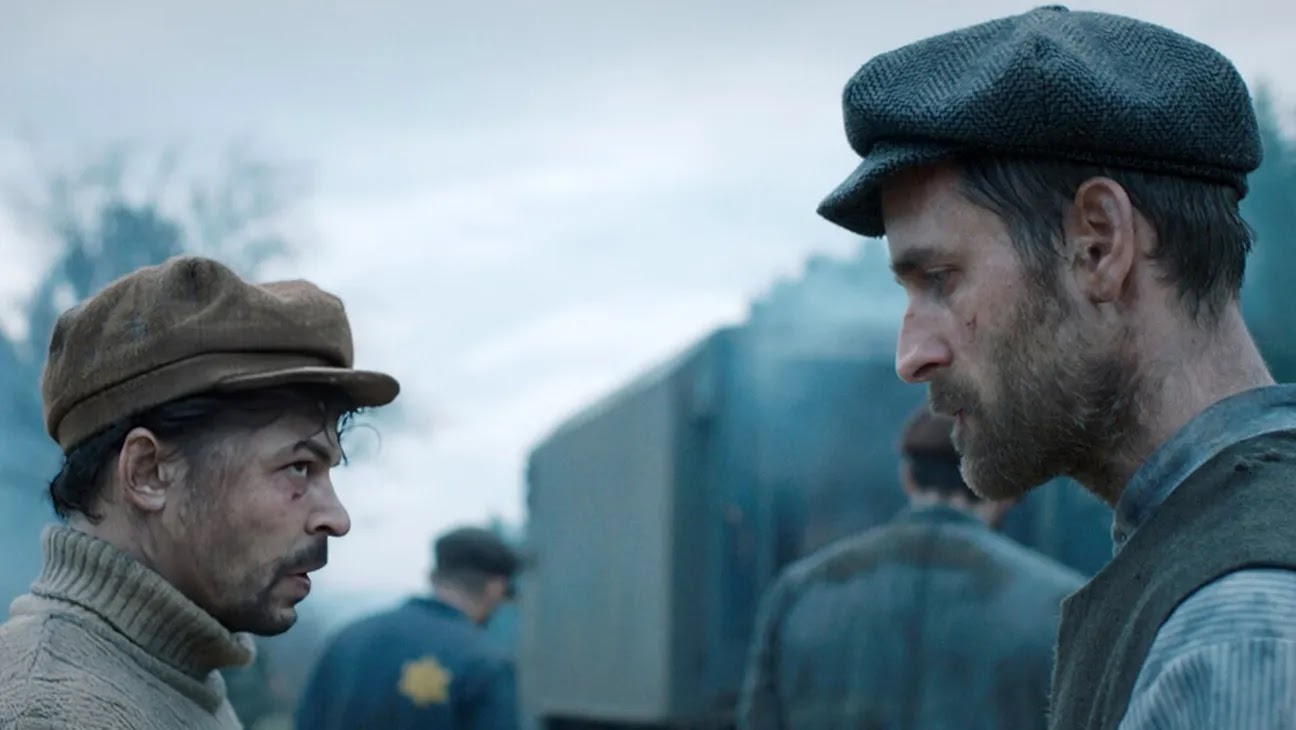
The World Will Tremble, a film from director Lior Geller,  focuses on a 1942 escape from Chelmno, the first death camp created by the German army in Poland. Two of the escapees are credited with bringing first-hand accounts of the mass murder of Jews to the outside world. Prior to the escape, we meet Jewish men who've been pressed into horrible labors at Chelmno: digging mass graves and hauling bodies out of trucks after gassing. Cruelty abides. A German officer assures new victims they'll be treated better than they were in crowded ghettos. Instead, all of them are murdered. After introducing life in the camp, the movie follows two escapees (Oliver Jackson-Cohen and Jeremy Neumark Jones) through Polish forests as they attempt to elude German pursuit. A late-picture scene brings the men to a village, not yet liquidated, where the local rabbi has difficulty accepting their account. I wish that The World will Tremble had felt more developed, but Geller succeeds in calling attention to a story that's not well known. You may want to think of what's depicted at Chelmno as an Auschwitz prequel. You'll see Michal Podchlebnik, one of the real escapees, in an epilogue. For the record, Podchlebnik, who died in 1985 the age of 78, appeared in Claude Lanzmann's Shoah. He also testified in 1961 at the trail of Adolf Eichmann.


Thursday, February 23, 2023

A vivid look at a woman who wrote


 She wrote only one novel but it became a classic. She was thirty years old when she died of tuberculosis. One of her sisters also became a famous novelist. Sounds like Jeopardy, no? Answer: Who is Emily Bronte?
 In Emily, director Frances O'Connor draws on some the limited facts about Bronte’s brief life. More importantly, she finds something of the wildly independent spirit that infused Bronte's signature work, Wuthering Heights.
  That's not to say that Emily spends all its time brooding or wandering the moors that haunted Bronte's Heathcliff. Brilliantly rendered by Emma Mackey, Emily becomes a semi-fictional creation that helps us appreciate the artist behind the art, not a character who once lived but one who feels fully alive.
   The movie embeds Emily's story in her family life.
   Bronte's stuffy widowed father (Adrian Dunbar) favors sister Charlotte (Alexandra Dowling) and tolerates wayward brother Bran (Fionn Whitehead). 
   Gemma Jones portrays Aunt Branwell, the woman who holds the Bronte household together. As the youngest of the Bronte sisters, Anne (Amelia Gething) benefits from everyone's affection.
  Aspiring writers during the time the movie takes place, Emily and Charlotte engage in an intense sibling rivalry. Charlotte, of course, wrote Jane Eyre, another highly regarded novel.
  Bronte scholars will recognize the many liberties that O'Connor, who also wrote the movie's screenplay, takes -- none more prominent than the inclusion of a torrid love affair between Emily and newly arrived clergyman William Weightman (Oliver Jackson-Cohen). 
   Tormented by his clerical conscience, Weightman staggers into an affair that Emily has far less trouble embracing. He can't entirely overcome the guilt that springs from an ingrained sense of propriety. 
    It's hardly a spoiler to note that the affair leads to heartbreak and allows O'Connor to make effective use of a hoary literary conceit. No fair telling more but this risky ploy easily could have curdled. Instead, it works, giving the movie a novelistic feel.
    Emily's brother Branwell proves a delusional mess, the Bronte who declares himself a writer and romanticizes his role as such. The problem: If he ever had any talent, Bran surrendered it to drink and opium.
    When Branwell shares a manuscript with Emily, she delivers a takedown so withering, it may give you chills. I was tempted to try to copy it verbatim should the need for such a brutally honest reaction ever present itself. And, no, I don't think it I could say those words to anyone.
     In the movie's most unsettling scene, Emily dons a mask that her father had made of her late mother. She seems to channel her mother's spirit. I didn't quite know what to make of the moment and I'm not sure the movie did either. Still, it augments the unease surrounding Emily, the feeling that she exists at a remove from others.
    O'Connor presumes that we understand Emily's attraction to the fragrance and forbidding mysteries of the moors.  It helps I suppose to have read Wuthering Heights or at least seen William Wyler's 1939 adaptation starring Merle Oberon and Laurence Olivier. 
    Emily isn't a bona fide biopic. Maybe that's why the movie never feels as if it might by suffocated by period-piece trappings. Besides, Emily may be something better than a straight depiction of Bronte's life: A look at the vital spirit that burned in a writer whose dark novel about ferocious love still resonates almost 175 years after her death.

Thursday, February 27, 2020

When a woman's abuser can't be seen

Elisabeth Moss dominates a smart new version of The Invisible Man.
Her antagonist may be invisible, but the same can't be said for Elisabeth Moss. The actress dominates nearly every scene of The Invisible Man, a #MeToo-influenced take on the 1897 novel by H.G. Wells.

The setup: Brilliant scientist Adrian Griffin (Oliver Jackson-Cohen) has been abusing his wife, Moss's Cecilia. After Cecilia leaves him in the movie's pulse-pounding prolog, Adrian feigns his death. The twist: He's able to make himself invisible so that he can torment Cecilia. He refuses to let her go.

As Adrian begins to make his invisible presence felt, director Leigh Whannell creates plenty of high tension, punctuated by a few nicely placed jumps scares.

There's no mystery about what's happening to Cecilia, but Whannell wrings suspense out of Cecilia's situation: She can't convince anyone else that her former husband isn't dead. We're left to wonder when and how Mr. Invisible will strike next.

The screenplay, also by Whannell, adds some tasty complications. Turns out that Adrian's lawyer brother Tom (Michael Dorman) is the executor of the scientist's estate. He tells Cecilia that she's been left $5 million by Adrian, money that will be doled out in $100,000 installments.

Although the focus remains on Cecilia, additional characters turn up. Harriet Dyer plays Cecilia's sister, a woman with whom Cecilia hasn't always gotten along. Aldis Hodge portrays James, a cop who takes Cecilia into his suburban home when she's fleeing her husband. James' teenage daughter (Storm Reid) bonds with Cecilia. Reid's character wants to study design. Cecilia is an architect by trade.

Strong atmospherics add to the gathering unease. Whannell turns his camera into a stalker, giving us the Invisible Man's point of view at times when it's most frightening. He skillfully deals with the standard elements of horror, a scene in which Cecilia enters an attic in hopes of confronting her nemesis.

Scenes in the mental institution where Cecilia eventually finds herself are chilling and give Moss an opportunity for some Grand Guignol theatrics.

Moreover, Adrain's house -- the place where he maintains his lab -- is a tour de force of icy modernism, full of sleek surfaces that give you the impression that in Adrian's house, nothing has ever been misplaced. Adrian hasn't allowed an ounce of warmth to penetrate his retreat.

Now, it would be misleading if I didn't tell you that the story falters here and there and the whole idea of building a movie around the notion that someone has mastered the art of becoming invisible remains ... well ... preposterous.

But Whannell, who acted in the Saw movies and who wrote and directed Upgrade, clearly has chops for this kind of movie. He also demonstrates that he's paid attention to Alfred Hitchcock's understanding of how to create a menacing mood.

Now, I said that the movie seems like a spawn of the #MeToo moment. That's true -- and also obvious. It's worth pointing out an irony, though. Many of those accused of sexually and psychologically abusing women hardly could be called invisible. They were protected by their visibility and power.

OK, so The Invisible Man doesn't plumb every inch of metaphoric depth contained in its principal conceit. But Moss and Whannell serve up enough chills to make the movie as effective as James Whale's 1933 version. and unlike many wise-ass forays into the pop-cultural closet, The Invisible man wastes no time winking at us. It's smart enough to take itself seriously, which makes it easy for us to follow suit.