Showing posts with label Rosario Dawson. Show all posts

Wednesday, September 14, 2022

Bob’s Cinema Diary: Sept. 14: '22 — 'Clerks III' and 'Simchas & Sorrows'

 Clerks III


I suppose lots of folks are fond of remembering Kevin Smith’s Clerks, a black-and-white indie that debuted in 1994. Not me. Since Clerks was released, I’ve not been tempted to revisit the movie and I somehow missed Clerks II, possibly because I was out of the country at the time of its release. Now comes Clerks III, a comedy that likely will provide a trip down nostalgia lane for Smith’s fans. Much of the original cast has returned, supplemented by Rosario Dawson, who appeared in the second installment. Smith’s brand of snark, pop-cultural awareness (90s style), and mild self-mockery have never been my cup of amusement. In this latest addition, convenience store co-owner (Jeff Anderson) convinces his pal Dante (Brian O'Hallaran) to help him finance a movie that very much resembles the original Clerks — or, as we’re prone to saying these days — a movie that adds a meta layer to its Jersey origins. Mildly amusing at times but muddied by the introduction of death as a topic of consideration, Clerks III features two (count 'em) heart attacks. Smith clearly knows how to add a bit of zest before the proceedings turn sentimental. Still, Clerks has little to offer those who are not committed to completing the Clerks cycle or waiting for several "surprise" cameos.

Simchas & Sorrows
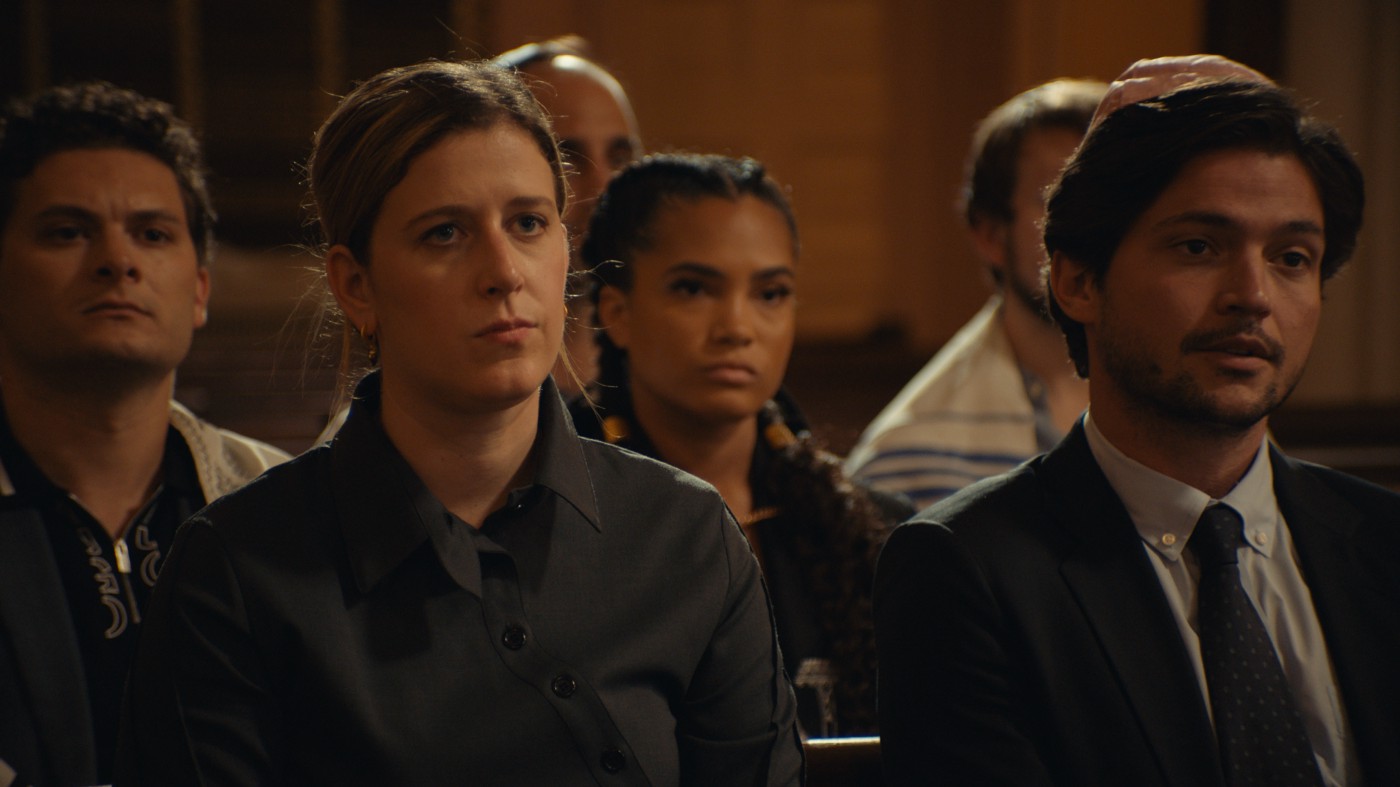


Finally, a movie about converting  to Judaism. I’m kidding of course. I doubt whether the world has been waiting for someone to explore this subject. But it's tackled head-in Simchas & Sorrows, a rom-com that interrupts a generally humorous approach for serious observations, most of them delivered by a progressive rabbi (Nari Nef) who refuses to ignore an elephant in the room: She raises the subject of Palestinians with the couples she instructs. Writer/director Genevieve Adams plays Agnes, a Catholic-educated woman who’s engaged to Levi (Thomas McDonell), a young Jewish man who wants his future wife to convert. Agnes, who has given up on religion, is also pregnant. The prospect of a child further complicates matters of cultural difference. The characters are rounded out by Levi’s brother and his condescending fiancee (Annalise Cepero), by Levi's father (Chip Zien) father, and by Agnes’s grandfather (John Collum). Adams conveys a message about tolerance, acceptance, and ways to live in a multi-cultural, multi-religious world but the movie seems to prefer sincerity to sharply realized drama. Yes, it’s good to be respectful and not be too insistent on dotting every “i” and crossing every cultural “t.” No arguing with the message, but a last-minute revelation feels like a cop-out and, to me at least, it didn't feel as if the movie had fully engaged with its subject.

Thursday, April 20, 2017

'Unforgettable?' More like regrettable

In trying to dream up a reason that someone might want to see the new movie Unforgettable, I could come up with only one reason -- and it's more about curiosity than anything that might be termed credible persuasion. Katherine Heigl, who usually plays sweet, turns bitter to play the latest murderous ice queen to provide an audience with reasons to hiss, boo and giggle. Sporting shoulder-length blond hair that never has seen a curl and an alabaster complexion, Heigl looks like a late-model android; there's something unnervingly fake about her appearance. As directed by Denise Di Novi, from a screenplay by Christian Hodson, Unforgettable can't even manage to attain the level of superior trash. It's not for want of trying: A melodramatic story introduces us to Julia Banks (Rosario Dawson), a writer who leaves San Francisco to join her fiancé David (Geoff Stults) and his daughter Lily (Isabella Kai Rice). Traumatized by an abusive relationship in which she was beaten, Julia is ready for a new life. Enter Heigl's Tessa, David's insanely possessive former wife who intrudes herself on her husband's new relationship. Tessa ultimately carries her obsession to absurdly violent heights. A near thorough lack of plausibility and scenes that had a preview audience laughing (in the wrong places, I think) make this a preposterous entry into an already soggy spring lineup.

Thursday, December 11, 2014

Chris Rock on the streets of New York

In Top Five, a talented comedian finds a movie that he truly makes his own.
Chris Rock comes close to hitting his stride in Top Five, a new comedy about an alcoholic comedian who's trying to establish himself as a serious actor.

In his third directorial effort after I Think I Love My Wife (2007) and Head of State (2003), Rock finally finds a vehicle that brings some of the smarts, raunch, social insight and bravado of his stand-up routines to the big screen, along with enough vulnerability to protect him from accusations of undue vanity.

In this outing, Rock -- who directed and wrote the screenplay -- portrays Andre Allen, a stand-up comic who finds a niche (and an enlarged bank account) in Hollywood playing a character called Hammy the Bear, a cop in a bear suit who mows down criminals with his automatic weapon.

The Hammy movies are enormously popular, but Allen's sick of making them. That's why he ignores the advice of his agent (Kevin Hart) and pushes himself into a new arena with a serious movie called Uprizing!, the story of a 1791 Haitian slave revolt. The poster features a bearded Allen brandishing a machete.

Of course, Uprizing! is on track to bomb, thus thwarting Allen's attempts at reinvention.

Rock's screenplay mostly follows Allen around New York City as he meets with a variety of indignities on his film's opening day. Rock doesn't miss the opportunity to take a few nicely placed shots at movie-biz hype -- an easy but ever-ripe target.

Rock's character's last name is Allen, and his fans want him to return to his funny stuff. Sound like anyone you can think of? Allen spends a fair amount of time walking and talking in Manhattan, but the humor and tone of Top Five is light years away from Woody Allen, who never got down and, yes, dirty the way Rock can.

A fair amount of the movie's humor tends toward the raunchy and ribald, notably a bit in which a Houston hustler (Cedrick the Entertainer) introduces a visiting Allen to couple of hookers. The encounter devolves into what Allen describes as the low point that finally got him off the sauce.

I won't give away any of the other gags, but there's an amusing bit that suggests an even better movie, one that's more conversational than crude. Visiting the Brooklyn neighborhood that spawned him, Allen meets up with Tracy Morgan and a variety of others who create the riffs that give the movie its title. They're trying to name the top five hip hop artists.

Rock builds his slender story around a running bit: A New York Times reporter (Rosario Dawson) wants to write a profile about Allen, who hates the Times for having panned all of his movies. Pressured by his manager, Allen reluctantly agrees.

Rock and Dawson generate sparks of antagonism and potential romance that suggest something more than a reporter/source relationship with Dawson matching Rock step-for-step.

Did I mention Allen's engaged? Gabrielle Union orbits the New York story: She's in LA, a blatant striver who has arranged to marry Allen as part of a reality show to be aired on Bravo.

Draw your own conclusions about the hot sauce gag, which is better discovered in theaters. Many will regard it as a comic high point. I didn't.

But rapper DMX singing his version of Smile made up it.

There's also a moment in which Allen finds himself in a choke hold administered by a New York Cop, an unintended evocation of recent events.

Don't look for a structural masterpiece: Rock builds his loose-limbed comedy around a variety of bits with a few serious moments added to make Allen's struggle with alcohol and desperation more plausible.

Although Rock appears in nearly every scene, he bolsters the movie with lively cameos from Kevin Hart, JB Smove, Whoopi Goldberg, Adam Sandler and Jerry Seinfeld.

Judging by the movie's cameos and by its ending, it's safe to say that Rock has a deep respect and love for stand-up and the people who do it.

It's tempting to wonder where Rock's movie career goes from here. Like his main character, Rock might be most comfortable with an audience in front of him and a mike in his hand.

In that environment, he's sharp, smart, savvy about pop culture, and unworried about giving offense. He's a comic with honesty and conviction, and in Top Five, he frequently comes across that way.

Thursday, March 27, 2014

Cesar Chavez unionizes farm workers

Cesar Chavez, a truncated bio-pic about one of the country's most famous labor organizers, offers a step-by-step look at the hard work of winning decent working conditions and reasonable wages for migrant laborers in California.

Director Diego Luna, who starred in Y Tu Mama Tambien and who previously directed a small movie called Abel, does a solid job of refreshing memories about Chavez's landmark efforts during the 1960s.

Working from a script credited to Keir Pearson and Timothy J. Sexton, Luna concentrates on the five years in which Chavez (Michael Pena) helped organize the workers who picked grapes for California wine growers.

After deciding he needed to be closer to the workers he was trying to help, Chavez moved his family to the agricultural town of Delano, Ca., and began the arduous work that resulted in the formation of the Farmer Workers Union.

Chavez and coworker Delores Huerta (Rosario Dawson) ultimately found themselves leading a lengthy strike, which the workers ultimately won.

The rest of the supporting cast doesn't make much of an impression. A grower named Bogdanovitch (John Malkovich ) becomes the movie's main bad guy. Wes Bentley makes a brief appearance as a lawyer who helps Chavez. We also see Robert Kennedy (Jack Holmes), who turned up to support Chavez during a 25-day hunger strike that he staged.

Please, a moratorium on actors playing Kennedys. It almost always a distraction.

Chavez's wife Helen (America Ferrera) proves a woman of independent spirit, and, at times, Chavez's devotion to the farm workers causes him to spend less time with his oldest son than he'd like.

Pena portrays Chavez as a regular guy who believed in non-violence and who had no doubt that the farm workers were being exploited. His convictions seem almost inbred, an inseparable part of his being.

At times, Cesar Chavez can feel too routine, and the use of news footage doesn't do much to expand the movie's reach. We don't learn much about Chavez's eight children, and if Chavez had deep personal failings, the movie isn't interested in finding them.

Still, Cesar Chavez is represented as a tireless leader who wrought major changes and whose story deserves to be told. Viewed as an expansion of the voices represented in American movies, I'd call it a start. Let's hope it's not the finish.

Thursday, April 11, 2013

Technique rules in stylized 'Trance'

Director Danny Boyle's new thriller misses the mark.
Is it possible for a director to put too much skill on display? I wondered about that while watching Danny Boyle's new thriller Trance, an over-produced hunk of intrigue that revolves around an art theft.

Boyle seems to be trying for a dizzying head trip of a movie, but in Trance, technique doesn't always translate into mind buzz; instead, technique seems to breed more technique.

Here's the story: A worker at a London auction house (James McAvoy) helps orchestrate an art heist in which a valuable painting by Goya will be stolen. The theft is successful, apart from one detail: During the theft, McAvoy's Simon is conked on the head. He loses his memory, and can't recall where he stashed the stolen painting.

The chief thief (Vincent Cassel's Franck) tries torture as a memory aid, pulling out several of Simon's fingernails. When that doesn't work, Franck switches gears, hiring a hypnotist (Rosario Dawson) to help unlock McAvoy's lost memories.

Nothing more than a classy MacGuffin, the painting quickly recedes in importance as Boyle plays with issues of betrayal, loyalty, desire and obsession. The result: An overly complex story that remains watchable without totally engaging on either an emotional or intellectual level.

Because Trance blurs the line between what's apparent and what's real, it's constantly playing games with us. We invest attention in scenes that we take as real only to discover that we're watching one of Simon's hypnosis-induced hallucinations.

McAvoy trades on his lively, nice guy image. Rosario, who at one point appears fully naked -- as in full-frontal nudity -- projects a sense of calm control, and Cassel manages a fair amount of mobster menace.

Known to audiences for movies such as 127 Hours, 28 Days Later and the Oscar-winning Slumdog Millionaire, Boyle may have been betting that the journey rather than the destination would carry the day -- that along with McAvoy's avidity, Dawson's sexiness and Cassel's brutish force.

It's not an entirely good bet. Once you break through the visual trickery, flashbacks and hypnotic falderal, Trance isn't especially difficult to out-guess.

Those familiar with Boyle's work won't be surprised to learn that Trance has its share of vividly realized scenes and moments. Boyle keeps our eyes and his camera busy, but that's not ultimately enough.