Rocky Mountain Movies & Denver Movie Review
FOR MOVIE LOVERS WHO AREN'T EASILY SWEPT AWAY
Tuesday, April 7, 2026
A feverish ‘Hamlet’ with Riz Ahmed'
Friday, January 2, 2026
Leftovers from the old year
The end of the year usually finds critics weighing in on some of the year's more serious offerings, movies that probably will dominate the upcoming awards season. That wouldn't apply to Anaconda. Director Tom Gormican offers the sixth installment of the series, this one starring a usually reliable comedy crew that includes Paul Rudd, Jack Black, Thandiwe Newton, and Steve Zahn. The story revolves around a quartet of old friends who reunite to rekindle the spark of enthusiasm they felt about the horror movies of their teens. Black, as a director of wedding videos, joins Rudd, as an actor with a dismal career, for a no-budget indie remake of their beloved Anaconda. Along with Newton, as a former high school pal, and Zahn, as another pal and cameraman, the principals head for the Amazon. Selton Mello appears as Santiago, the local hired as the movie's snake handler. Gormican mixes broad comedy and satire about movie cliches, but the movie's laughs may have gotten lost in the jungle, and its additions of horror seem like transfusions of gore into an already lost cause.
And while we're on the subject of strong casts and weak results, consider Goodbye June, a Christmas movie that marks Kate Winslet's directorial debut. Winslet also appears on screen along with Toni Collette, Andrea Riseborough, and Johnny Flynn. They're siblings dealing with the imminent death from cancer of their mother (Helen Mirren). Dad (Timothy Spall) seems more interested in football and alcohol than in his family. Did I mention that the movie takes place at Christmas time and reaches a sentimental conclusion when grandchildren perform a Christmas play for their dying grandma? This one is meant to jerk tears, but if I were going to shed any tears, they would be for a cast that deserved better material. No hard feelings, though. These accomplished actors surely will triumph anew.
Wednesday, April 3, 2024
A potentially good story wasted
Friday, December 23, 2022
An eccentric detective at West Point
A great cast can't save The Pale Blue Eye, a gloomy melodramatic story about a detective (Christian Bale) who investigates the murder of a cadet who was hanged before his heart was cut from his chest. Adapting his screenplay from a novel by Louis Bayard, director Scott Cooper delivers a chilly drama that brings a historical figure -- Edgar Allan Poe -- into a plot weighted with secrets. Poe (Harry Melling) did attend West Point, but the story is pure fiction. Bale's Augustus Landor invites Poe to join him in trying to solve a crime that has the Academy on edge. In addition to Bale, the movie casts Gillian Anderson and Toby Jones as a husband and wife whose son (Harry Lawtey) also attends West Point. Their daughter (Lucy Boynton) catches Poe's eye. Charlotte Gainsbourg portrays a waitress at a local pub who carries on an affair with Bale's Augustus Landor. Yes, that's Robert Duvall as an expert on witchcraft whom Landor consults. Suggestions of the paranormal waft through the wintery depictions of West Point, where Timothy Spall takes a turn as the school's embattled superintendent. A moody depiction of 19th-century life turns Cooper's movie into a mystery that's a bore or perhaps "chore" is the better word. The gothic environment Cooper creates is credibly somber but the drama feels freeze-dried.
Thursday, February 17, 2022
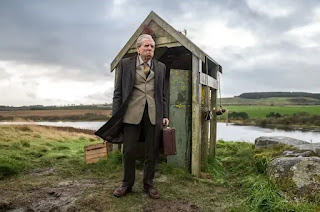
A sad journey to Land's End
Watching Timothy Spall put one foot in front of the other as he shuffles through one situation after another ranks as one of the more painful sights of the year.
Thursday, November 4, 2021
Diana and deadening life among royals
They eat the best foods but take no joy in dining. Surrounded by grandeur, they have become exemplars of stifling insularity. A funereal solemnity embraces them, suggesting a form of social rigor mortis.
Wednesday, February 28, 2018
'Party' guests are out for blood
It concerns me to know that I’ve sometimes felt the way Timothy Spall looks in The Party, a slender black comedy filmed in black-and-white. But even at a shockingly brief one hour and 11 minutes, The Party feels as if it could have been condensed into a 40-minute short as it builds toward a nifty punchline.
Spall, who has never projected so much doom and futility, portrays a British academic whose doctor has given him a fatal diagnosis. Haggard and expressionless, Spall’s Bill seems the personification of pitiless depression.
Joining Spall's Bill in this happily bitter ensemble piece are his wife Janet (Kristin Scott Thomas) and a variety of friends: the catty, mordant April (Patricia Clarkson), her bromide-spouting boyfriend (Bruno Ganz), a coke-snorting financial executive (Cillian Murphy), and a lesbian couple portrayed by Cherry Jones and Emily Mortimer.
The group has gathered to celebrate Janet’s appointment to a ministerial post in the department overseeing Britain's health.
The movie revolves around Albee-style insults that the characters hurl at one another while harboring secrets that will be revealed as the movie builds toward its final surprise.
Part of the trouble with movies such as The Party is that they seem to ask us to feel superior to their embittered, pretentious characters while creating few points of real identification.
Directed by Sally Potter, who also wrote the screenplay, The Party's main thrust -- the celebration that goes terribly wrong -- feels awfully familiar. Clarkson deftly delivers her character’s withering lines and Spall convincingly dangles at the end of his character’s rope, but The Party passes without arriving at a consequential destination.
Thursday, February 15, 2018
Aardman again achieves its goal — silliness
Thursday, January 8, 2015
Portrait of the artist as a troll
When the painter J.M.W. Turner dies at the end of director Mike Leigh's Mr. Turner, we feel a sense of vacancy, an acute absence that's not to be confused with sadness.
The reason for this lack of familiar emotion may be twofold: To begin with, Leigh has no taste for melodrama. Just as important, Timothy Spall's performance as Turner has been so full of grunts, muttered-asides and vivid physicality that it dominates nearly every scene, even when Turner's listening to someone else talk.
Spall creates a Turner who's part troll, part genius, and part emotionally crippled creature who was capable of incredible callousness. In short, Spall so fills the screen with his portrayal of Turner that when the great painter breathes his last breath, we almost feel the air escaping from the screen.
The director of movies such as Another Year, Vera Drake, Topsy-Turvy and Secrets and Lies can be spot-on or off-putting. In Mr. Turner, he's both.
Masterfully acted, Mr. Turner is no cinematic museum piece: It's an interpretive portrait of a man who lived in harsh times -- and seemed entirely up to the task.
Falling into provocative mode, Leigh shows us that great art (of which we see too little in the film) can spring from a harsh, even boorish source. Art and exemplary character do not necessarily go hand-in-hand, Mr. Turner leads us to believe. An artist can commit many sins, so long as delusion about his efforts is not one of them.
When we meet Turner, he's already a well-regarded artist. Upon returning from a trip to the Netherlands, Turner sets to work, and his household begins adjusting to his presence.
Turner's jovial father (Paul Jesson) has retired from his business as a barber so that he can fetch paints for his son and provide a hardy form of love and companionship.
Turner's even more devoted servant (Dorothy Atkinson) waits on him tirelessly, hoping that the great man might one day leave a few crumbs of affection on her meager plate. Occasionally, she serves as the target of Turner's sexual aggressions.
Turner also has an embittered former wife (Ruth Sheen) who cannot persuade him to acknowledge the two children he's had with her.
Turner's most normal relationship arrives when he travels to the seaside town of Margate. There, he strikes up a convivial affair with his landlady (Marion Bailey). He's actually kind to her. In return, she cares for him when they're together and at the end of his life. Think of it as a twilight alliance.
Bailey's Mrs. Booth doesn't seem to understand Turner's art, but she displays a natural acceptance of the man, no small feat. Turner died at the age of 76.
The movie doesn't so much advance a plot as it gathers scenes. At one point, Turner is visited by Mary Somerville (Lesley Manville), a woman whose scientific inclinations and observations about color fascinate him.
He sometimes visits the Royal Academy of Art, where he seems on amiable -- if gruff -- terms with his fellow artists, aside from John Constable (James Fleet). In on of the movie's best moments, Turner one-ups Constable in a major way.
Turner's also pestered from time to time by a financially challenged artist Benjamin Haydon (Martin Savage), a painter of lesser talent. Haydon rages against his misfortunes by condemning those who refuse to exalt his work.
Although the movie covers about 20 years, Leigh does little to mark the passage of time. He simply moves from one scene to the next. It's Spall -- with his harsh and grunting ways -- who gives the movie a center.
Everyone else becomes a kind of bit player, small planets revolving around Turner's glaring sun. John Ruskin (Joshua McGuire) championed Turner's work, but comes off as an effete snob who has taken cultural superiority to appalling extremes.
Relying on the exceptional cinematography of Dick Pope and the careful production design of Suzie Davies, Leigh creates a period piece that takes us from the high point of Turner's success to a time when his work -- which began breaking the ground for Impression -- was derided by the public, his colleagues and even Queen Victoria.
True to his contradictory nature, a sales-conscious Turner bequeathed many of his paintings to the British public, turning down a major sum of money for them.
Pope's images of seascapes and landscapes suggest Turner paintings, and the movie makes it clear that Turner was a great student of light -- although it doesn't necessarily do justice to the remarkable sense of drama Turner brought to what were called his "marine" paintings.
I wish Leigh had spent more time showing us how Turner's artistic vision developed, but he seems to want to meet Turner on his own ground and without explanation. He compels us to spend time with an often disagreeable fellow.
I suppose that makes Mr. Turner a movie with a pugnacious attitude: It juts out its jaw, as if loudly to grunt, "Here he is. Make what you will of him."
Thursday, March 21, 2013
An unexpected coming-of-age story
In Ginger & Rosa, British director Sally Potter delivers a story that relies as much on character as on burnish and style.Putting aside the dizzying style of movies such as Yes and Orlando -- the director lends her considerable talents to a complex coming-of-age story that's bolstered by its political backdrop (the world trembles in the midst of the Cuban missile crisis) and its principal performance, an open-hearted look at troubled adolescence from the gifted Elle Fanning.
Fanning allows us to peek behind the walls of adolescence, to see a girl who's struggling with a boatload of issues.
No point being coy: Fanning's Ginger must come to grips with the fact that her iconoclastic father (Alesandro Nivola) refuses (in nearly every way) to conform to the contours of parenthood.
Nivola's Roland seems to regard fatherhood as a socially imposed inconvenience. He became a conscientious objector during World War II and went to prison. Now, he tries to encourage every spark of radicalism he sees in Ginger. As played by Nivola, Roland comes across as sincere -- if keenly lacking in self-awareness.
It's hardly surprising that Roland doesn't get along with Ginger's beleaguered mother, nicely played by Christina Hendricks of Mad Men fame. She's the one who has had to hold down the fort while Roland lives by principle.
In the early going, it seems as if the story is going to focus solely on the friendship between Ginger and Rosa (a convincing Alice Englert). The girls both were born in 1945, and their mothers went into labor at the same time.
They're bonded British babies in the age that began with the explosion of nuclear bombs in Japan, an event Potter uses -- somewhat portentously -- to start the movie.
Fanning and Englert play teen-agers who are forced to think about the seriousness of the world's situation while trying to navigate choppy adolescent waters. At one point, they soak in a bathtub together, reading tabloids and trying to shrink their jeans into form-fitting tightness. Ginger fancies herself a poet. Rosa's less inhibited, more of a free-spirit.
Both girls essentially are rudderless, but they deal with their drift in different ways. Ginger seeks solace from her mother's gay friends (Timothy Spall and Oliver Platt), a couple that's visited by a staunchly political American buddy (Annette Bening).
Absent a father in her life -- he split long ago -- Rosa becomes infatuated with Ginger's dad to a disastrous and disturbing degree.
Roland moves out of the house he shares with Hendrick's Natalie and sets up shop in a garret. He never seems to understand that his devotion to principle masks a stunning level of irresponsibility.
All of this builds to the inevitable dramatic blow-up, which hits like that early-picture nuclear explosion, a histrionic blast set off by the conflicts Potter implants in her story.
It's difficult not to wonder whether Potter's screenplay hasn't put a little too much on both its and Ginger's plates. The threat of global annihilation coupled with a host of daddy issues suggests nothing if not an over-reach. But a strong cast keeps Ginger & Rosa from losing its moorings, and Fanning gives the movie an emotional life so credible, it's safe to call it a rarity.