Showing posts with label annette bening. Show all posts

Wednesday, March 4, 2026

'The Bride!' celebrates its excesses


It's unlikely anyone will accuse Maggie Gyllenhaal of stinting on ambition in The Bride!,  a wild farrago of a movie that resists classification. 
  Is The Bride! a horror movie or a Gothic romance? Is it a feminist reimagining of movies of the 1930s, particularly James Whale's The Bride of Frankenstein? Is it a comedy that pays homage to Mel Brooks' Young Frankenstein with a rousing rendition of Puttin' on the Ritz?
  Or, is it a showcase for an uninhibited display of ferocity from Jessie Buckley in another fearless performance?
  As it turns out, The Bride! is all those things, a movie that makes no bones about celebrating its excesses, of which there are too many.
   Gyllenhaal's big-screen gamble doesn't entirely, but her  approach yields intermittent payoffs. Perhaps the genre it mostly resembles is one in which two crazy outcasts tear across the American landscape, eventually finding love.
    Buckley appears in two roles, occasionally interrupting the narrative for portentous speeches delivered by Frankenstein's 19th-century author, Mary Shelley, who inspires a manic outburst by Ida, also Buckley, a Chicago moll who winds up dead in the movie's prologue.
    Enter Christian Bale's Frankenstein, a.k.a. "Frank," who visits Dr. Euphronious (Annette Bening), a scientist who has been experimenting with reanimating the dead. Poor Frank. He's lonely and craves the companionship of a woman who, like him, was created, not born. He yearns for a soulmate.
     Though she expresses reservations, Euphronious helps Frank dig up the recently deceased  Ida. Employing whizzing, flashing equipment that's heavy on old-fashioned dials and gauges, Euphronious jolts Ida back to life. 
     Initially, Ida, who can't remember her past, hardly seems an ideal partner for Frankenstein, played by Bale with a mixture of sincerity and goofiness, punctuated by occasional bursts of violence, mostly to protect Ida.
    Nothing if not loyal, Frank sticks to his lovelorn mission. He and Ida wend their way across the country, making stops at a roaring Chicago party, a sophisticated New York City black-tie event, and a rural drive-in theater.
    The wandering duo frequently attends movies, all of which star romantic lead Ronnie Reed (Jake Gyllenhaal). As we all once did, Frank learned about romance from the movies.
    Irate Chicago mobsters and a detective duo (Peter Sarsgaard and Penelope Cruz) pursue the fleeing renegades, as images of Bonnie and Clyde flash through our collective heads.
   Despite efforts to mask his appearance, Frankenstein can't always hide his stitched-together face, and Ida's tousled blonde hair and blood-red lips are accompanied by an ever-present stain on her right cheek, a souvenir from her reanimation. When it's popularized on tabloid front pages, her look turns into a fashion statement.
      I can't say that Gyllenhaal blends the movie's cornucopia of ingredients into a satisfying whole. She creates a mixed-bag of a movie that dashes across the screen, dazzling with its theatricality, amusing with its satiric fillips, and repelling with splashes of body horror. 
    Eclectic to the max, The Bride! practically drowns itself in movie love as it tries to match Buckley's expressions of unrestrained wildness. Say this, though: The Bride! earns the exclamation point in its title.


Thursday, February 10, 2022

Floating along with 'Death on the Nile'


   No, Kenneth Branagh, you didn't murder Death on the Nile, but you didn't bring it to scintillating life, either Yes, you have improved over your last venture into Agatha Christie territory, the lamentable 2017 adaptation of Murder on the Orient Express. But 
in neither case have you attained the sizzle to which I assume your aspired.
    Enough with the second-rate Poirot imitation.
    I had hoped that Death on the Nile would provide the tonic that the big-screen needs at this doom-struck moment. Hardly awful but lacking in distinguishing spark, Death on the Nile turns out to be a middle-grade effort.
   As was the case with Murder on the Orient Express, Branagh plays Hercule Poirot, the Belgian detective who has been solving crimes since Christie first introduced him in 1920.
   Branagh's performance — headlined by a freight train of a Belgian accent — functions somewhat in the same way as paint splattered on a carefully composed canvas. Branagh makes sure that we know Poirot is an oddball, a sharp-eyed detective with a taste for fancy pastries.
  None of this is to say that Death on the Nile lacks highlights, among them: Haris Zambarloukos's cinematography, Jim Clay's production design, and the costume design by Paco Delgado and Jobanjit Singh.
    But such accouterments have a downside, as well. I'm not sure that Emma Mackey, as the passionate, insanely jealous Jacqueline de Bellefort, isn't upstaged by her dress (think neo-Cleopatra) at a key point in the movie.
   Other highlights include Sophie Okonedo as an American jazz singer armed with a quick wit.  She's accompanied by her niece (Letitia Wright), a young woman who manages the singer’s business affairs. 
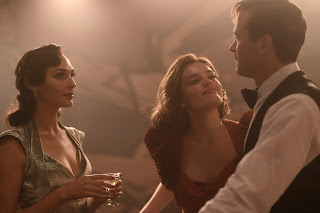
    Christie stories typically confine a large number characters in a single location, in this case, a yacht that embarks from Karnak for the honeymoon celebration of Linnet Ridgeway (Gal Gadot), a wealthy beauty who has married Simon Doyle (Armie Hammer).
    Before the story arrives in Egypt, we get London-based cabaret scenes in which Doyle seems to be totally consumed with passion for Mackey's Jacqueline de Bellefort. Passion or not, Doyle doesn't hesitate to drop de Bellefort for Ridgeway, thus setting off the jealousy that drives the plot. 
    De Bellefort hates being aced out by her best friend but she's far from the movie's only suspect.
    The passenger manifest includes the British comedy team of Dawn French and Jenifer Saunders. Annette Bening plays mother to Bouc (Tom Bateman), Poirot's pal and a generally carefree fellow. 
    I could go on, but only at risk of turning this review into a roster.
    Rather, I'll say that screenwriter Michael Green begins with a World War I flashback in which we learn Poirot's backstory, which includes lost love and an explanation of why he wears a mustache that qualifies as a special effect.
     For a finale, all the movie's suspects gather in a single location so that Poirot can pick them apart, preying on their weaknesses, until he finally reveals whodunit. 
    No harm will come to those who see Death on the Nile and some may enjoy its throwback pleasures. But I was looking to be buoyed by watching these folks, many without virtue, bob wickedly on the Nile. 
    Instead, I found myself merely floating along.


Thursday, November 14, 2019

When no one wants to know the truth

Adam Driver stars in The Report, a movie about a senatorial aide who tries to uncover the real story behind CIA torture.
Adam Driver's single-minded intensity perfectly suits the character of Dan Jones, a Senate aide charged with investigating the CIA's use of torture in the days following 9/11.

Jones's boss -- Annette Bening's Sen. Dianne Feinstein as chair of the U.S. Select Committee on Intelligence -- supports him but exercises more caution than Jones would like.

It makes for a heady conflict, the committed truth-teller vs. the politically astute senator who wants to find the truth but who can't avoid playing all the angles. It works because Bening's too nuanced an actor to let us push Feinstein into the box of caricature.

If you're looking for a political slant, know this: The movie tries to balance anti-Bush leanings with a slam at the Obama administration, which wasn't eager to see Jones's report see daylight, either. Jon Hamm appears as an Obama aide who insists that his boss knows the score, even if he doesn't want to spread it across the nation's headlines.

Director Scott Z. Burns has assembled a fine group of supporting actors in what amounts to a by-the-numbers procedural about the ways one branch of government tries to exercise oversight over a government agency that relies on secrecy.

Maura Tierney portrays a CIA agent of single-minded intent; i.e., she sees nothing wrong with what became known as "enhanced interrogation techniques;" i.e., waterboarding and other forms of humiliation. Corey Stoll plays a lawyer who, at the film's opening, tries to school Jones in the unhappy fate of whistleblowers.

We also learn that the enhanced interrogation techniques were developed by independent contractors (Douglas Hodge and T. Ryder Smith) who challenged CIA agents who believed the best way to obtain information was to convince detainees that an agent was on their side. The argument: Not only were the enhanced interrogation techniques immoral; they didn't work.

Burns, who wrote the screenplays for The Bourne Ultimatum and An Inconvenient Truth) dutifully follows the drama as it depicts Jones's five-year effort to discover the truth. He also offers unflinching views of some of what the CIA did to detainees in its fruitless efforts to get the jump on terrorism.

The Report sometimes lacks the pulse-pounding excitement we expect from political thrillers, but it's a serious effort and it offers a rare view of the kind of person who can’t be sidetracked. For Jones, learning exactly what happened becomes a near-sacred duty.

Thursday, January 19, 2017

A look at women of the last century

Annette Bening occupies the center of a rich, anecdotal movie.

The house in Santa Barbara, Ca., constantly is being renovated. Its owner, a 55-year-old woman with a teen-age son, rents out rooms. The tenants include a mechanic who's a little long in the tooth to be called a hippie, a young woman recovering from cervical cancer, and a teen-age girl who occasionally slips into the house to sleep with the owner's son. By this I mean, she actually sleeps with the owner's son, forcing the boy to subdue his raging hormones as she looks for a safe place from her sometimes promiscuous exploits.

If you were around during the 70s, this all may have a vaguely familiar ring -- loosey-goosey social arrangements that approximate the intricacies of family: a single parent who often find herself at a loss when it comes to child rearing, sexual exploration and an overall sense of being too harried to search for deeper meaning.

Dad? He's not in the picture, having left for New York to start a new life.

That's the environment that director Mike Mills creates for 20th Century Women, a movie that manages to create a feeling for how life felt in 1979.

Normally, that might seem too narrow a gauge to hold our interest, but Mills has made a movie dominated by the shambling flow of the jangled lives of the women who populate it.

The result is rich, funny and warm -- although about three-quarters of the way through you may find yourself wondering whether Mills will be able to bring all these ingredients to some sort of a boil.

If that never happens, there are plenty of compensatory moments along the way: When the car of the owner of the house catches fire in a parking lot, she responds by inviting the firemen to dinner. And when her son points out that this is not exactly a normal response, she can't understand why her behavior might be considered odd.

Annette Bening gives the movie's anchor performance as Dorothea, a cigarette-smoking mother who winds up parenting a teen-age son (Lucas Jade Zumann) rather late in life. Unsure how to handle the young man, Dorothea seeks help from her cancer-conquering tenant (Greta Gerwig) and from Julie (Elle Fanning), the girl who becomes a near-constant visitor.

Supposedly based on Mills's own upbringing, 20th Century Women benefits from the actresses who grace it. Playing an aspiring photographer, Gerwig brings a mixture of confusion and vivaciousness to the movie, and Fanning perfectly captures the incipient world-weariness of a young woman whose sexual behavior has out-paced her emotional ability to deal with it. Fanning's character is a mass of contradictions; she's exploring her womanhood before even leaving the backpack stage.

Needless to say Dorothea's experiment doesn't entirely work. After Jamie goes clubbing with Gerwig's character, Dorothea wistfully muses that she'll never see that side of her son, a teen-ager trying to negotiate a separate social world for himself.

It's possible that the other actresses were inspired by the gifted Bening, whose Dorothea presides over the house, tries to maintain her composure and allow her son a degree of freedom he hasn't really sought.

In his best role in a long time, Billy Crudup plays a mechanic, the man in the house who tires to keep his poise. He, too, seems to be stuck in an emotional limbo.

Finding his way proves difficult for young Jamie, whose life is guided by three formidable but sometimes floundering women. We're told the story through Jamie's eyes.

Enjoyable in pieces -- and I don't mean that as a slam -- 20th Century Women makes a simple request: It asks us to spend some time with these appealing characters. They engage us in a series of gestures and responses that, like life itself, can charm, amuse and confound.

Thursday, March 26, 2015

An aging rocker seeks redemption

Al Pacino stars as a singer who squandered his talent.
In 2005, a British musician named Steve Tilston learned that John Lennon had written him an encouraging letter. The catch: Tilston never received the letter, which was written in 1971 and sent to a rock magazine, where it apparently languished until it wound up in the hands of a collector.

The story instantly raised questions about how Tilston's life might have unfolded had he been able to read that letter when it was sent.

That mind-blowing incident inspired director Dan Fogelman's Danny Collins, the fictionalized story of a sell-out American musician (Al Pacino) who -- like his real-life counterpart -- learns too late that he once received a letter from Lennon urging him to pursue his own vision.

Never having seen the letter, Danny followed a commercial path. When we meet Danny, he has become a kind of show-business joke, a singer whose work appeals to aging boomers who implore him to repeat what amounts to a series of insipid hits, most notably a song entitled "Hey, Baby Doll."

When Danny's manager (Christopher Plummer) finds the letter and presents it to Danny as a birthday present, the singer's world is ... you'll pardon the expression ... rocked.

Danny suddenly realizes what he's known all along: He's wasted his life on trivial rock and wanton sex, much of it to the accompaniment of drugs and alcohol.

From an artistic point of view, Danny committed the worst of all sins: He betrayed his own talent.

Deep into his 60s, Danny decides that it's time for a change.

He drops a pre-arranged tour, junks his philandering young girlfriend, leaves his plush Los Angeles home and heads to New Jersey, where he checks into a Hilton hotel. He insists on having a baby grand piano delivered to his room so he can write the music he should have been creating all along.

Why New Jersey? Danny has a grown son (Bobby Cannavale) in New Jersey. He's never seen the young man, but Danny thinks it's time to set his personal life straight. To do this, Danny must overcome the justifiable resentments of a son he essentially abandoned.

Cannavale's Tom works construction. His wife (Jennifer Garner) is expecting the couple's second child. The first child, a daughter, suffers from ADHD, and touches Danny's heart. He wants to be a grandpa.

Danny's commitment to sobriety wavers with the ups and downs of his developing relationship with his son. He also tries to seduce the hotel's manager (Annette Bening), a prim woman who's smart enough not to fall for Danny's banter -- at least not at first.

Neither drippy enough to slop over into sentiment nor observant enough to be entirely convincing, Danny Collins hardly qualifies as the kind of movie in which you'd like to see Pacino.

Pacino makes it clear that Danny isn't the least bit deluded about the kind of figure he cuts. He's tired of being preposterous, but he's also addicted to the material success that a one-note career has given him.

Fogelman (Crazy, Stupid Love) doesn't always make obvious choices, although much of what transpires in Danny Collins feels contrived.

Watching Pacino has its rewards, but this story of a man seeking redemption in his golden years fails to provide either him or us with sufficient challenge.

Thursday, March 21, 2013

An unexpected coming-of-age story

Elle Fanning sparks complex coming-of-age story, Ginger & Rosa
In Ginger & Rosa, British director Sally Potter delivers a story that relies as much on character as on burnish and style.

Putting aside the dizzying style of movies such as Yes and Orlando -- the director lends her considerable talents to a complex coming-of-age story that's bolstered by its political backdrop (the world trembles in the midst of the Cuban missile crisis) and its principal performance, an open-hearted look at troubled adolescence from the gifted Elle Fanning.

Fanning allows us to peek behind the walls of adolescence, to see a girl who's struggling with a boatload of issues.

No point being coy: Fanning's Ginger must come to grips with the fact that her iconoclastic father (Alesandro Nivola) refuses (in nearly every way) to conform to the contours of parenthood.

Nivola's Roland seems to regard fatherhood as a socially imposed inconvenience. He became a conscientious objector during World War II and went to prison. Now, he tries to encourage every spark of radicalism he sees in Ginger. As played by Nivola, Roland comes across as sincere -- if keenly lacking in self-awareness.

It's hardly surprising that Roland doesn't get along with Ginger's beleaguered mother, nicely played by Christina Hendricks of Mad Men fame. She's the one who has had to hold down the fort while Roland lives by principle.

In the early going, it seems as if the story is going to focus solely on the friendship between Ginger and Rosa (a convincing Alice Englert). The girls both were born in 1945, and their mothers went into labor at the same time.

They're bonded British babies in the age that began with the explosion of nuclear bombs in Japan, an event Potter uses -- somewhat portentously -- to start the movie.

Fanning and Englert play teen-agers who are forced to think about the seriousness of the world's situation while trying to navigate choppy adolescent waters. At one point, they soak in a bathtub together, reading tabloids and trying to shrink their jeans into form-fitting tightness. Ginger fancies herself a poet. Rosa's less inhibited, more of a free-spirit.

Both girls essentially are rudderless, but they deal with their drift in different ways. Ginger seeks solace from her mother's gay friends (Timothy Spall and Oliver Platt), a couple that's visited by a staunchly political American buddy (Annette Bening).

Absent a father in her life -- he split long ago -- Rosa becomes infatuated with Ginger's dad to a disastrous and disturbing degree.

Roland moves out of the house he shares with Hendrick's Natalie and sets up shop in a garret. He never seems to understand that his devotion to principle masks a stunning level of irresponsibility.

All of this builds to the inevitable dramatic blow-up, which hits like that early-picture nuclear explosion, a histrionic blast set off by the conflicts Potter implants in her story.

It's difficult not to wonder whether Potter's screenplay hasn't put a little too much on both its and Ginger's plates. The threat of global annihilation coupled with a host of daddy issues suggests nothing if not an over-reach. But a strong cast keeps Ginger & Rosa from losing its moorings, and Fanning gives the movie an emotional life so credible, it's safe to call it a rarity.


Friday, July 16, 2010

Gay parents face an empty nest

One big, not-always-happy family.

Lisa Cholodenko's The Kids Are All Right has been widely hailed as an important, absorbing and entertaining work. I mention the positive buzz -- complete with a fawning Charlie Rose love-in that lasted nearly an hour -- not to cavil and carp, but to clue you in. Lots of substantial voices rank Cholondenko's movie as one of the year's best.

I wish I could add mine to the rising chorus of acclaim, but I found the movie to be only mildly amusing, a work that lacks the richness that we expect from movies that approach any sort of greatness. If I had to classify Cholendenko's movie, I'd call it a reasonably typical indie effort built around a subject that deserves more attention, long-term gay relationships and the establishment of new kinds of families.

The movie focuses on a lesbian relationship in which each of the partners has had a child thanks to sperm from the same donor. When the movie opens, the kids are mired in adolescence, and one of them -- a 15-year-old boy -- decides that he'd like to meet his biological father. The other, an 18-year-old girl who's college bound, goes along with her brother's wishes.

The idea of exploring what might happen if a man suddenly emerged as an important figure in the lives of these kids is intriguing, but the resultant film doesn't live up to the promise, perhaps because it's a little too content to swim in the mainstream. Cholendko's humor isn't overly broad, but it's not full of subtlety or resonance, either.

I wish the movie had been more about the kids than the adults. I say this because the performances by Mia Wasikowska, familiar from Tim Burton's Alice in Wonderland,* and Josh Hutcherson, who has less prominent big-screen exposure, perfectly capture the anger and confusion of adolescents who are on the brink of leaving home. Both Hutcherson's Laser (I'm not kidding about the name) and Wasikowska's Joan seem to have adopted patronizing but entirely credible attitudes toward their parents. When the women -- whom they call "the moms" -- tell the story of how they met for the gazillionth time, the kids react with eye-rolling disapproval.

The two main adult roles are played by Annette Bening and Julianne Moore. Bening's Nic, a physician by trade, is the alpha partner in a 20-year relationship that's lost some of its spark. Moore's Jules has focused on raising the kids, and is just beginning to think about returning to a career as a landscape designer, a task made more difficult by her lack of self-esteem.

Mark Ruffalo does some of his best work yet, as Paul, the sperm donor who suddenly finds himself involved in the lives of Nic, Jules and their two kids. Paul runs a restaurant that specializes in locally grown food; he's casually self-absorbed, which is more than you can say for either Jules or Nic; their self-asbsorption is pretty intense.

But here's the thing: Paul is an appealing and amusing character until the movie tries to turn the tables on him as the result of a plot twist that can't be revealed here. For the record, I didn't find that twist entirely credible.

Some critics have commented that The Kids Are All Right makes an important and timely point: Gay and straight marriages aren't all that different. Same problems. Same annoyances. Same possibilities for betrayal. Same opportunities for forgiveness. Fair enough, and Choldenko wisely refrains from pushing any agenda.

The movie's major lesbian sex scene is played for laughs, which -- or so it seems to me -- lets mainstream audiences off the hook. I'm not arguing for explicit sex, and I wouldn't even mention any of this if the movie didn't include heterosexual sex scenes that are more explicit, although they, too, have comic intentions.

So I leave it to you. Know that the positive reviews outweigh the negative and make your own judgments. I'll hang back here with the less enthusiastic crowd, continuing to wait for a movie that had a little more to say about a subject that deserves its own movie, hopefully more than one.

*Thanks to the reader who pointed out that I initially and incorrectly said that Mia Wasikowska had been in The Lovely Bones. No excuse, really. Just dumb on my part.

Monday, May 17, 2010

The director who loves women

Mother and Child, the latest movie from writer/director Rodrigo Garcia, is slated to open in Denver May 21 and is just beginning its journey around the country.

Garcia, whose previous efforts include the movie Nine Lives and lots of prestigious television work on HBO series such as Six Feet Under, Big Love, The Sopranos and In Treatment, might be dubbed the director who loves women, and in Mother and Child, he does something that has become increasingly rare in the current movie climate: He provides an uncluttered platform on which three gifted actresses can explore agonizing emotional issues.

The movie’s stars -- Annette Bening, Naomi Watts and Kerry Washington -- play women who are dealing with mother/daughter issues, usually from both sides of the equation. Whatever audiences think about Mother and Child, it’s difficult to imagine that this dynamic trio of actresses isn’t delighted with the outcome.

If so, they have good reason. Garcia – the 50-year-old son of acclaimed novelist Gabriel García Márquez – provides them a showcase that allows for ample expression of complexity and contradiction.

Bening plays Karen, a woman who became pregnant as a teen-ager and whose mother forced her to give the baby up for adoption. Watts plays Elizabeth, the grown daughter Karen has never met, and Washington portrays a successful young woman who decides to adopt a baby because she’s unable to become pregnant.

With Garcia navigating choppy emotional waters, the talk in a recent interview gravitated toward acting. Movie acting can be difficult to write about and sometimes difficult to understand, even for a director whose work reflects a deep respect for character, an approach Garcia learned from early stints as a cameraman, with directors such as Mike Nichols and Robert Benton.

“I don’ t know how actors prepare,’’ said Garcia. “I enjoy not knowing. I like to have a couple of conversations just to make sure that we want to make the same movie. I don’t want surprises about what the story is, but I leave the details of how a role is performed to the actors.”

Allowing for a process that relies on equal amounts of preparation and spontaneous expression requires the creation of a calm on-set environment – or at least the illusion of one.

“With all the movies that I’ve done -- especially the three that I’ve written -- the budgets have been low and the schedules, frightening. (Mother and Child was shot in a fleet 29 days.) I have this memory of running 100 miles per hour before the actors arrived. Then when the actors come on set, you feel like you’re pulling the horses back so that everything can move at 20 miles an hour. The actors feel it’s all very relaxed, as if we’re just ambling. The moment they leave, the shit hits the fan, and it’s chaos again.”

Here, then, Garcia’s thoughts on his three principal actresses and the characters each of them plays.

Q. So what drew you to Bening?

Garcia: Part of it is instinct. You always have your list of who the great actresses for a role would be. Annette is able to convey a lot of intelligence, emotion, and strength. She’s a very natural actress. Maybe ‘naturalistic’ is a better word. I like an actor who can project different things at the same time – vulnerability, emotion and intelligence. Annette’s also very good with words. There are some great actors who aren’t necessarily good with dialogue.

Q. Does it take extra commitment for an actress to play a character who refuses to ingratiate herself with an audience? Karen avoids men, and isn’t shy about expressing hostility, even toward people who reach out to her.

Garcia: Karen is a prickly pear, a complicated person. I’m sure a lot of actresses would have been uneasy about playing her. They might have wanted to soften her, to pander to the audience. But Annette always understood that it (Karen’s insistence on walling herself off from others) was coming from a place of pain. She had been forced to give up a baby. She was protecting herself, like a porcupine.

Q. Karen’s also an older woman who’s not trying to disguise her age. She doesn’t spend much time on her appearance. Maybe that’s part of the way she keeps the world at bay, but I didn’t see any vanity in Bening’s performance.

Garcia: Karen’s not out to be liked. Annette embraced that even more than I thought she would. There was no make-up. The hair was always a little disheveled. Annette was able, very fastidiously, to track Karen’s journey.

Q. Naomi Watts also plays a character who’s not terribly sympathetic. Elizabeth is a hard-boiled attorney who keeps a tight rein on her personal life. She’s ambitious, ultra-competent and sexually aggressive.

Garcia: I made a point of proving that Elizabeth was a very accomplished lawyer. She’s smart. She uses sex to control the environment and people around her, but she doesn’t use it to get a promotion. I thought that distinction was important.

Elizabeth is very hostile in the way she controls things. She doesn’t care what you think. Naomi was the first person we went to. Like Annette with Karen, she understood that Elizabeth’s behavior stems from a wound she has inside.

In the case of Karen and Elizabeth, a big choice was made for them, to separate them against their will. In different ways, they decided to control their lives so that such choices would not be made for them again, so that they would not be exposed to pain.

Q. The role of Elizabeth requires a bit of nudity – both physical and emotional. How tough was that?

Garcia. Naomi probably thinks it’s worth it to her to do physical and emotional nudity if it takes her somewhere in her journey as an actor. Whether she’s comfortable or not, who knows? We had scenes that involved emotional and physical nakedness, and she did them five weeks after having a baby.

Q. It seems to me that Watts is willing to push boundaries, to really explore emotional extremes.

Garcia: She’s good at playing characters with strong contradictions, characters that are emotionally strung out. To play a woman like Elizabeth or the women she played in Mulholland Drive or 21 Grams, Naomi really had to go for it. Of course, when you spend time with her on the set, she ‘s also very funny. She has a naughty sense of humor. She could have a career doing romantic comedies or action stuff.

Q. Kerry Washington’s bio reads like a study in achievement. She’s on President Obama’s Committee on the Arts and the Humanities. She graduated Magne Cum Laude from George Washington University. She’s currently working in David Mamet’s play Race on Broadway, and has a Phi Beta Kappa key.

Garcia. I had seen Kerry only in The Dead Girl and The Last King of Scotland. She registered with me. We worked for one day on a short subject we did for a charity, and I thought she would be a perfect Lucy. She’s nothing like Lucy in many ways and like her in others. She has this spunk and this desire to do really well.
 

Q: Lucy is nothing if not strong willed. Is Washington like that?

Garca: Kerry is tireless. She’s this dynamo. She taught me a lot about Lucy. I wasn’t in tune with the fact that Lucy is such a perfectionist. That’s what I started understanding from Kerry’s performance. Lucy saw her inability to get pregnant as a personal failure, a blemish in her record. That’s what made her so desperate.

Q. But it’s certainly not a one-dimensional performance. Lucy’s dealing with a marriage that may be in trouble, as well as with her own feelings about not being able to conceive. Garcia: Kerry also brought a lot of humor to Lucy. People find something funny in Lucy’s hysterical desperation.

Q. You seem to like writing about women.

Garcia: I find it hard to write men. Men’s lives often are about exterior pursuits. Success in work. Money. Conquering the girl. Conquering the mountain. Killing the lion. I’m more interested in stories about the complicated nature of two people relating to each other. The person you can’t live with and can’t live without. The person next to you. A parent, a child, a sibling or a spouse.

Q. We probably should say something about the men in this movie. Jimmy Smits plays one of Karen’s co-workers at the assisted living facility where she works. She does her best to hold him at arm’s length, but he pursues her anyway. And Elizabeth has an affair with her boss (Samuel L. Jackson), the lawyer who owns the firm where she lands a job. He’s older than she, but he’s clearly a man of conscience, accomplishment and compassion.

Garcia: So many times in movies about women, the men are the enemy. I already had a couple of women who had such confrontational relationships with the world that I thought, ‘Let me put two really good men in front of them.’ These women are so at odds with the world, what would they do if I sent them a couple of really good guys? I wanted to see how they’d deal with that."