Showing posts with label animation. Show all posts

Thursday, February 24, 2022

Time for the Oscar-nominated short films

     It's always dangerous to draw broad generalizations from a limited universe of films, but it's tempting -- and not all temptations should be resisted. If one were to generalize -- and I'm about to do just that -- this year's crop of Oscar nominated short films paints a fairly bleak portrait of worlds full of crushed ambitions, dashed hopes, oppressive societies, and lost opportunities.
    Having said all that, it may seem odd to say that there's also uplifting amounts of creativity and dedication in this year's crop of short films -- and, as always, I recommend that you see them, although I'm not going to provide individual reviews of each effort. 
   Count me among those who are peeved that the Academy decided not to include awards for short films in its live telecast. I understand that the show tends to drone, but the Oscar platform provides a much-needed opportunity for the Academy to honor individual expression and true independence. 
    Evidently, the winners will be recognized during the broadcast, but it's not the same as being part of the live proceedings.
   A final note: Many of the live action shorts (small dramatic features) seem to have abandoned the once-prevalent punch-line approach to short filmmaking. I'm talking about films that ended with a memorable kicker, something to burn the film into memory.
   I'd call that a good thing.
  So what about this years crop of films? We begin with the animated shorts.
Affairs of the Art. Beryl, a Welsh woman tells stories about the obsessions of family members while lamenting her failure to develop as an artist. Hand-drawn animation produces often grotesque images that include one character's preoccupation with taxidermy and a portly woman's wrestling match with a push-up bra. Directed by Joanna Quinn and written by Les Mills. 
Bestia
.
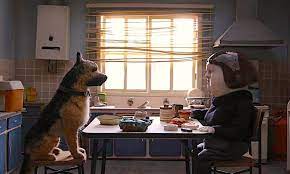
 Director Hugo Covarrubias takes a chilling look at Ingrid Olderock, a real-life character who was dubbed "The Woman with the Dogs." Olderock helped "disappear" people during the Pinochet era in Chile. Her idea of how to employ her German Shepherds doesn’t exactly qualify as pet friendly. Presented as a stout, expressionless doll, Olderock provides the centerpiece of a disturbing film.
Boxballet. Set in 1993, this Russian entry focuses on a relationship between a rail-thin ballerina and a tank of a boxer who's seen better days. Director Anton Dyakov and co-writer Andrey Vasilyev create a beauty-and-the-beast fable that proves touching.
Robin Robin. More geared toward typical expectations than its fellow nominees, Robin Robin was directed by Daniel Ojari and Michael Please and produced by Aardman Animations, best known for Wallace and Gromit films. Raised by a group of mice, a robin finds her identity and learns how to be a productive member of the group that nurtured her. That sounds didactic but Ojari and Please work with a light touch that makes room for peppy musical numbers. Their goal is to entertain, not instruct.
The Windshield Wiper. Spanish director Alberto Meigo tries to answer an age-old question: What is love? He tells the story by focusing on a man sitting alone in a cafe and musing on the question. Composed of memories, emotions, and quietly poignant episode, the  resultant film offers a mix of personal and slightly abstracted  observations.

Live Action
The Dress. This 30-minute Polish entry introduces us to Julka, a woman who works as a maid in a hotel and happens to be what we now call "a person of short stature." Julka's size figures into a story that refuses to dismiss her desires for sexual and emotional intimacy. Director Tadeusz Lysiak builds toward a disturbing encounter with a purportedly empathetic truck driver has shattering impact. Anna Dzieduszycka's performance as Julka proves memorable.
The Long Goodbye. Riz Ahmed, who shares a writing credit with director Aneil Karia, stars in a British film that begins by immersing us in the bustle of a family preparing for a wedding. Joy vanishes when a group of white nationalists terrorizes the Pakistani family as the police stand idly by. Hand-held and jittery in ways that I found off-putting but must have been intended to emphasize the transition from chaotic anticipation to racist violence. 
Ala Kachuu
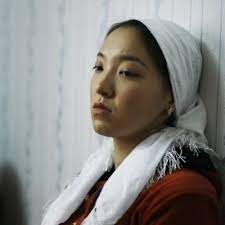
. Sezim, a woman living in Kyrgyzstan, tries to convince her mother to allow her to attend university. Denied the chance, she leaves her rural village and heads to the city. While waiting for university admission, Sezim works in a bakery where she becomes a target for a young man who wants to kidnap a woman to become his bride. To westerners, Semi's story may seem unbelievable -- but Swedish director Maria Brendle exposes what's said to be a fairly common practice in a culture in which female roles are oppressively defined.
Please Hold. KD Davila offers a disturbing but clever look at a future in which artificial intelligence and computerized responses dominate everything -- including the unjust jailing of an innocent man who finds himself stuck in a Kafkaesque nightmare that very much resembles experiences we've all had with automated phone calls.
On My Mind. Martin Strange-Hansen's film finds a man sitting at a bar looking massively depressed. When he learns that the bar has a karaoke machine, he implores a sympathetic bartender and the place's greedy owner to allow him to sing one song, "Always on My Mind." Sounds corny but Strange-Hansen keeps emotions under control as the movie slowly reveals the reasons for this tormented man's song and why he wants to sing it. 

Documentaries
Lead Me Home. Pedro Kos and Jon Shenk tackle homelessness in Los Angeles, San Francisco, and Seattle. The directors contrast the high-gloss beauty of these cities with the teeming impoverishment of people who have wound up living on the street. A little slick and perhaps too diffuse to have as much impact as may have been intended, but still effective.
The Queen of Basketball
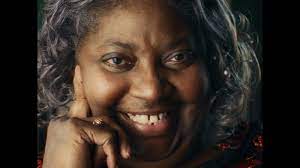
. Luisa Harris, a six-foot, three-inch center,  won high school and college championships, an Olympic silver medal, and even was drafted by the then New Orleans Jazz of the NBA. Harris declined a tryout, thinking that she couldn't dominate the way she had in women's basketball. Harris, who played during the 1970s, preceded the WNBA and never got a chance to take her talent to a logical next stage. Director Ben Proudfoot's film introduces her to a wider audience.
Three Songs for Benazir. Set in Afghanistan, the movie chronicles the life of a young husband who wants to join the military to fight the Taliban. His family prefers that he keep his head down. Instead, Shasta winds up working in the opium fields and developing an addiction he must overcome. Feelings of helplessness -- being observed by US drones and subjected to Taliban cruelty --  pervade a story that must have been extremely difficult to film by co-directors Elizabeth and Gulistan Mirzael but which could have benefited from fleshing out.
When We Were Bullies. Director Jay Rosenblatt's documentary examines a bullying incident in which the director participated when he was a kid in a Brooklyn elementary school. Rosenblatt contacted fellow classmates, most of whom remember a playground incident that has troubled Rosenblatt ever since it occurred some 50 years earlier.
Audible. A look at a young man who plays football for the Maryland School of the Deaf, a team that compiled a 42-game winning streak. often defeating hearing teams. Director Matthew Ogens focuses on Amaree, a kid who excels at football but must deal with some difficult emotional issues, including the suicide of a friend. Ogens brings us into the non-hearing world and makes us care about the kids who live in it.


Thursday, January 30, 2020

It’s time to consider short films

Taken individually, the short films in this year's Oscar program are all refreshingly concise; i.e., no more than 40 minutes in length. But the only way these shorts can be seen is in packages, five films in each serving. Although this kind of presentation is unavoidable, the approach can be frustrating.

Watching five films in succession leaves little time to digest what you've seen. No sooner has one film finished than you're asked to involve yourself in another. I think this hurts high-impact films, particularly those in the documentary-shorts category.

The short documentary In the Absence, for example, examines a series of inept decisions that made the Sewol ferry disaster of 2014 even worse. You'll recall that 300 people died in that Korean ferry accident. High school students on a field trip made up the bulk of the casualties. Watching Absence in the same program as the charming Walk Run Cha-Cha can make your head spin.

Even in the animated category, wild tonal shifts can be found as one film gives way to another. Memorable, director Bruno Collet's touching look at a painter suffering from Alzheimer's bumps up against Matthew A. Cherry's Hair Love, a story about an African-American father struggling to master the art of combing his daughter's hair. Hair Love, by the way, might be the most buoyant of the animated shorts, although it, too, strikes some serious notes.

Of course, there's a flip side to what I'm saying. These packages of Oscar-nominated short films provide a window into an astonishing range of approaches and interests. Shorts also constitute one of the few areas where you can be reasonably sure that filmmakers are following their interests rather than the usual commercial imperatives.

And in a moment when few features run less than two hours, shorts also remind us that brevity needn't be an obstacle to telling a meaningful story.

Animated Shorts

This year's animated shorts stuck me as less self-consciously arty than those of previous years, although they often traverse difficult emotional terrain. Siqi Song's Sister can be viewed as a companion piece of Nanfu Wang's documentary One Child Nation. Song explores the impact of China's one-child policy on a boy who imagines what his life might have been had he had a sister.

Director Daria Kascheeva's Daughter employs stop-action animation to create a story about a woman who remembers her difficult relationship with her father while he lies on his deathbed. Kashcheeva sculpts her characters from paper mache, a technique that gives the movie a heavy, somber feeling that perfectly fits its subject.

I already mentioned Hair Love and Memorable, so I'll move to Kitbull, an entry from Rosana Sullivan who has worked for Pixar; Sullivan introduces us to a scraggly stray cat who befriends an abused pit bull, an unlikely friendship that carries obvious metaphoric weight.

I've always found it difficult to predict winners in the shorts category, so I'm not going to try, although I'll tell you that my favorite is Collet's Memorable, which depicts an artist losing touch with his two principal loves, his wife and his art.

Live-Action Shorts
As I watched Saria -- a recreation of a real-life story -- I had to remind myself that I wasn't watching a documentary. This speaks to the film's power. Director Bryan Buckley doesn't flinch from a difficult topic and the ending of his film packs a horrific wallop.

Belgium's A Sister, directed by Delphine Girard, almost instantly becomes an exercise in high tension. A woman who has been kidnapped tricks her abductor into allowing her to call her sister to check in on her daughter. Instead of phoning her sister, she reaches a police emergency operator who plays along and tries to save the woman.

Marshall Curry's The Neighbors' Window begins as if it's going to be a kinky study of voyeurism. Initially attracted to watching a couple's lovemaking, a New York husband and wife continue to observe the lives of two people occupying the apartment across the street from them. The story increasingly focuses on the prying wife -- a mother dealing with three small children -- who becomes obsessed with what she sees the couple's freedom. You may be able to guess where Curry's story is headed, but the movie succinctly makes its point. And, no, the moral of the tale has nothing to do with the wisdom of buying curtains.

Directed by Meryam Joobeur and Maria Gracia Turgeon, Brotherhood takes us to Tunisia for a story about tensions between a father and a son, a young man who left home to join fighters in Syria. The son returns with a pregnant young woman who's hidden by a niqab and who he introduces as his wife. Faced with terrible unemployment, many of Tunisia's young men left for Syria and, as is the case here, many came to regret their decision. The relationship between the returning son and his brothers proves touching as the story builds toward a tragic conclusion that left me with questions about precisely what the filmmakers were trying to say.

Yves Piat and Damien Megherbi may have made the category's prohibitive favorite, the amusing NEFTA Football Club, which also takes place in Tunisia. While playing in the desert, two brothers discover a lost donkey that's wandering about wearing a set of earphones. We'll later learn what the earphones are about, but the story reveals its first twist when the older brother realizes that the donkey is carrying bags full of drugs. Could this be a gateway to a huge windfall? Obstacles and various O. Henry-like turns make the film instructive and entertaining.

Documentary Shorts

Ever heard of Resignation Syndrome? I hadn't, but I learned about it while watching John Haptas and Kristine Samuelson's Life Overtakes Me, the moving story of eastern European children who fall into catatonic states as a way avoiding tensions resulting from constant threats of deportation from Sweden, the country to which their parents have fled.

In Laura Nix's Walk Run Cha-Cha, we meet a Vietnamese couple that arrived in the U.S. 40 years ago. Paul and Millie Cao talk about leaving Vietnam, being reunited in the US and living lives built around work and family. After raising their kids and meeting their responsibilities, Paul and Millie take up dancing. Finally, they feel a measure of true personal freedom.

As mentioned earlier, Yi Seung-Jun's In the Absence explores the tragic story of a ferry accident. I'd say that Jun's film has more emotional punch than the others in this category, which rounds out with Smriti Mundhra and Sami Khan's St. Louis Superman and Carol Dysinger's Learning to Skateboard in a Warzone (if you're a girl).

St. Louis Superman introduces us to Bruce Franks, a father and rapper who runs for a spot in the Missouri State legislature after the shooting that roiled Ferguson, Mo., in 2014.

In Learning to Skateboard, Dysinger tells the story of an Afghan program that uses skateboarding to help instill confidence in girls who also receive instruction in reading and math, sometimes against the wishes of parents who either fear for their daughters safety or have tradition-bound ideas about what girls should be doing with their time.

If you have the time, you’d do well to see all three programs. You’ll be informed and entertained, but you’ll also be helping to support a form of cinematic expression that’s a vital part of film culture. You'll also notice that unlike some of the other Oscar categories, women are well-represented.


Thursday, November 30, 2017

A girl fights for her family's survival

The Breadwinner takes an animated look at life in Afghanistan under the Taliban.
The Breadwinner isn't the first film to deal with the plight of Afghan women living under the Taliban (2003's Osama was devastating), but it may be the first animated feature to tackle such a difficult subject.

Irish director Nora Twomey, who co-directed the much-admired The Secret of Kells, takes us to Kabul for a story about Parvana (voice by Saara Chaudry), a girl whose father (Ali Badshah) is arrested for possession of a book the Taliban disdains. The young thug who betrays this peaceful older man has personal motives for his actions. Besides, we get the impression that any book, other than the Koran, would have offended Taliban sensibilities.

Parvana's mother Fattema (Laara Sadiq) and her older sister Soraya (Shaista Latif) don't know how they are going to survive because, as women, they can't even venture into the street unaccompanied by a male relative. This prohibition makes a dangerous ordeal out of such simple tasks as buying groceries or fetching water from the local well.

Early on Fattema, who's also caring for her toddler son, attempts to visit her husband in the forbidding prison where he's being held. She's badly beaten for her efforts.

It falls to Parvana to devise a solution to keep the family afloat. She cuts her hair, pretends to be a boy and begins to move about Kabul with new-found freedom. She also receives help with her ruse from Shauzia (Soma Chhaya), another girl who has adopted the same strategy as a means of coping with Taliban tyrannies.

The Breadwinner focuses on children but should not be considered a children's movie, even though older kids would do well to see it. It's a harsh story about what happens when fanatics terrorize a culture.

The story also puts special emphasis on the importance of storytelling as a means of helping people to survive terrible conditions. The movie opens with Parvana's father telling her stories about Afghanistan's past and includes a running fable that Parvana tells her baby brother. Parvana's story involves a boy who must try to save his village from the ravages of the evil Elephant King, a tale that roughly parallels Parvana's efforts to help keep her family afloat.

The animation is simple, sometimes involving cut-outs: Twomey's team creates a dusty picture of Kabul as a place where the life of the marketplace hasn't entirely been squelched.

The Breadwinner, which derives from a young-adult novel by Deborah Ellis, affirms Parvana's strength and determination and serves as a moving introduction to what it means for women to live under constraints that serve to subjugate and dehumanize them. Small but powerful, The Breadwinner qualifies as an adept telling of an important story.

Thursday, January 29, 2015

Time for Oscar-nominated shorts

Writing about Oscar-nominated shorts is never easy. We're talking about more than 15 films that range in length from 40 minutes to less than four.

Inevitably, reviewers are bound to give something (you'll pardon the expression) short-shrift. And if I tell you that I found the documentaries to be exceptionally strong this year, it's not because I mean to dissuade you from seeing either the animated or fictional shorts programs.

For the record: In Denver, the animated shorts and short features will be playing in two programs with separate admissions at Landmark's Mayan. The documentary shorts will be playing at the Sie Film Center in one program with one admission.

Of the animated nominees -- eight in all -- several stood out for me:

Norway's Me and My Moulton (photo at left) tells a story about a girl trying to adjust to the tastes of her idiosyncratic parents. Disney's Feast introduces us to a dog who suffers when his master discovers a new girlfriend and nouvelle cousine. Who wants the kind of table scraps that are served with parsley sprigs? The Bigger Picture deals with two adult brothers trying to come to grips with the aging and death of their mother.

The short feature program includes Boogaloo and Graham (photo at right), a 14-minute look at two Belfast brothers who in 1978 become attached to their pet chickens. As ridiculous as it sounds, the film takes place against a backdrop of complex issues. In La Lampe Au Beurre De Yak (Butter Lamp), a photographer takes pictures of Tibetan nomads against faux backdrops that ultimately conceal a disturbing reality, and Parvaneh, from Switzerland, tells the story of the brief, unexpected friendship between two teen-age girls, one from Afghanistan. The Phone Call, a poignant entry from the UK, stars Sally Hawkins as a woman talking to a desperate widower on a suicide hotline.

As for the documentaries, prepare to be devastated -- and I mean that in a good way.

Beautiful and touching, Joanna (from Russia) focuses on the relationship between a cancer-stricken mother and her young son. HBO's Crisis Hotline (which also can be seen on HBOGo) brings us into the only U.S. call center that responds to distraught veterans; and the Reaper (an appropriately grim nominee from Mexico) introduces us to a man who works in a slaughter house where he kills as many as 500 bulls per day.

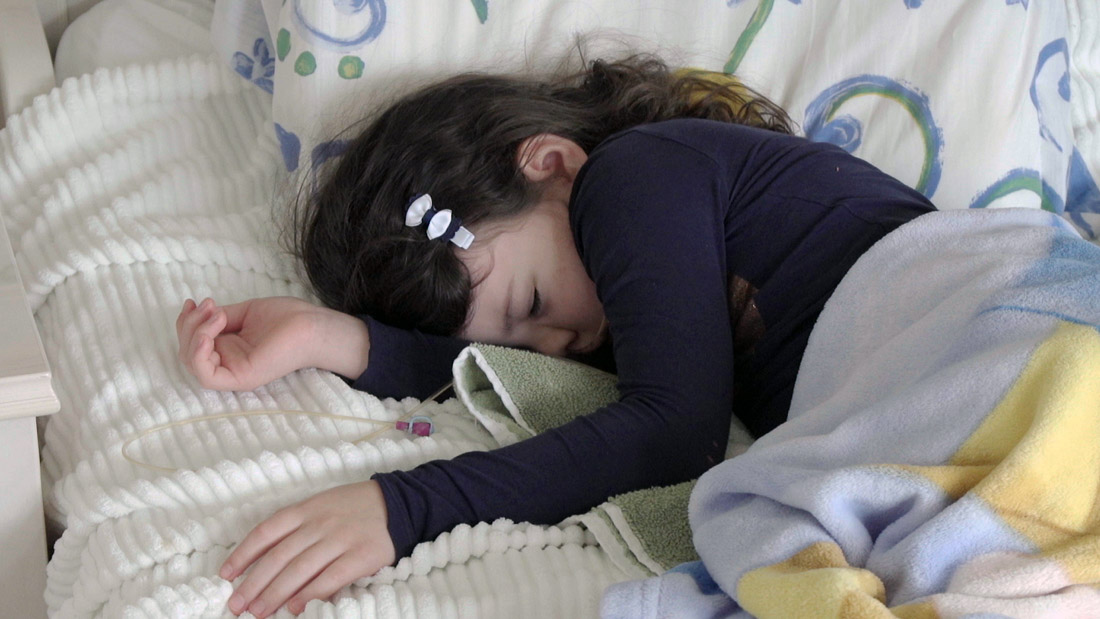
Our Curse (photo at right) is an honest and touching look at two exhausted Polish parents coping with a newborn who faces a lifetime of mechanical ventilation when he sleeps.

In sum: If you're the sort who complains that too many movies are about nothing, you'll find solace and inspiration in these shorts programs, most of which have ample substance.

Thursday, November 25, 2010

A quick look at an art-house weekend

Here's one dog story you haven't seen before.
Here's a truth that's not generally discussed. The owners of dogs spend more time than they'd like to admit pondering their pets bodily functions. Now comes a dog movie that not only acknowledges this hidden truth but takes it to a strangely idiosyncratic extreme. My Dog Tulip is a creatively animated version of a 1956 memoir by J. R. Ackerley, who served as arts editor for the BBC magazine, The Listener. Beautifully drawn and boasting excellent voice work (notably from Christopher Plummer) as Ackerley), the movie is so unlike most animal movies that it can be as disconcerting as it is cozy. Not only is Ackerley obsessive about Tulip's bowel movements, he also devotes considerable time to finding the proper mate for the Alsatian he rescued from a neglectful family. Directors Paul and Sandra Fierlinger have made a one-of-a-kind dog story that boasts a literate narration and an intriguing view of a man who spent 15 years with a creature that came closest to fulfilling his notion of the ideal companion.

Think 'My Big Fat Indian Restaurant'

Less quriky by far is the comedy, Today's Special, a look at the relationship between an Indian-American son and his family in Queens, N.Y. Generally, I'm a sucker for food movies, particularly those that spend lots of time in restaurant kitchens. Although this one traffics in some heavily sketched cliches -- think My Big Fat Indian Restaurant -- it nonetheless benefits from the aromas we imagine in the food we watch being prepared and from its very particular New York City setting. The story begins when Samir (Aasif Mandvi) quits his job as a sous chef to travel to Paris. His plans are thwarted when his father becomes ill; Samir reluctantly fills in for Dad at his restaurant, a once prosperous Indian joint that's fallen on hard times. To save the restaurant, Samir hires Akbar (Naseeruddin Shah), a cab driver who understands the mysteries of Indian cooking, knowledge that somehow eluded Samir. Samir learns to put passion in his cooking as the movie moves to resolve his relationship with a difficult-to-please father. Alternately corny and warm, Today's Special holds few surprises, but the food and Shah's sonorous voice add welcome seasoning.