Thursday, September 22, 2022

Natascha McElhone in a movie set in Malta


Forget the opera. Carmen, a movie from director Valerie Buhagiar, casts Natascha McElhone as a middle-aged woman who has spent much of her life as a kind of servant to her brother (Henry Zammit), a priest in a Maltese village. When the brother dies, McElhone's Carmen finds herself at loose ends. Following tradition, a new priest -- not yet arrived --wants his sister (Michela Farrugia) to tend to the church's chores. Sans money, prospects and shelter, Carmen proves more resourceful than we expect. She also receives help from a pigeon that seems to be guiding her steps, a ploy that pushes the story into fairy tale turf. Necessity drives Carmen to steal keys from a sleeping guard. She opens the church from which she's been banished and hides in the confessional. The story takes an odd turn when parishioners begin confessing to her. Undaunted, Carmen dispenses advice that's both bold and comical. Later, she'll "borrow" some candlesticks and a chalice from the church and sell them to a pawnbroker (Steven Love) in a nearby city. Buhagiar can't paper over all the screenplay's implausibilities and McElhone's performance probably deserved a richer movie. Still, Carmen, set in the 1980s, can be viewed as a pleasing tribute to a woman with fortitude enough to find a new life.

Wednesday, September 21, 2022

It’s dressed up but where’s it going?


 By the time I saw Don’t Worry Darling, the movie already had become the subject of an off-screen backstory involving its director and two of its stars. Consider yourself fortunate if you’ve been able to avoid reading about tensions between actress Florence Pugh and director Olivia Wilde, as well as stories about Wilde and the movie’s male lead, Harry Styles.
  I’d been unable to miss the chatter but didn’t give it much thought as I watched Wilde receive a monumental assist from cinematographer Mathew Libatique whose eye-popping colors give the movie an arty glaze, like a high polish on an expensive new car.
  This could be a case, though, where the movie's strengths and its weakness tend to merge. Don't Worry Darling has trouble blasting through the style that Wilde (Booksmart) brings to it and pushing beyond what we know from the outset: Composed surfaces ultimately can't conceal their cracks.
  The story, if you haven’t heard, involves a group of folks who work for the vaguely defined Victory Project, a company that has created the isolated town of Victory, a retreat where employees live, dress, and act as if the 1950s had never ended. 
  The men head to an office — called the headquarters — while the women tend to cooking and kids, and — if Pugh's character is any indication — the crucial task of cleaning windows.
  The women of this manicured world are happily oppressed; they love greeting their men with drink in hand — and more. An early scene finds Style’s Jack Chambers arriving home to perform oral sex on his wife Alice (Pugh). Styles propels his eager spouse to heights of ecstasy as she knocks dinner off the dining room table.
   So goes another perfect day.
   Thanks to set decorator Rachel Ferrara and production designer Katie Byron, these early scenes present the lives of a supposedly privileged few, folks who have fled the ambivalence of contemporary life, all the while reinforcing the role of men as kings of their midcentury castles.
   Visually, everything is groomed to the max. Costume designer Arianne Phillips's clothes look as if they’d been purchased at a thrift store that sold nothing but items that had never been worn.
   Pugh (Midsommar, Little Women, and Black Widow) already has established her credentials as an actress who can anchor a movie. She does so here, out-classing Styles with a performance of burgeoning desperation. Alice suspects that the game is rigged.
   An executive named Frank (a terrific Chris Pine) hovers over the happy residents of Victory. An empathetic boss and true believer, Frank’s affirmations make him seem like the president of a fraternity, the kind of guy who  specializes in kissing the dean's ass. Of course, we know from the start that Frank can't be trusted.
  Several women round out the cast. Gemma Chan plays Shelley, Frank’s loyal wife, Wilde appears as Bunny, Alice’s friend, and KiKi Layne portrays Margaret, a woman who has seen through the Victory Project illusion. Finding no exit, she leaps off a roof.
   Some scenes make you wish Wilde had indulged the story in more weirdness. At a company party, for example, Frank learns that he’s about to be promoted. He's required to do a celebratory dance that makes him look like a puppet jiggling on the end of someone’s strings.
   So what are we left with?
   Visual jokes about the ‘50s — the men leaving home in synch as they drive what appear to be beautifully restored cars of the period — can carry a movie only so far and much rides on third-act revelations, which the screenplay handles in cursory manner that some may find a bit befuddling.
  It’s possible that Wilde wants to deliver a cautionary message: The supposed time when America brimmed with security, order and middle-class comfort rested on illusion, delusion and the stifling of women.
  But watching the movie I felt as if I'd been invited to a dinner at which the host had set a great table but didn't follow through with a satisfying main course. 


Thursday, September 15, 2022

Viola Davis gets fierce as a warrior


  An actress of intense focus, Viola Davis might have been born to play a female warrior — not a Wonder Woman style superhero but a a battler born of hard experience and bone-deep commitment. With a swaggering walk and steely gaze, Davis mixes indomitable will and commitment to principle.
   Inspired by a true story, The Woman King introduces us to the so-called Amazons or in terms of Dahomey culture, the Agojie. These were women trained for war in the Kingdom of Dahomey after many of  its men were captured and sold into slavery by the rival Oyo empire. 
  The conflict between Oyo and Dahomey forms a backdrop for plentiful action sequences in which the women prove their formidable strength. 
  Director Gina Prince-Blythewood, working from a screenplay by Dana Stevens and Maria Bello, finds the heart of the movie when she introduces Nawi (Thuso Mbedu),  a young woman who’s handed to the Agojie by her father.
  Cocky and arrogant, Nawi must learn to submit to the Agojie ethos, which roughly amounts to one for all and all for one: Military success relies on the smooth functioning of the group rather than on individual heroics — although there’s plenty of the latter,  The Woman King being a movie not a historical tract.
  Men don’t much feature in the story, primarily because the Agojie are housed in a separate and restricted part of the king’s palace.    
   John Boyega portrays the Dahomey ruler, King Ghezo, a monarch with many wives and mildly conservative views. Davis’s Nanisca tries to convince the king that selling Africans is wrong regardless of the ethnic group to which someone belongs. 
  Two additional women (Adrienne Warren and Lashana Lynch) distinguish themselves as Agojie warriors, mentors and confidants.
   European intrusions arrive in the form of a white slave trader (Hero Fiennes Tiffen) and his pal Malik (Jordan Bolger). Born of an Africa mother and a white father, Malik has been sent to Dahomey by his mother to find his roots. 
  Nawi catches his eye and the screenplay toys with a dubiously plotted romance while trying to remain true to the notion that the last thing the Agojie need are male protectors. 
   The Woman King team creates an alluring Dahomey village where the Agojie train and where Nanisca eases her strained muscles in the azure waters of an indoor pool, perhaps the 19th century equivalent of a hot tub.
    If the Dahomey village has been idealized, so be it. Viewers may find other suggestions of the kind of cultural celebration that existed on a much more hyper-realized level in Black Panther. 
   Aside form the slavers, the principal villain in the piece arrives in the person of Oda (Jimmy Odukoya), who rules over the Oyo and ruthlessly participates in the slave trade in alliance with the Portuguese. Nanisca has her own reasons for wanting to vanquish Oda. 
   The Woman King was filmed in South Africa, not in the West African nation of Benin, as the former Republic of Dahomey now is known. Presumably, the rituals and dances staged by Prince-Blythewood  reflect a degree of authenticity.
   As for historical accuracy, a little time with Google will let you know that the movie cuts corners, opting to provide what might might be considered an outline of the forces at work in West Africa during the second decade of the 19th century.
   Whatever its shortcomings, The Woman King has Viola Davis, who’s playing a character enhanced by conviction and strength wrought from the punishing toil of living.
    The sight of Nanisca charging an enemy, her scimitar pointing skyward, will make you believe that she can strike fear into the hearts of anyone who would do her wrong.


A prequel serves up horror of its own


    Maybe you haven't spent the last several months yearning for a prequel to the movie X, released earlier this year. Perhaps you didn't even see X, a well-regarded helping of horror about the dangers of trying to make a porn film on an isolated farm.
    Director Ti West's reasonably smart film referenced horror history while serving up its own brand of chills.
   Pearl takes us back to 1918 to tell us how the desiccated hag of the first movie spent her youth. Using the same settings found in X, West enhances the color of his images. He adopts an approach reminiscent of the way Todd Haynes paid homage to director Douglas Sirk in Far From Heaven. Pearl comes on like melodramatic comfort food from a bygone cinematic era.
    Too much genuflecting at the altar of film history? 
    Maybe, but West links his work to the past and, in this case, to his previous movie.
   References to other movies aside, Pearl functions well as a stand-alone effort, although it won't be everyone's idea of a scary good time. Slowly paced and evocative, Pearl uses its nostalgic allure to draw us into the increasingly weird world of its title character.
    West turns Pearl into a showcase for Mia Goth, who played dual roles in the first movie and was unrecognizable as the killer crone of X.  Here, Goth meets the moment with unsettling flashes of mania and longing.
  Goth's Pearl lives an emotionally and sexually undernourished life on a farm with her sternly religious mother (Tandi Wright) and paralyzed father (Mathew Sunderland).
   Dressed in overalls, Pearl looks as if she might have tumbled out of Norman Rockwell painting. We know better, particularly when Pearl spears a goose with a pitchfork and feeds it an alligator or when she has enthusiastic masturbatory sex with a scarecrow.
   Pearl joins a long line of insanely frustrated women. She dreams of being a star and finds encouragement from the projectionist (David Corenswet) at the town theater. He urges her to dream -- but shows her a "special" film he acquired in France, a helping of porn that underscores the theme of dreams that are smashed or even perverted.
   Pearl's chance at escape arrives when a friend (Emma Jenkins-Purro) tells her that a traveling dance troupe plans to hold auditions at the town's church. 
  Against a backdrop of illuminated crosses, Pearl gives a knock-out performance but an eerily stoic panel of judges rejects her. They want a blonde.
   What's a frustrated young woman supposed to with her husband off fighting World War? And what about those movie-inspired fantasies in which Pearl sees black-and-white images of chorus girls kicking their way to the glamorous life she believes she deserves?
  The answer is obvious but still alarming. Pearl's smile --a grin that stretches her face to the breaking point -- no longer will mask the evil that festers within.
  West offers gore and murder but served sparingly when compared to the butchery that sometimes dominates contemporary horror.
   And despite his love for movie references, West’s approach remains idiosyncratic and he’s not afraid to take chances -- big ones. At one point, Pearl delivers a lengthy monologue, part confessional and part threat. It could have derailed the movie but Goth makes it work.
   Clearly, Pearl is too twisted and weird for all viewers. But it's more accomplished than X and it allows Goth to smear the screen with blood, unleashed rage, and a killer smile -- or maybe I should say, a killer’s smile.


Wednesday, September 14, 2022

Whodunit? No matter, the actors are fun


     We're in the 1950s and London audiences are flocking to a stage  adaptation of Agatha Christie's Mousetrap, so much so that the production has just celebrated its 100th performance. 
   Always eager to capitalize on a bona fide success, Hollywood has taken note: A film production looms. 
   At a party celebrating the play's success, the cynical director who has been asked to make the movie is murdered. The age-old question arises: Whodunit?
    In the case of See How They Run, it hardly matters who committed the crime. The movie is less a mystery than a genre spoof  that clearly knows the game its playing.
     Working from a screenplay by Mark Chappell, director Tom George allows his movie to run on winking humor and the pleasure of watching actors "sell'' characters that border on the parodic.
     First, there's Leo Kopernick (Adrien Brody), the obnoxious and newly murdered movie director who we learn had been feuding with the movie's screenwriter, the mincing Melvyn Crocker-Norris (David Oyelowo). 
     Two policeman anchor the story. Demonstrating a flare for character comedy, Saoirse Ronan portrays Constable Stalker, a novice cop who's eager to prove her worth.  
     Sam Rockwell joins Ronan as Inspector Stoppard, a veteran detective who's entirely too fond of drink and who's prone to falling asleep on the job. Rockwell doesn't overdo the English accent but still conveys disbelief and rueful judgment as he and Stalker set about solving the crime.
     Ruth Wilson as the play's producer and Reece Shearsmith as the aspiring producer of the movie both do fine work. Harris Dickinson finds laughs as Richard ("Call me Dickie") Attenborough.
     No need offering a cast roster but everyone seems to have understood the nature of material that may remind audiences of Knives Out, which, I suppose it must be said, was better.
    Comparison to other movies, as well as expectations associated with Glass Onion, director Rian Johnson's follow-up to Knives Out,  shouldn't detract from a movie that (bless its soul) finds a lane and occupies it well -- or at least, well enough.
    So who did it? Why, the actors, of course. They're largely responsible for delivering the generally snappy goods.

Bob’s Cinema Diary: Sept. 14: '22 — 'Clerks III' and 'Simchas & Sorrows'

 Clerks III


I suppose lots of folks are fond of remembering Kevin Smith’s Clerks, a black-and-white indie that debuted in 1994. Not me. Since Clerks was released, I’ve not been tempted to revisit the movie and I somehow missed Clerks II, possibly because I was out of the country at the time of its release. Now comes Clerks III, a comedy that likely will provide a trip down nostalgia lane for Smith’s fans. Much of the original cast has returned, supplemented by Rosario Dawson, who appeared in the second installment. Smith’s brand of snark, pop-cultural awareness (90s style), and mild self-mockery have never been my cup of amusement. In this latest addition, convenience store co-owner (Jeff Anderson) convinces his pal Dante (Brian O'Hallaran) to help him finance a movie that very much resembles the original Clerks — or, as we’re prone to saying these days — a movie that adds a meta layer to its Jersey origins. Mildly amusing at times but muddied by the introduction of death as a topic of consideration, Clerks III features two (count 'em) heart attacks. Smith clearly knows how to add a bit of zest before the proceedings turn sentimental. Still, Clerks has little to offer those who are not committed to completing the Clerks cycle or waiting for several "surprise" cameos.

Simchas & Sorrows


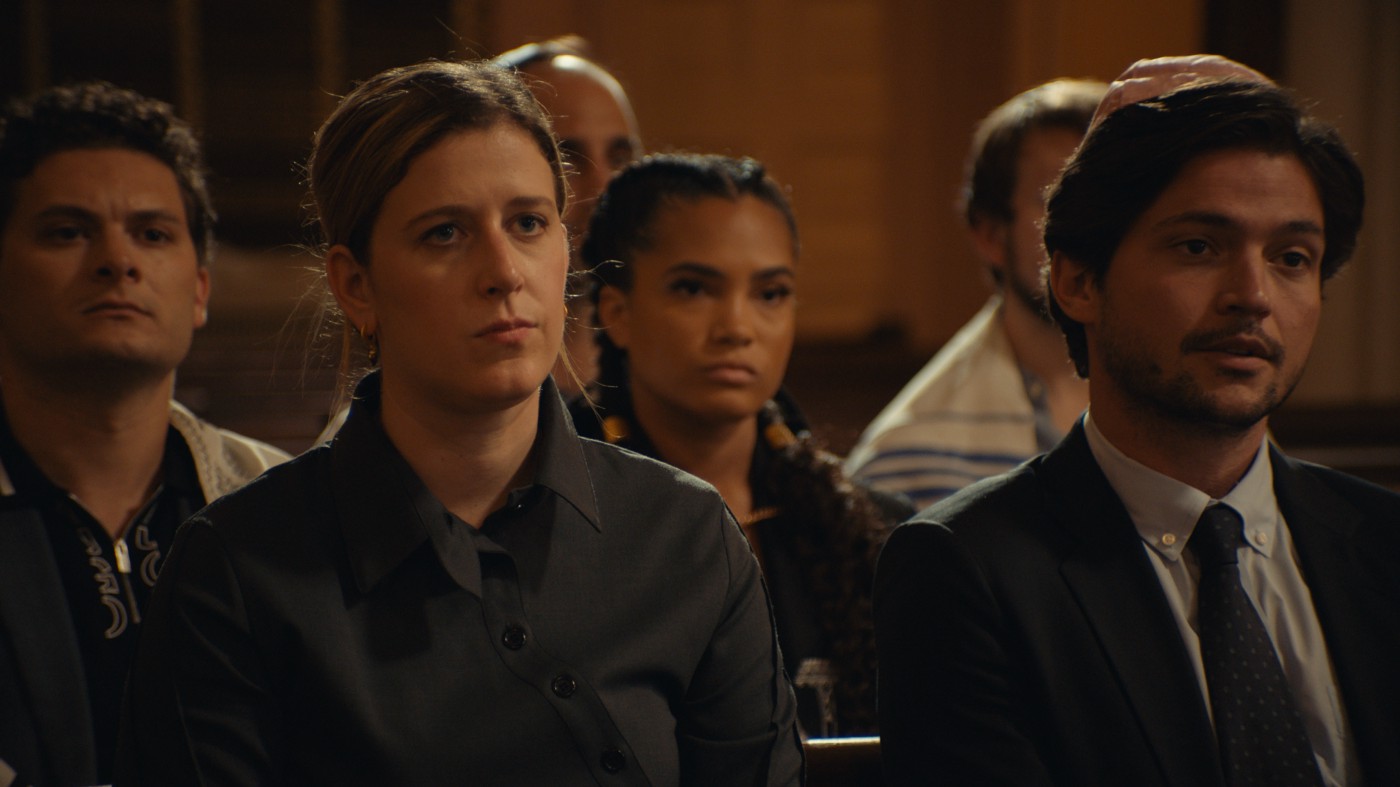
Finally, a movie about converting  to Judaism. I’m kidding of course. I doubt whether the world has been waiting for someone to explore this subject. But it's tackled head-in Simchas & Sorrows, a rom-com that interrupts a generally humorous approach for serious observations, most of them delivered by a progressive rabbi (Nari Nef) who refuses to ignore an elephant in the room: She raises the subject of Palestinians with the couples she instructs. Writer/director Genevieve Adams plays Agnes, a Catholic-educated woman who’s engaged to Levi (Thomas McDonell), a young Jewish man who wants his future wife to convert. Agnes, who has given up on religion, is also pregnant. The prospect of a child further complicates matters of cultural difference. The characters are rounded out by Levi’s brother and his condescending fiancee (Annalise Cepero), by Levi's father (Chip Zien) father, and by Agnes’s grandfather (John Collum). Adams conveys a message about tolerance, acceptance, and ways to live in a multi-cultural, multi-religious world but the movie seems to prefer sincerity to sharply realized drama. Yes, it’s good to be respectful and not be too insistent on dotting every “i” and crossing every cultural “t.” No arguing with the message, but a last-minute revelation feels like a cop-out and, to me at least, it didn't feel as if the movie had fully engaged with its subject.

Thursday, September 8, 2022

Standing up for herself in 'God's Country'


  Throughout its 102-minute running time, I wondered why Sandra Guidry -- a character played by Thandiwe Newton in a finely wrought performance -- decided to move from New Orleans to the isolated wilderness of a western town that hosts a small college and a local populace that doesn't eagerly welcome strangers.
 Director Julian Higgins, who-cowrote the movie's screenplay with Shaye Ogbonna, does answer the question. Victimized by hurricane Katrina and feeling guilty for being unable to protect her mother, Sandra left her job as a New Orleans police officer to take a tenure-track position at the local college. 
  Sandra brought her aging mother with her but mom didn't last long; the movie opens with Sandra attending her mother's cremation. 
  Sandra, perhaps the town's only Black resident, may have wanted extreme isolation or maybe the framework of the story doesn't quite support everything Higgins has in mind.
    God's Country, by the way, was based on Winter Light, a short story by James Lee Burke, which may be why the film sometimes reflects the kind of sketching often found in short fiction.
     In addition, a 2015 short film, also by Higgins, told roughly the same story -- only the main character was named Roger Guidry and was played by a male. I've never seen the short film but it seems obvious that the gender switch added new resonance.
    All that aside, Higgins creates a tightly woven drama that pits Sandra against two brothers (Joris Jarsky and Jefferson White), the head of her department at the college (Kai Lennox), and her own past. 
   Sandra's patience faces extreme tests -- both with departmental racism and the two hostile brothers who won't take "no" for answer when it comes to trespassing on her property where they want to hunt.
    Higgins wisely softens the lines of a revenge saga, creating an unexpectedly affecting scene in which one of the brothers comes close to recognizing a common bond with Sandra. 
     The local sheriff (Jeremy Bobb) sets the stage for an explosive conclusion when he expresses his reluctance to respond after one of the brothers fires an arrow into Sandra’s front door. Folks in these parts settle differences themselves, he tells her, upholding a mythic western ethos of self-sufficiency.
     But even the exasperated sheriff doesn’t always meet expectation. As a guest at a school Christmas party, Bobb's Gus Wolf -- who's actually the acting sheriff -- labors to understand Sandra. Despite her service as a police officer, her background couldn't be more different than his.
     Newton wisely reins in Sandra's anger as the movie references other issues.
     An example: A question about sexual abuse arises when one of Sandra's best students (Tanya Beatty) shares a story about inappropriate behavior by the head of the English department.
     Shot in Montana, God's Country isn't likely to serve as an advertisement for Big Sky Country, although we're never told the name of the town or state where Sandra has landed. Higgins and cinematographer Andrew Wheeler do their best to capture landscapes chastened and made dreary by a harsh winter. 
      God’s Country may not be a small gem. But with considerable help from Newton, Higgins creates a somber portrait of an isolated but iron-willed woman trying to assert her power in a hostile environment.


A shot of horror from Neil LaBute


 Well, it's better than Out of the Blue, a recently released Neo-noir clinker.
 I’m referring to House of Darkness, the second movie from writer/director Neil LaBute to reach theaters within the last couple of weeks.
  LaBute's early triumph, In the Company of Men (1997), prompted many to accuse him of mining a strong vein of mysogyny. I didn't see the movie that way but LaBute's work usually paves the way for strong arguments.
  In House of Darkness, LaBute gives full vent to any desire he might have had to distribute a healthy comeuppance to insensitive men. 
  The result is a medium-grade horror film in which a libidinous but  shallow financial advisor (Justin Long) meets his match in the person of three sisters (well-played by Kate Bosworth, Gia Crovatin, and Lucy Waters). 
   The movie begins just after Long's Hap Jackson meets Bosworth's Mina Murray at a bar. Hap gives Mina a ride home, hoping the trip will lead to something more. He anticipates a conquest, so much so that he calls one his buddies to brag when Mina leaves him alone to prepare drinks.
    In this case, home happens to be a mansion surrounded by woods, a sure sign that Hap has as much chance of finding carnal bliss as one might have locating a Serena hater at the US Open — or anywhere else for that matter.
   For much of its 88-minute running time, House of Darkness plays like a creepy two-hander as Mina and Hap flirt, spar and try to out-maneuver each other. Mina, who initially seems like a push-over, quickly reveals a cunning side and we know that Hap -- poor Hap, if you will -- is in for it.
   But how much do we feel for hapless Hap? Not much, as it turns out.
   As played by Long, Hap varies his personality to fit whatever situation he confronts. He doesn’t inspire either high levels of identification or sympathy. 
   It's also clear -- thanks to a giveaway title -- that horror looms.
   To arrive at the movie's bloody conclusion, LaBute introduces a mythic fairy-tale element and pushes the story to gory extremes.
    More game-like than deep, House of Darkness keeps you watching. And say this: It's difficult to sustain interest when a movie creates little doubt about where it's headed. A strong cast -- hats off particularly to Crovatin -- creates enough tension to carry LaBute's revenge-driven effort to its inevitable finale.

Thursday, September 1, 2022

Two short takes before a long weekend

 Honk for Jesus: Save Your Soul


Writer/director Adamma Ebo tackles the hypocrisies of a Black megachurch in Honk for Jesus. Save Your Soul, a muddled satire that seems unsure how hard it wants to hit. I have no idea what Ebo believes when it comes to religion but her movie can confound as it tries to blend comic and serious elements. Decked out in some of the year's most flamboyant costumes, a commanding Regina Hall plays the First Lady of the Atlanta megachurch where her husband (Sterling K. Brown) presides. Early on, we learn that Brown's pastor Lee-Curtis Childs has disgraced himself. He's busy warding off suits by former male congregants who have claimed sexual abuse. Hall's Trinitie Childs stands by her man, even though she knows he has foundered on the rocks of what the church regards as a forbidden temptation. Hall holds the movie together as Brown conveys the fallen pastor's attempts to regain his pulpit privileges, which include an immaculately groomed mansion, a sleek Bugatti, and celebrity status. A rival couple (Nicole Beharie and Conphidance) prepares to lure the Childs's disillusioned flock to a new venue. Hall and Beharie give the movie its backbone, even though its broadly comic gestures and moments of high drama can't compensate for an already depleted mock-doc approach. The movie, which includes Trinitie's donning of white face for a weirdly misguided roadside promotional effort, can't resolve what feels like uncertainty about how sharp a satiric knife to wield.

The Good Boss 


Javier Bardem's Julio Blanco runs a company that manufactures scales. Julio claims to care about his employees, insisting that they've become members of an extended family. That’s true if you happen to be part of a family that gives you a trinket and a hug as it pushes out the door. Alternately smarmy and exasperated, Julio deals with a cascading series of problems on the eve of a visit from a team of judges who will decide whether the company receives a coveted award for its achievements. Julio wants to win, but layoffs -- notably of a protesting former employee (Oscar de la Fuente), marital problems of an important manager (Manolo Solo), and Julio's dalliance with a slyly seductive intern (Almudena Amor) --  push him toward extremes. Otherwise, director Fernando Leon de Aranoa, who also wrote the screenplay, sketches in upbeat strokes that allow Bardem to build a wry performance around Julio's well-practiced duplicity. Thanks to Bardem and a fine complementary cast, The Good Boss amuses, even though it takes a darkly jolting turn as the 10-day period before the factory's inspection draws to a close. I wouldn't take The Good Boss as a definitive critique of capitalist hypocrisy. Still, as an enjoyable comedy and a showcase for Bardem, it can be as diverting as it needs to be.