Showing posts with label Javier Bardem. Show all posts

Monday, June 23, 2025

'F1' races into summer's sweepstakes


  Formula One racing -- and just about every other sport -- offers abundant opportunities for brand promotion. Brand names adorn cars, drivers' suits, and racing venues.  F1: The Movie, which immerses in the Formula One world,  may not shatter box office records, but it may be the envy of folks who work placing products in movies.
   Identifiable brands seem natural enough because Formula One racing leans heavily on branding. Evidently, 2024's sponsorships reportedly topped $2 billion. 
   So, yes, among other things, you can keep count of the number of brands you'll notice in F1, a movie starring Brad Pitt and cars that look as if they belong on launch pads in sci-fi movies.
    You'll find plenty of high-tech flourish in F1, but director Joseph Kosinski (Top Gun Maverick) isn't offering a crash course on the use of technology in racing. He's engineering a major helping of IMAX-level footage that seems intended to give viewers a feel for what it's like to drive at speeds exceeding 230 miles per hour. 
    Kosinski builds F1 around a script that cashes in on Pitt's increasingly grizzled star power while relying on clichés about an underdog team that seeks to beat the odds. What? You thought I was going to say that the movie proved why most underdogs never have their day?
   So is the movie any good?
   F1 begins well enough with Pitt's Sonny Hayes notching a NASCAR win in Daytona.  Sonny barely has time to celebrate when a Formula One bigwig and former racing pal (Javier Bardem) offers to fly him to London to join his losing APX team. APX badly needs a racing vet.
    Initially reluctant, Sonny agrees. He heads to London where he meets Joshua Pearce (Damson Idris), a brash young teammate who's more confident than he has any right to be. Old-school Sonny and new-school Joshua compete to determine who'll lead the team. 
   So is the movie any good?
   I'm getting there.
   Once the rivalry is established, Kosinski introduces the APX team, which includes chief technical director Kate (Kerry Condon), presented as the first woman to hold such a post. She's also a potential romantic interest for Sonny.
   The movie then marches through a variety of races including the Hungarian Grand Prix and the Belgian Grand Prix as it builds toward the Abu Dhabi Grand Prix, the movie's last Formula One Race, which arrives complete with a military flyover and a bit of been-there-done-that racing fatigue.
    So is the movie any good? C'mon tell us already.
    Well, the sharply edited racing sequences have visceral kick, although they start to feel repetitive. A few wrinkles in the subplot -- a move by a rogue APX board member (Tobias Menzies) to oust Javier's character -- add little.
    The screenplay by Ehren Kruger and Kosinski plays it both ways with Condon's character. A staunchly independent woman in a man's world, Kate's still subject to Sonny's charms.
      Pitt brings old-pro savvy to Sonny, a guy who insists he doesn't race for money. Despite injuries and failure to realize his big dream, he keeps pursuing the rare feeling that occurs for him when everything clicks behind the wheel, and, in his words, he's "flying."
      Inside his helmet, Sonny almost looks like an afterthought while driving, a man whose reflexes might not be a match for the sensors lodged in the car's chassis. I half wondered whether racing could reach a point where drivers become obsolete. Cars could be "driven" by control-room techies. But wait ... Isn't that what video games are for?
     Still, I found the technical aspects of modern racing intriguing and the movie's crashes left me gasping.
    But I've dragged this on long enough. Is the movie any good?
     The best I can say is that it's not bad, and it's scaled to entertain in an environment that captures some of the glamor and grit of Formula One racing.  
     Pitt is playing a type -- something like a loner cowboy in a motorized world -- but he does it well, and the rest of the cast hits the right notes, although Idris's character doesn't have much dimension and Bardem drifts in and out of the movie without gaining much of a foothold.
     Both Ford v Ferrari (2019) and Ferrari (2023) were better movies. Why? Each had more compelling  characters, even if the racing footage in those films wasn't as impressive as what F1 offers during its two-and-half hour running time.
     So in the end, the movie stands as a big summer package that tends to falter during its non-racing pit stops. F1 may not plumb any depths, but Kosinski works in unapologetically bold strokes that make it clear that the movie knows what it's after -- large-scale thrills. 


Monday, February 26, 2024

'Dune: Part II': a stunning epic


 Huge in scale, long in the telling (166 minutes). and sporting arcane references from author Frank Herbert's landmark 1965 sci-fi novel, Dune: Part II has arrived. Don’t fret. Director Denis Villeneuve, who released Part One in 2023, delivers a movie with enough visionary heft and action to justify its epic scope.
  I thought Villeneuve's initial effort represented a marked improvement over David Lynch's 1984 sci-fi foray into Duneland, making the most of a drama steeped in intrigue and boasting enough bizarre-looking characters to sustain several otherworldly parade floats.
   More action-oriented than Part One and benefiting from cinematographer Grieg Fraser's stunning desert imagery, Part Two tells a story even non-fans should be able to follow as opposing planets in a vast galactic empire vie for control of melange, a rare spice that serves as an emblem of power.
   In this edition, we spend more time with the Fremen, desert dwellers of Arrakis, the planet where spice is mined and refined and where the heartless Harkonnen have become an occupying force.
    Much of the movie involves efforts by Paul Atreides (Timothee Chalamet) to earn a place among the Fremen. Paul wants to join their fight against the Harkonnen, led by the blubberous Baron Harkonnen (Stellan Skarsgard).
   Eventually, the Baron unleashes his nephew Feyd-Rautha, a sneering, sadistic villain brought to frighteningly sharp life by Austin Butler.
    Villeneuve keeps a large supporting cast from swamping the various throughlines. A dust-covered Javier Bardem adds humor to his portrayal of Fremen leader Stilgar. Dave Bautista brings bulky menace to the role of Beast Rabban, another Harkonnen sadist, and a subdued Christopher Walken turns up as the emperor who presides over a vast planetary imperium. Josh Brolin returns as Paul's one-time mentor.
    With all that out of the way, let's get to the heart of the movie, provided by Chalomet and Zendaya, who plays the Fremen warrior Chani, a young woman dedicated to ridding the Fremen of oppressive colonial rule. 
     Paul, who earns the Fremen name Usul, and Chani fall in love, allowing the movie to raise questions about Paul’s loyalties. Is he for Fremen freedom or will he use their belief in him to augment his power? Can the aristocratic Paul be trusted by the justifiably suspicious masses?
    Much is made about whether Paul might be the messiah some of  the more fervent Fremen have been awaiting, allowing the movie to touch on additional issues concerning the dangerous ways religious and political aspiration can corrupt each other.
    The stakes may be starkly drawn, but characters are nicely shaded. Rebecca Ferguson returns as Paul's mother, encouraging his ambitious side and sometimes finding herself at odds with her son.
     Part Two thrives on scale, booming set-pieces (a gladiatorial battle with, alas, a crowd that looks CIG-generated), and the summoning of giant sandworms that live beneath the surface of Arrakis and are the source of melange, the spice with near-miraculous powers.
       For all its intricacies, betrayals, and plotting, the story retains its thematic resonance. What moral prices must be paid to control the spice.
      Now, after almost six hours of movie, Dune isn't finished. Questions remain for Paul, Chani, and the entire empire. Expect Part Three. I find that a bit dispiriting. If a story can't be told in six hours, maybe it's a miniseries.
      But the world of Dune remains intriguingly complex, full of characters whose roles shift and evolve. Credit Villeneuve with filling the screen with enough exotic flavor and bold action to keep Dune vividly alive through two helpings. 
      There's no reason to think he couldn't do the same in a third.


Thursday, September 1, 2022

Two short takes before a long weekend

 Honk for Jesus: Save Your Soul


Writer/director Adamma Ebo tackles the hypocrisies of a Black megachurch in Honk for Jesus. Save Your Soul, a muddled satire that seems unsure how hard it wants to hit. I have no idea what Ebo believes when it comes to religion but her movie can confound as it tries to blend comic and serious elements. Decked out in some of the year's most flamboyant costumes, a commanding Regina Hall plays the First Lady of the Atlanta megachurch where her husband (Sterling K. Brown) presides. Early on, we learn that Brown's pastor Lee-Curtis Childs has disgraced himself. He's busy warding off suits by former male congregants who have claimed sexual abuse. Hall's Trinitie Childs stands by her man, even though she knows he has foundered on the rocks of what the church regards as a forbidden temptation. Hall holds the movie together as Brown conveys the fallen pastor's attempts to regain his pulpit privileges, which include an immaculately groomed mansion, a sleek Bugatti, and celebrity status. A rival couple (Nicole Beharie and Conphidance) prepares to lure the Childs's disillusioned flock to a new venue. Hall and Beharie give the movie its backbone, even though its broadly comic gestures and moments of high drama can't compensate for an already depleted mock-doc approach. The movie, which includes Trinitie's donning of white face for a weirdly misguided roadside promotional effort, can't resolve what feels like uncertainty about how sharp a satiric knife to wield.

The Good Boss 


Javier Bardem's Julio Blanco runs a company that manufactures scales. Julio claims to care about his employees, insisting that they've become members of an extended family. That’s true if you happen to be part of a family that gives you a trinket and a hug as it pushes out the door. Alternately smarmy and exasperated, Julio deals with a cascading series of problems on the eve of a visit from a team of judges who will decide whether the company receives a coveted award for its achievements. Julio wants to win, but layoffs -- notably of a protesting former employee (Oscar de la Fuente), marital problems of an important manager (Manolo Solo), and Julio's dalliance with a slyly seductive intern (Almudena Amor) --  push him toward extremes. Otherwise, director Fernando Leon de Aranoa, who also wrote the screenplay, sketches in upbeat strokes that allow Bardem to build a wry performance around Julio's well-practiced duplicity. Thanks to Bardem and a fine complementary cast, The Good Boss amuses, even though it takes a darkly jolting turn as the 10-day period before the factory's inspection draws to a close. I wouldn't take The Good Boss as a definitive critique of capitalist hypocrisy. Still, as an enjoyable comedy and a showcase for Bardem, it can be as diverting as it needs to be.

Wednesday, December 8, 2021

One week in the life of Lucy and Ricky


   Writer/director Aaron Sorkin tries to add a chapter to show business history with Being the Ricardos,  a movie built around one apparently pivotal week in the life of the fabled sitcom, I Love Lucy
  For the most part, Being the Ricardos offers an insider's view of  preparation for the 37th episode in a series that regularly attracted 60 million viewers to CBS every Monday night.
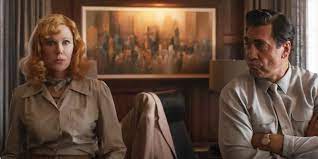
   Casting Nicole Kidman as Lucille Ball and Javier Bardem as Desi Arnaz, Sorkin follows several themes through a story that detours to provide a capsule review of Ball's Hollywood career. She never made it to A-list ranks and instead became one of the entertainment's great physical comics.
   So, about those themes: Ball is accused of being a Communist, the Ball-Arnaz marriage wobbles, and Arnaz fights the network over whether the show can continue with a pregnant Ball. 
   It may seem odd to younger audiences but during the 1950s, pregnancy couldn't be mentioned on TV, presumably because it might encourage thoughts about how this essential human condition came about.
   As for politics, the '50s preoccupation with Communism has been dealt with before with cases much more powerful than Ball's. In 1936, she checked a box saying that she was a member of the Communist party, evidently as a way of appreciating the left-wing grandfather who raised her. 
   None of its story lines prove powerful enough to carry the movie. Sorkin hasn't really made clear what he's trying to say -- other than to expose the gap between back-stage and on-camera realities and to tell us that making comedy is a serious business.
    Kidman doesn't seem like an ideal choice for playing Lucille Ball. When she's playing Ball, Kidman seems like ... well ... Kidman — with red hair, of course. 
   As Lucy, though, she perfectly captures the expressions, movements, and voice that made Ball a great comedian. It’s one hell of a feat. 
  Sorkin may have meant for us to fret about potential consequences of Ball's being tainted as a Red, to use the language of the day,  by Radio broadcaster Walter Winchell. 
   Would the papers get hold of the story and run with it? If they did, could the show survive? 
   I won't get into specifics about the way Sorkin resolves the question. All I'll say is that relief comes from an unexpected source and is presented as a triumph. Yippie. Lucy's off the hook.
   How about lamenting the red-bating hysteria that put her "on the hook" in the first place?
   Bardem makes a convicting Arnaz, a womanizing bandleader who found his way to stardom when Ball insisted he be part of her transition from radio to television. Arnaz proved a strong comic partner for Ball with a shrewd appreciation of how to use the show's success to pressure network executives into doing what he wanted.
   The secondary casting is quite good. J.K. Simmons and Nina Arianda play William Frawley and Vivian Vance, the actors who portrayed the Ricardos' neighbors, Fred and Ethel Mertz. 
   Simmons captures Frawley's fondness for alcohol and wit and Vance makes a perfect second-fiddle to Ball, a woman who's not without her resentments about having to be subordinate to Lucy.
   As for the marriage: Arnaz's philandering hardly seems shocking.
   Tony Hale as Josh Oppenheimer, the show's executive producer, and Alia Shawkat, as the only woman writer on the show's staff, both have nice turns.
   To add authenticity and to take care of expository chores, Sorkin includes interviews with some of the show's writers and producers (all played by actors) as seen in their older, reflective years. The wise elders clue us about the reality of bygone days.
   It occurred to me that a truly revealing and far more intriguing movie could have been made about Frawley and Vance. In it, we might have seen Arnaz and Ball through the lens of those indispensable and often neglected performers: “supporting” actors. 
    But what do I know? 
    Being the Ricardos never convinced me that Sorkin's movie was more than a sporadically entertaining look at what amounts to ancient TV historyWithout either the comforts of nostalgia or the urgency of highly focused drama, I was left taking note of how often I could forget it was Kidman playing Lucille Ball and Bardem smacking the congas as Desi Arnaz. 

Thursday, September 14, 2017

It's one 'Mother!' of a movie

Director Darren Aronofsky's wild-ass horror movie aims big -- maybe too big..

Take the exclamation point in the movie's title seriously. Watching director Darren Aronofsky's Mother! is like reading a book in which every word has been italicized for effect: the silences are oh so ominous, the creak of a shoe on a wooden floor can be jarring and when a furnace fires up, it's like a bomb has exploded. The aural atmosphere of Mother! has been amped up to take what starts as a chamber-piece helping of horror and inflate it to the point of explosion -- maybe beyond that.

In his efforts to harness as much on-screen venom as possible, Aronofsky has enlisted an A-list cast led by Jennifer Lawrence and Javier Bardem. Bardem plays a poet; Lawrence plays his devoted wife. The couple has just moved into an isolated country home.

Irritable to the point of hostility, Bardem's character ignores Lawrence's character. She plasters walls and works on turning the house into a little piece of paradise. You probably have a pretty good idea where all attempts at creating paradise wind up.

Buried in an increasingly chaotic plot, you'll find a mordant comedy about the burden of uninvited guests. The first of these is a man who identifies himself as an orthopedic surgeon (Ed Harris). The surgeon excuses his intrusion by saying he thought he had arrived at a bed and breakfast inn.

Harris' character smokes when asked not to, and claims to be a devoted fan of Bardem's work. He also says he's dying. It doesn't take long for the surgeon's wife (Michelle Pfeiffer) to show up. She's so rude, she makes Harris's character look considerate. She leaves a mess wherever she goes and pushes Lawrence's character into all manner of unwanted conversations.

To augment this bizarre scenario, the couple's two grown sons (Brian Gleeson and Domhnall Gleeson) show up and immediately engage in a Cain-and-Abel style fight over their father's will.

The credits identify Lawrence's character only as Mother; Bardem is referred to as Him. This tells us that we're watching a film that wants to mine a metaphorical motherland. As is often the case, Aronofsky aims big.

Aronofsky toys with every horror trope he can find: eerie basements, spurts of blood and a steady stream of unexplained noises.

All the while, Aronofsky frames Lawrence's face in booming close-ups; Lawrence expresses perpetual consternation over the fact that her husband insists that these uninvited guests stay; his desire amounts to a betrayal.

Generally, Lawrence's character behaves in ways that make little sense, a problem that afflicts much of the rest of the movie, but Aronofsky seems intent on making us ride a wave that swells with bizarre shocks.

With a movie such as Mother!, much hinges on whether Aronofsky can tie things together. Watching Mother! is like listening to a very long (and not entirely interesting joke) hoping that the punchline makes the time we're investing worthwhile.

Now if you want to excavate some meaning from all the stylistic bric-a-brac, try this. Bardem's character is a self-absorbed artist who pays very little attention to his wife. He allows his guests to insult and berate her, every now and again offering his apologies. The fact that Harris's character is a fan suggests that Bardem's character will put up with anything -- so long as it's accompanied by massive adulation.

Aronofsky carries this notion to wild extremes in the movie's final act, which I won't describe here because Aronofsky's images do have a surprising quality that should be discovered in a theater.

Aronofsky (Noah, Black Swan, The Wrestler and The Fountain) certainly knows how to create vivid images but when he finally wraps up his movie, I had the sense that I had just watched a perversely overproduced and willfully malicious episode of The Twilight Zone. It's as if Aronofsky has channeled impulses from filmmakers such as Roman Polanski (Rosemary's Baby) and Michael Haneke (Funny Games) and given them an even more twisted spin.

Mostly I felt sorry for Lawrence, a gifted actress playing a character who takes a psychological and physical beating as the film progresses. Aronofsky may be trying to describe a particularly loathsome form of male behavior, especially among artistic men, but to make his point Lawrence must become the movie's sacrificial lamb.

Whatever the case, it's worth noting that in enlarging the characters played by Bardem and Lawrence to float his allegorical balloons, Aronofsky mostly ignores their humanity. I took the movie's preoccupation with close-ups as significant, a way of locking its characters in the prison of a tormenting vision.

With Mother!, Aronofsky huffs, puffs and damn well tries to blow the house down. But this time out, I found myself wondering whether there was anything more to the movie than the ominous howl of all that huffing and puffing.

Thursday, May 25, 2017

This 'Pirates' tells a cluttered tale

The approach in Pirates of the Caribbean: Dead Men Tell No Tales: Load up on effects.

Nobody has directed better Pirates of the Caribbean movies than Gore Verbinski. Verbinski, who took charge of three Pirate voyages beginning in 2003, has a flair for visual comedy that enlivened the Pirates movies he brought to the screen.

But we're now on the fifth Pirates movie and directing chores for Pirates of the Caribbean: Dead Men Tell No Tales have been assumed by Joachim Ronning and Espen Sandberg, the duo that directed Kon-Tiki, the story of Thor Heyerdahl, the explorer who made a 4,300-mile crossing of the Pacific on a raft.

In this mega-production, Ronning and Sandberg succumb to the temptation to pump up the volume as they showcase Johnny Depp's Captain Jack Sparrow and Geoffrey Rush's Captain Hector Barbossa, two portraits that show their wear.

The directors bolster familiar performances with a new crew that includes a ghastly looking villain who has lost an ample portion of his head, Javier Bardem's Captain Salazar. We also meet two new young actors (Brenton Thwaites and Kaya Scodelario).

Before I tell you anything else, let me confess that if I never saw Jack Sparrow again my life would in no way feel depleted, and even the movie's addition of a father/son and father/daughter dynamic didn't do much to enrich a summer entertainment that overdoses on effects. These include a rickety ship with a hull that opens to swallow its victims whole, ghost sharks, ghost pirates and a parting of the sea that might make Moses do a double take.

A plot that has been stuffed like a Thanksgiving Turkey finds British naval officers chasing young Thwaites's Henry, who is searching for Jack Sparrow and trying to lift the curse that separated him from his father. The Brits also pursue Scodelario's character, an astronomer who believes she knows how to locate Poseidon's much-sought-after Trident.

Thwaites Henry and Scodelario's Carina are the movie's love interests, but their romance hardly makes the pulse beat faster. She resists; he persists. We've seen it all before.

And yes, that's Paul McCartney who appears behind a great, bushy beard in a fleeting cameo.

Bardem's Salazar circles the movie in search of revenge against Jack Sparrow, the pirate responsible for sinking Salazar's ship when he was a respectable Spanish sea captain -- or some such. Salazar winds up as captain of a ghost ship.

Ronning and Sandberg tend to flood the plot with waves of effects, gliding camera moves and lots of shtick from Depp.

Nearly every moment of this edition is served to the accompaniment of Geoff Zanelli's unavoidable score, which struck me as an attempt to add momentum and meaning to events that might not carry much weight on their own.

Having said all that, it also should be noted that Dead Men Tell No Tales probably manufactures enough verve to satisfy audiences that can't get enough of this stuff.

If you've managed to set sail without these Pirates until now, Ronning and Sandberg provide little reason to change your behavior. But fans will turn out -- if only to continue the game of ranking the Pirates movies from best to worst. And, no, I doubt whether the game is over.*
*Thanks to the reader who pointed out a stupid mistake, which I've fixed. Would have published comment, but it arrived anonymously and I try not to publish anonymous comments.

Thursday, October 24, 2013

A 'Counselor' badly in need of advice

A great pedigree can't save this scattered, mildly pretentious thriller.
Tell me you weren't looking forward to The Counselor, a thriller with a screenplay by novelist Cormac McCarthy (No Country for Old Men), direction by the talented if variable Ridley Scott (Gladiator and Prometheus) and acting from a cast that includes Michael Fassbender, Brad Pitt, Javier Bardem, Penelope Cruz and Cameron Diaz.

That's the kind of pedigree that should excite moviegoers, especially those who are attracted to the spare toughness of McCarthy's worldview. In The Counselor -- McCarthy's first piece written solely for the screen -- the esteemed author creates a world in which toxic mixtures of greed and desperation reap heavy consequences and in which any display of naivety sets one up for an unimaginably dire fate.

The characters in The Counselor are surrounded by forces they can't control: Their only mistake lies in believing that a degree of control might be possible. When things go terribly wrong (as they must in a movie such as this) no amount of improvisation or bravado can spare the hapless. They're exposed for what they are: someone else's prey.

Contrary to its title, The Counselor isn't really about an individual; it's about systemic rot, most of it taking place in lavishly appointed environments where high-class consumption is the rule, much of it funded by money derived from the drug trade.

In The Counselor, drugs support the criminal upper class, an observation that seems a little tiresome for someone of McCarthy's stature. "Drugs again?" we ask ourselves, as we fight to stave off disappointment.

Fassbender plays a nameless attorney whose motivations are so sketchily presented, they're almost irrelevant. The Counselor feels as if his back is to the wall. He's helped a lot of criminals. Now, he wants to cash in by involving himself in a drug deal. He also wants to find a happily-ever-after situation with his wife, played by Cruz as the only character in the movie with any claim to innocence.

Fassbender's character deals with two associates. The wealthy Reiner (Bardem) is a genially sly man with an outrageous, blown-back hairstyle that make him look as if he just put his finger in a live electric socket. Reiner can be comical, but he warns the Counselor that deals such as the one he's contemplating tend to take on a life of their own. If everything sours, the Counselor won't have the slightest idea of how to cope. He'll be dangerously out of his depth.

The Counselor also meets with Pitt's Westray, a relaxed man with a fondness for a white cowboy hat. Westray also issues warnings to the Counselor. The easy-going Westray seems to understand that he may have pushed his luck too far. Perhaps he already should have abandoned crime, but he's playing things out, maybe even egging disaster on.

Diaz is cast in the movie's most mysterious role: She plays Malkina, a woman we first meet when she watches Reiner's pet leopards chasing down prey on an open plane. It doesn't take much by way of intuition to know that Malkina's all business and that when she does business, it will be bad business -- if not for herself, then for those she encounters.

In a bit of self-conscious boundary stretching we see Malkina having sex with Reiner's yellow, convertible sportscar. No, I'm not kidding. I won't describe exactly how this bizarre feat is accomplished. Know only that it involves Malkina doing a cheerleader-like split atop the car's windshield. Scott may be making a point in weirdly literal fashion: This woman gets off on material things.

The world of The Counselor is ripe with intrigue and abundant corruption, and yet, the movie can't be called a success.

To begin with Fassbender's character is never well-enough defined to hold the center of a movie. Bardem, so impressive as the lethal Anton Chigurh in the big-screen adaptation of McCarthy's No Country For Old Men, gives a performance that flirts with shtick, alternating comic exaggeration with a feeling that he briefly has returned to his senses, something like a jazz musician picking up the melody after a wild improvisational riff.

Diaz seems sufficiently jaded as a woman who strives to create a straight line between her intentions and her actions, even if those actions show up on the wrong side of the moral ledger.

And then there's the narrative itself. It takes an awfully long time for the story to lock in, and when it does, we watch less because we care about the outcome, but because we simply want to see the various chunks of story find a semblance of coherence. This is more a formal accomplishment than a deeply felt human one.

It's equally true that McCarthy's dialogue, though sometimes mordantly witty, carries the weight of pretension, so much so that by the movie's end, some of the characters (notably a crime lord played by Ruben Blades) begin to spell out the movie's harsh themes in an approach that's probably too clear, an example of literary obviousness that recursively articulates what we already know.

All of this makes for intermittently intriguing but only partially satisfying viewing experience, a movie in which adornment and opulence are conspicuously displayed as part of Scott's attempt to seduce us, and -- at times -- to show the gap between the upper classes of criminal life and the minions who serve them. We catch glimpses of the lumpen work force that keeps the drug wheels spinning, whether it comes to creatively executed assassinations or the drudgery of moving more product.

Scott and McCarthy put a lot on the table here, trying hard (too hard, probably) to add spice to a fairly routine story that, in its overall arc, looks as if it's trying to punish characters who have lived too large.

Scott and McCarthy have chosen a strange way to fail; their overly complex a story-telling approach makes things too difficult at the outset, and the proffered explanations for what we've been watching make the movie too easy in the end.

It sounds like an odd and perhaps even disrespectful thing to say about a McCarthy-written movie, but The Counselor could have used a rewrite.


Thursday, April 11, 2013

'To the Wonder:' A master mumbles

From its intriguing title to its trancelike beauty to the half-mumbled thoughts of its characters, everything about Terrence Malick's To the Wonder suggests that the director wanted to follow his masterful Tree of Life with something equally meaningful.

This time, though, Malick -- whose visual skills are never in question -- seems to be looking for deep meanings within a thin, schematically presented story that may have had little chance of taking him where he probably wanted to go.

The story, which whispers its way through the movie, involves a romance between an American engineer (Ben Affleck) and a woman living in France (Olga Kurylenko). Affleck's Neil makes an apparent move toward commitment when he brings Kurylenko's Marina to Oklahoma, along with her 10-year-old daughter (Tatiana Chiline).

"If you love me, there's nothing else I need,'' Marina says, perhaps to herself. Malick's characters are locked inside lives in which disappointment and yearning echo like cries in a lonely canyon. Who's listening? Maybe no one.

Marina better be right about not needing anything more than love because what we see of Oklahoma doesn't offer much to sustain interest, and it should go without saying that the ache of poetic romance is better felt in France than in the bleak Oklahoma subdivision where the story settles.

Malick presents Marina as a nymph-like creature who spins and dances around Neil's sparsely furnished house. She says she's happy, but it doesn't take long for her isolated daughter to begin longing for home. Who could blame her? I, too, was yearning for Paris the moment Malick set his cameras onto the desolate Oklahoma plains.

Malick eventually introduces another major character into this quietly desperate mix. Javier Bardem portrays the troubled Father Quintana, a priest who wanders around visiting the poor and talking to God, who (sad to say) isn't talking back. Father Quintana hasn't exactly lost his faith, but he's mired in some sort of spiritual fatigue. He's doing what's expected of him, but he's not feeling the priestly vibe.

At one point, a dispirited Marina returns to Paris with her daughter. While she's away, Neil strikes up a relationship with an old friend (Rachel McAdams), a practical westerner who seems well-suited to an Oklahoma-based lifestyle. Later, Marina returns to the U.S. in hopes of obtaining a green card. Her relationship with Neil resumes.

During one of her Oklahoma visits, Marina meets Anna (Romina Mondello), an Italian woman who tells her to get out of Oklahoma and seek a better life. Good advice.

To the Wonder is not plot-driven. It's not character-driven, either. It's driven by some nearly ineffable yearning that always seems to find its way into Malick's work -- for love, for spiritual renewal, for finding meaning in a world that can be beautiful photographed and still feel deeply alien.

Kurylenko and McAdams both play characters who, in this muted endeavor, surpass Affleck's Neil by a mile -- at least when it comes to interest. The deadpan and empty nature of Affleck's character make it difficult not to wonder what either woman sees in him.

At first I wondered whether Affleck had the resources to fill out this kind of vaguely defined character -- and then I began to wonder whether any actor could have brought Neil fully to life. As the cliche goes, there's no there there.

To describe To the Wonder as uneventful seems as superfluous as saying Hip-Hop music has a beat. We spend most of our time watching Malick exercise his cinematic chops, often to a heavy-duty musical sampler that includes work by Wagner, Berlioz, Hayden, Respighi, Tchaikovsky, and Gorecki.

Look, I have admired much of Malick's small but powerful body of work. And I gave To the Wonder the benefit of as much doubt as possible -- right up until the moment when my desire for anything resembling drama no longer could be suppressed. I wanted Malick to stop poeticizing and start dramatizing.

Granted, Malick always seems to be looking for something deep, and it's possible that the sadness in Malick's work stems from the somber realization that the world never fulfills our deepest longings. Few filmmakers are able to make boredom feel quite so exquisite; vacancy, quite so suggestive.

But To the Wonder may disappoint even Malick's more ardent fans. It does more to make us wonder what Malick's after than to help us experience the somber mystery of a world that seldom -- if ever -- wants to requite our love.


Thursday, November 8, 2012

For James Bond, life gets harder

Does Bond still have it? An exciting Skyfall puts the question to a staunch test.
As an iconic movie hero, James Bond has died many deaths, only to be reborn in new guises for new times. Once known for his impeccable style and unquestionable taste in martinis and women, Bond recently has settled into a recessionary mode -- at least as far as his erstwhile playboy image is concerned.

In Skyfall -- his third Bond movie -- Daniel Craig has become an even blunter, more stoic Bond. In a time when drones target terrorists, when small units of highly trained Navy SEALs can seem more effective than entire armies and when shadowy villains seem more interested in lethal disruption than in global conquest, the single-handed bravado of Bond might seem as out-dated as the preposterously ambitious villains of 007's big-screen formative years.

Skyfall continues Bond's march into the future -- and more. It entertains, chastens and finds its own distinctive voice.

In keeping with this new spirit, Skyfall features an amusingly sly villain, a former MI6 agent played with wily, seductive ease by Javier Bardem, who adds to the gallery of classic villains he began creating with Anton Chigurh in No Country For Old Men.

Despite his casually expressed cruelty and the threat he poses to British intelligence, Bardem's Silva isn't the only enemy Bond must face. Bond also must do battle with time. He's forced toward introspection as he wonders whether he's truly up to the task of combating the evil Silva and preserving the integrity of MI6. The devious Silva threatens to expose a raft of agents on the Internet. He must be stopped from executing a cyberterrorist assault on secrecy.

But even here, the Bond series faces adaptive pressures. Is Silva out to conquer the world as a result of a maniacal lust for power? Not really. He's more disgruntled employee than global threat. And as we eventually learn, he has good reason to be upset.

To fulfill its mission of creating a more human Bond, the series has brought on a director whose reputation hardly hinges on action. Sam Mendes (best known for American Beauty, Road to Perdition and Revolutionary Road) doesn't skimp on action set pieces, but he brings a welcome sense of dramatic grounding and psychological heft to the proceedings.

The trick, one supposes, is to balance innovation with tradition. There are beautiful women (Naomie Harris and Berenice Marlohe), an appearance by Bond's Aston Martin DB5 and a prologue that has Bond toppling onto a speeding train, as well as a bit in which the world's most famous spy races a motorcycle across rooftops in Istanbul. But Skyfall remains as much about propelling Bond into the 21st century as it is about delivering the winking thrills of yesteryear.

Maybe that's why Skyfall's most weirdly flirtatious scene takes place when the blond, soft-spoken Silva captures Bond and taunts him with homoerotic advances. For his part, 007 remains unfazed.

The need for redefinition pervades just about every aspect of the movie. M, the fabulous Judi Dench, is under threat from a bureaucrat (Ralph Fiennes) who thinks it's time for her to retire. The venerable Q has been replaced by a youthful version, played here by Ben Whishaw. Gadgetry seems to have been kept to a minimum.

Even the movie's climax feels a bit shrunken. The action eventually shifts to Bond's boyhood home in Scotland, where an old mentor (Albert Finney) is enlisted to help beat back Silva and his minions, who put the house (not fondly remembered by Bond) under severe assault. You get the idea: The scale of the picture exceeds the grandeur of its themes.

This being the 50th anniversary of the indestructible Bond franchise, it's fair to say -- as I already too much have -- that Skyfall is committed to entertaining while perpetuating the series. It continues the exciting, often intriguing and clever retooling of the Bond mythology, but what's really at stake isn't the continued existence of a weary, threatened world, but the future of Bond himself.

Physically powerful and much less prone to puckish humor than any of his predecessors, Craig may just carry Bond into the future with will, muscle and a severely knotted brow. Bond, as you'll notice, accepts each new assignment "with pleasure.'' It's to Craig's credit that we feel as if there also will be equal amounts of pain.

Thursday, August 12, 2010

Jula Roberts eats, prays and learns to love

It's hardly news that Julia Roberts can carry a movie. So you won't be shocked that she puts Eat, Pray, Love on her back, pretty much keeping this episodic adaptation of Elizabeth Gilbert's best-selling memoir from falling apart. Appealing as she is, Roberts can't elevate this travelogue into something meaningful and deep. I don't blame her, but director Ryan Murphy of Nip/Tuck fame seems to have forgotten that a long-standing internal conflict about life's meaning only can carry a movie so far. As was the case with Gilbert's book, the movie follows Gilbert as she leaves two failed relationships and tries to find herself during a yearlong trip that begins in Italy, continues in India and culminates in Bali. On her various stops, Gilbert learns life lessons, and eventually arrives at a point at which she can take a chance on love. The men in Gilbert's life are played by Billy Crudup (first husband); James Franco (Gilbert's next love); and Javier Bardem (the man who just might be able to persuade Gilbert to risk her heart.) Richard Jenkins portrays a Texan Gilbert meets in an Indian ashram; Jenkins is good, but the movie doesn't really allow any of these characters to flourish. They're like people we meet on a trip, feel a little close to and then forget. Roberts and supporting players do their best to give the movie some easy charm. I enjoyed looking at Rome, and reveled the airy openness of Gilbert's home in Bali, but Eat, Pray, Love offers a cliched view of the world and of its colorful characters, a smiling, toothless medicine man included. I couldn't watch Eat, Pray, Love without thinking how much more I wanted from these characters and from the movie itself. Director Murphy, one of the screenplay's co-writers, attempts to replicate the author's voice by having Roberts supply a narration. But if there's any authentic yearning in the movie, I didn't feel it. I also couldn't help thinking that if Arthur Frommer wrote self-help books instead of travel guides, this is how they'd look.