Becket Redfellow's unmarried mother was disowned by her wealthy father when she insisted on giving birth to her son. Dad evidently didn't like the situation, perhaps disapproving of Mom's choice of a mate and not knowing the poor guy would expire soon anyway.
Rocky Mountain Movies & Denver Movie Review
FOR MOVIE LOVERS WHO AREN'T EASILY SWEPT AWAY
Wednesday, February 18, 2026
This dark comedy doesn't sting
Becket Redfellow's unmarried mother was disowned by her wealthy father when she insisted on giving birth to her son. Dad evidently didn't like the situation, perhaps disapproving of Mom's choice of a mate and not knowing the poor guy would expire soon anyway.
Tuesday, October 10, 2023
Jamie Foxx scores in "The Burial'
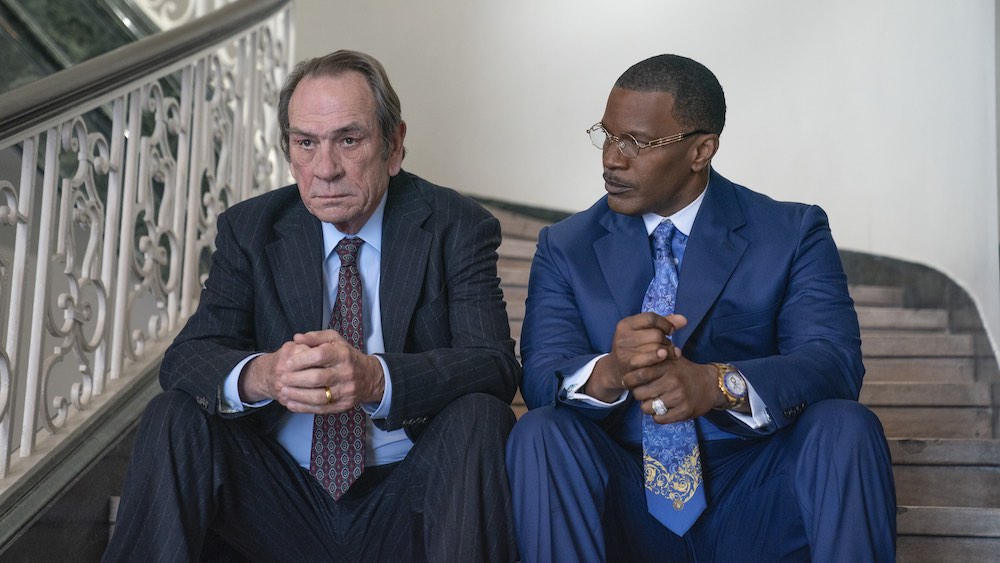
It may sound improbable, but The Burial might be the most entertaining movie ever made about a contract dispute. Ridiculous? Well, add this to the equation: One of the main characters in the movie owns funeral homes in Mississippi, not exactly an occupation that prompts anticipatory smiles.
Tuesday, November 26, 2019
A lawyer takes on a major corporation
Making a movie about a complex legal case that spanned 17 years can't be easy. Director Todd Haynes and star Mark Ruffalo accomplish the daunting task in Dark Waters, the story of an Ohio attorney who takes on DuPont, one of the world's leading chemical companies.
Ruffalo portrays Rob Bilott, a Cincinnati-based attorney who specializes in defending companies like DuPont. After some initial foot-dragging, Bilott agrees to represent a West Virginia farmer (Bill Camp) whose cattle are being poisoned by toxic waste that has been dumped near his acreage. Bilott's target: DuPont.
Those familiar with Haynes' work (Wonderstruck, Carol, Far From Heaven) know that he can be as much stylist as a storyteller. But here, Haynes works in an unassuming fashion. He's wise enough to know that a story that impacts so many people needs little embellishment.
Dark Waters moves beyond the plight of a single farmer to encompass the drinking water of an entire town. The chemical in question also was used in Teflon, a non-stick coating familiar to most Americans.
Early on, we meet the head of Bilott's law firm. Tim Robbins portrays an attorney who eventually buys into Bilott's mission, a stance that doesn't please all the partners. Some of them view Bilott as a traitor who's biting the hands that feed the firm.
And Tim's wife ( Anne Hathaway impressive in a smallish role) isn't blindly supportive; she resents the fact that the case takes Bilott away from his children.
Among the supporting cast, Victor Garber also stands out as the head of DuPont. Initially cordial, Garber's character turns vicious when his company's interests are threatened.
But it's Ruffalo who carries the movie; he creates a portrait of an attorney who couldn't be less slick. As a church-going ordinary guy, Bilott feels no need to put self-righteousness on display.
Bilott's case against DuPont involves the use of a chemical called PFOA. It takes lots of heavy research to discover what the chemical is and how it has been used. Persistence trumps genius-level legal maneuvers.
You might say that everyone involved with the production -- from cinematographer Ed Lachman to Haynes -- serves a story that rightly has been compared to movies such as Norma Rae, Erin Brokovich and The Insider.
That's not to say that Dark Waters lacks atmosphere. The movie makes its case while capturing the bleak environs of a failing West Virginia farm and the grayness of Midwestern environments that have seen better days.
Basing the movie on a 2016 article that appeared in The New York Times Magazine, screenwriters Mario Correa and Matthew Michael Carnahan do a fine job capitalizing on the inherent drama of a tale involving betrayed trust.
The film reinforces a sobering conclusion: In the end, we can't rely on the government or on corporations for protection. We have to hope that people such as Bilott will take on fights that initially look futile.
Don't expect an explosive movie. Dark Waters gradually insinuates itself into consciousness in ways that make you shudder; it presents a clear case of a company that put its own interests ahead of the general good.
Thursday, November 29, 2018
A family caught in a moment of crisis
Actor Paul Dano moves behind the camera to direct Wildlife, a big-screen adaptation of a Richard Ford novel set in Great Falls, Montana, a lonely outpost where a mother (Carey Mulligan) and her son (Ed Oxenbould) have been moved by Dad (Jake Gyllenhaal), a guy who can't seem to settle into anything. The town of Great Falls marks Dad's latest stop on what seems to have been a road to nowhere. Gyllenhaal's Jerry ignites the drama, which begins in 1960, when he's fired from his job tending the greens at a local golf club. The club offers him his job back, but Jerry -- stuck in a rut created by what seem to be obscure but irrevocable principles -- refuses. Instead, he's off to fight forest fires, putting his life in danger for very little money and leaving his wife to tend to their teenage son Joe. Joe, played with just the right degree of quiet confusion by Oxenbould, tries his best to cope, taking on the uneasy role of man of the house. With Jerry off fighting fires, Mulligan's Jeanette begins what seems a willed unravelment. She takes up a relationship with Warren Miller (Bill Camp), an unlikely love interest who owns the local car dealership and whose friendliness toward young Joe wavers between sincerity and calculation. Oddly, Jeanette drags her son into the whole business, taking him to dinner at Miller's house. Could anything be more uncomfortable for a kid? The fires raging away from the town suggest a looming conflagration but the fire that rages in Mulligan's performance pushes the movie toward its sad final shot. Not always easy to read, Wildlife nonetheless entangles us in the lives of characters who defy easy definition.
Sunday, December 24, 2017
Poker for big names and fat wallets
When I was browsing the internet looking for information on the real Molly Bloom, I came across a review of Bloom's book, which serves as the basis for writer Aaron Sorkin's eagerly awaited directorial debut.
A website devoted to books about poker featured a headline that suggested that the book struggled to find both an audience and a point.
I'm not sure that Sorkin's adaptation of Bloom's book, Molly's Game, will have trouble finding an audience, but it does have a bit of difficulty finding a larger point. Bloom's journey took her from an Olympic caliber skier to a woman who made a ton of money running high-stakes poker games before running afoul of the law.
In real life, Bloom's LA-based game attracted players such as Ben Affleck and Tobey Maguire. She evidently operated legally until she began taking a cut of the biggest pots. Such "raking" is illegal and evidently changes friendly games (even when played for ridiculously large stakes) into crimes.
Don't get me wrong. Molly's Game can be entertaining, and it features an energized performance from Jessica Chastain as Bloom, a woman whose brother Jeremy Bloom became both an Olympian and an NFL player.
Molly Bloom was on a similar Olympic track until a freak accident derailed her career. At loose ends, she headed to LA where she eventually moved from a gofer at high-stakes card games to an impresario of such big-money affairs.
Perhaps taking a cue from Bloom's book, Sorkin has Molly narrate the movie, a dialogue-heavy plunge into her point of view that, at times, makes it feel as if Molly's reading us the movie.
As much as any writer, Sorkin has a way of making it seem as if he's in the know about whatever subject he tackles. He floods the screen with poker jargon and makes sure that every actor speaks with the kind of rapidity that marked the great screwball comedies of yesteryear. The result can be dizzying, skilled actors engaging in tricky verbal workouts.
Idris Elba adds weight as Molly's attorney. Watching Elba and Chastain bat words over the metaphorical net that separates their characters creates a pleasure all its own.
Bloom's story moves from Los Angeles to New York City, unfolding in episodic fashion, almost as if Sorkin drops little short stories into the larger mix. This approach highlights the work of a strong supporting cast.
Jeremy Strong portrays Molly's first LA boss, a character who makes no attempt to be anything less than obnoxious. Michael Cera does good work as an arrogant player with skills; Bill Camp does a terrific job as a skilled player who swan-dives into a terrible losing streak, and Chris O'Dowd impresses as a dim-witted drunk who works off a gambling debt by bringing some troubling folks into one of Molly's New York games, figures from the Russian mob.
Kevin Costner has one of the movie's best small roles. He plays Molly's authoritarian father, a philandering psychology professor who presides over a flock of high-achieving offspring.
Up to a point, Sorkin benefits from the lavish surroundings that Molly created for those who gambled at her table: drinks, fine food, fancy hotel rooms and beautiful women to wait on both winners and losers.
Earlier, I mentioned that the movie might have difficulty making a point. By the end, it seems as if Sorkin wants to hold Molly out as an example of female achievement. She used her wits to create a small empire and honorably refuses to supply the FBI with the names of those who sat at her table. Public exposure might have ruined lives and destroyed families.
Pretty noble for someone who knows she made a small fortune serving the gambling addictions and fantasies of men who were willing to throw money at her in the form of out-sized tips.
I was entertained by much of Molly's Game, which -- at 140 minutes in length -- probably runs 20 minutes longer than necessary: Sorkin turns cards over with enough flair and snap to keep his movie watchable, but, in its entirety, the movie doesn't make the case for why Bloom's story is more than a sketch in a bigger picture that remains unpainted.